
Haptic Drone Detection System
Early drone warning that dismounted soldiers can feel
What is the Haptic Drone Detection System?
The Haptic Drone Detection System is a soldier-worn early warning system that detects approaching drones and lets dismounted soldiers feel where the drone threat is coming from. Helmet-mounted acoustic sensors pick up the sound of a drone, and a haptic belt translates the direction and distance of the drone into intuitive vibrations around the waist. No screen to check, no audio alarm to listen for.
Drones have changed the battlefield. In the war in Ukraine, drones are now estimated to cause around 70% of all casualties, and small FPV drones and multicopters are hard to see or hear in time. Our drone warning gives soldiers the critical seconds they need to take cover, conceal or take counter-measures, while their hands, eyes and ears stay free for the mission.
Elitac Wearables develops the system together with acoustic sensing specialist Microflown AVISA, in close collaboration with the Dutch Ministry of Defence.
Looking for drone threat detection for dismounted soldiers? Get in touch!


1
Helmet-mounted acoustic vector sensors detect the sound of drones, passively and without emitting any signal.
2
End User Device with ATAK: shares drone locations with the team and the command post.
3
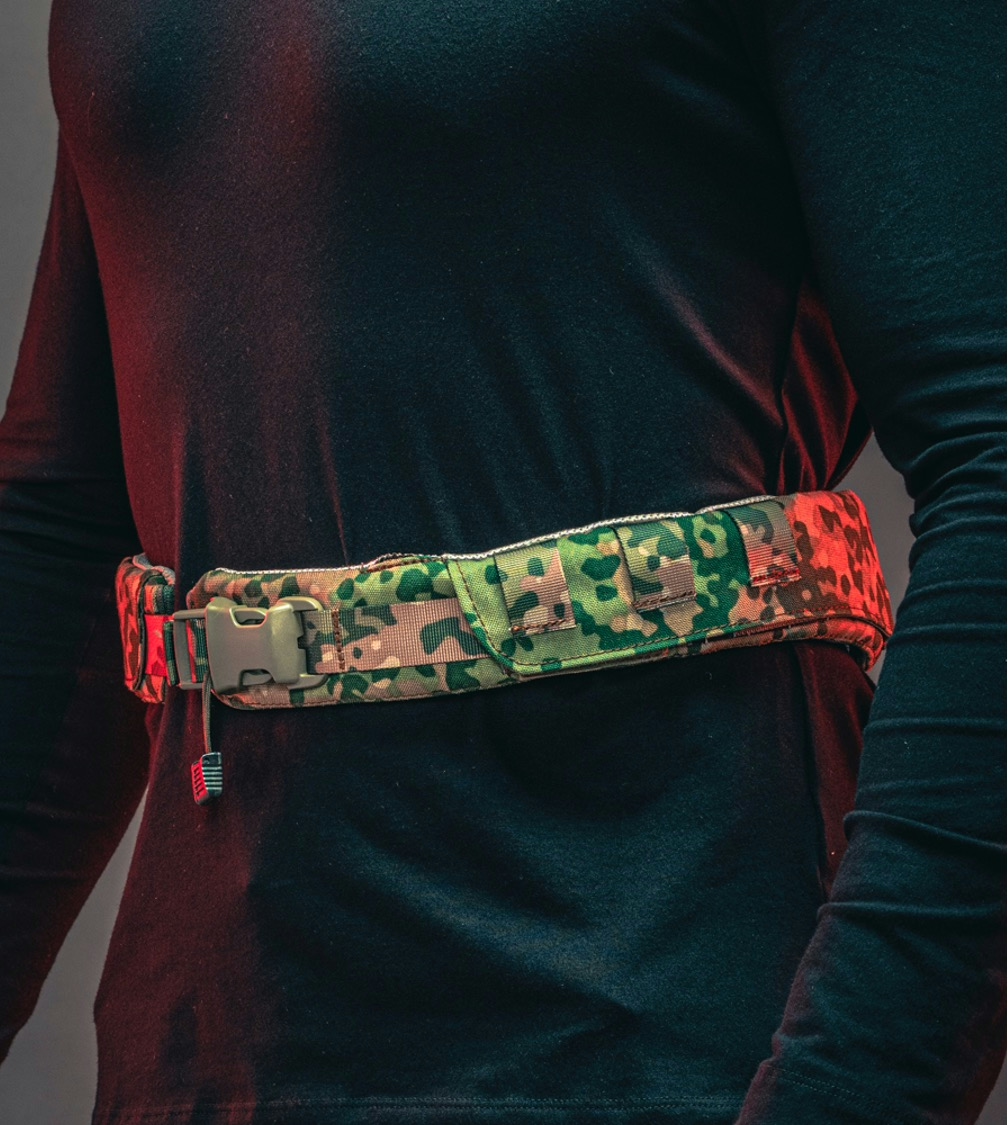
Mission Navigation Belt: vibration motors around the waist indicate drone direction, distance and urgency.
How the drone detection system works
The Haptic Drone Detection System combines passive acoustic UAS threat detection with haptic feedback technology. Acoustic vector sensors on the helmet listen for the unique sound signature of drone propellers and motors. A compact processing unit determines the direction of the drone, and the Mission Navigation Belt translates this into a vibration on the side of the body that faces the threat. When the soldier turns or the drone moves, the haptic signal updates automatically, so the indicated drone location is always correct. This allows the soldier to take swift appropriate action, take cover or decide on counter drone activity.
From single soldier to networked team
Stand-alone: individual drone warning
When the helmet sensors of a soldier detect a drone, the soldier immediately feels a haptic drone warning in the direction of the threat. At set intervals, the belt gives an updated cue of the direction of the drone, so the soldier always knows where the threat is, even while moving.
Networked: shared drone location for the whole team
When several soldiers are equipped, the system works as a distributed sensor network. Detections from multiple sensors are combined on a TAK server to determine the location of the drone. That location is shared through ATAK, and every soldier feels a personal haptic signal that indicates the direction and distance of the drone relative to their own position and orientation. Even a soldier whose own sensor did not hear the drone receives the correct warning.
Because detection is passive, the system does not emit any radio or radar signal. This keeps the user hard to detect and also works against autonomous and fibre-optic controlled drones that RF detection cannot pick up.
Built on field-tested haptic technology
The haptic interface builds on our Mission Navigation Belt, developed for the Dutch Ministry of Defence and field-tested by Dutch and German forces on foot, in small boats and on motorcycles (TRL 6). In the first proof-of-concept tests of the drone detection system, the acoustic sensors and the Mission Navigation Belt were successfully combined to warn soldiers of approaching drones.
“Soldiers were more aware of their surroundings and found the haptic cues extremely intuitive.”
Major Van Veen, Royal Netherlands Army, Defence Centre of Expertise
Developed with Microflown AVISA
Acoustic drone detection meets haptic feedback
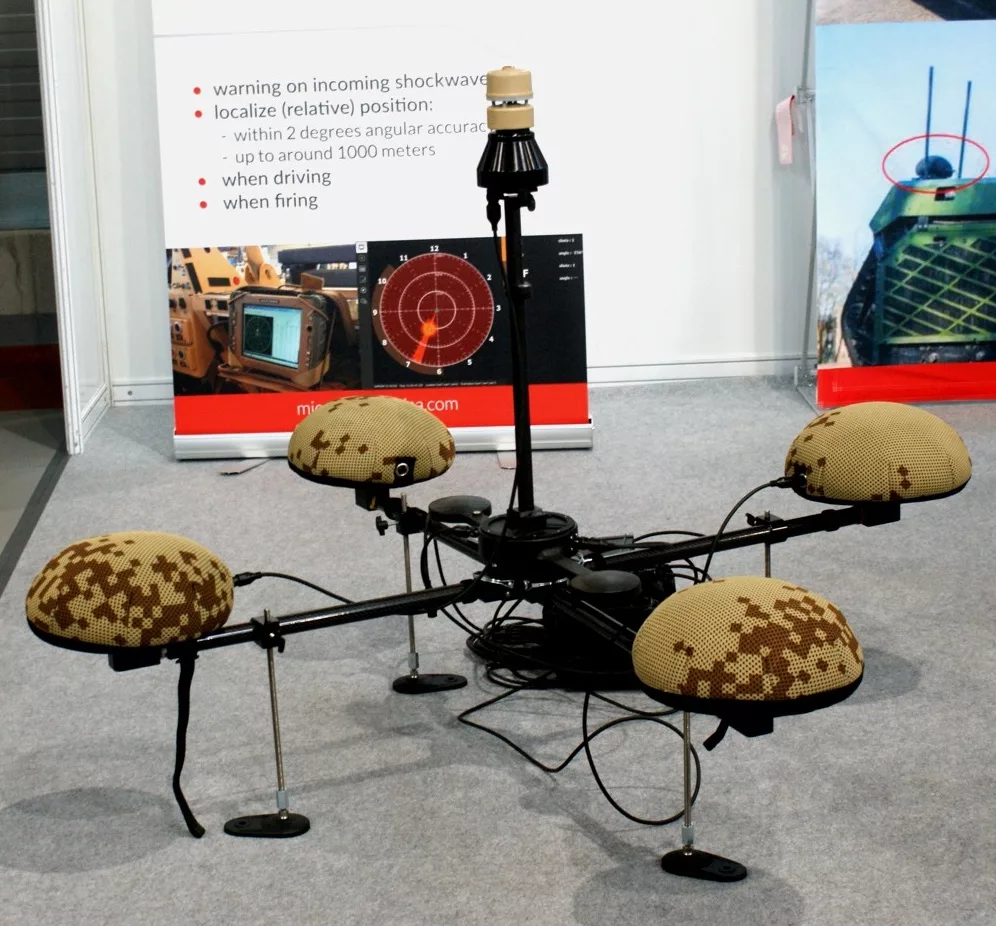
We develop the Haptic Drone Detection System together with Microflown AVISA, the Dutch specialist in passive acoustic sensing for defence and counter-UAS (C-UAS). Their patented acoustic vector sensors measure not only sound pressure but also the direction of sound waves, so they can detect and locate drones without emitting any signal. Elitac Wearables translates this detection data into intuitive haptic warnings and integrates the complete solution into the equipment of the soldier.
As a developer of haptic technology for defence, Elitac Wearables is also part of NATO DIANA, the Defence Innovation Accelerator for the North Atlantic. Read more about our military wearables development.
Trusted by defence and research organisations
We work with leading defence and research organisations, including TNO, the Royal Netherlands Aerospace Centre (NLR), the Center for Man and Aviation (CML) and the Dutch Ministry of Defence.




Current status
From proof of concept to validated prototypes
Following successful proof-of-concept tests, we have just performed a field demonstration in October 2026 together with Microflown AVISA and the Dutch Ministry of Defence: improving drone tracking, haptic patterns and the integration with soldier equipment and ATAK.
The next steps are operational testing under realistic conditions and the delivery of fully integrated prototype systems.
Beyond defence, the same technology can support first responders, border security and the protection of critical infrastructure: wherever people need fast, silent and intuitive threat warnings.
Explore related technology
- Mission Navigation Belt: haptic navigation for dismounted soldiers
- Haptic feedback wearables: how we use vibrations to communicate information
- Military wearables development: advanced technology for soldier performance
- Bio-signal sensing: monitoring physiological strain in the field
Frequently asked questions about drone detection
What is a haptic drone detection system?
A haptic drone detection system is a wearable early warning system that detects drones and communicates the drone threat through vibrations on the body. The Haptic Drone Detection System by Elitac Wearables combines helmet-mounted acoustic sensors with a haptic belt, so dismounted soldiers feel the direction and distance of a drone without looking at a screen or listening to an alarm.
How does acoustic drone detection work?
Drones produce a distinctive sound from their propellers and motors. Acoustic vector sensors from Microflown AVISA measure both the sound pressure and the direction of the sound waves. This allows the system to detect a drone and determine where it is coming from, fully passively: the sensor only listens and does not emit any signal.
Why use haptic feedback for drone warnings instead of a screen or audio alarm?
In combat, the eyes and ears of soldiers are already overloaded. An extra screen or sound can be missed, can distract, or can even reveal their position. Haptic feedback uses the sense of touch, an otherwise unused channel. A vibration on the side of the body that faces the threat is understood almost instantly, which reduces cognitive load and reaction time.
Can the system detect drones that do not transmit radio signals?
Yes. Because detection is based on sound, the system does not depend on the radio link of the drone. This makes acoustic detection a valuable layer against autonomous drones, drones using frequency hopping and fibre-optic controlled FPV drones, which are hard to detect with RF sensors.
Does the system integrate with ATAK and existing soldier systems?
Yes. The system is designed with an integration-first approach. Drone detections can be shared via a TAK server and ATAK, so drone locations are available to the whole team and the command post. The Mission Navigation Belt connects to the End User Device of the soldier and can also be used for haptic navigation.
Who develops the Haptic Drone Detection System?
The system is developed by Elitac Wearables (Utrecht, the Netherlands), specialist in haptic feedback wearables, together with Microflown AVISA (Arnhem, the Netherlands), specialist in passive acoustic sensing for counter-UAS. Development and testing take place in close collaboration with the Dutch Ministry of Defence.
Can the technology be used outside defence?
Yes. The same combination of passive detection and silent haptic warnings is relevant for first responders, border security and teams that protect critical infrastructure such as ports, airports, energy plants and data centres.
Contact us
If you would like to learn more about our wearable product development services for wearable safety devices, please leave your details in the form. We will get back to you as soon as possible.
