Developed with the Dutch Ministry of Defence (Defence Expertise Centre for Military & Equipment, DEC M&U). Field-tested by Dutch and German forces on foot, on water and in vehicles.
Mission
Navigation Belt (MNB)
Haptic navigation belt.
Silent, hands-free navigation for soldiers.
Want to develop a wearable?
What is the Mission Navigation Belt?
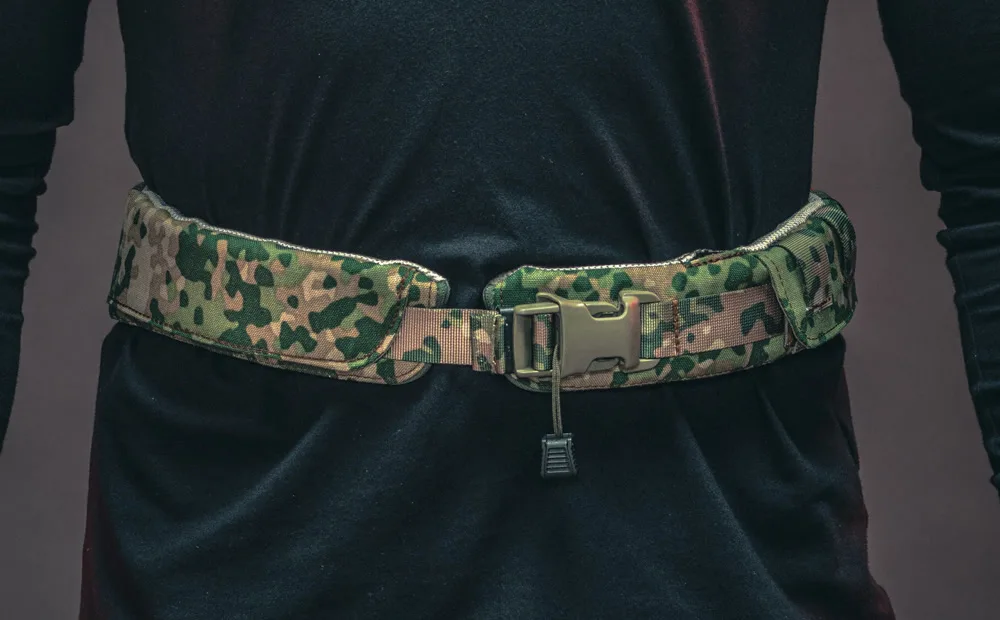
The Mission Navigation Belt (MNB) is a lightweight haptic navigation belt for soldiers. Seven small vibration motors around the waist point towards the next waypoint. In other words, soldiers feel where to go, without looking at a screen or listening to audio cues.
As a result, their hands, eyes and ears stay free for the mission. Moreover, the belt works on foot, on water and in vehicles, by day and by night.
A Dutch defence innovation
Elitac Wearables developed the MNB together with the Dutch Ministry of Defence. In fact, the idea won the Dutch Defence Innovation Competition in 2013. In 2020, we delivered the first series to the Royal Netherlands Army.
Looking for hands-free navigation for your soldiers? Get in touch!
The problem with screens and audio
Modern navigation systems are accurate, but soldiers have to keep checking a screen. As a result, their attention moves away from their surroundings. In addition, a lit screen at night or an audio cue can give away their position.
The solution: navigation you can feel
Haptic feedback uses the sense of touch, which soldiers hardly use for information in the field. Instead, a short vibration on the side of the body points the way. There is no need to stop, no screen to check and no sound that can be missed or overheard.
How the Mission Navigation Belt works
The Mission Navigation Belt is worn around the waist, on its own or integrated in a battle belt, vest or backpack. It also connects to the GPS-based navigation system of the soldier, such as the Elbit soldier system of the Royal Netherlands Army.
Our algorithms translate the waypoint data into short vibration patterns. Next, the motor that faces the next waypoint vibrates, so the soldier always knows which way to go. As soon as the soldier turns, the signal updates.
In addition, the belt can send pre-defined tactile commands or tactile Morse signals. As a result, it becomes a silent extension of the user interface of the soldier system.

1
Connects to the soldier system and receives waypoint navigation data.
2
Seven evenly spaced vibration motors point towards the next waypoint, whichever way the soldier faces.
3
Patent-pending sizing technology: fit the belt once, and the haptic feedback stays consistent.
4
Robust, waterproof design for the most demanding conditions.
5
No extra battery: the belt draws minimal power from the soldier system.
The Mission Navigation Belt at a glance
- Product: Mission Navigation Belt (MNB), a waist-worn haptic navigation belt for soldiers
- Haptic feedback: 7 evenly spaced vibration motors give 360° direction cues to the next waypoint
- Use: waypoint navigation on foot, on water and in vehicles, by day and by night
- Integration: plugs into GPS-based soldier systems; fits battle belts, vests and backpacks
- Power: no extra battery, powered by the soldier system (500 mW)
- Weight: 340 grams stand-alone; electronics module 120 grams
- Design: waterproof, robust and adjustable to size with patent-pending sizing technology
- Maturity: field-tested by Dutch and German forces (TRL 6); first series delivered to the Royal Netherlands Army in 2020
- Developed with: Dutch Ministry of Defence (DEC M&U) and the Royal Netherlands Army
On foot, on water and in vehicles
One belt for every mode of transport
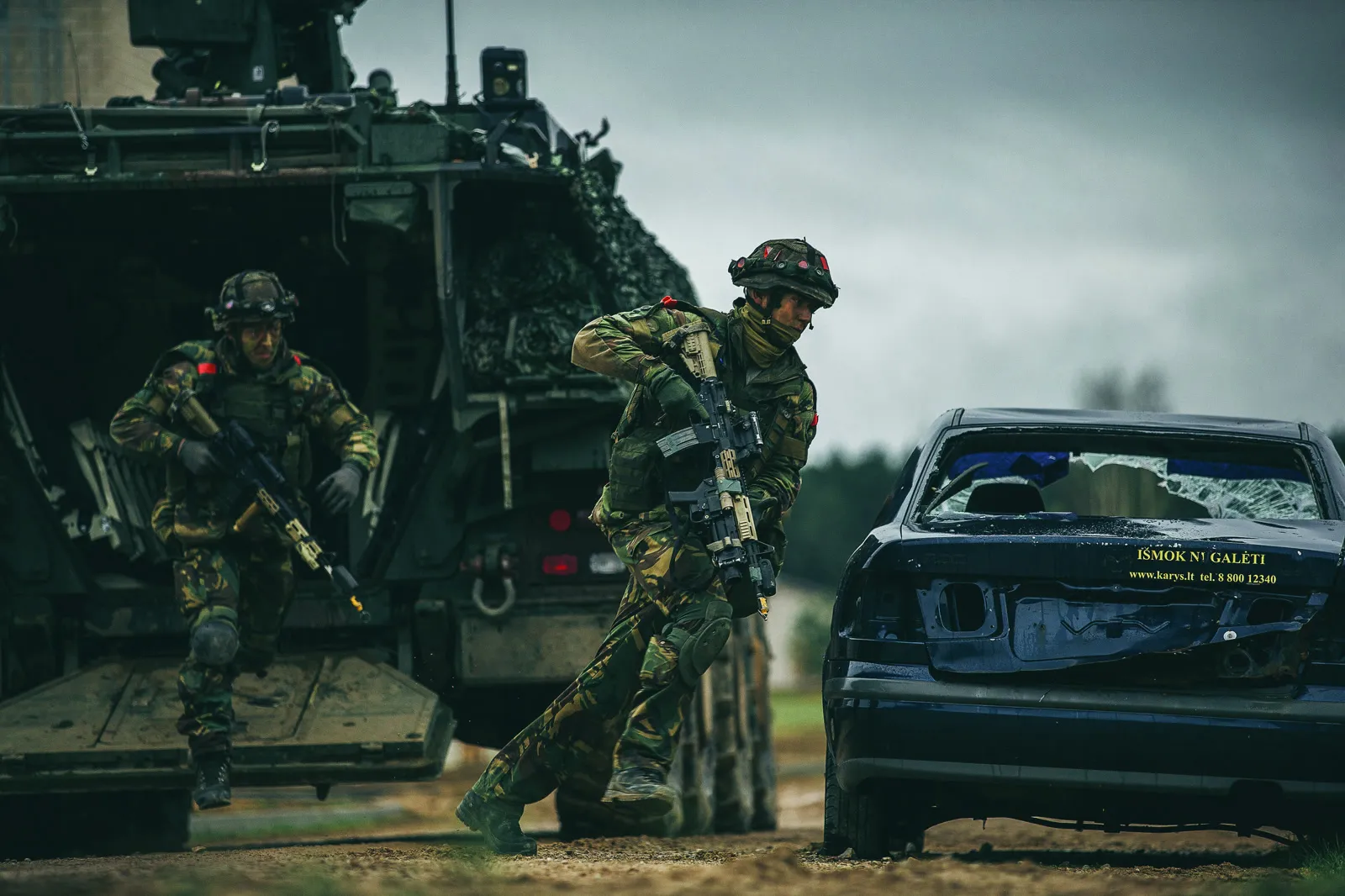
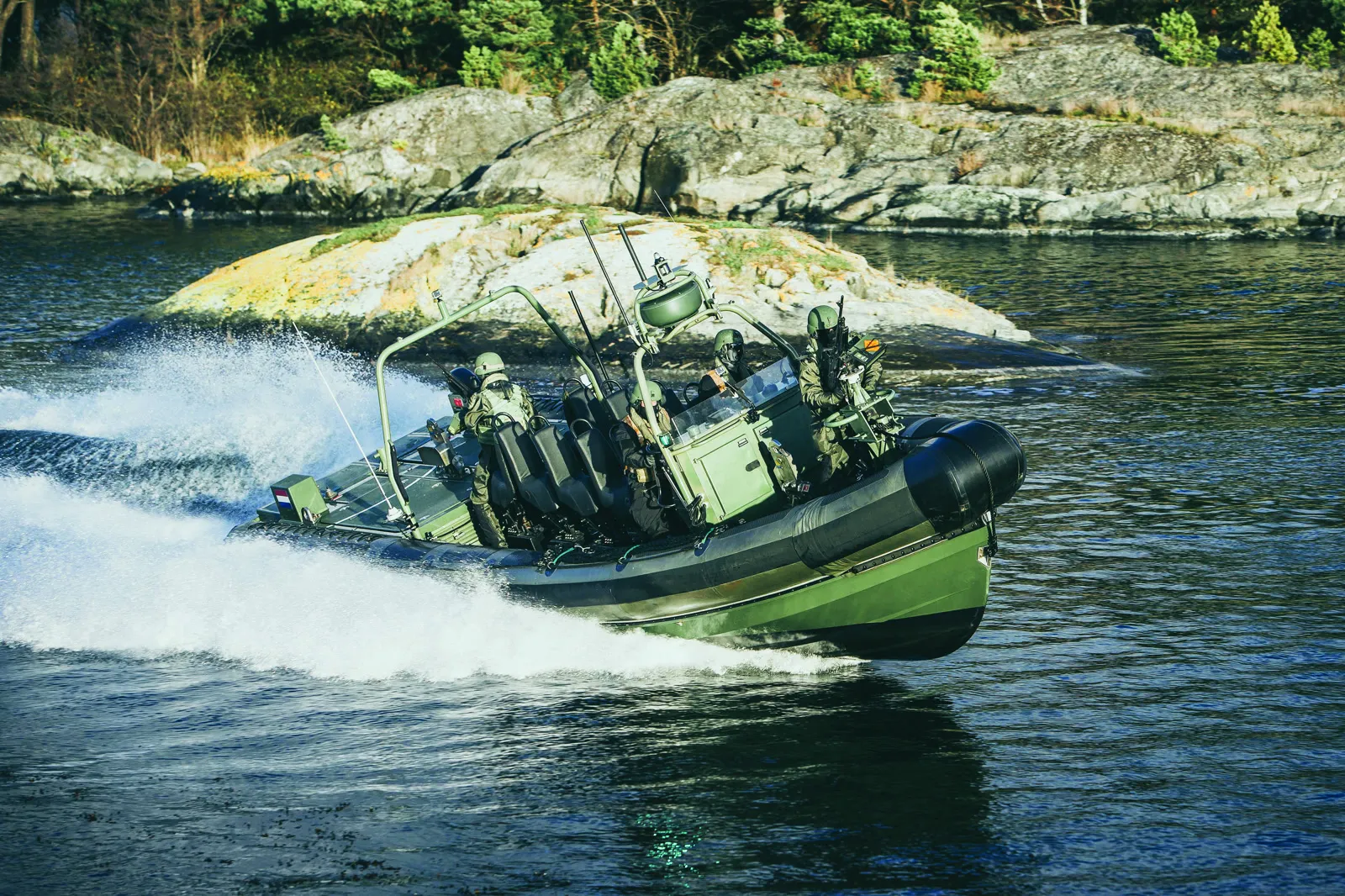
During one mission, soldiers often switch between walking, driving and sailing. Meanwhile, the Mission Navigation Belt keeps guiding them, whichever way they face. It also works when the direction of movement changes quickly.
Tested in tough conditions
Soldiers of the Royal Netherlands Army tested the belt in day and night scenarios, on land and on high-speed boats. Dutch and German forces also used it on foot, in small boats and on motorcycles. Even in full battle gear on a boat in choppy water, they could clearly feel the signals.

One haptic layer, many applications
More than navigation
In fact, the haptic interface of the MNB can carry any directional information from the soldier system. For example, the belt is the haptic layer of our Haptic Drone Detection System. As a result, soldiers feel the direction and distance of an approaching drone.
Beyond defence
The same technology can also guide first responders, security teams and divers: wherever people need silent, intuitive direction cues while their hands and eyes are busy.
Proven in the field
We developed the Mission Navigation Belt with and for soldiers. Repeated field tests with the Royal Netherlands Army, by day and by night, on land and on high-speed boats, shaped the final design. This is what they said:
Developed with the Dutch Ministry of Defence
From innovation competition to first series
First, Elitac Wearables won the 2013 Dutch Defence Innovation Competition with the idea for a wearable that lets soldiers feel navigation information. Together with the Royal Netherlands Army and the Defence Expertise Centre for Military & Equipment (DEC M&U), we developed it from feasibility study to market-ready product.
In 2020, we delivered the first series to the Royal Netherlands Army. Today, the belt is integrated with the Elbit soldier system that the army uses.
“The cooperation with Elitac Wearables was very fruitful. They always keep the end user in mind and are very pragmatic in their approach to solving soldiers’ problems. The Mission Navigation Belt is a good result of this.”
Major Van Veen, Royal Netherlands Army

Mission Navigation Belt project partners
Elitac Wearables developed the Mission Navigation Belt together with the Dutch Ministry of Defence, the Royal Netherlands Army and the Defence Expertise Centre for Military & Equipment (DEC M&U).


Trusted by defence and research organisations
Elitac Wearables works with leading defence and research organisations, including TNO, the Royal Netherlands Aerospace Centre (NLR), the Center for Man and Aviation (CML) and the Dutch Ministry of Defence. In addition, NATO selected Elitac Wearables for the NATO DIANA cohort: NATO’s Defence Innovation Accelerator for the North Atlantic. Read more about our military wearables development.



Current status
Delivered and in use
We delivered the first series of the Mission Navigation Belt to the Royal Netherlands Army in 2020. Since then, we keep developing the belt and its haptic patterns, for example for drone detection and threat warnings. Are you interested in the MNB for your organisation? Please get in touch.
Explore related technology
- Haptic Drone Detection System: feel the direction and distance of a drone
- Soldier Health Patch: automated vital signs monitoring and triage
- Haptic feedback wearables: how we use vibrations to communicate information
- Military wearables development: advanced technology for soldier performance
- Flight Sense System: wearable physiological monitoring for pilots
- Bio-signal sensing: measuring physiological signals with wearable sensors
Frequently asked questions about the Mission Navigation Belt
What is the Mission Navigation Belt?
The Mission Navigation Belt (MNB) is a lightweight haptic navigation belt for soldiers. Seven vibration motors around the waist point towards the next waypoint. As a result, soldiers navigate without looking at a screen or listening to audio cues, and keep their hands, eyes and ears free.
How does haptic navigation work?
The belt connects to the GPS-based navigation system of the soldier. Then, our algorithms turn the waypoint data into short vibrations. The motor that faces the next waypoint vibrates, and the signal updates as soon as the soldier turns. That way, the soldier always feels which way to go.
Why use haptic feedback instead of a screen or audio?
In the field, the eyes and ears of soldiers are already busy. For example, checking a screen takes attention away from the surroundings, and a lit screen or an audio cue can give away a position. In contrast, vibrations on the body are silent, invisible and understood almost instantly.
Which systems does the MNB connect to?
The MNB plugs into GPS-based soldier systems. For example, the Royal Netherlands Army uses it with its Elbit soldier system. The belt also fits battle belts, ballistic vests and backpacks.
Does the belt need its own battery?
No. The Mission Navigation Belt draws minimal power (500 mW) from the soldier system. Therefore, soldiers do not need to carry or charge an extra battery. The stand-alone belt weighs 340 grams.
Can the MNB be used on water and in vehicles?
Yes. The belt works on foot, on water and in vehicles, by day and by night. Soldiers of the Royal Netherlands Army tested it on land and on high-speed boats. Dutch and German forces also used it in small boats and on motorcycles.
Who developed the Mission Navigation Belt?
Elitac Wearables (Utrecht, the Netherlands) developed the Mission Navigation Belt with the Dutch Ministry of Defence, the Royal Netherlands Army and DEC M&U. The idea won the Dutch Defence Innovation Competition in 2013, and the first series was delivered in 2020.
Can the MNB be used for more than navigation?
Yes. The belt can send pre-defined tactile commands and tactile Morse signals. In addition, it is the haptic layer of the Haptic Drone Detection System by Elitac Wearables, which warns soldiers of the direction and distance of drones.
Contact us
Would you like to know more about the Mission Navigation Belt or our wearable product development services for haptic feedback wearables? Leave your details in the form. We will get back to you as soon as possible.