
Developing Haptic Devices for NATO Soldiers: Enhancing Awareness, Communication, and Drone Threat Response
Modern NATO operations demand rapid decision making, seamless coordination, and high situational awareness. With conflicts evolving and new threats emerging, soldiers are required to process more information in less time. Haptic feedback technology is becoming a key component in solving these challenges because it provides silent, intuitive, and instantly actionable feedback.
As part of the NATO DIANA 2026 Challenge program, Elitac Wearables is accelerating the development and market readiness of our Haptic Feedback Display technology. World class mentoring and exposure to real operational problem sets help us refine solutions that matter on the battlefield today.
One insight from the program, strengthened by observations from the Russia–Ukraine conflict and recent U.S. military doctrine, has become especially urgent:
NATO ground forces need a faster and more intuitive way to warn soldiers about incoming drone threats.
This blog explores the broader landscape of military haptics, and highlights how haptic feedback can play a decisive role in drone threat warning, navigation, training and future soldier systems across the NATO alliance.
What are haptic devices?
Haptic feedback devices deliver information through tactile sensations such as vibrations or pressure patterns. They create a direct communication channel to the human sense of touch, allowing soldiers to receive alerts without relying on sight or hearing.
For NATO forces operating in complex multi national environments, this sensory channel is extremely valuable. It remains clear and reliable even when visibility is poor, when communication must stay silent, or when auditory overload makes spoken commands difficult.
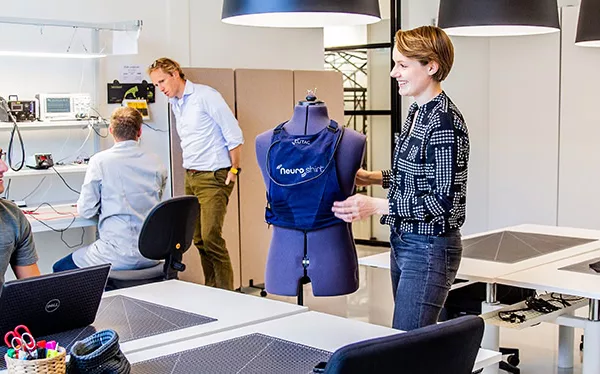
Haptic technology can be embedded into textiles, belts, vests, helmets, or integrated into existing NATO soldier systems.
Applications of haptic devices in NATO military training
NATO training emphasises interoperability, readiness, and realistic scenarios. Haptic devices support these goals by helping soldiers:
- Develop instinctive directional awareness
- React faster to simulated threats or IED alerts
- Navigate silently during night or stealth training
- Coordinate movement within multi national units
A haptic vest or belt can guide soldiers through urban warfare exercises using directional cues instead of spoken instructions. This strengthens muscle memory and mirrors the realities of modern operations where noise reduction, rapid response, and clarity are essential.
Drone threat warning: a rapidly growing operational need
Recent conflicts show that first person view attack drones are one of the most dangerous new threats to infantry. Flying at 80 to 120 km per hour, these drones often give soldiers only 3 to 5 seconds to react.
The problem is not detection.
Modern sensor networks and acoustic systems can detect incoming drones fast enough.
The real challenge is distribution.
How do you instantly transmit the direction of an approaching drone to every soldier in a team?
Visual alerts require looking at a screen.
Audio alerts get lost in the chaos of combat.
Haptics provide a new solution:
Instant, intuitive, and silent threat direction notification.
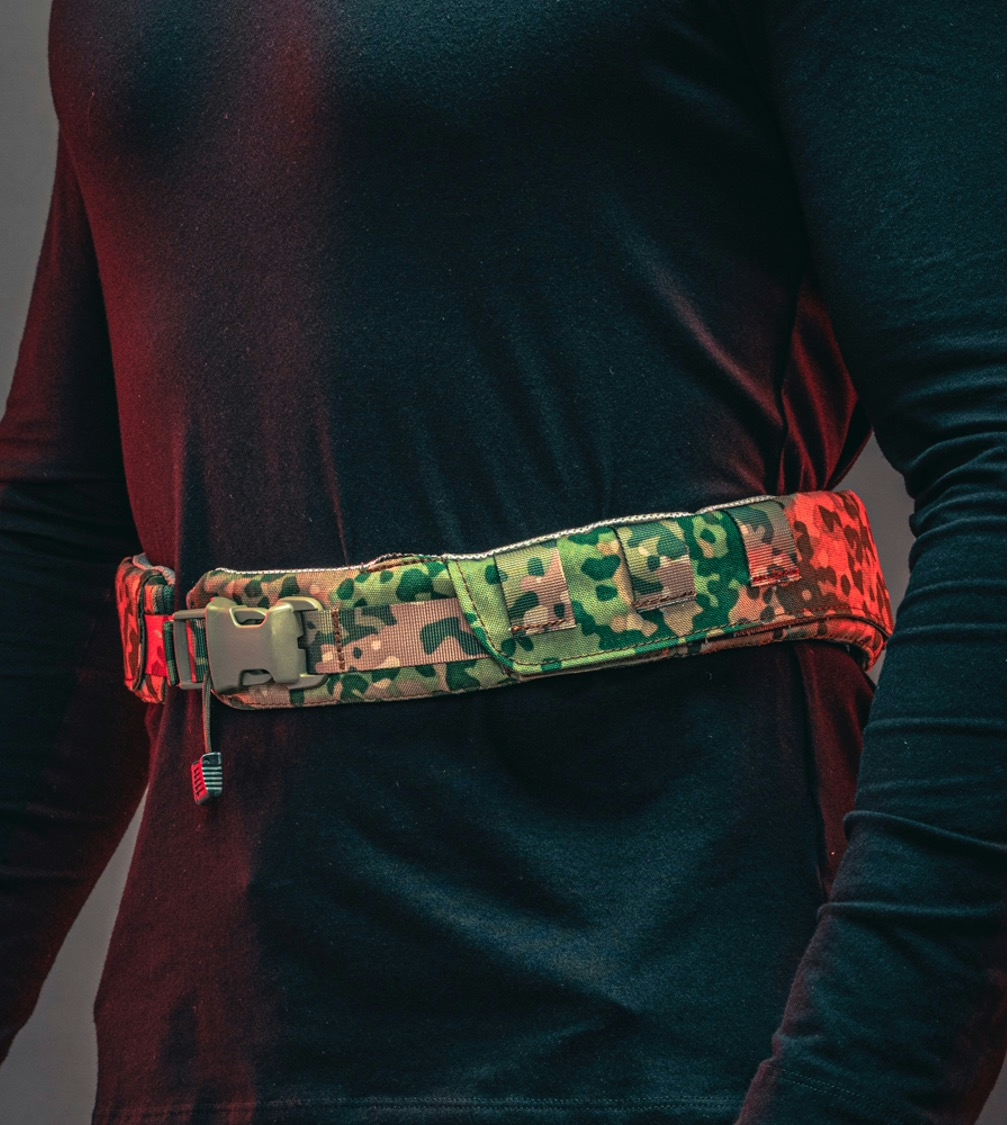
Using the Mission Navigation Belt (MNB) for drone threat warning
Our Mission Navigation Belt (MNB) offers a practical example of how NATO soldiers can receive immediate directional alerts without relying on their eyes or ears.
The MNB:
- Receives data from C4I combat systems, which aggregate inputs from acoustic drone detection sensors.
- Translates that data into clear, directional haptic cues along the belt.
- Gives the soldier an instant understanding of where the threat is coming from.
This provides soldiers with:
- Immediate threat awareness
- Faster access to cover or countermeasures
- Silent and screen free communication
- Reduced cognitive load
- Compatibility with existing NATO soldier systems
In battlefield conditions where every second matters, this can significantly increase survivability.
Wearable haptic gear for NATO battlefield operations
Across Europe and NATO mission areas, soldiers face diverse operational environments including forests, mountains, deserts, and dense urban terrain. Wearable haptics enhance performance in these environments by providing:
- Silent navigation support
- Threat alerts from detection systems
- Target or movement cues during coordinated assaults
- Remote direction commands from unit leaders
- Improved awareness for soldiers carrying heavy gear
Because haptic systems integrate easily with uniforms and body armour, they increase capability without adding complexity or weight.
Challenges in military haptic development
Creating reliable haptic technology for NATO use requires solving several design challenges:
- Durability in harsh climates and extreme environments
- Low power consumption for long mission times
- Comfortable designs that do not restrict movement
- Seamless compatibility with NATO C4I and soldier systems
- Ruggedised electronics and military grade textiles
Elitac Wearables specialises in smart textile engineering and soldier focused design, ensuring that haptic devices meet NATO expectations for reliability and user comfort.
Haptic feedback in communication and navigation
Haptic communication has massive potential for NATO units, especially when operations require stealth or when audio channels are saturated.
Applications include:
- Silent movement commands for fire teams
- Directional navigation cues during complex terrain crossings
- Alerts for friendly unit boundaries or restricted zones
- Reinforcement of AR way finding cues without requiring visual attention
By shifting key signals to the sense of touch, soldiers can maintain full visual and auditory awareness of the battlefield.
Future innovations in NATO military haptic technology
Haptic systems are rapidly evolving. Within the NATO DIANA program, Elitac Wearables is exploring next generation capabilities such as:
- Edge computing to adapt to mission data in real time
- Wireless smart textiles suitable for NATO uniform integration
- Haptics combined with vital signs monitoring for health and stress management and even automated triage
- Smaller and more precise actuators for advanced tactical communication
These innovations aim to support NATO’s Future Soldier and Soldier as a System programs.
Conclusion: Haptics are becoming essential for NATO readiness
From silent navigation signals to life saving drone threat warnings, haptic feedback is redefining how soldiers interact with information. The combination of sensor networks, C4I systems, and wearable haptics can create a faster, more intuitive soldier centred interface for the modern battlefield.
Within the NATO DIANA 2026 Challenge, we are committed to pushing this capability forward and to helping NATO forces stay safe, informed, and prepared for the rapidly changing character of conflict.
If you are exploring haptics for defence, public safety, or high demand operational environments, we would be glad to connect:
👉 https://elitacwearables.com/contact/