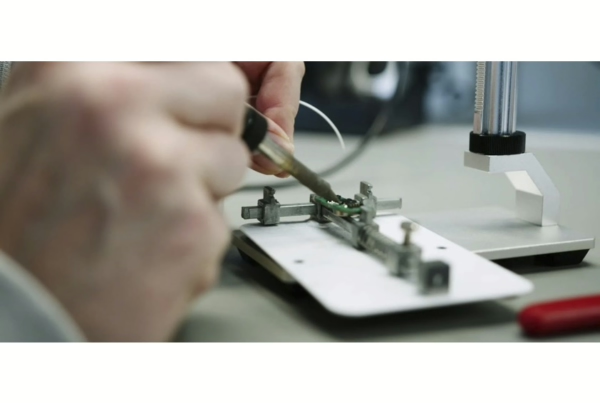
Electronics integrated into textiles must meet a range of certifications depending on where the product is sold, what it does, and who wears it. In Europe, the minimum requirement for most wearable electronics is CE marking, but the specific directives and standards that sit beneath that mark vary significantly based on the product’s function. Medical e-textiles, for example, face a fundamentally different regulatory path than industrial or consumer smart garments.
The earlier certification planning enters the development process, the less it costs and the fewer redesigns it forces. The sections below address the most common questions development teams face when navigating compliance for smart textile products.
Which regulatory frameworks apply to e-textiles?
E-textiles sit at the intersection of multiple regulatory frameworks, and which ones apply depends on the product’s intended use and market. In Europe, the primary frameworks are the Radio Equipment Directive (RED), the General Product Safety Regulation (GPSR), the Medical Device Regulation (MDR), and, for hazardous environments, the ATEX Directive. Most electronics integrated into textiles will fall under at least one of these, and many will fall under several simultaneously.
The RED applies to any product that transmits or receives radio waves, which includes the vast majority of connected wearables. The GPSR sets baseline safety expectations for all consumer products placed on the EU market. If a smart textile product is intended to diagnose, monitor, or treat a medical condition, the MDR applies and introduces a substantially more demanding compliance pathway. For products worn in potentially explosive atmospheres, such as industrial workwear in oil and gas environments, ATEX certification becomes relevant.
What makes e-textiles particularly complex is that the textile and electronic components are often assessed separately under different standards, yet the integrated product must be evaluated as a whole. A conductive yarn that passes textile safety standards may behave differently once current flows through it in a functioning garment. Regulatory frameworks have not always kept pace with the speed of innovation in smart textile development, which means development teams frequently need to interpret how existing standards apply to novel product configurations.
What certifications are needed for wearable electronics sold in Europe?
Wearable electronics sold in Europe require CE marking as the baseline market access requirement. CE marking is not a single certification but a declaration that the product complies with all applicable EU directives and harmonised standards. For most electronics integrated into textiles, this means demonstrating conformity with the RED, the Low Voltage Directive (LVD) if the device operates above 50 V AC or 75 V DC, and the EMC Directive for electromagnetic compatibility.
Beyond CE marking, specific product categories carry additional requirements. Products with wireless connectivity must pass radio testing. Products with rechargeable batteries must address battery safety standards. Skin-contact products may need to demonstrate compliance with REACH regulations concerning restricted chemical substances, which is particularly relevant for conductive inks and coatings used in printed electronics on fabric.
For smart textile products entering the medical device category under the MDR, the certification burden increases substantially. Class I medical wearables can self-declare conformity, but Class IIa and above require a Notified Body to review technical documentation and, in many cases, clinical evidence. The MDR has significantly tightened what was previously an accessible pathway, and teams that designed to the older Medical Device Directive (MDD) may find their compliance documentation no longer sufficient.
It is also worth noting that CE marking does not automatically grant market access outside the EU. Products sold in the UK post-Brexit require UKCA marking. The US market requires FCC authorisation for radio devices and, for medical wearables, FDA clearance or approval depending on the device classification.
How does product function determine which standards apply?
The function of a smart textile product is the single most important factor in determining which standards apply. A garment that monitors heart rate for fitness tracking faces a different regulatory path than one that monitors cardiac arrhythmias for clinical decision-making, even if the underlying sensor technology is identical. The intended use, as stated by the manufacturer, defines the regulatory category.
Function-based classification works across several dimensions. A product that emits radio signals is automatically subject to the RED regardless of what else it does. A product that touches skin and contains electronic components must consider both electromagnetic safety and chemical safety for skin-contact materials. A product that delivers mechanical stimulation, such as haptic feedback, may need to demonstrate that the actuators cannot cause harm under foreseeable conditions of use.
For teams developing products in the space between wellness and medical, the intended use statement is a critical document. Claiming that a wearable “monitors stress levels” reads very differently to regulators than claiming it “aids in stress management.” The former can imply a diagnostic function; the latter positions the product as a general wellness tool. These distinctions have real consequences for which conformity assessment route is available and how much clinical or technical evidence must be generated.
What testing requirements are specific to textile-integrated electronics?
Textile-integrated electronics face testing requirements that standard electronics testing does not fully address. The most significant additions relate to washability, mechanical durability under flexion and stretch, and the stability of electrical performance after repeated laundering. These are not covered by standard electronic product testing and must be planned as a distinct part of the validation process.
Relevant textile-specific testing typically includes assessments of electrical continuity after washing cycles, mechanical stress testing of connections between conductive elements and rigid components, and evaluation of skin contact safety for any materials that remain in sustained contact with the wearer. For products using conductive yarns, the resistance of those yarns must remain within specification after repeated mechanical deformation and washing.
EMC testing for e-textiles also presents unique challenges. The human body affects antenna performance and electromagnetic behaviour, and a product tested on a bench may behave differently when worn. On-body testing or simulation is increasingly expected for body-worn devices, particularly those with wireless communication. Similarly, SAR (Specific Absorption Rate) testing is required for devices that transmit radio frequency energy close to the body, such as wearables with integrated Bluetooth or cellular connectivity.
For medical e-textiles, biocompatibility testing under ISO 10993 may be required, evaluating cytotoxicity, sensitisation, and irritation potential of all materials in contact with skin. This applies not just to the electronics but to any adhesives, coatings, or textile treatments used in the integrated product.
When should certification be planned into the development process?
Certification planning should begin at the concept stage, not at the end of development. The most expensive certification problems are the ones discovered during pre-compliance testing when the hardware design is already fixed. A component choice made early, a PCB layout decision, or a material selected for cost reasons can create compliance failures that require a full redesign to resolve.
In practice, this means three things. First, the compliance scope should be defined during the feasibility phase, before any custom development begins. Knowing whether a product falls under the MDR, RED, or ATEX shapes every downstream decision about architecture, materials, and testing budget. Second, pre-compliance testing should be integrated into the prototype phase, not deferred to the first production run. Running informal EMC checks on early prototypes identifies antenna and shielding issues while the design is still fluid. Third, the technical documentation required for CE marking and similar declarations should be built continuously throughout development rather than assembled retrospectively.
At Elitac Wearables, certification scope is identified as part of the feasibility check at the start of every project. This means clients understand their compliance obligations before committing to a development budget, and the hardware and firmware architecture is designed with those obligations in mind from day one. In the development process, DVT (Design Validation Testing) in Phase 5 specifically includes regulatory pre-compliance testing before the first certified production batch is manufactured.
How do certifications differ for medical versus non-medical e-textiles?
Medical e-textiles and non-medical e-textiles follow fundamentally different certification pathways. Non-medical smart garments primarily need to demonstrate product safety and, where wireless communication is involved, radio conformity. Medical e-textiles must additionally demonstrate clinical performance, risk management, and ongoing post-market surveillance. The difference is not incremental; it represents a qualitatively different level of regulatory scrutiny.
Non-medical e-textiles
For non-medical applications, the conformity assessment process is largely self-declaratory for products that do not require Notified Body involvement. The manufacturer conducts or commissions the required testing, compiles a technical file, and signs a Declaration of Conformity. The process is demanding but manageable within a structured development timeline. Key standards include harmonised standards under the RED for radio performance, EN 55032 and related standards for EMC, and relevant IEC standards for electrical safety.
Medical e-textiles
For medical e-textiles, the MDR introduces requirements that touch every stage of development. A clinical evaluation must demonstrate that the device achieves its intended clinical purpose and that the benefits outweigh the risks. A risk management file following ISO 14971 must document all foreseeable hazards and the controls applied. A quality management system conforming to ISO 13485 must govern the development and manufacturing process. For Class IIa devices and above, a Notified Body must audit the technical documentation and, in some cases, conduct unannounced manufacturing audits.
The MDR also requires a Unique Device Identifier (UDI) system and registration in the EUDAMED database. Post-market surveillance is mandatory, meaning that once a medical e-textile is on the market, the manufacturer must actively collect and evaluate real-world performance data and update the clinical evaluation accordingly.
The practical implication for development teams is that medical classification should be confirmed as early as possible. Designing a product as a wellness device and later reclassifying it as medical is far more disruptive than building to medical standards from the start. Conversely, over-engineering a non-medical product to meet medical standards wastes time and budget that could be directed elsewhere.
How Elitac Wearables helps with certifications for electronics integrated into textiles
Navigating certification for smart textile development is one of the areas where working with a specialist makes the most tangible difference. Elitac Wearables brings direct experience with the full range of applicable frameworks, including MDR for Class I and Class II medical wearables, CE marking under RED and LVD, ATEX for hazardous-environment applications, and military certification requirements.
- Compliance scope is defined at the feasibility stage, before any development spend is committed
- Hardware architecture, component selection, and firmware design are shaped by certification requirements from the outset
- Pre-compliance testing is integrated into the prototype phase to catch issues while the design is still changeable
- Technical documentation is built continuously throughout development, not assembled under pressure before a product launch
- The team has hands-on experience with both the textile and electronics dimensions of compliance, which most generalist development partners cannot offer
If you are developing electronics integrated into textiles and need a partner who understands both the regulatory landscape and the engineering reality, speak to the Elitac Wearables team about your project.
Related Articles
- Are military wearables waterproof and ruggedized for combat?
- How do haptic feedback wearables support accessibility needs?
- What does post-launch wearable product support and iteration actually cost?
- What is the real ROI of investing in a custom wearable product?
- What should a Head of Product demand from a wearable development partner at each project milestone?