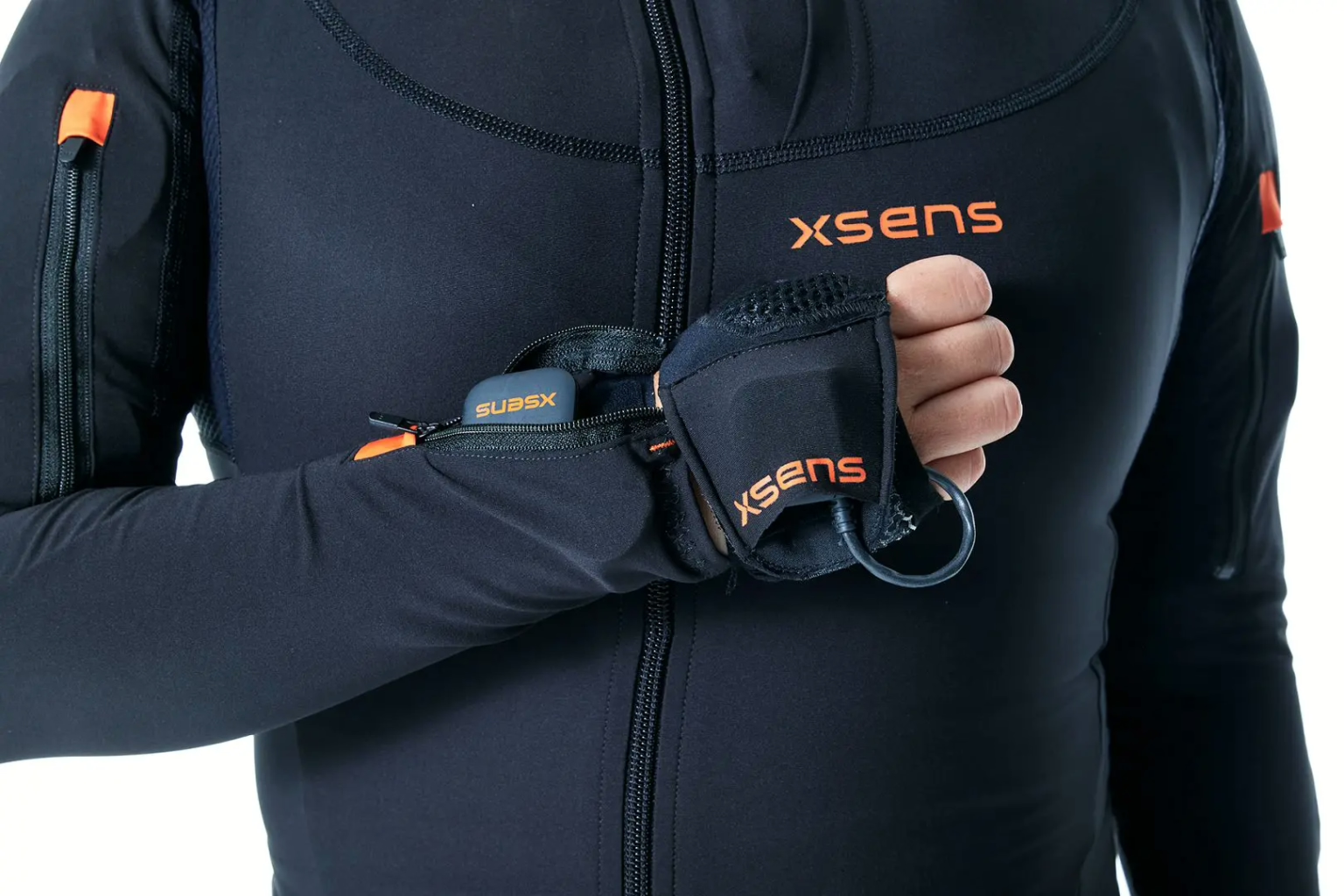


Haptic feedback wearables are powered by a combination of actuators, drivers, sensors, microcontrollers, (wireless) communication modules and power management components working together as a tightly integrated system. The actuator produces the physical sensation, but every other component in the chain determines whether that sensation is meaningful, reliable, and energy-efficient enough to function in a real-world wearable. This article unpacks each major hardware layer in a haptic wearable system, from the motors that generate vibration to the power constraints that shape every design decision.
What types of actuators are used in haptic wearables?
The four main actuator types used in haptic feedback wearables are Eccentric Rotating Mass (ERM) motors, Linear Resonant Actuators (LRAs), Voice Coils (VCM) and piezoelectric actuators. Each generates tactile sensation through a different physical mechanism, and each involves a different set of trade-offs in terms of size, response time, frequency range, power draw, and integration complexity.
ERM motors spin an off-centre mass to generate vibration. They are inexpensive, widely available, and straightforward to drive, which makes them common in early prototypes and cost-sensitive applications. The downside is that they are slow to start and stop, which limits the resolution of haptic patterns you can deliver.
LRAs use a spring-mass mechanism to vibrate a mass along a single axis at a resonant frequency, typically around 170 to 200 Hz. They respond faster than ERMs, consume less power at their resonant frequency, and produce cleaner, more controllable vibration. This makes them the preferred choice for body-worn applications where nuanced tactile communication matters.
Voice Coils (VCM) work on the same basic principle as a loudspeaker: a coil suspended in a magnetic field moves linearly when current is applied, and they can produce serious force across a wide frequency range, more powerful than either ERM or LRA motors. We use them very rarely in wearables. Unlike an LRA, a VCM has no resonance to exploit, so sustaining that force means drawing continuous current rather than a brief resonant pulse, which is hard to justify on a wearable’s power budget. They are also considerably bigger and heavier than ERM or LRA motors, more expensive to source, and the continuous current draw generates more heat, which matters when the actuator sits against the skin. For most body-worn applications, that combination of size, power draw, heat, and cost outweighs the extra force they deliver.
Piezoelectric actuators operate on an entirely different principle: they deform when voltage is applied, generating very fast, precise vibration across a wide frequency range. They are thin, silent in terms of mechanical noise, and capable of delivering high-fidelity haptic patterns. The trade-off is that they require higher drive voltages, which adds complexity to the power supply design. Another trade-off is that the amplitude is small for piezoelectric actuators. In applications where form factor and precision matter most, such as medical wearables or military navigation systems, piezo actuators are increasingly relevant.
For body-worn devices specifically, the choice of actuator is never purely technical. Comfort, placement on the body, garment construction, and the type of information being communicated all influence which actuator is appropriate. A belt-mounted navigation device has very different requirements from a rehabilitation garment delivering therapeutic stimulation to a limb.
How does a haptic driver IC control feedback output?
A haptic driver IC sits between the power supply and the actuator, translating low-power digital commands from the microcontroller into the precise electrical signals needed to drive vibration. Without a dedicated driver, the microcontroller cannot supply enough current to operate an actuator reliably, and the waveform shaping needed for high-quality haptic output would require significantly more firmware complexity.
The driver IC handles several functions simultaneously. It amplifies the drive signal to the voltage and current levels the actuator requires. It also manages waveform generation, including the brake and overdrive signals that allow LRAs to start and stop quickly rather than trailing off gradually. Many modern haptic driver ICs include an internal library of pre-defined waveform effects, which reduces the processing load on the microcontroller and simplifies firmware development.
For LRA actuators in particular, the driver IC performs auto-resonance tracking. Because an LRA’s resonant frequency can shift slightly based on temperature, load, and manufacturing tolerances, the driver continuously monitors back-EMF from the actuator and adjusts the drive frequency in real time to maintain peak efficiency. This is not something a general-purpose motor driver can replicate without substantial additional engineering.
In a wearable context, the driver IC also contributes to power efficiency. A well-configured driver activates the actuator only when needed, applies the correct braking signal to stop vibration cleanly, and draws minimal quiescent current during idle periods. These details matter enormously when your device needs to run for an entire working shift or clinical session on a small battery.
What sensors feed data into a haptic feedback system?
The sensors that feed a haptic feedback system depend entirely on what the wearable is designed to communicate. Common sensor inputs include inertial measurement units (IMUs), pressure sensors, GNSS receivers, biosignal sensors such as ECG or EMG electrodes, and environmental sensors. The sensors provide the raw data; the haptic system translates that data into a tactile signal the wearer can interpret.
In a navigation wearable, the primary input is positional data from GNSS combined with heading data from an IMU. The Mission Navigation Belt developed for the Royal Netherlands Army uses this approach: GNSS and orientation data are processed to determine which direction the soldier needs to move, and the haptic system delivers directional vibration cues to the corresponding position on the body. No screen, no audio, no distraction.
In a balance rehabilitation wearable, the sensor input is typically an IMU measuring trunk tilt and sway. The system detects deviation from a stable posture and delivers corrective haptic cues to guide the wearer back toward balance. The BalanceBelt operates on this principle, using motion sensing to drive real-time haptic feedback that helps people with severe balance disorders move with confidence.
Biosignal sensors add another layer of complexity. When ECG, EMG, or EDA data feeds a haptic system, the signal processing chain must handle motion artefacts, electrode contact variability, and noise from the surrounding electronics. Dry electrodes, which are commonly used in high-movement wearable applications, perform differently from wet gel electrodes and require specific signal conditioning before the data is reliable enough to act on. Getting this chain right is one of the more technically demanding aspects of biosignal-driven haptic wearable development.
What’s the difference between ERM and LRA haptic motors?
The key difference between ERM and LRA haptic motors is how they generate vibration and how precisely that vibration can be controlled. ERMs spin a rotating eccentric mass to create vibration across a broad frequency range, while LRAs oscillate a mass linearly at a fixed resonant frequency. LRAs start and stop faster, consume less power at resonance, and produce cleaner, more controllable haptic output.
ERM motors: simple, affordable, imprecise
ERM motors are the older technology and remain common because they are inexpensive and easy to drive. A basic PWM signal from a microcontroller is enough to get one running. However, the rotating mass takes time to spin up and spin down, which means the vibration onset and offset are gradual rather than sharp. This makes it difficult to deliver short, distinct haptic pulses. The frequency of vibration is also tied to the motor’s rotation speed, so you have limited control over the tactile character of the output.
LRA motors: responsive, efficient, controllable
LRAs operate at a fixed resonant frequency, typically in the 150 to 200 Hz range, and use a voice-coil mechanism to move a mass back and forth along a single axis. Because the motion is linear rather than rotational, the actuator can start and stop within milliseconds when driven correctly. This enables crisp, distinct haptic events, which is critical when the wearable needs to communicate specific information through patterns of vibration rather than a simple on/off buzz.
For body-worn devices, the faster response time and lower power consumption of LRAs at resonance make them the preferred choice in most professional and medical applications. The trade-off is that LRAs require a more sophisticated driver IC to manage resonance tracking and braking, which adds a small amount of cost and firmware complexity. In applications where haptic precision genuinely matters, that trade-off is almost always worth making.
How does the microcontroller manage haptic feedback in a wearable?
The microcontroller in a haptic wearable coordinates the entire feedback loop: it reads sensor data, processes it to determine whether a haptic event is required, selects the appropriate vibration pattern, and sends commands to the haptic driver IC. The quality of the haptic experience depends heavily on how well this logic is implemented in firmware, not just on the hardware components themselves.
Timing is critical. A haptic cue that arrives 300 milliseconds after the triggering event feels disconnected from the cause. A cue that fires too frequently becomes noise the wearer learns to ignore. The microcontroller firmware must manage event detection, debouncing, pattern sequencing, and priority logic to ensure that only meaningful, well-timed haptic signals reach the wearer.
In multi-actuator wearables, the microcontroller also manages spatial coordination. A belt with eight actuators positioned around the torso can communicate direction, urgency, and intensity simultaneously, but only if the firmware correctly sequences which actuators fire, in what order, and at what intensity. This is where the difference between a functional prototype and a genuinely usable wearable becomes apparent.
Power management is another microcontroller responsibility that directly affects haptic performance. The firmware must ensure that the haptic driver and actuator are powered down when not in use, that wake-up latency is low enough not to delay feedback, and that competing power demands from radios, sensors, and displays (screens) do not cause voltage drops that degrade actuator performance. These interactions are rarely visible in a lab setting but become significant in real-world use, particularly in battery-constrained devices.
Elitac Wearables addresses these firmware-level challenges by writing dedicated, purpose-built firmware for each wearable rather than relying on a general-purpose operating system. Because a haptic wearable typically runs a single application at a time, this dedicated approach keeps haptic timing, actuator coordination, and power states tightly optimised for that specific body-worn device.
What power supply constraints affect haptic hardware design?
Power supply constraints in haptic wearable hardware design centre on three main tensions: the actuator’s peak current demand during activation, the system’s need to minimise idle power draw, and the physical limits on battery size imposed by the wearable form factor. Getting these three factors into balance is one of the most common sources of late-stage development problems in haptic wearable technology.
Actuators draw significantly more current during the initial drive phase than during steady-state vibration. An LRA being overdriven at startup to achieve fast onset can draw several hundred milliamps for a brief period. If the power supply cannot deliver that peak current without a voltage drop, the actuator underperforms and the haptic output is weaker than intended. This means the power supply design must account for peak transient demand, not just average consumption.
At the system level, battery life is rarely a single-component problem. In practice, firmware behaviour, radio transmission intervals, sensor sampling rates, and display activity all contribute to total power draw. Increasing the battery size to compensate for poor power management is a common but costly mistake. A larger battery means a heavier, bulkier device, which often triggers a cascade of redesign work affecting the enclosure, the textile integration, and the comfort of the garment.
The more effective approach treats power management as a system-level discipline from the earliest design stages. This means selecting components with appropriate sleep-state current profiles, writing firmware that aggressively manages active and idle states, and validating real-world power consumption under actual usage patterns rather than theoretical best-case scenarios. Teams that address power constraints late in development often discover that the fix requires changes across hardware, firmware, and physical design simultaneously.
How Elitac Wearables helps with haptic hardware component selection and integration
Selecting the right haptic hardware components is not a catalogue exercise. The actuator, driver IC, sensors, microcontroller, and power supply must work together as a coherent system, designed around the specific body location, use case, environmental conditions, and regulatory requirements of your wearable. Getting any one of those layers wrong creates problems that compound through the rest of development.
Elitac Wearables provides end-to-end haptic feedback wearable development, covering every layer of the hardware stack under one roof. For B2B clients with a development challenge, this means:
- Actuator selection based on your specific application, body location, comfort requirements, and target haptic resolution, covering ERM, LRA, and piezo options
- Driver IC configuration and firmware-level timing design, including Elitac’s proprietary TacOS operating system for wearable-optimised haptic control
- Sensor integration for the data inputs that drive your haptic logic, whether that is positional, biosignal, or environmental data
- Power management optimisation across hardware and firmware to maximise battery life without increasing device size
- Electronics-textile integration to ensure the full haptic system functions reliably in a worn, flexible, washable garment
- Certification guidance for medical, military, or industrial applications from the earliest hardware design decisions
If you are building a haptic wearable and need a development partner with proven experience across medical, defence, and sports applications, contact Elitac Wearables to discuss your project requirements.
Related Articles
- How do haptic wearables differ from force feedback devices?
- Are haptic feedback wearables suitable for enterprise use?
- What happens when wearable product development goes over budget, and how do you prevent it?
- How do you find a contract manufacturer for a wearable device?
- How do you future-proof a wearable product during the development phase?