For most product teams operating in medical, defence, or industrial sectors, investing in haptic feedback wearables in 2026 is a well-timed strategic move — not a speculative bet. Haptic wearables have crossed the threshold from a research novelty to a commercially viable product category, and organisations that move now will build a meaningful lead over those that wait. The questions below unpack what that investment actually involves, what it costs, and how to make the right call for your roadmap.
What makes haptic feedback wearables different from other wearable tech?
Haptic feedback wearables communicate directly with the wearer’s body through touch — using vibration, pressure, or tactile patterns to deliver information without visual or auditory signals. Unlike fitness trackers or biosensing devices that collect data from the body, haptic feedback devices send information to the body, creating a fundamentally different interaction model.
This distinction matters enormously for product teams. Most wearable categories — heart rate monitors, GPS trackers, motion capture suits — are input devices. They observe. Haptic wearables are output devices. They instruct, alert, or guide. That changes everything about how you design them, what success looks like, and who the end user actually is.
The technical complexity is also in a different league. A haptic wearable must deliver precise, repeatable tactile sensations through a textile or enclosure that moves with the body, often in demanding environments. The actuator type matters enormously: ERM (Eccentric Rotating Mass) motors are cost-effective and widely used, LRAs (Linear Resonant Actuators) offer faster response and more precise frequency control, and piezo actuators provide the highest precision with minimal power draw — but each demands a different integration approach, firmware strategy, and body-placement logic.
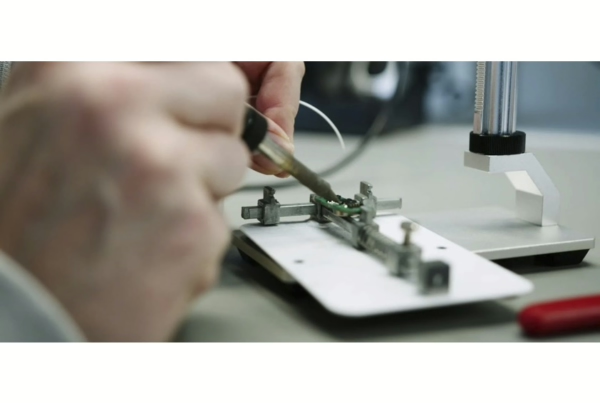
Add to this the challenge of textile integration, power management, and real-world body movement, and you have a category that requires genuine specialist knowledge to execute well. This is not a domain where general electronics expertise transfers cleanly.
Which industries are adopting haptic wearables fastest in 2026?
In 2026, the fastest adoption of haptic feedback wearables is happening in medical rehabilitation, defence and tactical operations, and industrial safety. These three sectors share a common driver: they need to deliver critical information to users whose hands, eyes, or ears are already occupied — and where a missed signal has real consequences.
Medical and rehabilitation
In clinical and rehabilitation settings, haptic wearables are being used to support balance correction, gait training, and sensory substitution for patients with neurological conditions. Devices like the BalanceBelt — developed to help people with balance disorders — demonstrate how vibrotactile feedback can replace or supplement sensory signals the body is no longer generating reliably. The combination of clinical need, reimbursement potential, and EU regulatory frameworks is accelerating investment here.
Defence and tactical
Military applications have been among the earliest adopters of serious haptic wearable development. Navigation, situational awareness, and hands-free communication under operational conditions are all strong use cases. The Mission Navigation Belt, developed for the Royal Netherlands Army, is a live example of how haptic feedback solves a real operational problem: guiding soldiers without requiring them to look at a screen or listen for an audio cue in a noisy environment.
Sports performance and industrial safety
Sports performance teams are integrating haptic wearables into training systems for real-time coaching feedback, while industrial safety applications are emerging around posture monitoring, hazard alerts, and ergonomic guidance for workers in high-risk environments. Both sectors benefit from the same core advantage: non-intrusive, immediate feedback that does not disrupt the primary task.
How much does it cost to develop a haptic feedback wearable?
Developing a haptic feedback wearable from concept to a market-ready product typically requires a minimum initial budget of around €30,000 for early-stage feasibility and proof-of-concept work, scaling to €200,000 or more for full development through to certified, production-ready hardware. The range is wide because the cost is driven by complexity, not by the haptic component alone.
The most useful way to think about cost is by development phase. A feasibility check — verifying that your concept is technically viable and identifying the right actuator, integration approach, and firmware architecture — typically takes one to four weeks and is the lowest-cost entry point. A proof of concept (PoC) built with off-the-shelf components and existing firmware building blocks costs significantly less than a custom hardware prototype, and it is often the right tool for securing internal sign-off or investor validation before committing to full development.
Where costs escalate quickly is at the transition from prototype to a production-ready product. Certification alone — whether CE marking, MDR compliance for medical wearables, or ATEX for hazardous environments — adds both time and cost that many product teams underestimate. Textile integration, washability requirements, and miniaturisation all add engineering hours that are difficult to estimate without a thorough feasibility assessment.
A practical rule of thumb: if your team is treating haptic feedback as a feature addition rather than a core system, you are likely underestimating the development cost. Haptics requires its own firmware logic, actuator placement strategy, and user testing cycle. Teams that account for this upfront consistently deliver better products at lower total cost than those who retrofit it late in development.
What are the biggest technical challenges in haptic wearable development?
The biggest technical challenges in haptic wearable development are actuator selection and placement, textile integration, power management, and firmware-level timing precision. Each of these is solvable — but each requires specific expertise that general electronics development teams rarely have.
Actuator selection is deceptively complex. The right choice between ERM, LRA, and piezo depends on the body location, the required sensation resolution, the power budget, and the enclosure constraints. An actuator that performs well on a wrist behaves very differently when embedded in a vest or a boot. Getting this wrong early means redesigning the hardware later — which is expensive and time-consuming.
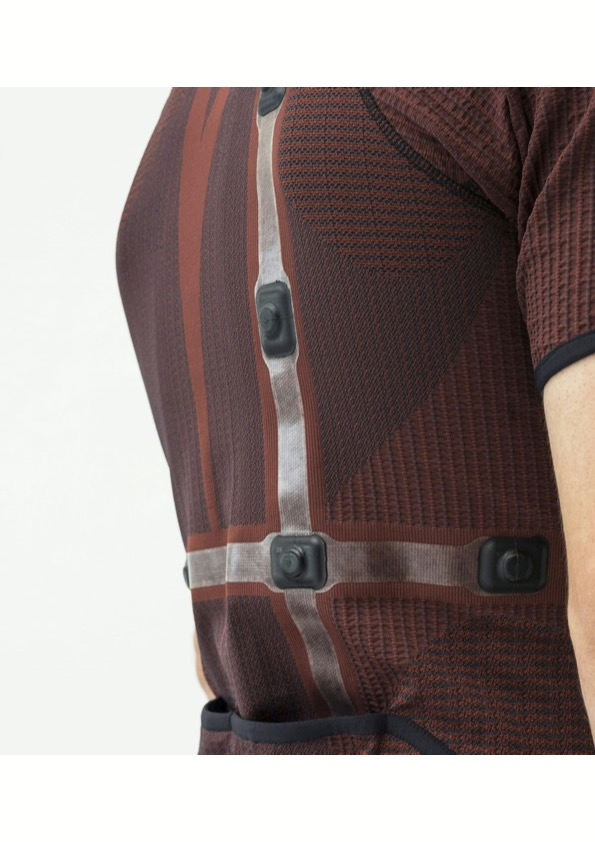
Textile integration presents its own set of problems. Conductive yarns, printed electronics, and modular snap-on components each have different implications for washability, flexibility, and long-term durability. A haptic wearable that works perfectly in the lab but degrades after ten washes is not a product — it is a prototype that never made it. Designing for the full use lifecycle from the start requires experience across both electronics and textile disciplines simultaneously.
Power management is a system-level challenge, not a component-level one. Battery life problems in wearables are almost never solved by fitting a larger battery. They are caused by firmware keeping components active longer than necessary, inefficient data handling, and hardware component choices that do not match real-world usage patterns. Structured optimisation across hardware, firmware, and data architecture is the correct approach — and it routinely delivers meaningful battery life extension without increasing the device footprint.
Finally, haptic pattern design and firmware timing require a level of precision that surprises many product teams. A vibration that fires 50 milliseconds too late or at the wrong frequency is not just less effective — it can be actively confusing or uncomfortable for the wearer. This is a discipline in its own right, and it sits at the intersection of human factors, firmware engineering, and sensory psychology.
Should you build haptic wearable capability in-house or partner with a specialist?
For most product teams, partnering with a specialist is the faster, lower-risk, and ultimately more cost-effective path to a market-ready haptic wearable. Building the capability in-house is viable for organisations with a long-term strategic commitment to wearables as a core business — but it requires assembling a genuinely multi-disciplinary team that combines hardware, firmware, textile, and human factors expertise. That takes years, not months.
The honest question to ask is not “can we do this ourselves?” but “what would it cost us to do this ourselves, and what would we be giving up while we figure it out?” For most R&D directors and CTOs, the answer reveals that in-house development carries significant hidden costs: recruitment, equipment, failed iterations, and the opportunity cost of delayed market entry.
The fragmentation risk is equally important. Many organisations attempt to assemble haptic wearable capability by sourcing electronics from one supplier, textile work from another, and firmware from a third. This approach consistently produces integration failures — not because any single supplier is inadequate, but because no single party owns the full system. When something goes wrong at the interface between electronics and textile, or between firmware and actuator behaviour, there is no one accountable for the whole.
Partnering with a specialist who carries all disciplines under one roof eliminates this risk. It also compresses timelines significantly. A team that has already solved actuator selection for body-worn devices, built firmware timing logic for haptic patterns, and navigated MDR certification for a medical wearable does not need to learn those lessons on your project — and that experience has real monetary value.
When is the right time to add haptic feedback to your product roadmap?
The right time to add haptic feedback to your product roadmap is as early as possible in the development cycle — ideally at the concept or feasibility stage, not as a late addition to an existing design. Haptic feedback is a system-level capability, and retrofitting it into a product that was not designed with it in mind is significantly harder and more expensive than building it in from the start.
The most common mistake product teams make is treating haptics as a feature to be added in a later version. This works occasionally — but only when the original hardware was designed with sufficient space, power headroom, and firmware flexibility to accommodate actuators and their control logic. More often, a late-stage haptic addition triggers a cascade of redesign decisions: enclosure changes, power budget reallocation, firmware restructuring, and additional user testing cycles.
If your product roadmap includes any of the following, haptic feedback deserves a place in your next planning cycle:
- Users who need to receive information without looking at a screen or listening for an audio alert
- Applications in high-noise, high-movement, or safety-critical environments
- Medical or rehabilitation use cases where sensory substitution or biofeedback is clinically relevant
- Navigation, posture correction, or training scenarios where real-time guidance improves performance
- Competitive differentiation in a market where existing products rely on visual or auditory output alone
The feasibility check is the right entry point if you are not yet certain whether haptic feedback is the right solution for your application. It is a low-commitment, short-duration engagement that gives you a clear technical and commercial picture before any significant investment is made.
How Elitac Wearables helps with haptic feedback wearable development
Elitac Wearables is a Netherlands-based specialist in end-to-end haptic wearable development, working with product teams in medical, defence, sports, and industrial sectors who need more than a generic electronics supplier. For CTOs, heads of product, and R&D directors facing the challenges described above, Elitac operates as an integrated development partner — not a vendor you hand a specification to and wait.
What that means in practice:
- Actuator selection and haptic system design: Expert guidance on ERM, LRA, and piezo selection based on your specific application, body location, power budget, and performance requirements
- Electronics-textile integration: Over a decade of experience embedding electronics into garments and body-worn devices, covering washability, flexibility, and long-term durability
- Firmware and TacOS: Proprietary wearable firmware platform that accelerates development and reduces integration risk across haptic pattern design, power management, and sensor coordination
- Certification support: Hands-on experience with MDR, CE marking, and ATEX — integrated into the development process from the start, not bolted on at the end
- Rapid validation: Functional demonstrators delivered in weeks, not months, so you can validate your concept before committing to full production investment
If your team is evaluating whether haptic feedback belongs on your product roadmap, or if you are already in development and hitting the technical walls described in this article, the right first step is a conversation. Elitac’s feasibility check is designed exactly for this moment — a focused, low-commitment engagement that gives you a clear answer before you commit serious budget. Get in touch to discuss your project.
Related Articles
- How do defence wearables improve soldier performance?
- What are the security considerations for haptic feedback wearables?
- What are the most common mistakes made in wearable product development?
- What should a CTO look for when evaluating a wearable development partner?
- What is the cost of developing a wearable product from scratch?