

Yes, haptic feedback wearables can meaningfully help people with hearing impairments. These devices convert sound into vibrotactile signals that the wearer can feel on their skin, giving the deaf and hard of hearing a physical channel for perceiving audio information. The technology is not a replacement for hearing, but it opens a genuinely useful parallel pathway for sound awareness, communication, and situational safety. Below, we unpack how the technology works, who it helps, and what it takes to build it properly.
How do haptic wearables convert sound into touch?
Haptic wearables convert sound into touch by using a microphone or audio input to capture acoustic signals, processing that input in real time, and then driving actuators embedded in a wearable device to produce corresponding vibration patterns on the skin. The wearer feels rhythm, intensity, and frequency variation as distinct tactile sensations rather than hearing them as sound.
The conversion process involves several layers of signal processing. Raw audio is typically filtered and segmented by frequency band, so a low bass rumble produces a different vibration pattern than a high-pitched alarm or a spoken consonant. The processed signal then drives one or more actuators, which may be ERM motors, linear resonant actuators (LRAs), or piezo elements, depending on the precision and frequency range required.
The quality of the tactile experience depends heavily on how well the signal processing maps acoustic features onto the body’s sensitivity profile. Human skin is most responsive to vibrations in the 200 to 300 Hz range, which is considerably narrower than the full audible spectrum. Good haptic system design accounts for this by compressing or remapping the audio signal into the tactile sweet spot rather than simply mirroring it. This is where actuator selection and vibration pattern design become technically demanding, and where the difference between a functional prototype and a genuinely useful device is made.
What types of hearing impairment can haptic wearables support?
Haptic wearables can support a wide range of hearing impairment profiles, from mild to profound deafness. They are particularly valuable for people with severe to profound hearing loss who receive limited benefit from conventional amplification, as well as for individuals who are deaf from birth and have no auditory reference point to compare against.
The technology is not condition-specific. It does not require any residual hearing function to work, which makes it relevant across:
- Congenital deafness: People born without hearing can learn to interpret tactile patterns as environmental cues, speech rhythms, or alerts without needing a prior auditory experience to anchor the sensation.
- Acquired hearing loss: Those who have lost hearing through age, noise exposure, or illness often retain a strong auditory memory, which can help them map tactile signals onto familiar sounds more quickly.
- Single-sided deafness: Haptic devices can supplement or replace directional sound awareness on the impaired side without interfering with the functioning ear.
- Auditory processing disorders: Some users struggle to interpret sound even with adequate hearing sensitivity; tactile reinforcement of key audio signals can reduce cognitive load in noisy environments.
The degree of benefit varies by application. For environmental awareness, such as detecting a doorbell, alarm, or approaching vehicle, the bar for usefulness is relatively low, and haptic wearables perform well. For speech perception, the challenge is considerably greater, and current devices tend to support rhythm and prosody rather than full phoneme discrimination.
Where on the body are haptic devices worn for hearing applications?
For hearing applications, haptic devices are most commonly worn on the wrist, forearm, torso, or neck, with placement chosen to maximise tactile sensitivity, comfort during extended wear, and the practical needs of the application. There is no single correct location, and the optimal site depends on what the device is communicating and how the wearer will use it.
The wrist and forearm are popular starting points because skin sensitivity is relatively high there, the location is socially unobtrusive, and wristband form factors are familiar to users. Wrist-worn devices work well for alert-based applications, such as notifying a user of a phone call or a smoke alarm.
The torso offers a much larger surface area, which matters when the goal is to convey richer or spatially distributed information. A vest or belt with multiple actuators positioned around the body can deliver directional cues, for example, indicating which side a sound is coming from, in a way a single wristband cannot. Research into sensory substitution has explored torso-based arrays extensively for this reason.
The neck and throat area is used in some speech-focused devices, where the proximity to the vocal tract allows the device to also capture the wearer’s own speech vibrations for biofeedback applications. This placement is more specialised and less common in consumer-facing products.
Placement also affects how well the device can be integrated into clothing or existing accessories, which is a practical constraint that shapes the engineering brief from the outset.
How does haptic feedback compare to cochlear implants and hearing aids?
Haptic feedback wearables, cochlear implants, and hearing aids address hearing loss through fundamentally different mechanisms and serve different user populations. Hearing aids amplify sound for people with residual hearing; cochlear implants bypass damaged hair cells and electrically stimulate the auditory nerve; haptic wearables deliver tactile sensations that carry audio-derived information without engaging the auditory system at all.
This distinction has practical implications for who each technology serves:
- Hearing aids require a functioning auditory pathway and are ineffective for profound or total deafness.
- Cochlear implants are surgical devices that require medical candidacy, significant cost, and rehabilitation. They offer high speech intelligibility for suitable candidates but carry surgical risk and are irreversible in the sense that residual natural hearing is often lost during implantation.
- Haptic wearables are non-invasive, require no surgery, and can be used alongside other assistive technologies. They are accessible to users who are not cochlear implant candidates and to those who choose not to pursue implantation.
The trade-off is in richness of experience. Cochlear implants, when successful, produce a perception closer to natural hearing than any current haptic device can achieve. Haptic wearables convey a narrower range of information, but they do so without medical risk, at lower cost, and with the flexibility to be updated or replaced as the technology improves. For many users, particularly those seeking environmental awareness rather than speech comprehension, that trade-off is entirely acceptable.
The most promising direction is not competition between these approaches but combination. Haptic wearables used alongside cochlear implants or residual hearing can reinforce specific cues, reduce listening fatigue, or cover situations where the primary device performs poorly, such as in very noisy environments.
What are the current limitations of haptic wearables for the deaf and hard of hearing?
The most significant current limitation of haptic wearables for hearing applications is the bandwidth gap between what the auditory system can process and what the tactile system can meaningfully interpret. Human skin can resolve far less information per second than the ear, which places a hard ceiling on how much audio content can be conveyed through vibration alone.
Beyond this fundamental constraint, several practical challenges affect the usefulness of current devices:
- Learning curve: Tactile substitution for sound is not intuitive. Users typically require weeks or months of training to interpret vibration patterns as meaningful information, which limits adoption for casual or low-commitment use cases.
- Speech intelligibility: Conveying full speech through touch remains an unsolved problem. Current devices can represent rhythm, stress, and some phoneme categories, but word recognition rates without visual support are low compared to cochlear implants.
- Actuator placement and comfort: Devices worn for extended periods must be comfortable, stable, and discreet. Multi-actuator arrays that improve information richness tend to be bulkier and harder to wear all day.
- Battery life: Continuous audio processing and actuator driving are energy-intensive. Achieving a full day of use in a compact form factor requires careful power management at both the hardware and firmware level.
- Latency: Any perceptible delay between a sound event and the corresponding vibration disrupts the user’s ability to correlate the two, particularly for speech or music applications.
None of these limitations are insurmountable, but they require engineering decisions to be made deliberately and early in the development process. Treating them as afterthoughts tends to be expensive.
What does the development of a haptic hearing wearable involve?
Developing a haptic wearable for hearing applications involves far more than selecting a vibration motor and writing some signal processing code. It requires coordinated decisions across audio capture, signal processing, actuator selection, mechanical integration, firmware, power management, user testing, and, where the device makes medical claims, regulatory compliance.
The process typically begins with defining the use case precisely. A device designed to alert a deaf user to a smoke alarm has very different requirements from one intended to support speech perception or music appreciation. The use case determines the signal processing strategy, the number and placement of actuators, the form factor, and the performance benchmarks that matter.
Actuator selection is a consequential early decision. ERM motors are low-cost and widely available but offer limited frequency control. LRAs provide more precise frequency targeting and faster response, making them better suited to nuanced pattern design. Piezo actuators can deliver high-frequency, high-resolution feedback but require more complex drive circuitry. The right choice depends on the tactile vocabulary the device needs to express and the body location where it will be worn.
Firmware and signal processing sit at the heart of the system. The algorithm that maps audio features to vibration patterns determines whether the device feels like a useful tool or an arbitrary buzz. This is not a problem that can be solved in a single iteration; it requires cycles of user testing with the actual target population, not just internal evaluation.
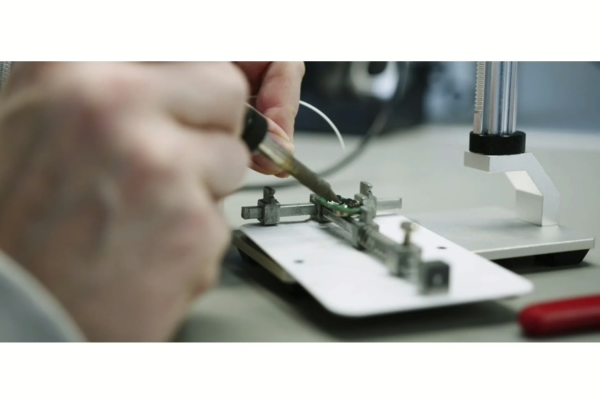
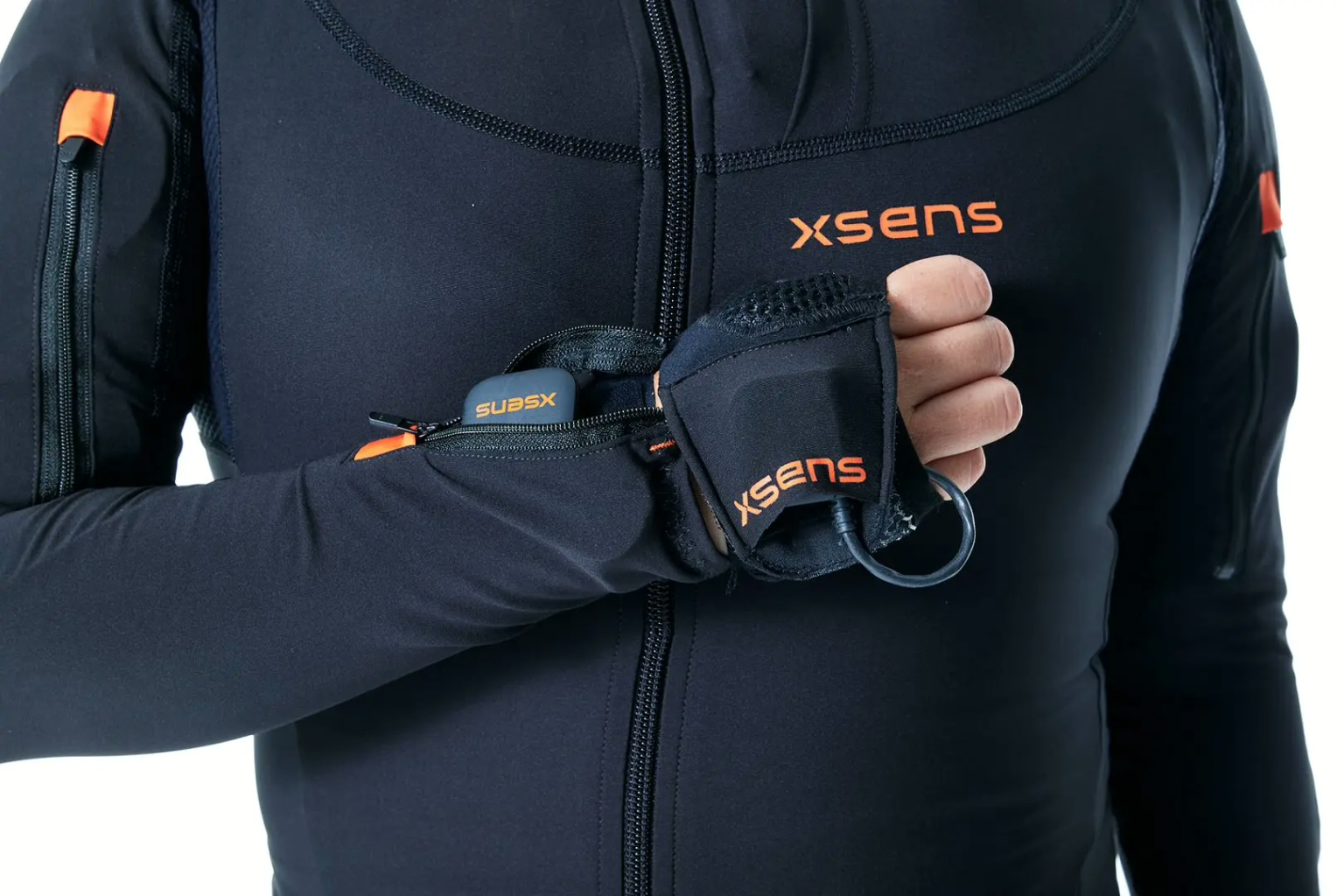
Wearability and textile integration matter more than they initially appear. A device that users abandon after a week because it is uncomfortable, embarrassing to wear, or difficult to put on has failed regardless of its technical performance. Integrating electronics into a garment or soft wearable in a way that survives daily use, washing, and physical movement demands specific expertise in electronics-textile integration.
How Elitac Wearables helps with haptic hearing wearable development
Building a haptic wearable for hearing applications is technically demanding at every layer, from signal processing and actuator selection to textile integration and certification. Elitac Wearables brings all of those disciplines in-house, which means the decisions that affect each other, and they all do, are made by people who are in the same room.
For organisations developing a haptic hearing device, working with Elitac Wearables means:
- Actuator selection grounded in body-worn experience: Elitac’s team has worked with ERM, LRA, and piezo actuators across medical, military, and sports applications and can advise on the right choice for your specific placement, pattern complexity, and power budget.
- Signal processing and firmware built for wearables: The proprietary TacOS operating system is purpose-built for haptic wearables, handling timing, pattern management, and power optimisation at the firmware level.
- Electronics-textile integration: With over a decade of experience embedding electronics into garments and soft wearables, Elitac can design a device that is comfortable enough to wear all day and robust enough to survive it.
- Validation-first development: Rather than committing to production tooling before the concept is proven, Elitac’s approach delivers functional demonstrators early, so you can test with real users before significant capital is at risk.
- Certification guidance: If your device makes medical claims, MDR compliance needs to shape hardware decisions from day one, not be retrofitted at the end. Elitac’s experience with Class I and II medical wearables means that guidance is built into the development process.
If you are developing a haptic wearable for the deaf or hard of hearing community and need a development partner who understands the full technical picture, get in touch with the Elitac team to discuss your project.
Related Articles
- How do wearables improve training outcomes for defence personnel?
- Are haptic feedback wearables suitable for enterprise use?
- How do you manage battery life constraints in wearable development?
- How long does wearable product development take?
- Can a startup successfully compete in wearable product development?