
The future of haptic feedback wearables is defined by greater intelligence, miniaturisation, and real-world utility. Advances in materials science, embedded AI, and flexible electronics are converging to make haptic wearable technology more precise, more comfortable, and more commercially viable across sectors including medical, defence, industrial safety, and sports performance. The sections below work through the most important questions shaping where this field is heading.
How far has haptic wearable technology come in recent years?
Haptic wearable technology has moved from laboratory novelty to deployable products across several demanding sectors. Where early devices relied on simple vibration motors strapped to the body, today’s haptic wearables integrate actuators directly into garments, deliver precisely timed feedback patterns, and operate under real-world conditions including sweat, movement, and long duty cycles. The gap between proof of concept and production-ready product has narrowed significantly, though it remains technically demanding.
The clearest evidence of this progress is visible in the kinds of applications now in active deployment. Tactile navigation systems guide soldiers and emergency responders without requiring them to look at a screen. Balance rehabilitation wearables deliver vibrotactile cues that help patients with vestibular disorders retrain their postural responses. Sports performance suits use haptic feedback to correct movement patterns in real time. These are not pilot studies — they are fielded products built to survive contact with the real world.
The actuator landscape has also matured considerably. ERM (Eccentric Rotating Mass) motors, once the default choice for their low cost, are increasingly being supplemented or replaced by LRA (Linear Resonant Actuator) and piezoelectric actuators where precision, latency, and form factor matter more than unit price. Firmware-level control of haptic timing and pattern design has become a discipline in its own right, enabling developers to encode genuinely meaningful signals rather than generic buzzes.
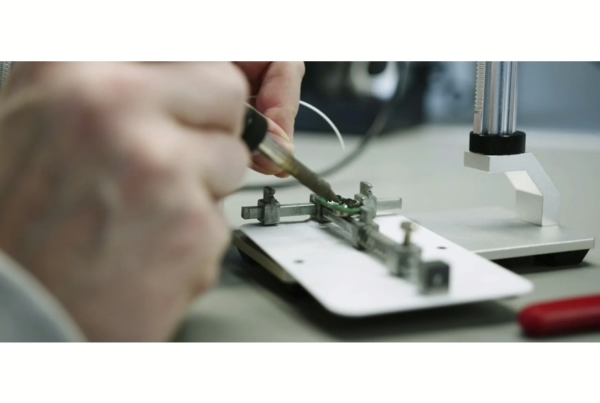
What has not changed is the difficulty of the integration challenge. Embedding electronics into a garment that must flex, wash, breathe, and sit comfortably against skin for hours remains one of the hardest problems in wearable engineering. Progress here has been real but incremental, which is why deep specialist expertise continues to separate functional products from failed prototypes.
What emerging applications will drive haptic wearable adoption?
The emerging applications most likely to drive broad adoption of haptic wearable technology are medical rehabilitation, industrial safety, navigation for eyes-free environments, and immersive training. These domains share a common trait: haptic feedback solves a problem that visual or audio feedback cannot, either because the user’s eyes and ears are occupied or because the feedback needs to be private, immediate, and body-referenced.
Medical rehabilitation and assistive technology
In clinical and home rehabilitation settings, haptic wearables are being developed to support patients with conditions including stroke, Parkinson’s disease, and balance disorders. Vibrotactile cueing can prompt movement initiation, reinforce correct gait patterns, or substitute for lost sensory input. The advantage over screen-based feedback is immediacy — the cue arrives at the body part that needs to respond, without requiring the patient to interpret a display.
Industrial safety and professional workwear
Smart PPE is an area where haptic feedback addresses a genuine safety gap. Workers in high-noise environments, those operating heavy machinery, or those working in proximity to hazard zones cannot always rely on audible alarms. A haptic alert delivered to the torso or wrist bypasses that problem entirely. As regulatory pressure on workplace safety increases and the cost of wearable electronics falls, this application is moving from niche to mainstream faster than most segments.
Navigation and situational awareness
Haptic navigation — delivering directional information through vibration patterns on the body — has proven its value in military applications and is now being explored for first responders, visually impaired users, and industrial inspection teams. The appeal is that it leaves hands free and eyes unoccupied while still delivering precise spatial information. As GPS integration and sensor miniaturisation improve, the accuracy and reliability of these systems will increase further.
How will advances in materials and electronics change haptic wearables?
Advances in flexible electronics, conductive textiles, and soft actuator materials will fundamentally change what haptic wearables can do and where they can be worn. The current generation of devices typically involves rigid electronic modules attached to or embedded in textile substrates. The next generation will increasingly use electronics that flex and stretch with the body, enabling haptic feedback across larger surface areas and in locations that are currently impractical.
Conductive yarns and printed electronics are already in use for signal routing within garments, but their reliability under repeated mechanical stress and washing cycles remains a live engineering challenge. Progress in encapsulation techniques and in the yarns themselves is improving durability, and commercial textile partners are increasingly developing materials specifically designed for electronics integration rather than treating it as an afterthought.
On the actuator side, soft robotics is opening new possibilities. Pneumatic and hydraulic textile actuators can deliver compression, pressure, and shape-change effects that rigid vibration motors cannot replicate. These are particularly relevant for medical wearables where the therapeutic effect depends on distributed pressure rather than point-source vibration. The engineering complexity is significant, but the clinical and commercial potential is substantial.
Power management is another area where materials and electronics advances intersect. Thinner, higher-density batteries, combined with more efficient firmware and smarter duty cycling, are extending the operational life of haptic wearables without requiring larger enclosures. Energy harvesting from body movement remains largely experimental for high-power haptic applications, but it is a credible medium-term direction for low-power sensing and feedback systems.
What role will AI and sensor fusion play in future haptic feedback systems?
AI and sensor fusion will make haptic feedback systems adaptive rather than pre-programmed. Instead of delivering fixed vibration patterns triggered by simple thresholds, future haptic wearables will interpret multi-sensor data in real time, infer what the user is doing and what they need, and adjust the feedback accordingly. This shift from reactive to predictive haptics is the single biggest functional leap the field is approaching.
Sensor fusion — combining data from IMUs, biosensors, environmental sensors, and positional systems — gives the device a richer picture of context. A navigation belt that knows the wearer is running can adjust the urgency and pattern of its directional cues. A rehabilitation wearable that detects a gait deviation can trigger corrective feedback before the user falls rather than after. A safety wearable that tracks both heart rate and proximity data can distinguish between a worker who is stressed and a worker who is in danger.
On-device machine learning is becoming feasible as embedded processors grow more capable and model compression techniques improve. Running inference locally matters for haptic applications because latency is critical — a feedback cue that arrives 200 milliseconds late may be worse than no cue at all. Edge AI removes the round-trip to a cloud server and keeps the system functional in environments where connectivity is unreliable, which covers most of the sectors where haptic wearables are most needed.
The practical implication for development teams is that haptic system design can no longer be treated as purely a hardware problem. The algorithm layer — how sensor data is interpreted and translated into feedback — is increasingly where product differentiation lives. Teams that invest in this layer alongside actuator selection and textile integration will produce meaningfully better products.
What are the biggest technical challenges still facing haptic wearables?
The biggest technical challenges facing haptic wearables today are electronics-textile integration durability, battery life under realistic usage conditions, haptic signal design, and the complexity of combining multiple disciplines within a single product. None of these are unsolved in principle, but all of them require deep specialist knowledge to navigate without costly late-stage failures.
Durability and washability of integrated electronics
A wearable that fails after ten wash cycles is not a product — it is a prototype. Achieving genuine durability in electronics-textile integration requires careful selection of encapsulation methods, connection techniques, and substrate materials, followed by rigorous mechanical and environmental testing. This is an area where experience across many product types matters enormously, because failure modes are highly specific to the combination of materials and construction methods used.
Battery life and power architecture
Battery performance is consistently one of the last problems teams discover and one of the hardest to fix late in development. Haptic actuators draw significant current during operation, and the power architecture must be designed from the outset to manage peak loads without over-sizing the battery. When battery life shortfalls appear late in development, the instinct is to specify a larger battery — but this triggers a cascade of enclosure redesign, new tooling, and schedule delays. The better approach is systematic optimisation across firmware, hardware, and usage patterns from early in the development cycle.
Haptic signal design and perceptual effectiveness
Vibration patterns that are technically correct can still fail to communicate meaningfully to users. Haptic signal design — determining which patterns convey which meanings, how intensity should vary with urgency, and how the feedback interacts with the noise of everyday movement — requires both engineering expertise and structured user research. This is often underestimated by development teams that treat haptics as a simple output rather than a communication channel that must be learned by the user.
Which industries are closest to deploying next-generation haptic wearables?
The industries closest to deploying next-generation haptic wearables are defence and public safety, medical rehabilitation, and industrial safety. These sectors share a combination of high willingness to invest, clear use cases where haptic feedback outperforms alternatives, and regulatory pathways that, while demanding, are well established enough for development teams to navigate.
Defence has been an early adopter because the operational case is clear and the procurement appetite exists for technology that reduces cognitive load and improves situational awareness under pressure. Haptic navigation systems, proximity alerts, and physiological monitoring wearables are all in active development or deployment across NATO member forces. The Royal Netherlands Army’s Mission Navigation Belt is one example of how haptic wearables have moved from concept to fielded equipment in this sector.
Medical rehabilitation is close behind, driven by an ageing population, rising prevalence of neurological conditions, and growing evidence that somatosensory feedback can accelerate recovery from stroke, vestibular disorders, and movement impairments. The regulatory bar is higher here — Class I and Class II medical device certification under EU MDR requires documented clinical evidence and quality management systems — but the market opportunity is substantial and growing.
Industrial safety is arguably the fastest-moving commercial segment. The combination of falling component costs, increasing regulatory scrutiny of workplace safety, and the practical limitations of audio-visual alerts in noisy or visually demanding environments is creating strong demand for haptic PPE. This is a sector where a well-executed wearable can demonstrate clear ROI in reduced incident rates, which accelerates procurement decisions considerably.
Sports performance and consumer fitness wearables are also progressing, though the price sensitivity of consumer markets creates different constraints than professional or clinical applications. High-performance sports technology — motion capture suits, biomechanical coaching wearables, and fatigue monitoring systems — sits closer to the professional end of this spectrum and is advancing rapidly.
How Elitac Wearables helps organisations develop haptic wearable technology
For organisations navigating the complexity outlined above, having the right development partner makes the difference between a product that reaches market and one that stalls at prototype. Elitac Wearables provides end-to-end haptic wearable development with every relevant discipline in-house — hardware, firmware, textile integration, biosignal sensing, and human factors — so there are no handoffs between suppliers and no gaps in accountability.
Practically, this means clients receive:
- Actuator selection and full haptic system design, covering ERM, LRA, and piezo technologies matched to the specific application and body location
- Firmware-level haptic pattern design using the proprietary TacOS operating system, purpose-built for wearable constraints
- Electronics-textile integration across washable, flexible, and body-worn contexts, drawing on over a decade of cross-sector experience
- Battery performance optimisation from early in the development cycle, avoiding the costly late-stage redesigns that derail timelines
- Certification guidance for MDR, CE, ATEX, and military standards, coordinated from within the same team that built the product
- Rapid validation: 10 functional demonstrators in 12 weeks at under 25% of typical production-phase cost, giving decision-makers clarity before major investment
The result is a development process that eliminates the fragmentation — electronics here, textiles there, nobody owning the integration — that causes most wearable projects to fail or stall. If your organisation is developing a haptic wearable and needs a partner that has solved these problems before, speak to the Elitac team about your project.
Related Articles
- What role do wearables play in special forces operations?
- How do smart uniforms work in military applications?
- What questions should you ask a wearable development agency before signing a contract?
- How do you reduce time-to-market in wearable product development?
- What is the difference between wearable and traditional product development?