

The industries that benefit most from smart textile development are healthcare, defence, sports performance, and industrial safety. These sectors share a common need: reliable, body-worn technology that captures data, delivers feedback, or monitors conditions in environments where conventional electronics simply cannot go. Electronics integrated into textiles unlock capabilities that rigid devices cannot match, and the organisations moving fastest are those with the clearest use case and the most to gain from wearable-grade sensing or actuation.
Smart textile development is not a single technology but a discipline that spans conductive yarns, printed electronics, flexible PCBs, dry biosensors, and haptic actuators, all engineered to survive washing, movement, and real-world wear. The sections below examine which sectors are leading adoption, what drives their specific requirements, and what organisations should evaluate before committing to a development partner.
Which sectors are adopting smart textiles fastest?
Healthcare, defence, and elite sports are the sectors adopting smart textile development at the fastest rate in 2026. These three areas share a critical characteristic: they operate in high-stakes environments where the quality of data from a body-worn device directly affects outcomes, whether that is patient recovery, soldier safety, or athletic performance. Industrial safety is accelerating alongside them as regulatory pressure on worker monitoring increases.
The common thread across all fast-moving sectors is not budget alone. It is the presence of a concrete, measurable problem that conventional electronics cannot solve. A rigid chest-strap monitor is impractical for a surgeon performing a six-hour procedure. A bulky GPS unit undermines a soldier’s operational mobility. A pressure-sensitive insole only works if it actually fits inside a boot. In each case, electronics integrated into textiles are the only engineering path that preserves both function and wearability.
Consumer wearables have driven public awareness of the category, but the most technically demanding and commercially significant smart textile development is happening in professional and regulated sectors. That is where the engineering complexity is highest, the validation requirements are strictest, and the real-world impact is most tangible.
How are smart textiles used in medical and healthcare applications?
In medical and healthcare applications, smart textiles are used to monitor vital signs continuously, deliver therapeutic stimulation, support rehabilitation, and restore physical function in patients with chronic conditions. The ability to integrate biosensors directly into garments means patients can be monitored during normal daily activity rather than only in clinical settings, producing richer and more representative data.
Biosignal sensing is one of the most technically demanding aspects of medical smart textile development. Measuring ECG, EMG, EEG, or EDA through fabric-embedded dry electrodes requires careful electrode material selection, placement engineering, and motion artefact management. When a patient moves, the electrode-to-skin contact changes, and that introduces noise that can render data clinically unusable. Solving this is not a materials problem alone. It requires integrated firmware that filters artefacts in real time and hardware designed around the actual movement patterns of the target patient group.
Haptic feedback adds another dimension to medical wearables. The BalanceBelt, developed by Elitac Wearables, demonstrates this directly. It combines precise motion sensing with vibrotactile feedback to help people with severe balance disorders walk with confidence. The device does not display data on a screen. It communicates directly with the wearer’s body, translating sensor readings into subtle directional cues that the nervous system can act on. That kind of interaction design requires expertise across sensing, actuation, firmware, and human factors simultaneously.
Medical device certification adds a layer of complexity that most development teams underestimate. MDR compliance for Class I and Class II wearables affects hardware choices, software documentation, clinical validation protocols, and quality management systems. Organisations that treat certification as a final-stage checkbox rather than a design-phase constraint routinely face costly redesigns. The right development partner integrates regulatory requirements from the first feasibility discussion.
What makes smart textiles valuable for defence and military use?
Smart textiles are valuable in defence and military applications because they deliver sensing, navigation, and communication capabilities without adding burden, restricting movement, or compromising situational awareness. Soldiers operate in environments where every gram of equipment matters and where hands, eyes, and ears must remain free. Electronics integrated into textiles can embed functionality directly into uniform layers, eliminating the need for separate carried devices.
The Mission Navigation Belt, developed by Elitac Wearables in collaboration with the Dutch Ministry of Defence, is a direct example of this principle in practice. The belt delivers silent, screen-free navigation information through haptic feedback, allowing soldiers to receive directional cues without looking at a device or listening for an audio prompt. It integrates with existing GPS systems and was delivered to the Royal Netherlands Army in 2020 following a Defence Innovation Competition win. The engineering challenge was not the GPS integration. It was building a haptic feedback system rugged enough for field conditions, comfortable enough for extended wear, and reliable enough to trust in a navigation-critical scenario.
Military certification requirements are among the most demanding in any sector. Wearables intended for defence use must meet standards for environmental resilience, electromagnetic compatibility, and operational reliability that go well beyond CE marking. Development teams without prior experience in military certification frameworks frequently discover these requirements too late in the process, at a point where fundamental hardware changes become unavoidable.
Biosignal monitoring is also gaining traction in defence contexts. The Flight Sense System, a multi-biosensor wearable built for extreme conditions, measures ECG, heart rate, heart rate variability, respiration, and acceleration using dry-electrode technology optimised for high-movement environments. Applications range from pilot fatigue monitoring to field medical triage. In each case, the value of the smart textile is that it captures data without interrupting the operational task.
How do sports and performance teams use smart textile technology?
Sports and performance teams use smart textile technology to capture biomechanical and physiological data during actual training and competition, not just in laboratory conditions. Electronics integrated into textiles allow coaches and performance analysts to measure movement quality, load distribution, muscle activity, and cardiovascular response in real time, without the constraints of wired sensor rigs or bulky monitoring equipment.
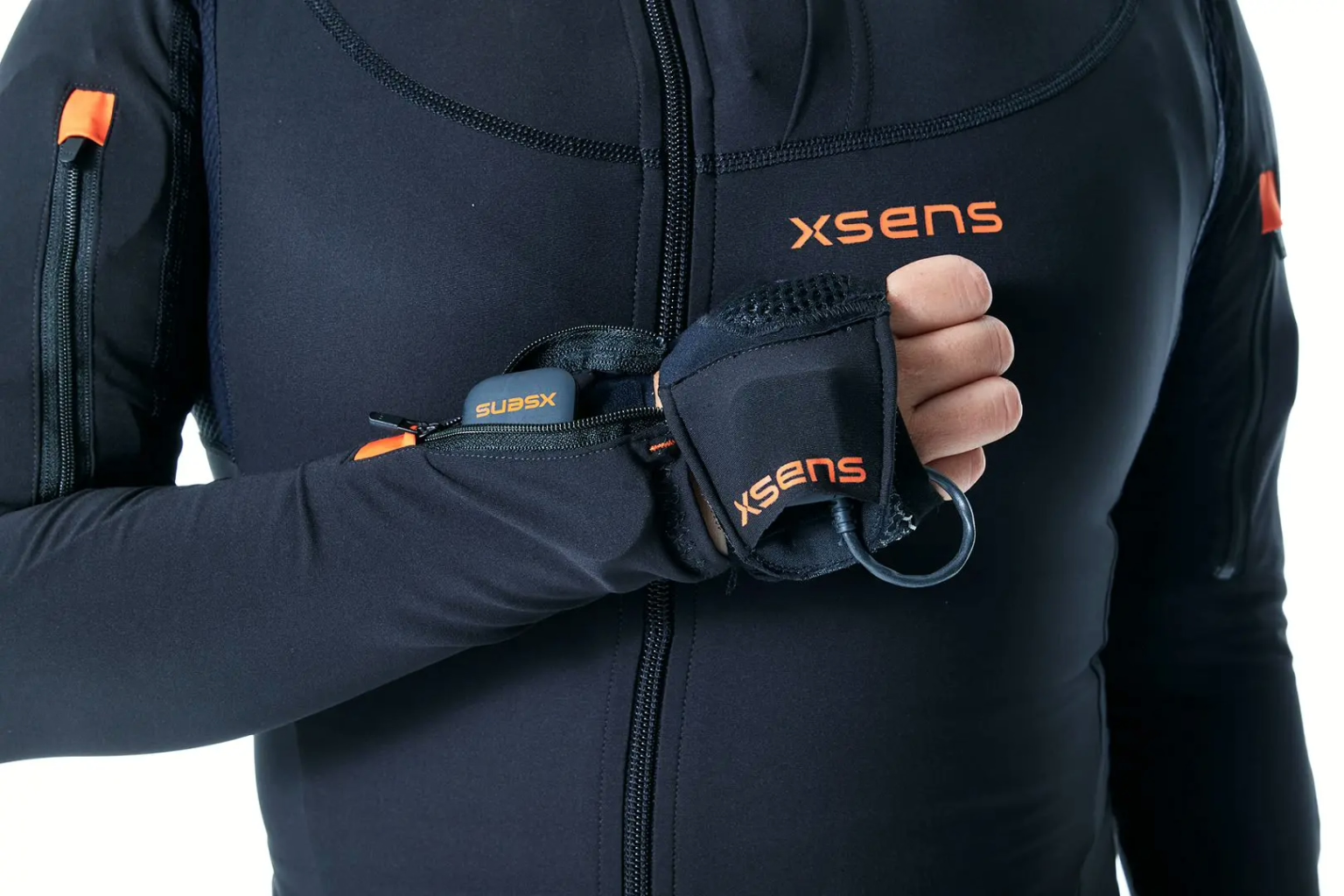
The practical value is in the ecological validity of the data. A motion capture suit worn during a live training session produces information that a lab-based assessment cannot replicate. Xsens, a leader in motion capture technology, has worked with Elitac Wearables on suit development for exactly this reason. Bringing high-fidelity inertial measurement into a wearable textile format requires solving for sensor placement, connector durability, cable routing under dynamic load, and firmware that processes IMU data at the speed and accuracy the application demands.
Pressure sensing is another high-value application in sports. The Danu Sports SmartSocks combine pressure and IMU sensors to track athletic performance and flag injury risk indicators in real time. Elitac Wearables provided hardware and firmware review, bug resolution, performance optimisation, and new feature implementation before market launch, and continues to provide full product management services. The engineering challenge with a smart sock is that the sensing system must survive repeated compression, washing, and the mechanical stress of athletic movement without degrading sensor accuracy over time.
Haptic feedback has emerging applications in sports coaching. Real-time vibrotactile cues can guide technique correction during movement, giving athletes immediate feedback without requiring them to look at a screen or pause their session. Building haptic systems that work reliably under sweat, movement, and physical contact requires actuator selection expertise and firmware precision that most sports technology teams do not have in-house.
Where does industrial safety benefit from smart fabric development?
Industrial safety benefits from smart fabric development primarily in worker monitoring, hazard detection, and ergonomic risk reduction. Smart textiles embedded in workwear can monitor physiological indicators such as heart rate and body temperature, detect exposure to hazardous conditions, or capture posture and movement data that identify injury-risk loading patterns before an incident occurs.
The engineering requirements for industrial safety wearables are distinct from other sectors. Garments must survive industrial washing cycles, exposure to chemicals, mechanical abrasion, and, in some environments, the requirements of ATEX certification for use in explosive atmospheres. These constraints directly affect every component choice, from the conductive yarn specification to the enclosure design for embedded electronics to the antenna placement for wireless communication.
Selecting the right electronics-textile integration technique is critical in this context. Conductive yarns, printed electronics, and modular electronics attachment each carry different trade-offs in terms of washability, flexibility, durability, and cost. A technique that works well in a sports garment may fail in an industrial workwear context after fifty industrial wash cycles. Development teams with over ten years of experience across washable, flexible, and body-worn contexts can navigate these trade-offs from the outset, rather than discovering them during validation.
The business case for smart workwear is strengthening as occupational health data becomes a regulatory and insurance priority. Organisations that can demonstrate continuous ergonomic monitoring and early intervention have a measurable argument for reduced injury rates and lower absence costs. The technology to deliver this exists. The challenge is building it into a garment that workers will actually wear consistently, which is ultimately a human factors problem as much as an engineering one.
What should organisations consider before choosing a smart textile development partner?
Before choosing a smart textile development partner, organisations should evaluate whether the partner has genuine multidisciplinary capability in-house, direct experience in the relevant sector and its certification requirements, and a development process that integrates regulatory and human factors considerations from the start rather than treating them as late-stage additions.
The most common and costly failure mode in smart textile development is fragmentation. When hardware expertise sits with one supplier, textile engineering with another, and firmware with a third, no single party owns the integration. Problems at the boundary between disciplines, which is where most wearable development problems live, fall between teams. Timelines extend, accountability blurs, and the client carries the coordination risk. A partner with all disciplines under one roof eliminates that structural weakness.
Sector-specific experience matters because the technical requirements of smart textile development vary significantly between healthcare, defence, sports, and industrial safety. MDR compliance shapes hardware and software documentation requirements in medical. Military certification imposes environmental and reliability standards in defence. ATEX requirements constrain component and enclosure choices in industrial settings. A development partner that has navigated these frameworks before will design for them from day one. One that has not will discover the requirements when the redesign is most expensive.
Organisations should also assess the partner’s approach to validation. Up to 70% of wearable prototypes never reach production, and the primary cause is validating too late. The right partner will push for early user testing, build demonstrators that are fit for validation rather than optimised for production, and help clients make informed decisions before committing to tooling costs that typically run between 100,000 and 500,000 euros. A partner that moves directly to production-ready prototypes without structured validation is compressing the timeline at the expense of the outcome.
Finally, consider the partner’s relationship with certification. Certification is not a process that happens after the product is built. It is a set of constraints that should shape every design decision from the first feasibility discussion. Partners with direct MDR, CE marking, ATEX, and military certification experience will build those requirements into the development process. Those without that experience will not, and the client will pay for the gap.
How Elitac Wearables helps with smart textile development
Elitac Wearables is a Netherlands-based end-to-end development partner for organisations building technically complex wearables in healthcare, defence, sports, and industrial safety. The team brings every discipline required for smart textile development under one roof, removing the fragmentation risk that derails most projects.
- Full in-house capability across hardware, firmware, textile integration, biosignal sensing, haptics, and human factors
- Over ten years of experience with electronics integrated into textiles across washable, flexible, and body-worn contexts
- Direct experience with MDR, CE marking, ATEX, and military certification requirements
- Proprietary TacOS firmware platform and a 180m² Wearables Lab for faster, lower-risk iteration
- Proven delivery across medical, defence, and sports sectors, including the BalanceBelt, Mission Navigation Belt, and Flight Sense System
- A “build for validation” approach that reduces wasted investment before production commitment
If your organisation is working on a smart textile challenge and needs a development partner with the depth to take it from concept to certified product, get in touch with the Elitac Wearables team to discuss your project.
Related Articles
- Why is haptic feedback important in wearable technology?
- How do haptic feedback wearables improve user experience?
- What is the future of haptic feedback wearable technology?
- What are the most common mistakes made in wearable product development?
- How do you choose the right hardware for a wearable device?