
Firmware is the invisible layer that makes a wearable device actually work. It sits between the physical hardware and any higher-level software, translating sensor readings into meaningful data, triggering actuators at the right moment, and managing power so the device lasts through a full day of use. For any organisation investing in custom wearable product development, firmware is not an afterthought — it is a core engineering discipline that shapes what the product can do, how reliably it does it, and how long the battery lasts. The questions below unpack exactly what firmware does, why it is so difficult to get right in wearables, and when to bring firmware engineering into your development process.
How does firmware connect hardware and software in a wearable?
Firmware is the embedded software that runs directly on a wearable’s microcontroller, acting as the essential bridge between physical hardware and any higher-level application or cloud system. Without firmware, the hardware has no instructions and the software has nothing to talk to. It is the layer that gives a wearable its behaviour.
In a wearable device, this bridge role is particularly demanding. The firmware must continuously read signals from sensors — accelerometers, gyroscopes, heart rate monitors, dry electrodes — interpret what those signals mean, and decide what to do with them. At the same time, it controls outputs: activating a haptic actuator, transmitting data over Bluetooth Low Energy, or writing to onboard storage.
Think of firmware as the operating logic of the device. It determines timing, priority, and communication protocols. When a sensor fires, the firmware decides whether that data is worth processing immediately, queuing for batch transmission, or discarding as noise. When a wireless connection drops, the firmware decides how to handle reconnection without losing data or draining the battery. These decisions happen thousands of times per second, invisibly, in real time.
In wearables specifically, the firmware also manages the relationship between the body and the device. A sensor reading on a stationary bench behaves differently from the same sensor on a moving limb. Firmware must account for motion artefacts, variable skin contact, and the unpredictable conditions of real-world use — something generic embedded software is rarely designed to handle.
What specific functions does firmware handle in a wearable device?
Firmware in a wearable handles sensor data acquisition, actuator control, power management, wireless communication, data storage, and real-time decision logic. These functions run concurrently on hardware with very limited processing resources, which makes wearable firmware engineering fundamentally different from standard software development.
Breaking this down into the functions that matter most for a wearable product:
- Sensor management: Configuring sampling rates, filtering raw signals, and handling sensor fusion when multiple data streams need to be combined into a single meaningful output.
- Haptic control: For devices with tactile feedback, firmware governs actuator timing, pattern sequencing, and intensity modulation. Whether the actuator is an ERM, LRA, or piezo element, the firmware defines the precise behaviour the user feels.
- Power state management: Switching between active, idle, and sleep modes based on activity, context, or scheduled intervals — one of the most consequential functions for battery life.
- Wireless communication: Managing BLE pairing, data packet structure, connection quality, and reconnection logic without introducing latency or data loss.
- Data integrity: Ensuring that sensor readings are timestamped correctly, stored reliably when a connection is unavailable, and transmitted without corruption when connectivity resumes.
- Error handling: Detecting and recovering from hardware faults, unexpected inputs, or edge cases that would otherwise cause the device to freeze or behave unpredictably in the field.
Each of these functions requires deliberate design decisions. The choices made at the firmware level directly determine whether the finished product feels responsive and reliable, or sluggish and inconsistent.
Why is firmware development particularly complex for wearables?
Firmware development is more complex in wearables than in most other embedded systems because the operating environment is fundamentally unpredictable. The device is worn on a moving human body, operates on a small battery, must maintain wireless connectivity, and often needs to meet medical or safety certification standards — all simultaneously, on hardware with constrained processing power.
Several factors compound this complexity in ways that catch development teams off guard.
The body changes everything
Sensors that perform cleanly on a test bench behave differently when strapped to a moving forearm or integrated into a textile that shifts with every step. Motion artefacts contaminate biosignal data. Skin conductance varies with sweat and temperature. Pressure on a sensor changes depending on how tightly a garment fits. Firmware must filter, compensate, and adapt to all of this in real time — and the filtering logic has to be developed and validated against actual body-worn data, not simulated inputs.
Resource constraints force hard trade-offs
A wearable microcontroller has a fraction of the memory and processing headroom available to a smartphone or laptop. Every firmware function competes for those resources. A more sophisticated haptic pattern requires more processing. Higher sensor sampling rates consume more power. Better wireless reliability means more frequent radio activity, which drains the battery faster. Firmware engineers must constantly balance capability against constraint — and the right balance is different for every product.
Certification requirements add another layer. For medical-grade wearables, firmware must meet documentation and validation standards that go well beyond typical embedded development. Every decision needs to be traceable, every edge case accounted for, and every update managed within a controlled process. This is not something a team can retrofit at the end of a project.
How does firmware affect battery life in wearable devices?
Firmware is the single biggest lever for battery life in a wearable device. The hardware sets the ceiling — the battery capacity, the efficiency of the components — but firmware determines how close to that ceiling the device actually gets. Poor firmware can cut effective battery life by 30 to 50 percent compared to a well-optimised implementation on identical hardware.
The mechanisms through which firmware affects battery life are specific and addressable:
- Sleep scheduling: A device that does not aggressively enter low-power sleep states between active periods wastes energy continuously. Firmware controls exactly when and how deeply the device sleeps.
- Sensor polling frequency: Sampling a sensor ten times per second versus once per second is a significant power difference. Firmware sets these rates and can adjust them dynamically based on context — for example, reducing sampling when the user is stationary.
- Radio duty cycle: Bluetooth transmission is one of the most power-hungry operations a wearable performs. Firmware controls how often the radio activates, how much data is sent per transmission, and whether the device can batch data to reduce radio-on time.
- Processing efficiency: Algorithms that run on the device rather than offloading to a phone or cloud consume local power. Firmware engineers must decide what to compute on-device, and optimise that computation to minimise cycles.
When battery life falls short late in development, the instinct is often to increase battery size. This triggers a cascade: a larger battery requires a larger enclosure, which means new tooling, a redesigned form factor, and weeks or months of delay. In most cases, structured firmware optimisation resolves the shortfall without any hardware change — and it is far less disruptive to address early than after the enclosure design is locked.
What happens when firmware needs to be updated after product launch?
After a wearable product launches, firmware updates are delivered over-the-air (OTA) via the device’s wireless connection. If OTA update capability is not built into the firmware architecture from the start, post-launch updates become extremely difficult or impossible to deploy without physically retrieving devices — which is impractical at any meaningful scale.
OTA firmware update capability is not a feature to add later; it is a foundational architectural decision. The firmware must include a bootloader that can receive a new firmware image, verify its integrity, and safely apply it without bricking the device if the update is interrupted. This requires careful design of memory partitioning, fallback logic, and update validation — none of which can be easily retrofitted into a firmware architecture that was not designed with it in mind.
Beyond the technical mechanism, post-launch firmware updates raise process questions that matter for regulated products. In medical-grade wearables, a firmware update may constitute a significant change that requires revalidation, updated documentation, and, in some cases, regulatory notification. Development teams that treat firmware as a living, updatable system from day one — with version control, release processes, and change management built in — are far better positioned to handle this than those that treat firmware as a one-time deliverable.
For products in safety, defence, or clinical environments, the ability to push a firmware fix or improvement to deployed devices is a genuine competitive advantage. It means a product can improve after launch, respond to field-discovered issues, and extend its useful life without hardware replacement.
When in the wearable development process should firmware work begin?
Firmware work should begin at the proof-of-concept stage, not after hardware is finalised. Treating firmware as something that follows hardware design is one of the most common and costly mistakes in wearable product development. The two disciplines are deeply interdependent, and decisions made in hardware directly constrain what firmware can achieve.
The practical reason is this: microcontroller selection, memory allocation, peripheral interfaces, and power architecture all have firmware implications. If a hardware engineer selects a microcontroller without input from the firmware team, the firmware team may inherit a platform that cannot support the required sampling rates, lacks the memory for the intended algorithms, or does not have the peripheral support needed for the chosen sensors. Unwinding these decisions later is expensive.
In a well-structured wearable development process, firmware engineers are involved from the feasibility check onward. They contribute to component selection, define the data architecture, and begin developing core modules — power management, communication stack, sensor drivers — in parallel with hardware design. By the time the first prototype is built, the firmware is not starting from zero; it is being integrated into known hardware with a clear functional specification.
Early firmware involvement also accelerates iteration. When hardware and firmware are developed in parallel, a bug discovered during user testing can be traced to its root cause — hardware, firmware, or their interaction — far more quickly than when firmware is layered onto finished hardware by a team that had no involvement in its design.
How Elitac Wearables helps with firmware in wearable product development
For organisations that need a development partner rather than a contractor, firmware expertise cannot be isolated from the rest of the product. It has to be embedded in the same team that designs the hardware, selects the actuators, integrates the textiles, and plans for certification.
That is exactly how Elitac Wearables approaches custom wearable product development. The firmware team works alongside hardware engineers, haptics specialists, and biosignal experts from the earliest feasibility stage — not brought in after the enclosure is designed. Elitac’s proprietary firmware platform, TacOS, provides a foundation of pre-validated modules covering power management, wireless communication, and haptic control, which reduces development time and de-risks the firmware architecture from the start.
What this means in practice for a buyer evaluating wearable product development services:
- Firmware decisions are made in context — informed by the hardware, the sensor set, the use environment, and the certification pathway, all within one team
- Battery life is addressed as a system-level challenge from day one, not a problem to solve after launch
- OTA update capability and post-launch firmware management are built into the architecture, not retrofitted
- For medical or regulated products, firmware validation and documentation are handled as part of the development process, not as a separate workstream
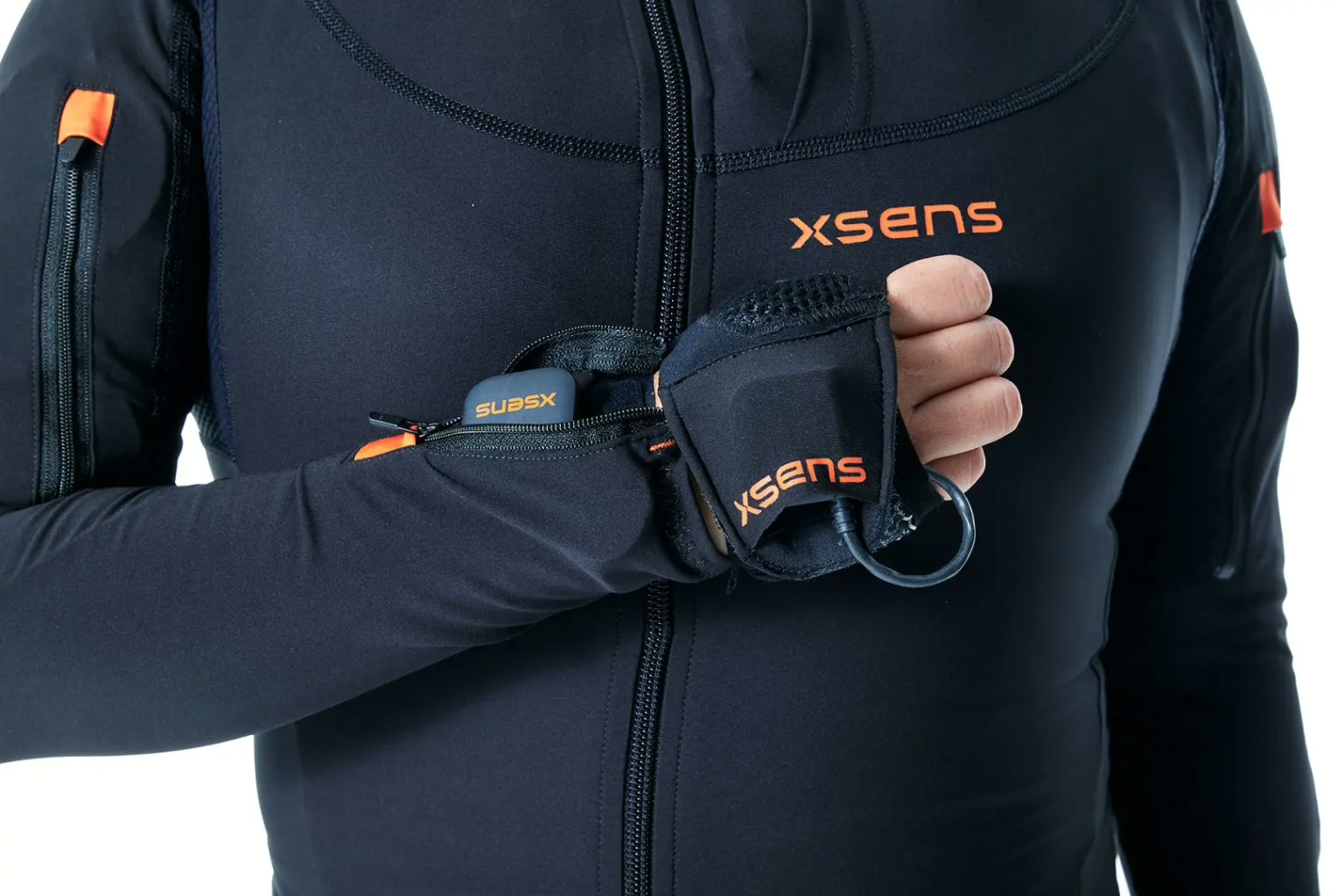
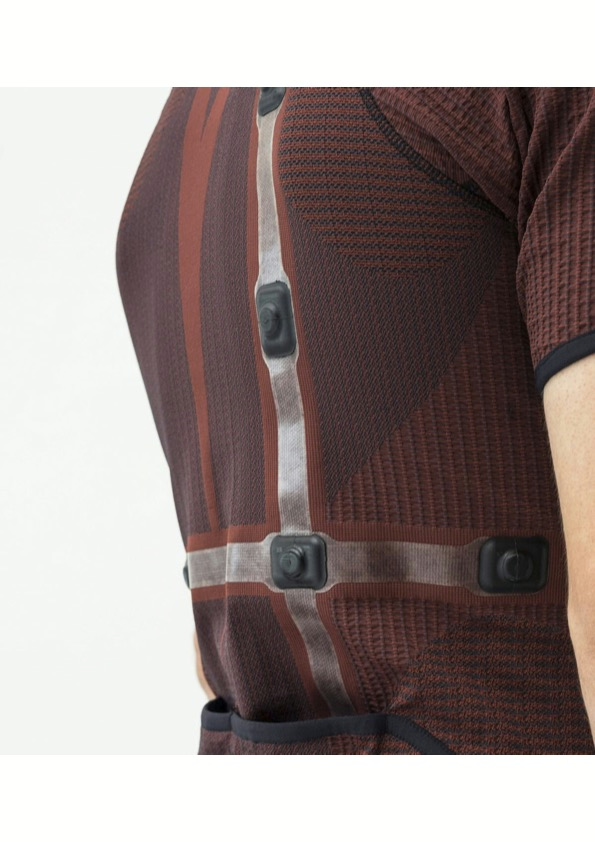
- The Mission Navigation Belt for the Royal Netherlands Army and the motion capture suit that works with Xsens are examples of products where firmware complexity was central to the outcome — not peripheral to it
If your organisation is working through a wearable development challenge where firmware is becoming a bottleneck — or where you want to avoid it becoming one — get in touch with Elitac Wearables to discuss where your project stands and what the right next step looks like.
Related Articles
- What is the future of military wearable technology?
- How do haptic feedback wearables support accessibility needs?
- How do you reduce time-to-market in wearable product development?
- How do you structure a wearable product development team for a complex, multi-market launch?
- What is the difference between a prototype and an MVP in wearable development?