
The most effective way to reduce time-to-market in wearable product development is to eliminate handoffs. Every time a hardware specification leaves one team and lands with another – a separate firmware house, a textile supplier, a certification consultant – you lose weeks to ramp-up, misalignment, and rework. Organisations that keep all disciplines under one roof, or partner with someone who does, consistently move faster and with fewer costly surprises. The sections below address the specific questions that determine how quickly a wearable reaches market, from prototyping infrastructure to certification timing.
What actually slows down wearable product development?
The most common cause of delay in wearable product development is fragmented expertise across multiple suppliers. When hardware, firmware, textiles, and human factors are handled by separate teams with no unified accountability, integration failures accumulate silently until they surface as expensive rework late in the cycle. Coordination overhead alone can consume months that look, on paper, like productive development time.
Beyond fragmentation, the following factors consistently extend timelines in custom wearable product development:
- Late-stage certification decisions. Teams that treat regulatory compliance as a final step discover that their hardware or material choices are incompatible with certification requirements, forcing redesigns at the worst possible moment.
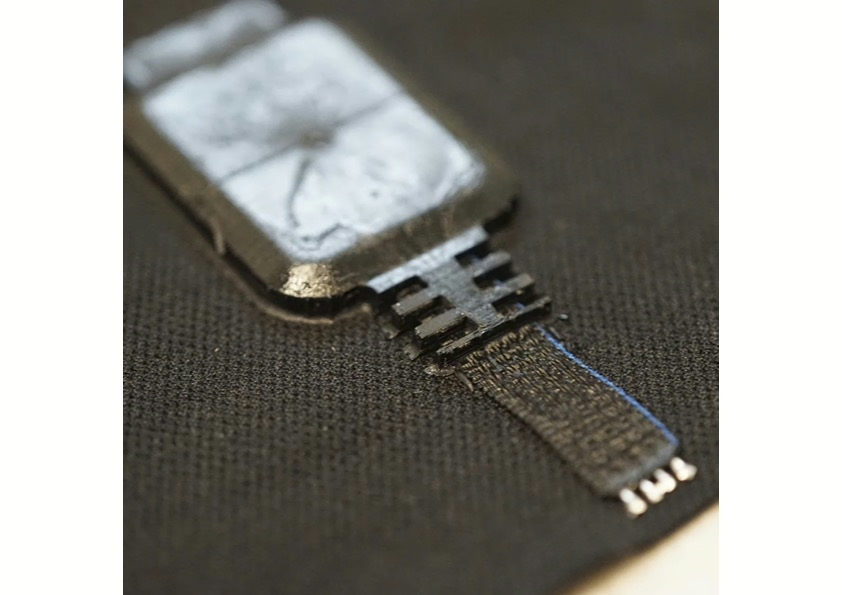
- Underestimating electronics-textile integration. Embedding electronics into a garment that must flex, wash, and survive real-world wear is not a manufacturing problem – it is a multi-disciplinary engineering challenge. Teams that approach it as the former lose significant time.
- Inadequate prototyping infrastructure. Outsourcing every physical iteration adds lead time and communication overhead. Each round-trip to an external prototyping supplier costs days that compound across a development cycle.
- Scope changes driven by poor early validation. When proof-of-concept work is rushed or skipped, assumptions about user behaviour, comfort, and performance go untested until the prototype stage – where changing them is far more expensive.
- Component selection mismatches. Choosing sensors or actuators that are technically capable in isolation but poorly matched to the wearable’s power budget, form factor, or usage pattern forces iteration that could have been avoided with deeper upfront expertise.
The underlying pattern is that wearable development delays are rarely caused by a single technical failure. They are caused by the cumulative effect of decisions made without full visibility of the system. A team that sees only hardware misses the firmware implications. A team that sees only textiles misses the electronics integration challenge. Speed requires the whole picture.
How does in-house prototyping capability affect development speed?
In-house prototyping capability directly compresses iteration cycles by removing the lead time, communication overhead, and dependency risk associated with external suppliers. When a team can build, test, and modify a physical prototype in the same building where the engineering decisions are made, the feedback loop shrinks from weeks to days. For wearable product development, where each iteration typically involves coordinating hardware, textiles, and firmware simultaneously, this compression is significant.
The practical difference becomes most visible at the proof-of-concept and pilot sample stages. A feasibility check that would take six to eight weeks when coordinated across external partners can be completed in one to four weeks when prototyping tools – 3D printers, laser cutters, sewing equipment, and software testing rigs – are immediately accessible. That difference is not marginal. It determines whether a project retains momentum or stalls while waiting for external capacity.
In-house capability also changes the quality of decisions. When a design engineer can hold a physical version of their concept within 48 hours of a specification change, they make better decisions. They feel the weight, test the fit, and assess the integration in a way that a CAD file or a supplier’s email cannot replicate. For wearables specifically – where comfort, wearability, and sensor placement interact in ways that are difficult to model – this tactile feedback loop is not a luxury. It is a core part of getting the product right.
The risk reduction argument is equally important for buyers evaluating wearable prototyping and production services. External prototyping introduces a dependency that can collapse a project timeline if a supplier is delayed, unavailable, or simply misunderstands the brief. In-house capability eliminates that single point of failure.
What’s the difference between a development partner and a contract manufacturer for wearables?
A development partner and a contract manufacturer serve fundamentally different roles in the wearable product lifecycle. A contract manufacturer executes a defined specification – they produce what you hand them. A development partner helps you arrive at the right specification in the first place, then supports you through every stage from concept to a certified product. For organisations without deep in-house wearable engineering expertise, the distinction determines whether a project succeeds or stalls.
Contract manufacturers are the right choice when the design is finalised, validated, and ready for volume production. They optimise for cost-per-unit, repeatability, and throughput. They are not structured to solve engineering problems, navigate certification requirements, or iterate on a design that is still evolving. Handing an immature wearable design to a contract manufacturer is one of the most reliable ways to generate expensive, time-consuming problems.
A development partner, by contrast, contributes expertise at every stage where decisions have downstream consequences. This includes:
- Evaluating technical feasibility before significant investment is committed
- Selecting components – sensors, actuators, microcontrollers – that are matched to the wearable’s real-world operating conditions
- Designing electronics-textile integration that survives the wash, flex, and wear cycles the product will face
- Building and testing prototypes iteratively with end users
- Structuring the development process to satisfy certification requirements from the outset, rather than retrofitting compliance at the end
For biometric wearable product development in particular – where the device may need to meet MDR requirements for medical use, or perform reliably in high-movement conditions – a development partner’s multi-disciplinary capability is not optional. The integration challenges between biosignal sensing, textile substrate, firmware, and regulatory compliance are too interconnected for a single-discipline supplier to navigate effectively.
The practical implication for buyers: if your wearable concept is not yet fully specified and validated, a contract manufacturer will not help you get there. A development partner will.
How does cross-disciplinary expertise reduce wearable iteration cycles?
Cross-disciplinary expertise reduces wearable iteration cycles by catching integration failures before they become physical prototypes. When hardware engineers, firmware developers, textile specialists, and human factors experts collaborate from the earliest stages of a project, the decisions each discipline makes are immediately tested against the constraints of the others. Problems that would otherwise surface during prototype testing are resolved on paper – or in a shared design session – at a fraction of the cost and time.
Consider a concrete example: a team designing a wearable ECG garment for high-movement conditions. A hardware-only team might select high-performance wet electrodes and design the electronics around them. A textile specialist reviewing the same brief would immediately flag that wet electrodes are impractical for a garment worn during sport, and that the integration technique required for dry electrodes changes the PCB layout. A firmware engineer would add that the motion artefact challenge in high-movement EMG or ECG requires specific signal processing decisions that affect both hardware selection and power budget. None of these teams is wrong in isolation – but without the others in the room, each makes decisions that the next team has to undo.
The iteration cycle cost in wearable development is not just time – it is also the accumulated knowledge loss that happens when a revised brief moves between teams. Each handoff requires re-explanation, re-alignment, and re-validation. Cross-disciplinary teams working on the same project, in the same environment, eliminate this overhead. Decisions compound forward rather than cycling back.
For organisations evaluating custom wearable product development partners, the practical question to ask is not “do you have all these disciplines?” but “do they work together from day one?” A supplier that coordinates sub-contractors across disciplines still carries the coordination overhead and knowledge loss risk. The speed advantage comes from genuine integration, not just a broad capability list.
When should wearable development begin addressing certification?
Certification should be addressed from the first day of wearable product development, not as a final step before market launch. For medical wearables subject to MDR (Medical Device Regulation), ATEX-rated industrial devices, or military-grade equipment, the certification requirements directly constrain hardware choices, material selection, and testing protocols. Discovering those constraints after the design is finalised forces redesigns that are among the most expensive and time-consuming events in a development programme.
The practical implication is that the classification of the device – Class I or Class II medical, hazardous environment, consumer – should be determined during feasibility, before any component selection or textile integration decisions are made. That classification then shapes every subsequent engineering decision.
For MDR compliance specifically, the documentation burden begins accumulating from the earliest development stages. Clinical evaluation, risk management files, and technical documentation are not documents you write at the end – they are records of decisions made throughout development. A team that builds without this framework in place will spend significant time reconstructing the rationale for decisions that were made months earlier, often with incomplete records.
The cost difference is substantial. Certification costs for a standard wearable are manageable when integrated into the development process. Retrofitting compliance onto a finished design – particularly for Class II medical devices or ATEX-rated products – can add costs that dwarf the original development budget. The earlier certification requirements are treated as engineering constraints rather than administrative tasks, the less disruptive and expensive they become.
Which development stage offers the most time savings in wearables?
The proof-of-concept stage offers the greatest potential for time savings in wearable product development. Decisions made at PoC level – component selection, integration approach, firmware architecture, form factor direction – cascade through every subsequent phase. Getting them right early, with genuine multi-disciplinary input, eliminates the rework that accounts for a disproportionate share of total development time in most wearable programmes.
The reason is structural. A wearable development cycle typically runs from feasibility through proof of concept, pilot samples, final prototypes, first series, and scaled production. The cost and time required to change a decision grows at each stage. A component substitution at PoC might take a day. The same substitution at the final prototype stage – where PCB layouts, firmware, textile integration, and user testing protocols are built around the original choice – can take months.
Investing in a thorough, well-resourced PoC phase also has a secondary benefit: it produces the evidence base that de-risks every subsequent stage. A PoC that has been tested against real user behaviour, validated for power consumption, and confirmed as manufacturable in the chosen textile substrate gives the development team a solid foundation. A PoC that was rushed to meet a deadline gives them a false one.
For organisations that already have a PoC or early prototype when they engage a development partner, the time savings shift downstream – specifically to the transition between prototype and first series. This is the stage where wearable projects most commonly stall, as reliability gaps, certification gaps, and production scalability issues surface simultaneously. A partner with in-house production capability and certification experience can compress this transition significantly, because the same team that built the prototype understands exactly what needs to change for it to become a manufacturable, compliant product.
The short answer for buyers: do not economise on the proof-of-concept stage, and do not underestimate the complexity of the prototype-to-production transition. Those are where time is most often lost – and most reliably saved.
How Elitac Wearables helps reduce time-to-market
Elitac Wearables is structured specifically to eliminate the delays described throughout this article. As a full end-to-end wearable development partner based in Utrecht, the team brings hardware, firmware, textile integration, biosignal sensing, haptics, and human factors expertise under one roof – with no handoffs between suppliers and no knowledge gaps between disciplines. For CTOs, heads of product, and R&D directors who need a wearable to reach market without the delays that come from fragmented development, this structure is the practical difference between a project that moves and one that stalls.
Specifically, working with Elitac Wearables means:
- Faster iteration through an in-house 180m² Wearables Lab equipped with 3D printers, laser cutters, and permanent software testing set-ups – no waiting on external prototyping suppliers
- Reduced rework through multi-disciplinary collaboration from the first day of feasibility, catching integration conflicts before they become physical prototypes
- Certification integrated from the start, with experience across MDR Class I and II, CE marking, ATEX, and military requirements – so compliance never becomes a late-stage redesign trigger
- Proprietary TacOS firmware platform and proven wearable development building blocks that compress the PoC and pilot sample phases without sacrificing reliability
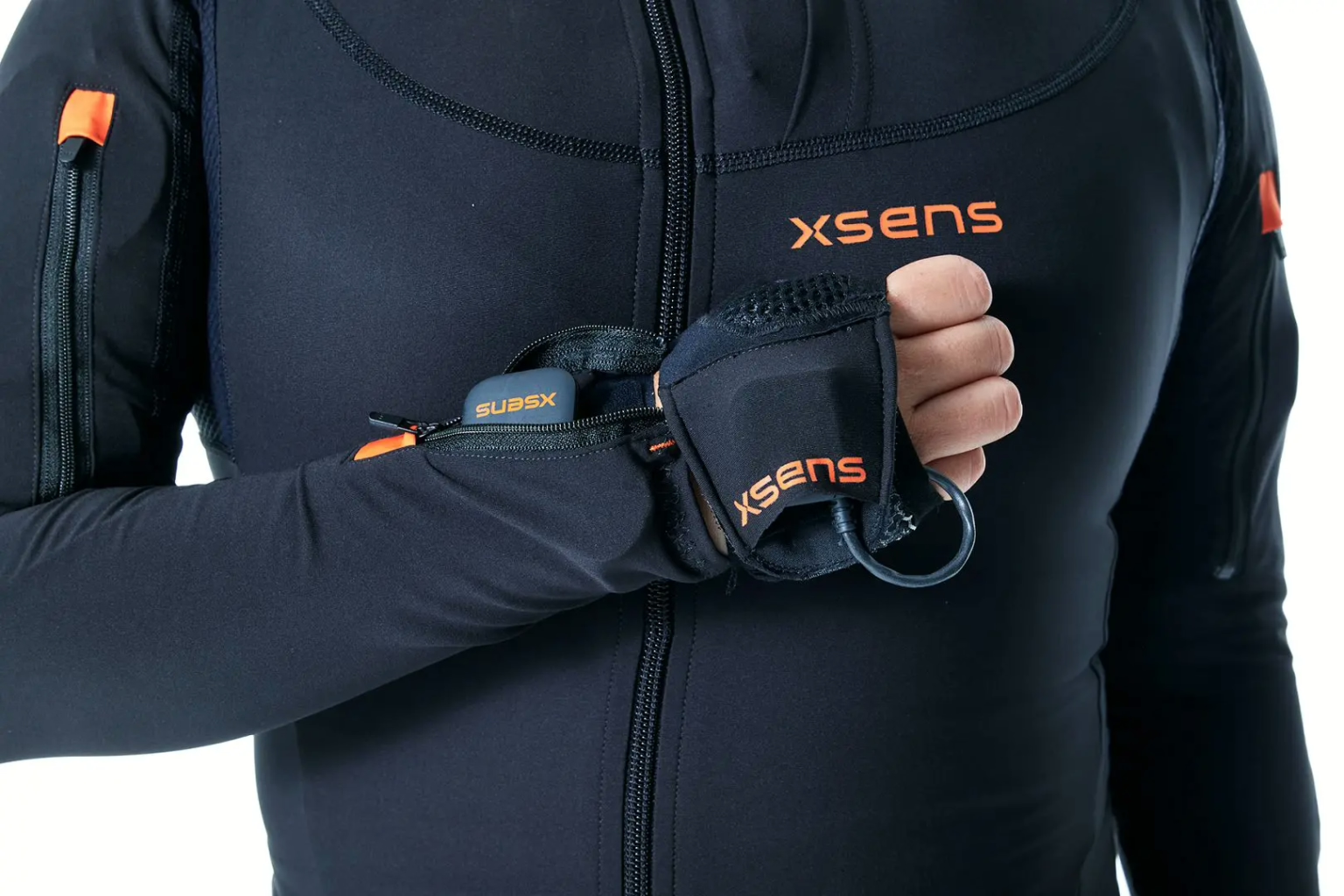
- Over a decade of cross-sector experience in medical, defence, sports, and industrial wearables – including the Mission Navigation Belt for the Royal Netherlands Army and motion capture suit development for Xsens – so your project benefits from patterns already learned on complex programmes
If your wearable project is at any stage – from early concept to a prototype that is not yet production-ready – and you need a technically rigorous partner who can take it forward without the delays that come from working across multiple suppliers, contact Elitac Wearables to discuss your development challenge.
Related Articles
- What are the cybersecurity risks of military wearables?
- What are the biggest challenges in developing military wearables?
- What are the latest haptic feedback wearable technologies in 2026?
- How do you build a wearable product business case that gets board-level buy-in?
- How do you protect your IP during wearable product development?