

Haptic feedback wearables in 2026 do far more than buzz. They deliver directional, coded and increasingly realistic touch signals across medical, defence, sports, industrial and VR applications. The biggest changes: a wider range of actuators, better textile integration, and feedback that adapts to real-time sensor data.
In short:
- Multi-actuator garments have replaced single vibration motors.
- Beyond ERM, LRA and piezo, wideband, electrotactile, pneumatic and microfluidic actuators are gaining ground.
- Sensors and smart algorithms make feedback adaptive instead of fixed.
- The hard part is still the system: firmware, power, textiles and user testing.
How has haptic feedback wearable technology evolved?
Ten years ago, most haptic wearables used one vibration motor that produced a generic buzz. Today, garments, belts and vests carry arrays of actuators that are each controlled separately. They can signal direction, intensity and rhythm-coded messages.
A good example is Elitac’s Mission Navigation Belt. Developed with the Dutch Ministry of Defence and field-tested by Dutch and German forces, it guides soldiers with vibration patterns around the waist, keeping eyes and hands free.
Textile integration is the other big step. Better conductive yarns, printed electronics and modular attachment methods now let haptic systems survive sweat, movement and washing.
What types of haptic actuators are used in modern wearables?
Most wearables still use vibration, but the choice of actuators is wider than ever. The right one depends on the sensation you need, body location, power budget and form factor.
ERM motors
Eccentric rotating mass motors spin an off-centre weight. They are cheap and easy to feel, but slow to start and stop, and frequency and strength cannot be set separately. Fine for simple alerts, less suited to precise patterns.
LRA actuators
Linear resonant actuators move a mass back and forth at one resonant frequency. They respond faster and feel crisper than ERMs, which helps users tell different signals apart. Firmware must keep them on resonance as conditions change.
Voice-coil (wideband) actuators
Voice-coil actuators work like a small loudspeaker. They cover a wide frequency range, so they can render impacts, textures and richer effects. They are larger and use more power than LRAs.
Piezoelectric actuators
Piezo actuators are thin, silent and very fast, with fine control. They need high drive voltages and more complex electronics, which adds cost.
Electrotactile and electrical muscle stimulation
Small currents through skin electrodes create touch or tingling sensations (electrotactile, similar to TENS) or make muscles contract (EMS) to suggest force or resistance. They are thin and have no moving parts, but sensations vary from person to person and depend on good skin contact.
Pneumatic, hydraulic and microfluidic actuators
Air or fluid-filled chambers create squeeze, pressure and force. Pneumatics suit soft textiles; hydraulics deliver stronger forces; microfluidics press tiny points of the skin for high-resolution fingertip touch. All need pumps or valves, which adds size and complexity.
Thermal elements
Peltier elements and heaters add warm and cold sensations. Promising, but still early in wearables because of power use and slow response.
Which industries are adopting haptic wearables in 2026?
Haptic wearables are used wherever people need information without looking or listening:
- Medical and rehabilitation: balance support, rehabilitation and posture training. The BalanceBelt, a Class 1 medical device, uses vibration to help people with balance disorders move more confidently in daily life.
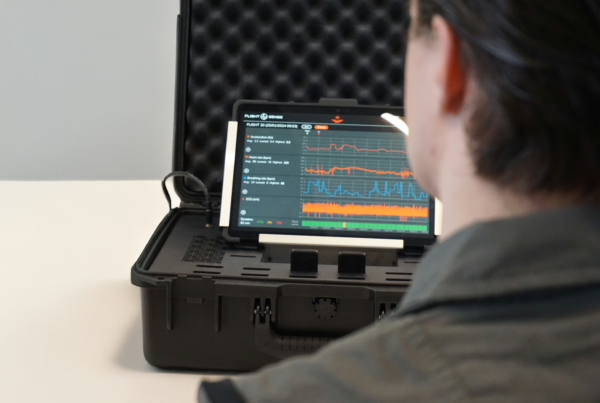
- Defence and aviation: silent navigation, situational awareness and orientation cues. Elitac works with CML (Center for Man and Aviation) and TNO on haptic feedback for pilots in flight-simulator training, for moments when vision drops away in blackout and whiteout situations.
- Mobility: tactile cues for drivers under high workload, as in the Sentaz tactile navigation car seat for emergency services.
- Sports and motion: real-time technique feedback, often combined with motion data from IMU sensors.
- Industrial safety: proximity alerts, posture correction and hazard warnings in smart PPE, especially where noise masks audio alarms.
- VR and XR training: haptic gloves, vests and suits that add touch to simulation. Read more in How do haptic wearables enhance virtual reality experiences?
What’s the difference between tactile and kinaesthetic haptic feedback?
Tactile feedback stimulates the skin: vibration, pressure, texture. Kinaesthetic feedback acts on muscles, joints and tendons: force, resistance, movement.
Most body-worn haptics are tactile, because compact, low-power actuators fit easily in a garment. Kinaesthetic feedback needs mechanisms that push back on the body, such as cables, brakes, pneumatics or exoskeletons. It is no longer research only: force-feedback gloves are commercially available for VR training. But it remains far more complex, so decide early which type your product needs.
How do haptic wearables use sensors and AI?
Sensors such as IMUs and biosignal electrodes (ECG, EMG) feed data to embedded algorithms. These decide when to trigger, change or suppress a haptic cue, based on the wearer’s movement, state or environment.
That allows personalisation. A rehabilitation device can adjust feedback strength to a patient’s progress; a sports wearable can hold back cues during intense efforts. Timing matters: for cues linked to a movement or contact, delays of even tens of milliseconds can make feedback feel disconnected.
Design the sensor, processing and haptic layers as one system from the start. Adding haptics to an existing sensor platform later often causes latency and power problems.
What are the main challenges in developing haptic feedback wearables?
- Actuator choice and placement: a datasheet does not tell you how an actuator feels on a moving body. Skin sensitivity differs strongly per body location.
- Textile integration: connections, cables and components must survive bending, moisture and washing.
- Firmware and timing: actuators, sensors and power states must be managed together without adding delay. Platforms like Elitac’s TacOS are built for this.
- Power: actuators are power-hungry. Treat battery life as a system requirement from day one. See also the battery impact of haptic feedback.
- Pattern design and user testing: signals only work if users understand them under real conditions, with movement, noise and stress.
- Safety and certification: especially for electrical stimulation and medical use (MDR).
How Elitac Wearables helps with haptic feedback wearable development
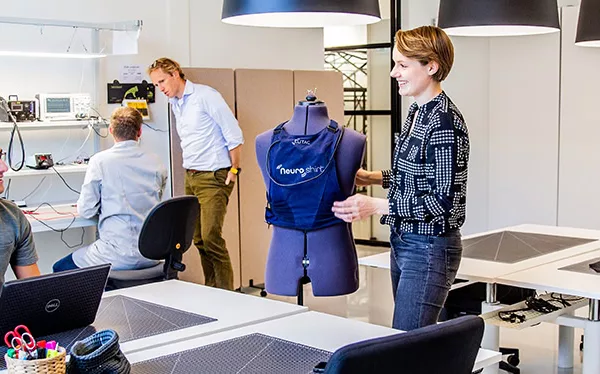
Elitac Wearables has developed haptic wearables for more than ten years, from navigation belts and medical devices to garments for motion capture. Examples include the Mission Navigation Belt, the BalanceBelt, a haptic feedback sleeve, haptic feedback research for pilot training with CML and TNO, and garment development for the Xsens Link motion capture suit.
What we bring:
- Actuator selection and haptic system design
- Haptic pattern design and firmware on our TacOS platform
- Electronics-textile integration for washable, body-worn products
- Sensor and biosignal integration for adaptive feedback
- Human factors and end-user testing
- Certification guidance (MDR, CE) from the first design phase
See our haptic feedback wearables services, or contact us to discuss your project.
Related Articles
- Can military wearables predict health emergencies before they happen?
- How accurate is haptic feedback in wearable devices?
- How do haptic wearables differ from force feedback devices?
- How do haptic feedback wearables support remote collaboration?
- What should a Head of Product demand from a wearable development partner at each project milestone?