Wearables support soldier situational awareness by delivering real-time information through multiple sensory channels, reducing the need for screens, radio calls, or hand signals in high-pressure environments. By combining haptic feedback, biosignal monitoring, and movement sensing, military wearables keep soldiers informed without drawing attention or interrupting focus. The sections below unpack the specific technologies, challenges, and development methods behind these systems.
What types of wearable technology are used by soldiers?
Military wearables span several distinct categories, each addressing a different layer of soldier situational awareness. The core types include haptic feedback devices, biosignal monitoring wearables, movement and positioning sensors, and smart textile systems that integrate electronics directly into clothing or load-bearing equipment. Each serves a specific operational purpose, and the most capable systems combine several of these functions in a single, ruggedised platform.
The most operationally mature category is navigation and communication wearables. These devices translate GPS data or command signals into physical cues, allowing soldiers to receive directional guidance without looking at a screen or listening for audio instructions. The Mission Navigation Belt, developed in collaboration with the Dutch Ministry of Defence, is a direct example: a haptic belt that delivers silent, hands-free navigation to infantry soldiers in the field.
Beyond navigation, defence organisations are increasingly deploying physiological monitoring wearables that track heart rate, heart rate variability, respiration, and stress indicators. These systems give commanders and medical personnel early visibility into soldier fatigue, heat stress, or injury, before the soldiers themselves may recognise the warning signs. Movement sensors, typically based on IMU (inertial measurement unit) technology, add another layer by tracking posture, gait, and physical load across a mission.
Smart textiles represent the frontier of military wearable development. Rather than attaching a device to the body, electronics are embedded directly into the fabric of uniforms or vests using conductive yarns or printed electronics. This approach reduces bulk, improves comfort during extended operations, and makes the technology far harder to detect or lose.
How does haptic feedback improve soldier navigation?
Haptic feedback improves soldier navigation by delivering directional cues through vibration patterns felt directly on the body, keeping eyes, ears, and hands entirely free. Instead of consulting a map, screen, or radio, a soldier receives a tactile signal at a specific point on the torso or wrist that communicates direction, distance, or a command, without producing any sound or visible light.
The operational advantage is significant. In combat or covert movement scenarios, any audio or visual output creates risk. Haptic signals are silent, invisible, and immediate. A soldier wearing a haptic navigation belt can receive a “turn left” instruction mid-movement without breaking stride, raising a hand, or making eye contact with a team member. This keeps the unit coordinated while reducing the cognitive cost of staying oriented.
How haptic navigation signals are designed
Effective haptic navigation relies on carefully designed vibration patterns rather than simple on/off pulses. The direction, duration, intensity, and sequence of vibrations all carry meaning. A sustained vibration on the left side of the torso might indicate a left turn, while a rapid pulse at the front signals a waypoint ahead. Designing these patterns requires a deep understanding of how the human body perceives tactile stimulation under physical and psychological stress, which is quite different from how it responds in a calm lab setting.
Actuator selection for military haptics
The type of actuator used in a military haptic device directly affects its reliability and effectiveness. ERM (Eccentric Rotating Mass) actuators are common in consumer devices but can lack the precision needed for directional military signals. LRA (Linear Resonant Actuator) and piezo actuators offer sharper, more controllable feedback, which is critical when a soldier needs to distinguish between multiple simultaneous signals. Selecting the right actuator for body-worn military use requires balancing signal clarity, power consumption, durability, and resistance to environmental conditions.
What sensors are built into military wearables?
Military wearables typically integrate several sensor types to support both individual soldier performance and unit-level situational awareness. The most common include IMUs for movement and positioning, ECG and heart rate sensors for physiological monitoring, temperature sensors for heat stress detection, and GPS receivers for location tracking. Advanced systems add respiration monitoring, EDA (electrodermal activity) for stress detection, and EMG sensors for muscle load assessment.
IMUs are foundational to most military wearables. An IMU combines accelerometers and gyroscopes to track orientation, movement speed, and direction with high precision. In navigation wearables, IMU data supplements GPS signals, which can be unreliable in urban environments, underground, or under dense tree cover. The combination of GPS and IMU, known as sensor fusion, provides continuous positioning even when satellite signals drop.
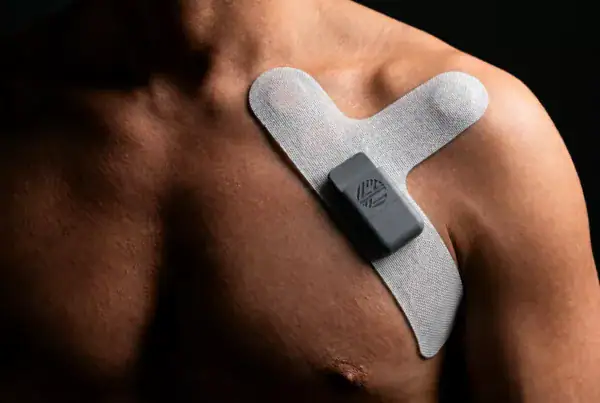
Physiological sensors introduce a different layer of capability. ECG sensors embedded in a chest strap or smart textile can monitor a soldier’s cardiac rhythm continuously, flagging arrhythmias or stress responses that might indicate fatigue or injury. Respiration sensors track breathing rate, which is a reliable early indicator of physical overload. Together, these signals give commanders real-time visibility into the physical state of their unit without requiring soldiers to self-report.
One of the most significant technical challenges in military sensor wearables is motion artefact: the interference that physical movement introduces into biosignal readings. A soldier running over rough terrain generates enormous amounts of electrical noise that can corrupt ECG or EMG data. Addressing this requires specialised dry electrode design, signal processing algorithms, and careful placement of sensors relative to the body’s movement patterns.
How do wearables reduce cognitive overload in combat situations?
Wearables reduce cognitive overload in combat by shifting information delivery from active, attention-demanding channels to passive, ambient ones. Instead of requiring a soldier to look at a screen, listen for a radio call, or interpret a hand signal, a well-designed wearable delivers the same information through a tactile or physiological channel that can be processed without diverting conscious attention from the immediate environment.
Cognitive overload is one of the most serious performance risks in high-stakes operations. When a soldier is simultaneously managing terrain, threat assessment, team coordination, and mission objectives, adding another screen or audio device to the mix creates genuine danger. Every second spent checking a device is a second not spent watching the environment. Wearables address this by moving information closer to the body and further from the conscious processing pipeline.
Haptic navigation is the clearest example. A directional vibration felt at the hip requires almost no cognitive processing: the body responds to it the way it responds to a tap on the shoulder, instinctively and immediately. Compare this to reading a map coordinate or interpreting a spoken instruction under fire, and the cognitive cost difference becomes obvious.
Physiological monitoring wearables contribute to cognitive load reduction from a different angle. By continuously tracking stress and fatigue markers, these systems can alert commanders when a soldier is approaching physical limits, enabling better decision-making about rotation, rest, and task allocation before performance degrades. This removes the burden of self-assessment from the soldier and distributes it to a system better positioned to be objective.
What are the biggest technical challenges in developing military wearables?
The biggest technical challenges in developing military wearables are ruggedisation, reliable biosignal acquisition under high-movement conditions, power management in the field, and integration of electronics into textile systems that must withstand operational stress. Military environments expose wearables to extremes of temperature, moisture, impact, and electromagnetic interference that standard consumer or medical devices are not built to handle.
Ruggedisation and environmental resilience
A wearable that works in a laboratory or clinical setting will often fail in the field within hours. Military wearables must maintain functionality across wide temperature ranges, resist water and dust ingress to relevant IP ratings, survive physical impact, and continue operating after repeated washing or chemical decontamination. Achieving this while keeping the device lightweight, comfortable, and unobtrusive is genuinely difficult. Every component choice, from the actuator to the connector to the enclosure material, must be evaluated against operational conditions rather than ideal ones.
Power management over extended missions
Battery life is a critical constraint in military wearable design. A device that requires charging every eight hours is operationally useless on a multi-day mission. Extending battery life without increasing device size requires a system-level approach: optimising firmware to prevent components from staying active longer than necessary, tuning sensor and radio duty cycles to match actual usage patterns, and making hardware component choices that align with real-world power budgets. Increasing battery capacity alone rarely solves the problem and typically triggers a cascade of redesign consequences.
Signal integrity in high-movement environments
Acquiring clean biosignal data from a soldier moving at speed, under load, and under stress is one of the hardest problems in military wearable engineering. Dry electrodes, which are essential for comfort and practical use without gel or preparation, are more susceptible to motion artefacts than wet electrodes. Solving this requires a combination of electrode material selection, placement optimisation, and signal processing algorithms designed specifically for high-movement conditions, not adapted from clinical protocols.
How are military wearables developed and tested for field use?
Military wearables are developed through a structured, iterative process that moves from feasibility assessment through proof of concept, prototype development, user testing in simulated field conditions, and ultimately certification and first-series production. Field testing is integrated throughout, not reserved for the end, because assumptions about how soldiers will interact with a device in a controlled setting rarely survive contact with real operational conditions.
Early-stage development focuses on validating core technical assumptions before significant investment is committed. Can the haptic signal be reliably felt through body armour? Does the biosensor maintain signal quality during a 10km run with full kit? Does the enclosure survive a drop onto hard ground? These questions need answers at the prototype stage, not during production tooling.
User testing with actual soldiers is irreplaceable. Military wearables must work for people under physical and psychological stress, wearing gloves, in low light, and with limited time to learn or adjust. Feedback from field users routinely surfaces comfort issues, interaction problems, and failure modes that no engineering team would predict from a desk. Building this feedback into iterative development cycles is what separates a functional prototype from a device that soldiers will actually use and trust.
Certification for military use adds another layer of complexity. Devices must meet relevant standards for electromagnetic compatibility, environmental resilience, and in some cases interoperability with existing defence communication and navigation infrastructure. Engaging with certification requirements from the earliest design stages, rather than treating them as a final hurdle, is the most reliable way to avoid costly late-stage redesigns.
How Elitac Wearables helps with soldier situational awareness
Developing military wearables that genuinely work in the field requires more than good intentions. It demands deep expertise across haptics, biosignal sensing, embedded hardware, firmware, and textile integration, all under one roof and accountable to a single outcome. That is exactly where Elitac Wearables operates.
The Mission Navigation Belt, developed in close collaboration with the Dutch Ministry of Defence and first delivered to the Royal Netherlands Army in 2020, is the most direct evidence of what this looks like in practice. It is a haptic feedback belt that delivers silent, screen-free navigation to soldiers, keeping hands, eyes, and ears free, built from the ground up for operational conditions rather than adapted from a consumer product.
For organisations developing tactical wearable devices or defence-grade biosignal monitoring systems, Elitac Wearables provides end-to-end development capability across every stage:
- Haptic system design, including actuator selection, vibration pattern engineering, and firmware-level timing
- Biosignal sensing for military and extreme-environment use, including dry electrode ECG, respiration, and IMU-based movement tracking
- Electronics-textile integration for systems that must be embedded in uniforms, vests, or load-bearing equipment
- Battery and power management optimisation designed for extended field use without increasing device size
- Certification support for military and defence standards, engaged from the earliest design decisions
- Field-realistic user testing integrated throughout the development cycle, not bolted on at the end
If you are working on a military wearable project and need a development partner with proven defence experience and every technical discipline in-house, get in touch with the Elitac Wearables team to discuss your requirements.
Related Articles
- How do military wearables differ across army, navy, and air force?
- How do smart uniforms work in military applications?
- What is the battery impact of haptic feedback on wearable devices?
- How do haptic feedback wearables support remote collaboration?
- What role does firmware play in wearable product development?