

Haptic wearables make VR feel physical. When you touch a virtual object and feel contact, resistance or impact on your skin, the experience becomes more believable, and in training it becomes more useful.
In short:
- Haptics add touch to what you see and hear in VR.
- Gloves serve the hands, vests the torso, suits the whole body.
- Good haptics are about timing, placement and pattern design, not just motors.
- Key limits today: resolution, latency, battery life and heat.
What can haptic wearables simulate in VR?
Haptic wearables can bring a wide range of sensations into VR. Some feel close to the real thing; others are convincing approximations built from clever patterns:
- Touch and contact: a light tap or the moment your hand meets an object.
- Pressure and squeeze: a grip, a tight strap, or a hand on your shoulder.
- Impact: a hit, a collision or a bullet strike, often with direction.
- Texture: rough, smooth or ridged surfaces sliding under a fingertip.
- Force feedback and resistance: fingers stopping on a solid object, or a lever that pushes back.
- Weight: suggested through resistance, pressure and muscle stimulation. True weight is hard to simulate, so this is usually an illusion.
- Tingling: an electric or buzzing sensation, for example from a force field or an electric shock in a game.
- Water drops and rain: short, light pulses that move across the skin.
- Temperature: warm or cool contact, such as fire, sun or cold metal. Still early in wearables.
- Direction and motion: pulses that move around the body to guide, warn or suggest movement.
Which actuators do haptic wearables use?
The actuator decides which sensations a wearable can deliver. Most products combine several types:
- ERM motors (eccentric rotating mass): cheap and common, with a broad buzz. Limited control over intensity and frequency.
- LRAs (linear resonant actuators): faster and crisper than ERMs, but tuned to one resonant frequency.
- Voice-coil (wideband) actuators: wider frequency range, good for textures, impacts and richer effects.
- Piezo actuators: very fast and precise, but need more complex, higher-voltage drive electronics.
- Electrical stimulation (TENS and EMS): small currents through skin electrodes. Electrotactile stimulation (TENS-like) gives tingling and touch sensations without moving parts; EMS contracts muscles to suggest force, resistance or weight. Thin and light, but sensations vary per person and skin contact must be good, so safety and comfort need careful design.
- Pneumatics: air-filled bladders that inflate to give squeeze, pressure or a soft impact. Well suited to textiles, but need pumps and valves.
- Hydraulics: fluid-driven actuators that deliver stronger, more controlled forces than air. Used mainly in high-end force feedback.
- Microfluidics: tiny fluid channels and chambers that press dots of the skin, giving high-resolution touch on the fingertips. Very realistic, but complex and costly.
- Mechanical force feedback: tendons, cables, brakes or clutches that stop or resist finger and joint movement.
- Thermal elements: Peltier elements or heaters for warm and cold sensations.
How does haptic feedback work inside a wearable?
The VR software sends an event. Firmware turns it into a pattern: timing, intensity, duration and location. Actuators turn that pattern into motion on the skin.
The pattern matters as much as the hardware. A punch should not feel like a fingertip sliding over a surface. Placement matters too: fingertips are very sensitive, the back and thighs much less. And the loop must be fast: aim for under ~20 ms between visual event and touch, because delays of a few tens of milliseconds become noticeable.
Haptic gloves, vests or full-body suits?
Haptic gloves
Gloves focus on the hands, where most VR interaction happens. They are the hardest to get right: fingertips notice every imprecision, and the glove must stay light and comfortable.
Haptic vests
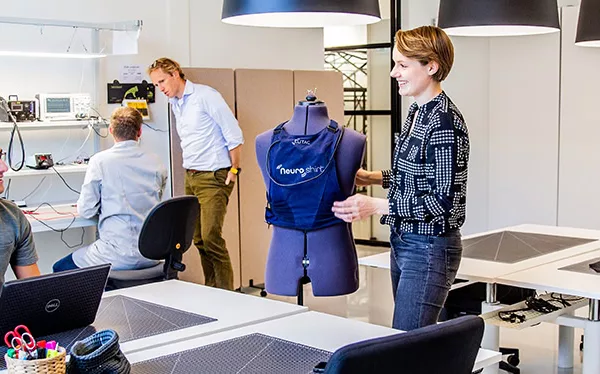
Vests deliver impacts, direction and environment cues across the torso. They are simpler to integrate and well suited to gaming and tactical training.
Full-body haptic suits
Full-body suits give the most complete experience but add the most complexity: many actuators, heat, cables and freedom of movement. Textile integration becomes critical.
Can haptic wearables reduce simulation sickness?
They can help. Simulation sickness comes largely from a mismatch: your eyes see motion that your balance organs do not feel. Haptics do not stimulate the balance organs, but they give the brain an extra, matching cue such as footsteps, contact or a directional pulse when turning. Research results are promising but mixed, so treat haptics as one part of a comfort strategy, not a cure.
Where does haptic VR add the most value?
Wherever touch carries information, not just immersion:
- Medical training: feeling tissue resistance and instrument pressure.
- Defence and aviation training: directional alerts and cues without extra screens or sounds.
- Rehabilitation: combining visual and physical feedback to support motor relearning.
- Industrial training: practising risky procedures with realistic feedback.
The same principle works outside VR. Elitac’s Mission Navigation Belt, developed with the Dutch Ministry of Defence, guides soldiers with vibration around the waist, keeping eyes and hands free.
What are the current limitations of haptic wearables in VR?
- Resolution: the hand has about 17,000 mechanoreceptors; no wearable comes close.
- Latency: more actuators and richer patterns make fast response harder.
- Battery life: actuators draw power; smart firmware sequencing helps more than a bigger battery.
- Heat and comfort: electronics against the skin need breathable textiles and smart layout.
- Complex sensations: fine texture, temperature and wetness remain largely unsolved.
How Elitac Wearables helps with haptic VR wearable development
Elitac Wearables has worked on body-worn haptics and sensor garments for more than ten years. A few examples:
- Motion capture suits. We helped Xsens (Movella) develop the garment and accessories of the Link motion capture suit, including gloves, used in gaming, film, research and VR. Read the Xsens Link Suit case study.
- VR and haptic gloves. We have supported leading VR glove developers such as SenseGlove and Manus on glove design and textile integration of electronics.
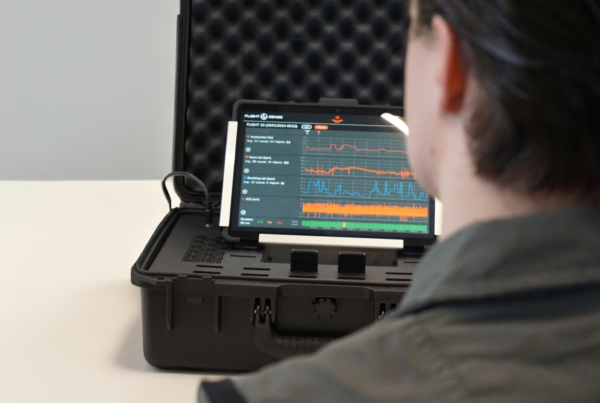
- Haptics for pilots. With CML (Center for Man and Aviation) and TNO, we work on haptic feedback for flight-simulator training, helping pilots keep orientation when vision drops away in blackout and whiteout situations. Related: our Flight Sense System for pilot physiology monitoring.
- Haptic garments. From navigation belts to a haptic feedback sleeve.
What we bring:
- Actuator choice (ERM, LRA, voice-coil, piezo) matched to your use case
- Haptic pattern design with TacOS, our own haptic firmware platform
- Electronics-in-textile integration that is comfortable and producible
- Power optimisation, human factors testing and certification guidance (MDR, defence)
See our haptic feedback wearables services, or contact us to discuss your project.
FAQ
Do I need haptic gloves or a vest for VR training?
Gloves for hand tasks, vests for direction and impact cues. Many training setups combine both.
How fast must haptic feedback be?
Aim for under ~20 ms between the visual event and the touch.
Can haptics stop VR motion sickness?
They can reduce it for some users, as part of a broader comfort strategy.
Related Articles
- How long does a smart textile development cycle take in 2026?
- Why is end-user testing critical in smart textile development?
- How do you scale smart textile development from prototype to production?
- What is the difference between an exoskeleton and a smart vest?
- What is the difference between a prototype and an MVP in wearable development?