
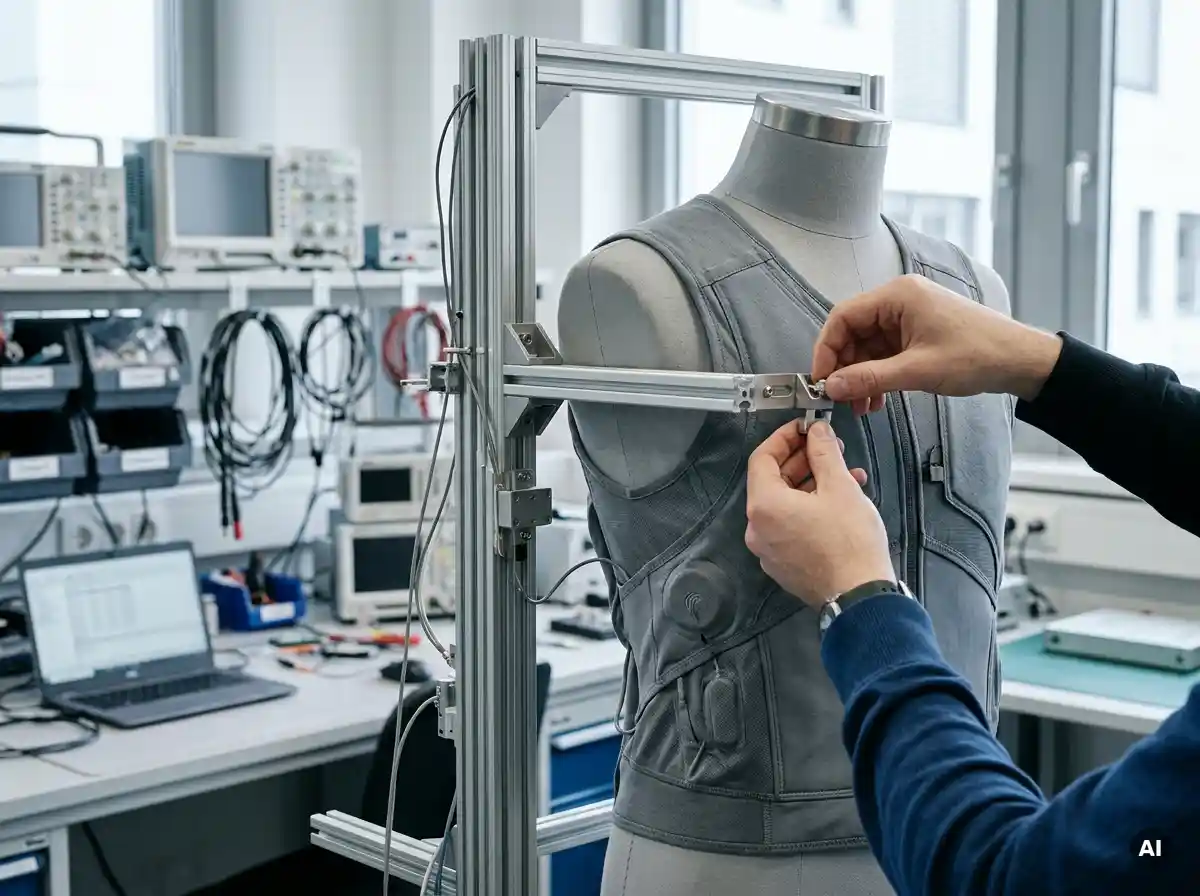
You agree on access to specialist testing equipment through a written equipment access agreement that fixes scope, cost basis, scheduling, liability, and data ownership before the first test runs. Settling these terms up front prevents disputes, protects test integrity, and keeps your development timeline intact.
The details matter most in wearable technology testing, where a single test campaign might involve motion capture, climatic chambers, EMC pre-compliance, or washability rigs. The sections below cover what to include, how costs work, who owns the results, how to schedule, and when external access beats buying.
What should an equipment access agreement include?
An equipment access agreement should define the equipment covered, the permitted use, the access period, the cost basis, operator responsibilities, liability and insurance, confidentiality, and ownership of test data. Each clause removes a common source of friction between the facility owner and the party using the equipment.
A workable shared lab access agreement usually covers these points:
- Equipment and scope: the exact instruments, firmware or software versions, and the test methods you will run.
- Operator model: whether your team runs the equipment after training or the lab’s technicians run it for you.
- Access window: dates, hours, and rules for rescheduling or cancelling.
- Calibration and accuracy: who maintains calibration and whether certificates accompany the results.
- Liability and damage: who pays if a prototype damages a fixture or a fixture damages a prototype.
- Confidentiality: how the facility protects your unreleased hardware and test results.
- Safety and compliance: required training, protective equipment, and handling rules for batteries or other hazardous components.
Pay particular attention to the calibration clause if the results will feed into certification. A test report without traceable calibration can force you to repeat the work at an accredited lab, which wastes both budget and calendar time.
How is the cost of using specialist testing equipment calculated?
The cost of using specialist testing equipment is typically calculated per hour, per day, or per test campaign, plus charges for operator time, consumables, setup, and any external calibration. Which model fits depends on how predictable your test plan is and whether the lab staff or your own engineers run the equipment.
Common pricing models
Time-based rates suit exploratory work, where you do not yet know how many iterations you need. Fixed-price test campaigns suit validation work with a defined method and pass criteria, because both sides know the scope. Retainer or block-booking arrangements suit teams that test every sprint and want guaranteed slots at a lower unit rate.
Costs that are easy to miss
The headline rate rarely tells the whole story. Ask about these items before you sign:
- Setup and teardown time, which some labs bill separately from run time.
- Technician or specialist operator hours.
- Consumables such as electrodes, test fabrics, or reference samples.
- Repeat runs after a failed or invalid test.
- Data processing and report writing.
Request a written estimate with a cap, and agree that overruns above a set percentage need your approval first. This keeps a test campaign from quietly growing past its budget.
Who owns the data and IP from equipment-based tests?
By default, the party that commissions and pays for the tests should own the raw test data and results, while the facility keeps ownership of its equipment, methods, and background know-how. This split should be stated in writing, because silence leaves room for conflicting assumptions about who may reuse or publish the data.
An intellectual property testing agreement should settle four questions:
- Raw data and reports: belong to the commissioning party, with the facility keeping a copy only if the agreement allows it.
- Test methods and fixtures: remain the facility’s property unless you paid for a custom fixture and agreed to transfer it.
- Improvements and inventions: if the lab’s staff contribute a new technique during your project, decide up front who owns it and who may license it.
- Publication rights: especially important when a university or research institute runs the tests, since academic partners often want to publish.
If your wearable contains a novel sensor layout or actuator pattern, treat test data as sensitive. Results can reveal performance characteristics that you would not want a competitor to see, so add a confidentiality term that survives the end of the contract.
How do you schedule access without delaying the project?
You avoid delays by booking equipment early, tying test dates to development milestones, and building buffer time around the slots that matter most. Specialist equipment has limited availability, so a booking made after your prototype is ready often means a wait of weeks rather than days.
Practical steps that keep the schedule intact:
- Reserve slots at planning stage. Book test windows when you set the project timeline, not when the hardware is finished.
- Prepare before you arrive. Finalise the test plan, sample counts, and pass criteria in advance so lab time goes to measurement rather than discussion.
- Bring spares. A damaged connector or flat battery should not cost you a whole session.
- Agree on rescheduling rules. Define notice periods and whether a missed slot is billed.
- Plan for re-tests. Assume at least one iteration will fail and hold a follow-up slot.
External certification labs deserve extra caution. Industry experience shows that lab scheduling is a common reason calendar time stretches during engineering validation, so book EMC, environmental, and regulatory pre-compliance slots as soon as the design is stable enough to test.
When is using a partner’s lab better than buying equipment?
Using a partner’s lab is better than buying equipment when you need the capability occasionally, when the instrument is expensive relative to its use, or when interpreting the results requires expertise you do not employ. Buying makes sense only when you will use the equipment continuously and have staff to operate and maintain it.
Weigh the decision against these criteria:
- Utilisation: equipment used a few days per year rarely repays its purchase price, calibration, and maintenance.
- Expertise: a motion capture rig or haptic characterisation setup is only as useful as the person who can interpret the output.
- Speed: a partner lab that already has the equipment running removes procurement, installation, and training time.
- Flexibility: external access lets you test across several methods without committing capital to any one of them.
- Confidentiality needs: highly sensitive work may justify keeping testing in-house despite the cost.
The in-house lab versus external lab question also depends on project stage. Early prototyping benefits from fast, flexible access to a partner’s facilities, while a mature product with steady production testing may justify its own test station. Many development teams settle on a hybrid: a small in-house setup for daily checks and partner access for specialist or certification-grade work.
How Elitac Wearables helps with access to specialist testing equipment
Elitac Wearables removes the equipment question from your critical path. Its 180m² Wearables Lab in Utrecht handles prototyping and testing in-house, and its network of university, hospital, and research partners covers specialist measurement beyond that.
- In-house lab: 3D printers, laser cutters, and permanent software testing set-ups support fast iteration without external booking delays.
- Clear terms: project scope, costs, and IP arrangements are agreed in writing before work begins, as described in how we work.
- Research network: partners such as TNO, UMC Utrecht, and the University of Twente extend access to specialist facilities when a project needs them.
- End-to-end capability: hardware, firmware, textile, and algorithm specialists work together, so test results lead directly to design decisions.
If you want to see how this fits your project, read about working with us or contact the team to discuss your testing needs.
Related Articles
- Can a wearable development partner support just one part of a project?
- What industries benefit most from smart textile development?
- What are the ethical concerns around soldier surveillance via wearables?
- How do defence forces use biometric wearables?
- Can haptic feedback wearables be customized for specific workflows?