
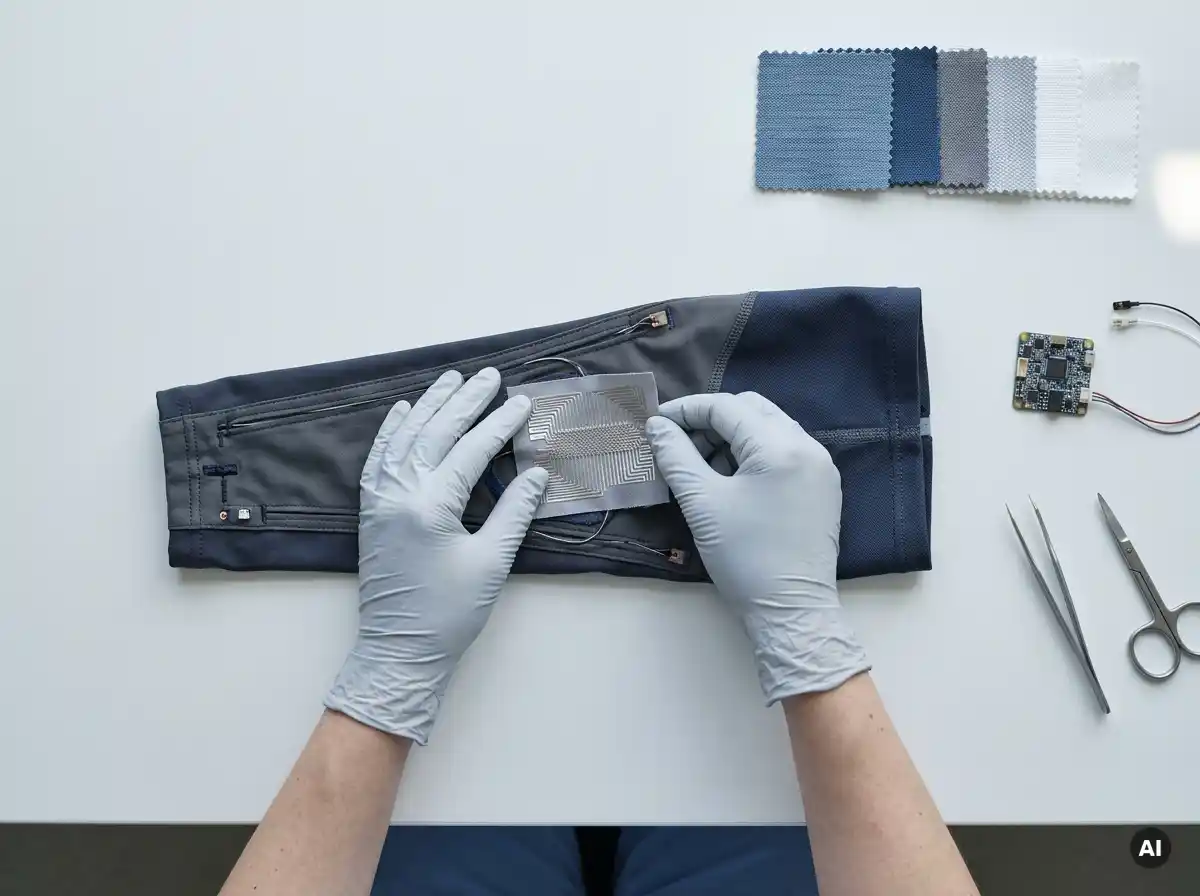
Yes, a wearable development partner can support just one part of a project. Feasibility checks, proof-of-concept builds, haptic design, firmware, textile integration, certification support, and pilot production can each be contracted on their own. The approach works best when the interfaces between phases are defined clearly before work begins.
Single-phase engagements suit teams that already own part of the problem, such as a medical device company with strong electronics but no textile or haptics experience. Below, we cover which stages can be separated, where the risks sit, how to scope the work, and how to choose a partner.
Which wearable development stages can be outsourced separately?
Every stage of wearable product development can be outsourced on its own: feasibility check, proof of concept, pilot samples, final prototype, first series, and scaled production. Specialist workstreams such as haptic design, firmware, electronics-textile integration, and certification support can also be contracted separately from the main project.
The six-phase structure gives natural boundaries. A feasibility check verifies techniques and materials in a few weeks. A proof of concept builds a first working version for early market feedback. Pilot samples test the design with real users. The final prototype locks the design. The first series and scaled production then move it into manufacturing.
Beyond phases, many teams outsource by discipline instead. Typical examples include:
- Actuator and sensor selection: choosing between ERM, LRA, and piezo actuators for a specific body location and use case
- Firmware and haptic pattern design: timing, intensity, and signal behaviour that users actually perceive
- Smart textile development: embedding electronics in fabric so they survive movement, washing, and wear
- Biosignal sensing: dry electrode placement and motion artefact reduction for ECG or EMG
- Certification support: aligning hardware and documentation with CE marking or MDR requirements
- Review and optimisation: a hardware or firmware review before launch, or battery life optimisation late in development
The right slice is usually the one where your in-house team hits the edge of its experience.
What are the risks of outsourcing only one phase?
The main risks of single-phase outsourcing are interface gaps, lost knowledge, and decisions that look sound in isolation but cause problems downstream. A prototype built without production in mind may need redesign later, and a design made without certification input can fail compliance testing.
Wearables amplify these risks because every layer depends on the others. Sensors behave differently on a moving body than on a bench. A textile choice affects electrode contact, which affects signal quality, which affects firmware filtering. A battery problem that appears late is rarely a battery problem. It is usually a system-level inefficiency across hardware, firmware, data handling, and user behaviour. Enlarging the cell then forces a bigger enclosure, new tooling, and delays.
Watch for these specific failure points:
- Handover loss: assumptions made during one phase never reach the next team
- Late validation: teams commit to tooling before testing comfort, usability, and perceived value with real users. Industry experience suggests this is a leading reason prototypes never reach production
- Disowned integration: when electronics and textile work sit with different suppliers, nobody owns the seam between them
- Certification surprises: regulatory needs discovered after the hardware design is frozen
Most of these risks shrink when the partner documents decisions, tests against the next phase’s needs, and flags downstream consequences early.
How should a single-phase wearable project be scoped?
A single-phase wearable project is scoped by defining the starting point, the deliverable, the acceptance criteria, and the handover format before work begins. The scope should state exactly what exists today, what the partner will produce, and how both sides will judge the result.
A practical scoping checklist covers five items:
- Current status: which development phase you are in and what evidence supports it (test results, user feedback, existing hardware)
- Target outcome: a defined deliverable such as a working demonstrator, a verified actuator selection, a firmware build, or a certification gap analysis
- Success criteria: measurable thresholds, for example signal quality under motion, battery runtime, or user perception of haptic cues
- Constraints from the next phase: production volume, target cost, certification route, and washability requirements that the output must respect
- Handover package: design files, firmware source, test data, and documentation your team or the next supplier can use
Budget expectations help too. Early phases cost far less than late ones. Rough indications run from about 1K to 10K for a feasibility check and 5K to 20K for a proof of concept, up to 40K to 100K for a final prototype, depending heavily on wearable type and complexity. A build-for-validation mindset also helps: demonstrators that test the idea with users cost a fraction of production-grade work and give clarity before the big investment decisions.
When does partial support make sense versus full development?
Partial support makes sense when your team already owns most of the product and lacks a clearly bounded capability, such as haptics, textile integration, or biosignal sensing. Full development fits better when no in-house wearable experience exists or when disciplines are so intertwined that splitting them would create integration risk.
Partial support usually works well in these situations:
- You have a mature device and need to add the wearable layer
- You have a prototype that works on the bench but not reliably on a body
- You need an independent hardware or firmware review before launch
- You want to validate a concept before committing to a larger budget
- You face a specific bottleneck, such as battery performance or actuator selection
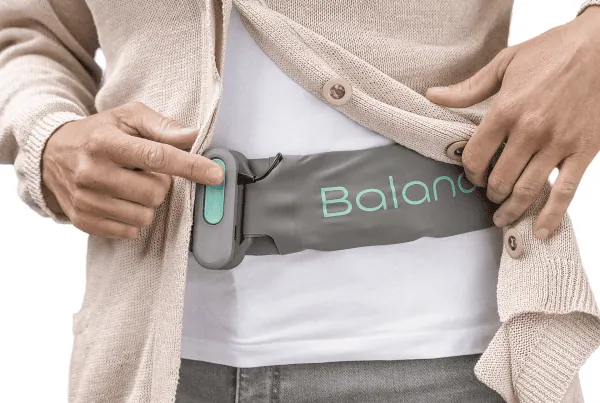
Full development is the safer route when the product spans several disciplines at once, for example a medical wearable that combines motion sensing, haptic feedback, textile integration, and MDR compliance. A project like that benefits from one team holding hardware, firmware, textile, and algorithm knowledge, because a wrong call in one area ripples through all the others. The BalanceBelt illustrates this: precise motion sensing, haptic feedback, clinical validation, and quality management all had to work as one system.
What should be checked before choosing a partner for one phase?
Before choosing a partner for one phase, check that they have delivered wearables in your sector, cover the disciplines your phase touches, work with in-house facilities, and can explain how their output feeds the next phase. A partner who only understands the slice you hire them for creates risk.
Ask these questions during selection:
- Relevant track record: have they shipped wearables with comparable requirements, such as medical, defence, sports, or safety?
- Depth in the contested area: can they discuss actuator trade-offs, dry electrode behaviour under movement, or textile integration techniques with specifics rather than generalities?
- Own infrastructure: do they prototype in-house, or do they outsource each iteration? In-house labs shorten feedback loops and lower risk
- Downstream awareness: do they ask about production volumes, certification, and washing requirements even though those sit outside the phase?
- Clean handover: will you receive files, firmware, and documentation you can actually reuse?
- Ownership terms: who holds the intellectual property at the end of the phase?
A strong partner also pushes back. If your plan for one phase would create a problem later, they should say so before you sign.
Can a partial engagement later expand into full development?
Yes, a partial engagement can expand into full development, and it often does. A well-run first phase produces documented designs, test data, and shared understanding of the product, so extending the partnership costs less than starting over with a new supplier.
Expansion works smoothly when the original scope anticipated it. That means agreeing on file formats, documentation standards, and decision logs from day one, and choosing a partner whose capabilities extend past your initial need. A team that begins with a feasibility check or a haptic review can continue into proof of concept, pilot samples, and a final prototype using the same people and the same lab. Some partners also handle limited production runs in-house and connect clients to manufacturing partners for larger volumes.
Expansion is optional, not a trap. If you only need one phase, a good partner delivers it cleanly and hands over everything required. Keeping the door open simply means you are never forced to restart if the project grows.
How Elitac Wearables helps with single-phase wearable development
Elitac Wearables works as an extension of your existing team, so you can bring in specialist wearable expertise for exactly the phase or discipline you need. From the 180m² Wearables Lab in Utrecht, the team covers hardware, firmware, textile integration, and haptics under one roof, and you can see how we work across the six development phases.
- Entry points to fit your budget: innovation consultancy, haptic development hardware, or development services for any phase from feasibility check to first series
- Specialist depth: haptic feedback, e-textile integration, biosignal sensing, battery optimisation, and certification support, backed by over 50 products developed
- Faster, lower-risk iteration: in-house prototyping and the proprietary TacOS firmware platform
- Room to grow: limited production up to 100 pieces in-house, with a manufacturing network for larger volumes
Learn more about working with us or contact our team to discuss which phase of your wearable project needs support.
Related Articles
- Should you prototype electronics integrated into textiles in-house or outsource?
- How do developers integrate haptic feedback into wearable devices?
- How do you evaluate the technical readiness of a wearable product before going to market?
- How do you reduce time-to-market in wearable product development?
- What are the hidden costs of wearable product development that most vendors won't tell you?