
Yes, haptic feedback wearables can be customised for specific workflows, and in most serious applications, they should be. A generic vibration pattern designed for one context will fail in another — the body, the environment, and the task all shape what tactile feedback actually communicates to the wearer. The sections below unpack exactly what customisation involves, how it maps to real workflows, and when it makes sense to build from scratch versus adapt existing hardware.
What parts of a haptic wearable can actually be customised?
Almost every layer of a haptic wearable is open to customisation, from the actuator type and placement to the vibration patterns, timing logic, and the firmware that drives it all. The degree of customisation available depends on whether you are working with a configurable off-the-shelf platform or commissioning a fully bespoke system, but the technical variables are consistent across both approaches.
The main customisable elements in a haptic wearable system are:
- Actuator type: ERM (Eccentric Rotating Mass), LRA (Linear Resonant Actuator), and piezo actuators each produce different tactile sensations. ERMs are cost-effective and widely understood; LRAs offer sharper, more precise pulses; piezo actuators deliver high-fidelity output with low power draw. The right choice depends on the body location, the intensity required, and the power budget.
- Actuator placement: Where on the body a haptic signal is delivered changes how it is perceived and interpreted. A vibration at the wrist reads differently from one at the torso or the forearm. Placement is determined by the workflow the device supports.
- Vibration patterns: Frequency, amplitude, rhythm, and duration can all be tuned. A short, sharp pulse signals urgency differently from a slow, rolling pattern that indicates a directional cue.
- Spatial encoding: Multiple actuators placed across the body can create directional or positional signals, which is how the Mission Navigation Belt provides turn-by-turn navigation through vibration alone.
- Firmware and timing logic: The rules governing when a signal fires, how long it lasts, and how it interacts with other signals in the system are defined at the firmware level and are fully configurable.
- Textile and form factor: The garment or carrier itself can be adapted for comfort, durability, washability, and the physical demands of the environment.
Customisation at any one of these layers without considering the others tends to produce suboptimal results. Effective haptic wearable design treats these variables as an interconnected system, not a checklist of independent options.
How does workflow mapping translate into haptic signal design?
Workflow mapping translates into haptic signal design by identifying the specific moments in a task where tactile feedback adds value, then assigning distinct, learnable vibration patterns to each of those moments. The goal is to create a signal vocabulary that a wearer can interpret quickly and accurately without looking at a screen or breaking their physical workflow.
The process typically begins with a structured analysis of the target workflow. Engineers and human factors specialists observe or document the task sequence, identify the decision points or alerts that currently rely on visual or auditory cues, and assess whether haptic feedback could replace or supplement those cues more effectively. In high-noise environments, for example, auditory alerts fail. In tasks requiring full visual attention, screen-based feedback is impractical. Haptics fills that gap.
From that analysis, a signal library is designed. Each signal needs to be:
- Distinguishable: Signals must be perceptually distinct from one another, even under physical exertion or cognitive load.
- Learnable: A wearer should be able to associate a pattern with its meaning within a reasonable training period.
- Appropriate in intensity: A signal strong enough to be felt through a thick glove may be uncomfortable on bare skin. Context determines calibration.
- Timed to the workflow: A haptic cue that fires too early or too late is worse than no cue at all. Timing logic must reflect the actual cadence of the task.
User testing at this stage is not optional. Haptic perception is subjective and varies between individuals, body locations, and physical states. Patterns that test well in a lab setting often need adjustment when validated in real working conditions. Building iteration cycles into development is what separates functional haptic systems from ones that get switched off after a week.
Which industries use workflow-customized haptic wearables?
Workflow-customised haptic wearables are used across defence, medical rehabilitation, industrial operations, and sports performance, wherever a task demands eyes-free feedback, operates in a high-noise environment, or requires real-time guidance that visual or auditory channels cannot reliably deliver.
Defence and navigation
Military and tactical applications were among the earliest serious use cases for workflow-specific haptic wearables. The Mission Navigation Belt, developed for the Royal Netherlands Army, is a direct example: soldiers receive directional navigation cues through vibration patterns on the torso, keeping their hands free and eyes on the environment. The workflow in this case is movement through terrain, and the haptic signals are mapped to directional commands that replace map-checking or radio communication.
Medical and rehabilitation
In clinical and rehabilitation contexts, haptic wearables are used to deliver biofeedback during movement therapy, support balance rehabilitation, and provide real-time posture correction cues. The BalanceBelt is a commercially available example, designed to help people with balance disorders by delivering vibrotactile feedback that orients the wearer spatially. The workflow here is daily movement, and the signal design is calibrated to the specific sensory deficit the device addresses.
Industrial and high-risk operations
In manufacturing, logistics, and hazardous environments, haptic wearables are being developed to alert workers to proximity hazards, guide assembly sequences, or signal equipment status without requiring the worker to divert attention. The workflow customisation in these settings is particularly demanding because the signal must be interpretable under physical stress, through protective clothing, and without any interruption to the task for training.
Sports performance
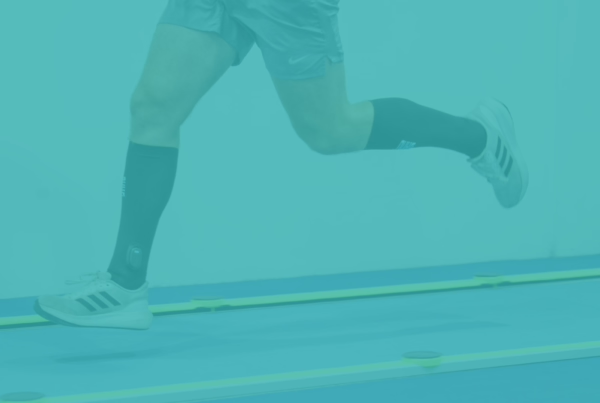
Coaches and sports scientists use haptic wearables to deliver real-time technique cues during training, replacing verbal instruction that disrupts concentration or is inaudible during high-intensity effort. The signal design maps directly to the biomechanical events being coached, whether that is a foot strike pattern, a joint angle threshold, or a pacing cue.
What’s the difference between configurable and fully custom haptic systems?
A configurable haptic system uses pre-built hardware and firmware that can be adjusted within defined parameters, such as changing vibration patterns or thresholds through software, without modifying the underlying architecture. A fully custom haptic system is engineered from the component level up to meet a specific application’s requirements, with no inherited constraints from an existing platform.
The distinction matters practically because configurable systems are faster and cheaper to deploy, but they carry limitations. The actuator type is fixed. The placement options are constrained by the existing form factor. The firmware can be adjusted, but only within the logic the platform was designed to support. For many workflows, that is sufficient, particularly in early-stage validation or when the use case is close to an existing product category.
Fully custom systems become necessary when:
- The body location or garment type is incompatible with existing hardware
- The signal complexity exceeds what a configurable platform’s firmware can handle
- The environment imposes physical demands, such as washability, impact resistance, or ATEX compliance, that off-the-shelf hardware cannot meet
- The product will be manufactured at scale and cost optimisation requires purpose-built components
- Regulatory requirements, such as MDR for a medical device, necessitate documented control over every component in the system
Many development projects begin with a configurable platform for early prototyping and validation, then transition to a custom architecture once the signal design and workflow requirements are confirmed. This staged approach reduces the risk of investing in bespoke hardware before the core concept is validated.
How long does it take to develop a workflow-specific haptic wearable?
Developing a workflow-specific haptic wearable typically takes between six months and two years from initial concept to a market-ready product, depending on the complexity of the workflow, the level of hardware customisation required, and the regulatory pathway the device must follow. A proof of concept for internal validation can be delivered significantly faster, often within eight to twelve weeks.
A realistic timeline breaks down roughly as follows:
- Feasibility check (two to four weeks): Verification that the proposed haptic approach is technically viable for the workflow and body location in question. This phase identifies the actuator candidates, placement strategy, and any integration constraints early, before significant investment is committed.
- Proof of concept (six to twelve weeks): A functional prototype built with off-the-shelf components and existing firmware building blocks. This is the stage at which the signal vocabulary is tested with real users in representative conditions. The outcome is evidence that the concept works, not a production-ready device.
- Prototype development (three to six months): The signal design is refined, custom hardware elements are introduced where necessary, and the garment or carrier is developed to meet the environmental and comfort requirements of the workflow.
- Validation and iteration (two to four months): Real-world testing with the target user group, followed by design adjustments based on findings. This phase is where most projects encounter unexpected challenges, particularly around signal perception under physical load.
- Certification and production preparation (two to six months): For regulated applications, certification processes run in parallel with final design refinement. CE marking, MDR compliance, or other regulatory requirements add time and must be planned from the outset, not retrofitted at the end.
The single most common cause of timeline overrun in haptic wearable development is validating too late. Teams that run user testing only after the hardware is finalised often discover that the signal design needs fundamental changes, which then requires reopening decisions that were considered closed.
When should an organization build a custom haptic wearable versus adapting existing hardware?
An organisation should build a custom haptic wearable when the workflow requirements, environmental constraints, or regulatory demands cannot be met by adapting an existing platform without compromising the core function. Adapting existing hardware makes sense when the use case is close enough to an established product category that the inherited constraints do not limit the outcome.
The clearest indicators that a custom build is the right path include:
- The device will be used in a regulated context, such as a Class I or Class II medical wearable, where component-level documentation and design control are mandatory
- The garment or body location is incompatible with existing form factors, for example, integrating haptics into a surgical glove, a compression sleeve, or a military vest
- The signal complexity, such as multi-actuator spatial encoding across the torso, exceeds what configurable platforms support
- The product will reach a volume where per-unit cost optimisation justifies the upfront investment in custom hardware
- The organisation requires IP ownership over the haptic system as a competitive differentiator
Adapting existing hardware is a legitimate and often underused option when speed to validation matters more than long-term optimisation. A configurable platform can get a concept in front of users in weeks rather than months, and the learning from that validation phase is what should drive the decision about whether to invest in a custom architecture.
The honest answer is that most organisations approach this decision too early, before they have enough workflow data to know what the hardware actually needs to do. Running a structured feasibility and proof-of-concept phase before committing to either path is almost always the lower-risk choice.
How Elitac Wearables helps with haptic feedback wearable customization
For organisations that have identified a workflow problem and need a haptic wearable built to solve it, the challenge is rarely the idea. It is the execution: selecting the right actuators, designing signal patterns that work under real conditions, integrating electronics into a garment that survives the environment, and navigating certification if the application is regulated. That is exactly where Elitac Wearables operates.
As a specialist wearable development partner, Elitac brings every discipline needed for workflow-specific haptic development under one roof:
- Haptic system design: Actuator selection across ERM, LRA, and piezo technologies, vibration pattern development, spatial encoding design, and firmware-level timing logic using the proprietary TacOS platform
- Workflow analysis and signal mapping: Human factors expertise to translate task requirements into a haptic signal vocabulary that users can learn and rely on
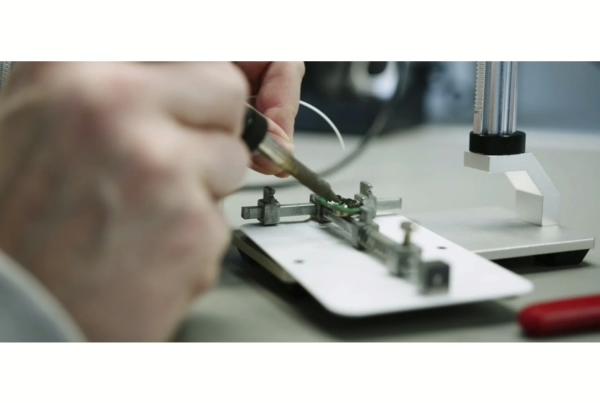
- Electronics-textile integration: Over a decade of experience embedding electronics into garments for washable, flexible, and body-worn applications
- Validation support: Structured user testing built into the development process, not bolted on at the end
- Certification guidance: MDR, CE marking, and ATEX experience for regulated applications, with certification requirements factored into hardware design from the start
Whether the starting point is a workflow problem with no product yet, an existing concept that has stalled, or a prototype that works in the lab but not in the field, Elitac Wearables takes projects from that point through to a market-ready, certified product. If you are working on a haptic wearable challenge and want to understand what the right development path looks like for your specific application, get in touch with the team for a direct conversation with the engineers who will build it.
Related Articles
- How do military wearables differ across army, navy, and air force?
- How do wearables improve training outcomes for defence personnel?
- How do wearables support soldier situational awareness?
- How do haptic feedback wearables perform in industrial environments?
- How do you choose the right hardware for a wearable device?