Military wearables are purpose-built electronic devices worn on the body that enhance soldier performance, safety, and situational awareness in operational environments. Unlike consumer fitness trackers, these systems are engineered to function reliably under extreme physical and environmental stress, integrating sensors, communications, and feedback mechanisms directly into uniforms, vests, and equipment. This article covers how they are used today, what forms they take, and where the technology is heading next.
How are wearables being used in modern military operations?
Military wearables are used across a wide range of operational tasks including navigation, health monitoring, communications, and threat detection. Soldiers wear them to receive real-time data without relying on screens or radios, keeping their hands, eyes, and ears free during active missions. The technology has moved well beyond early GPS watches into systems that are fully integrated with existing defence infrastructure.
In navigation, haptic wearables deliver directional cues through vibration patterns felt against the body, allowing soldiers to move silently through terrain without glancing at a device. The Mission Navigation Belt developed for the Royal Netherlands Army is a direct example: it integrates with GPS systems and communicates route information through tactile signals, removing the need for visual or auditory output in high-risk situations.
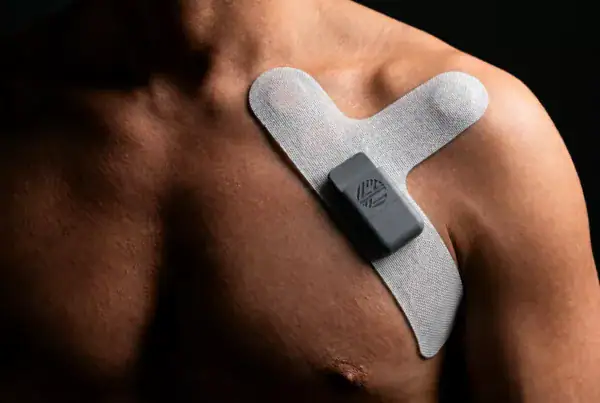
In health and performance monitoring, wearable biosensor systems track physiological data such as heart rate, heart rate variability, respiration rate, and body temperature. This allows medics and commanders to monitor troop readiness in real time and identify early signs of heat stress, exhaustion, or injury before they become mission-critical problems.
Communication and identification wearables are also gaining ground, allowing personnel to exchange data with command systems without breaking cover. The common thread across all these applications is the same: reducing cognitive load and physical risk by delivering the right information directly to the soldier’s body.
What types of military wearables exist?
Military wearable devices fall into several distinct categories based on their primary function: navigation and orientation systems, biosignal monitoring systems, communication and identification wearables, and protective smart textiles. Each category addresses a specific operational need, and many advanced systems combine capabilities from more than one category.
Navigation and haptic feedback systems
These wearables deliver positional and directional information through tactile or vibrotactile feedback rather than visual displays. Worn around the torso or wrist, they allow hands-free, eyes-free navigation in low-visibility or high-threat environments. The haptic output is typically generated by small vibration motors positioned around the body, with different patterns indicating direction, distance, or alerts.
Physiological monitoring systems
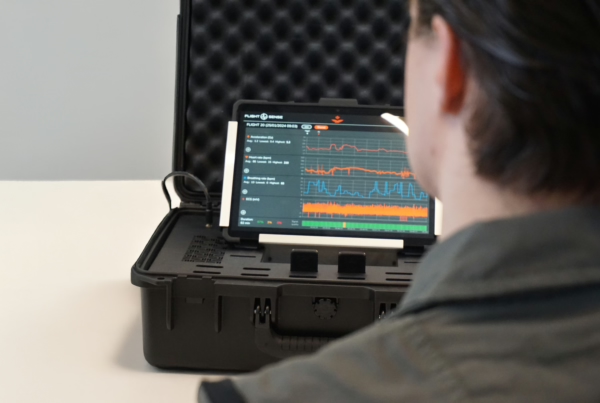
Biosensor wearables measure ECG, respiration, skin temperature, and movement to build a real-time picture of soldier health and performance. These systems use dry electrode technology to maintain signal quality during high-movement conditions, which is one of the core technical challenges in military-grade biosensing. Multi-sensor platforms like the Flight Sense System are designed specifically for this context, capturing ECG, heart rate variability, and acceleration data simultaneously in extreme environments.
Smart textiles and protective wearables
Electronics embedded directly into uniforms, body armour, or load-bearing equipment represent the frontier of military wearable technology. Conductive yarns and printed electronics allow sensors and actuators to be integrated without adding bulk or compromising the structural properties of the garment. Applications range from impact detection in protective gear to posture monitoring for soldiers carrying heavy loads.
What are the key technical challenges in developing military wearables?
Developing wearable technology for military use is significantly harder than developing consumer or even medical wearables. The core challenges are durability under extreme conditions, reliable signal quality during high-movement activity, power management in the field, and meeting stringent military certification requirements.
Ruggedisation is the starting point. A wearable that functions in a controlled clinical environment may fail completely when exposed to dust, moisture, temperature extremes, and mechanical shock. Every component, from the PCB to the textile substrate, must be selected and tested with those conditions in mind.
Signal quality during movement is another critical barrier. Biosensors placed on a moving body are prone to motion artefacts, where the sensor picks up noise from physical activity rather than the physiological signal being measured. Addressing this requires careful dry electrode selection, optimised sensor placement, and firmware-level signal processing to filter artefacts in real time.
Battery life is a persistent problem in field-deployed wearables. Soldiers cannot recharge devices during operations, which means power consumption must be optimised at every level of the system: hardware component selection, firmware behaviour, data transmission intervals, and sensor duty cycles. Treating battery performance as a system-level engineering challenge, rather than simply choosing a larger cell, is the approach that consistently delivers results without increasing device size or weight.
Finally, military certification adds a layer of complexity that many development teams underestimate. Devices must meet specific standards for electromagnetic compatibility, environmental resistance, and operational safety. Certification requirements should influence hardware design decisions from the earliest stages, not be addressed as a final step before deployment.
How do haptic wearables improve soldier performance?
Haptic wearables improve soldier performance by delivering critical information through touch, freeing visual and auditory channels for the immediate environment. In combat or high-pressure operational settings, a soldier’s attention is a finite resource. Any information that can be communicated without requiring the soldier to look at a screen or listen for an audio cue directly reduces cognitive load and reaction time.
Tactile navigation is the most established military application. Vibration patterns delivered around the waist or torso communicate direction intuitively, because the body naturally associates a vibration on the left side with “turn left.” Soldiers can receive and act on navigation instructions without breaking stride, lowering their weapon, or exposing a light source. In night operations or environments where noise discipline is critical, this is a meaningful operational advantage.
Beyond navigation, haptic feedback can communicate threat alerts, team status signals, or equipment warnings in situations where conventional signalling would be dangerous or impractical. The key to effective haptic design is pattern clarity: the vibration sequences must be distinct enough that a soldier can interpret them correctly under physical and psychological stress, without extensive conscious thought. This requires careful firmware-level timing and pattern design, not just the placement of a vibration motor.
Research into haptic perception on the body has shown that the torso is particularly well-suited to directional feedback because of its surface area and the density of mechanoreceptors across it. This anatomical insight directly informs where haptic actuators are positioned in well-designed military wearables.
Which military sectors are adopting wearable technology fastest?
Infantry and special operations units are currently the fastest adopters of military wearable technology, driven by the direct operational benefits of hands-free navigation, real-time health monitoring, and silent communication. Behind them, military medical and logistics sectors are accelerating adoption as the reliability and miniaturisation of biosensor systems improve.
Infantry applications are advancing quickly because the value proposition is immediate and measurable: a soldier who navigates more accurately, monitors their own physiological state, and communicates without breaking cover is operationally more effective. Defence agencies in Europe and North America have invested in haptic navigation and biosensor systems as part of broader soldier modernisation programmes.
Military medical units are adopting wearables for triage and remote patient monitoring, particularly in scenarios where evacuating a casualty immediately is not possible. Continuous physiological monitoring allows medics to track multiple patients simultaneously and prioritise intervention based on real-time data rather than periodic manual assessment.
Training environments are also a significant growth area. Wearables that capture movement, physiological load, and performance metrics during exercises allow commanders and trainers to analyse data after the fact and adjust training programmes accordingly. Motion capture systems, similar to those developed for sports and medical rehabilitation, are being adapted for military training contexts to assess technique, fatigue, and injury risk.
What does the future of military wearable technology look like?
The future of military wearable technology points toward deeper integration, greater autonomy in data processing, and wearables that adapt to the soldier’s physiological state in real time. The next generation of devices will not simply collect and transmit data, they will interpret it and respond with appropriate feedback or alerts without requiring human intervention in the loop.
Electronics-textile integration will become more seamless. Current systems often involve discrete sensor modules attached to garments. Future developments will embed sensing and actuation directly into the fabric structure using conductive yarns and printed electronics, producing wearables that are indistinguishable from standard military clothing in appearance and feel, while carrying full sensing capability.
Multi-modal wearables that combine haptics, biosensing, and communication in a single integrated system will replace the current fragmented approach, where separate devices handle separate functions. Reducing the number of worn devices decreases weight, complexity, and failure points, all of which matter in operational settings.
Artificial intelligence applied to physiological data will enable predictive health monitoring, flagging early indicators of heat injury, fatigue, or stress before they manifest as performance degradation. The challenge will be doing this computation efficiently enough to run on a body-worn device with limited battery capacity, which makes firmware optimisation and power management as strategically important as the sensing hardware itself.
Certification and interoperability standards will also evolve. As military wearables move from experimental programmes into standard issue, defence agencies will require devices that integrate with existing communications and command infrastructure, meet defined reliability standards, and can be maintained in the field. Development teams that build with certification requirements in mind from the first prototype will reach deployment significantly faster than those that treat it as an afterthought.
How Elitac Wearables helps with military wearable development
Developing a military-grade wearable is not a project for a generalist electronics supplier. It demands deep expertise across haptics, biosensing, electronics-textile integration, embedded firmware, and defence certification, all coordinated by a single team that understands how these disciplines interact under real operational conditions.
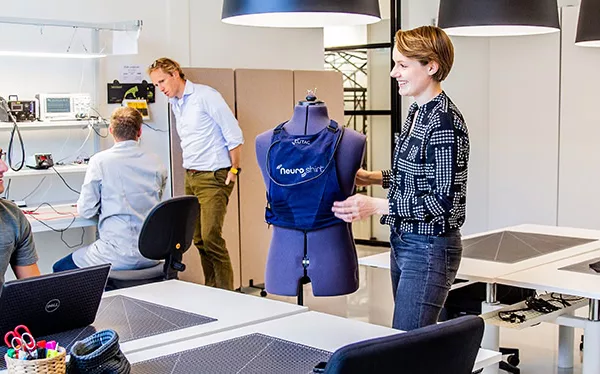
Elitac Wearables brings that full capability in-house. Our work on the Mission Navigation Belt for the Royal Netherlands Army and the Flight Sense System for military and extreme-environment biosensing demonstrates what it takes to build wearables that perform where it matters. Specifically, we offer:
- Haptic system design from actuator selection through to firmware-level pattern timing, optimised for body-worn military applications
- Biosensor integration using dry electrode technology and motion artefact management for reliable physiological data during high-movement activity
- Electronics-textile integration across flexible, washable, and ruggedised contexts using conductive yarns, printed electronics, and modular attachment
- Embedded firmware development including our proprietary TacOS platform, purpose-built for wearable power and performance constraints
- Military and defence certification guidance built into the development process from the earliest stages, not bolted on at the end
- End-to-end development from feasibility check and proof of concept through to validated prototype and production-ready product
If you are working on a defence wearable project and need a development partner with the technical depth to take it from concept to field-ready product, get in touch with our team to discuss where your project stands and what the right next step looks like.