

Military wearables communicate with command systems through a combination of short-range radio protocols, encrypted wireless data links, and gateway devices that bridge body-worn sensors to wider tactical networks. The specific protocols depend on the mission environment, the type of data being transmitted, and the security classification of the information involved. The sections below break down the key questions around how that communication works in practice.
What communication protocols do military wearables use?
Military wearables use a layered set of communication protocols, typically combining short-range personal area network (PAN) technologies for on-body data aggregation with longer-range radio links for transmission to command infrastructure. Bluetooth Low Energy (BLE), ANT+, and proprietary ultra-low-power radio protocols handle local sensor-to-hub communication, while military-grade UHF, VHF, and software-defined radio (SDR) systems carry data across tactical networks.
The choice of protocol is rarely straightforward. On-body networks need to be power-efficient, because soldiers cannot carry unlimited battery capacity. They also need to be robust against interference from other radio equipment in the field. That tension between energy efficiency and reliability drives most of the protocol selection decisions in military wearable design.
Beyond the radio layer, data formatting standards such as NATO’s STANAG specifications govern how information is packaged so that wearables from different manufacturers can feed into shared command architectures. The result is a stack of protocols rather than a single technology: one protocol moves data off the sensor, another aggregates it at a hub device, and a third transmits it up the chain of command.
In practice, many military wearable systems also incorporate mesh networking, where individual soldiers’ devices relay data for one another, extending effective range without requiring every unit to maintain a direct link to a base station. This adds resilience in environments where line-of-sight radio contact is unreliable.
How does data from wearable sensors reach command level?
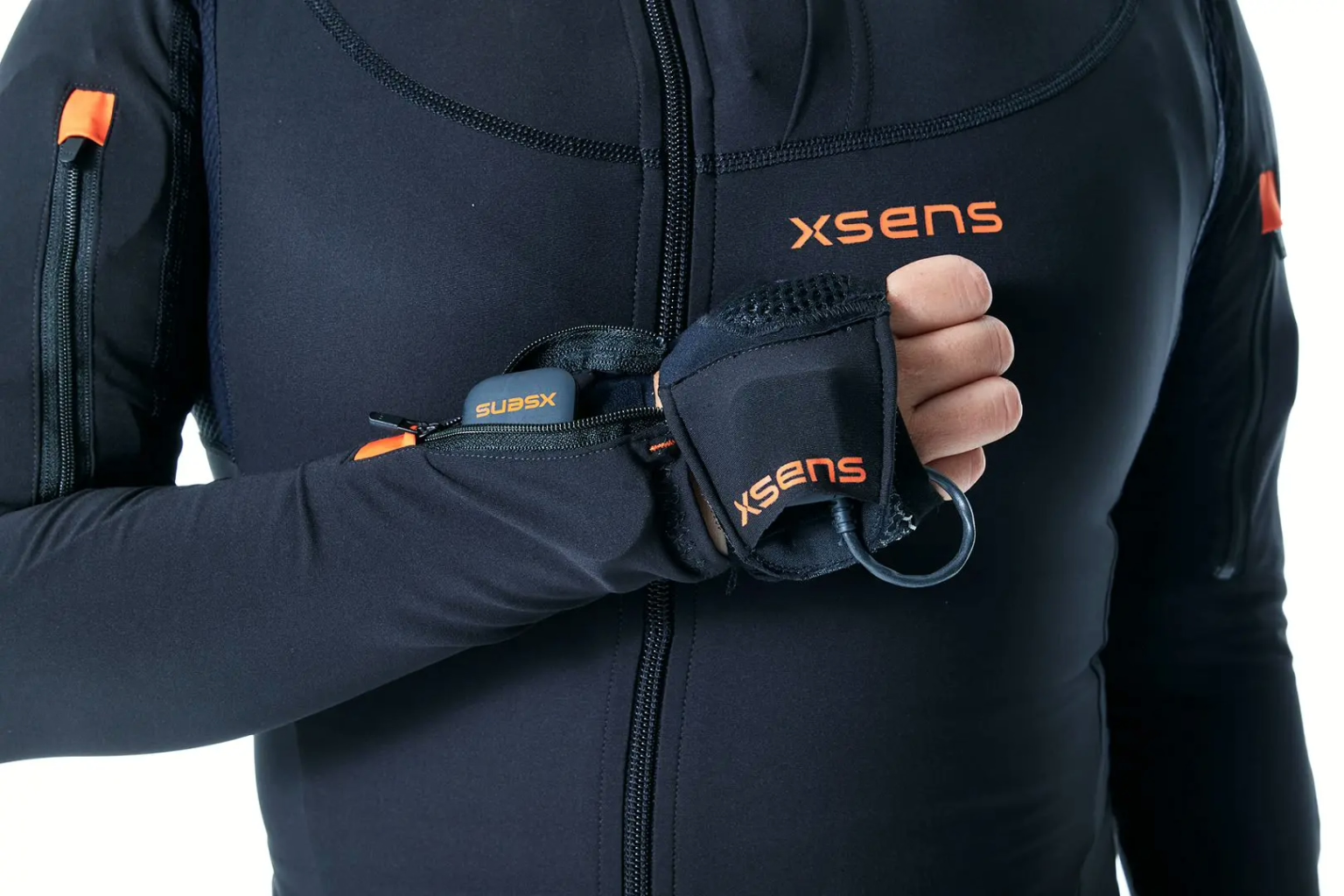
Data from military wearable sensors typically travels through a three-stage architecture: collection at the sensor, aggregation at a body-worn hub or personal role radio, and transmission to a tactical operations centre or command node. Each stage involves data processing decisions about what to transmit, at what resolution, and how often, because bandwidth on military radio networks is a constrained and contested resource.
At the sensor level, devices such as heart rate monitors, motion sensors, and environmental detectors generate continuous raw data streams. Transmitting all of that raw data in real time is rarely feasible or necessary. Instead, edge processing on the wearable or its hub performs local filtering and compression, extracting only the metrics that are operationally relevant, such as physiological alerts, position updates, or anomaly flags.
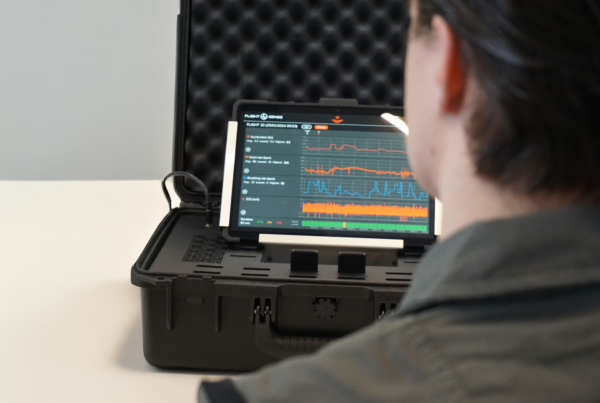
The aggregated data then enters the soldier’s personal communications system, which connects to the wider tactical network. In modern military architectures, this network is typically an IP-based system that allows wearable data to be routed alongside voice and video traffic. Command-level software then visualises the incoming streams, presenting unit commanders with a real-time picture of personnel status across the force.
Latency is a critical design constraint at every stage. A navigation alert delivered to a soldier’s haptic wearable, for example, is only useful if it arrives within a fraction of a second of the triggering event. That requirement shapes how data pipelines are architected from the sensor outward.
What encryption and security standards protect military wearable data?
Military wearable data is protected through end-to-end encryption applied at the device level before transmission, combined with authentication protocols that ensure only authorised nodes on the tactical network can receive and decode the data. The specific standards depend on the nation and classification level, but NATO member states typically align with NSA Suite B cryptographic algorithms or their national equivalents for classified communications.
The security challenge with wearables is particularly acute because the devices are physically exposed on the battlefield. A captured wearable must not become a security liability. This drives requirements for tamper detection, remote wipe capability, and hardware security modules (HSMs) that store cryptographic keys in a way that makes extraction extremely difficult, even with physical access to the device.
Authentication is equally important. Wearable data entering a command network must be verified as coming from a legitimate device and a legitimate user. Multi-factor authentication, device certificates, and challenge-response protocols are all used to prevent spoofed data from corrupting the operational picture at command level.
Power consumption is a recurring tension in this context. Strong encryption and continuous authentication require processing cycles and energy. Military wearable designers must balance the security requirements against the reality that a device that drains its battery in two hours provides no operational value. This is one reason why firmware-level power management is as important as the cryptographic design itself.
What are the main challenges in integrating wearables with legacy command systems?
The main challenge in integrating military wearables with legacy command systems is the mismatch between modern, IP-native wearable data streams and older command architectures that were not designed to ingest continuous sensor data from individual soldiers. Legacy systems often lack the data interfaces, processing capacity, and visualisation tools needed to make wearable data actionable at command level.
This integration problem has several distinct dimensions that are worth separating out.
Data format incompatibility
Legacy command systems were typically built around discrete, structured reports – situation reports, position updates, casualty notifications – transmitted at intervals. Wearable sensors produce continuous, high-frequency data streams in formats that legacy systems cannot natively parse. Middleware layers and data translation gateways are usually required, which add latency, complexity, and additional points of failure.
Network bandwidth constraints
Military tactical networks have limited and contested bandwidth. Adding wearable data streams from dozens or hundreds of soldiers can quickly saturate available capacity. Solving this requires intelligent data reduction at the edge – processing data on the wearable itself before transmission – and careful prioritisation of which data types are sent in real time versus logged locally for later retrieval.
Beyond these two dimensions, there is also the organisational challenge of getting command system operators to trust and act on wearable data. A physiological alert from a soldier’s biosensor is only useful if the receiving operator understands what it means and has a protocol for responding to it. Technology integration and human process integration must advance together, or the wearable data simply becomes noise in an already complex operational environment.
Certification and procurement cycles compound the difficulty. Military procurement moves slowly, and wearable technology moves fast. By the time a wearable system has been certified, tested, and integrated into a legacy command architecture, the underlying technology may already have advanced significantly.
Which military sectors are adopting wearable-to-command integration fastest?
Special operations forces, combat medics, and logistics units are currently the fastest adopters of wearable-to-command integration, driven by clear operational use cases where real-time data from individual personnel directly improves decision-making. Special operations units benefit from enhanced situational awareness and silent navigation; medical teams gain the ability to remotely monitor casualty status; logistics commanders can track personnel and equipment across complex supply chains.
Infantry units more broadly are adopting wearable integration at an accelerating pace as the technology matures and costs fall. The shift is being driven by programmes in several NATO member states that are investing in the connected soldier concept, where individual combatants become data nodes in a wider networked force. Navigation wearables, physiological monitoring systems, and environmental sensors are the most common starting points.
Air forces and naval services are also integrating wearables into pilot and crew monitoring programmes, where fatigue detection and physiological state monitoring have direct safety implications. These applications benefit from more controlled environments and more stable power infrastructure than ground-based deployments, which makes the integration engineering somewhat more tractable.
Training and simulation environments are another area of rapid adoption. Wearables that capture movement, physiological response, and positional data during exercises provide training commanders with objective performance data that was previously impossible to collect at scale. This use case has lower security requirements than operational deployment, which accelerates development and procurement cycles considerably.
How Elitac Wearables helps with military wearable development
Building a wearable that functions reliably in military conditions – and communicates effectively with command infrastructure – demands a level of technical integration that most development teams cannot deliver alone. Elitac Wearables has worked directly with defence clients, including the Royal Netherlands Army, to develop purpose-built military wearables such as the Mission Navigation Belt: a haptic feedback system that delivers silent, screen-free navigation to soldiers in the field, keeping hands, eyes, and ears free for the mission.
That project required solving exactly the kinds of challenges described in this article: robust wireless communication, power-efficient firmware, ruggedised hardware, and seamless integration with existing GPS and command systems. Elitac Wearables brings all of the disciplines needed to solve those problems under one roof:
- Embedded hardware and firmware design, including the proprietary TacOS operating system built specifically for body-worn devices
- Haptic feedback engineering, covering actuator selection, signal design, and firmware-level timing for tactile communication in high-noise environments
- Biosignal sensing, including dry-electrode ECG, IMU-based movement tracking, and motion artefact management for high-activity conditions
- Battery performance optimisation, using a system-level approach that has extended battery life by up to 50% without requiring hardware redesign
- Military certification guidance, ensuring that wearables meet the relevant standards for defence deployment
- Electronics-textile integration, enabling wearables that are lightweight, ergonomic, and built for sustained field use
If your organisation is developing a wearable for military or defence applications and needs a partner with proven experience at the intersection of hardware, firmware, haptics, and real-world field conditions, get in touch with Elitac Wearables to discuss your project.
Related Articles
- How do wearables improve training outcomes for defence personnel?
- How do wearables support soldier situational awareness?
- Why is haptic feedback important in wearable technology?
- What does post-launch wearable product support and iteration actually cost?
- What should a CTO look for when evaluating a wearable development partner?