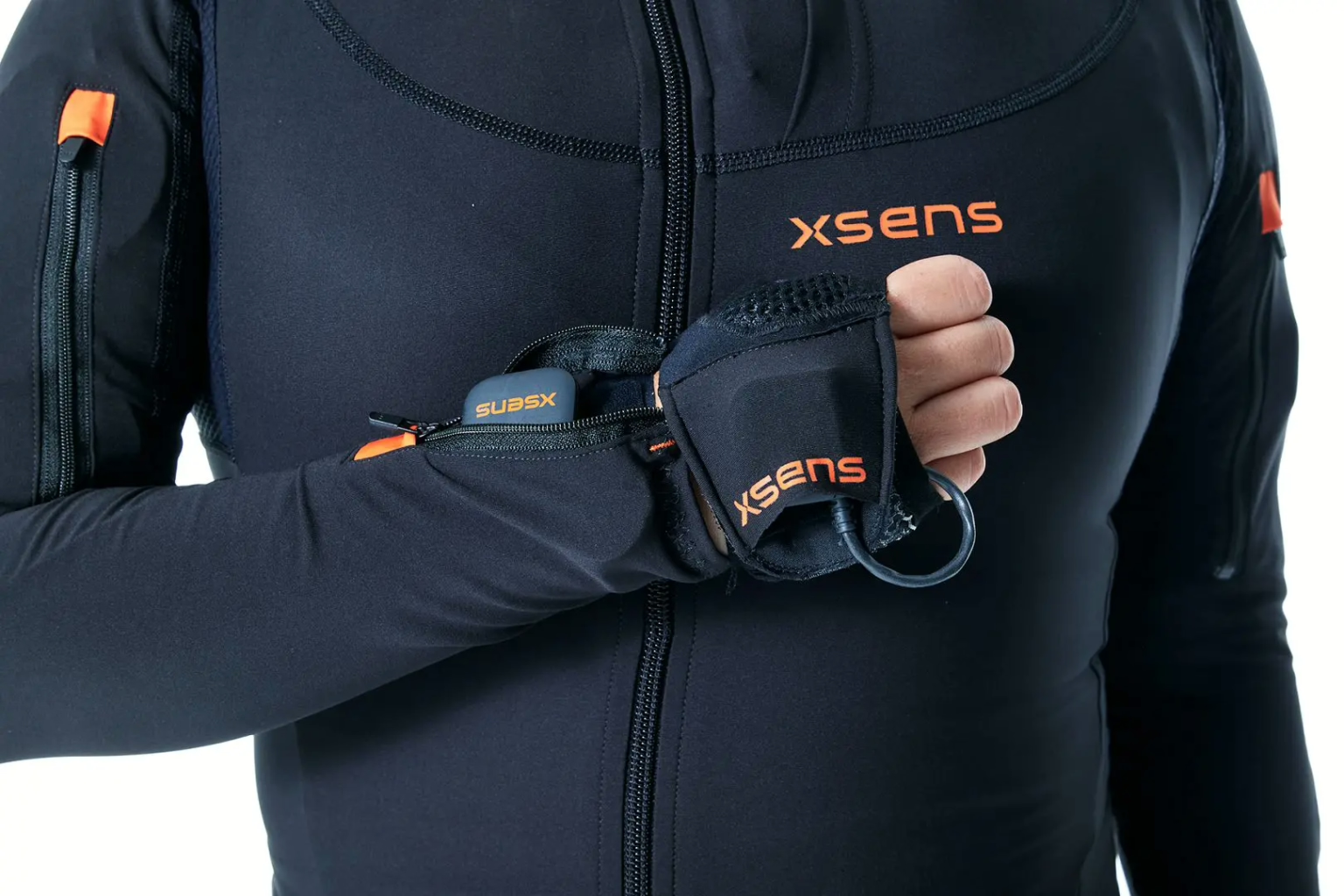


Scaling a wearable product from pilot to mass production requires a structured transition across engineering, manufacturing, and regulatory workstreams — and it rarely happens smoothly without deliberate planning. The core challenge is that a working pilot and a manufacturable product are fundamentally different things: what holds together in a lab or controlled trial often breaks apart under real-world production conditions. The sections below address the most critical questions teams face at each stage of that transition.
What changes when a wearable moves from pilot to production?
When a wearable moves from pilot to production, almost every engineering assumption gets stress-tested at scale. A pilot proves that a concept works; production proves that it works consistently, affordably, and reliably — across hundreds or thousands of units, assembled by people who were not involved in building the original prototype.
The most immediate changes happen in three areas. First, component sourcing shifts from flexible to fixed: the off-the-shelf parts and hand-soldered connections that served a pilot well must be replaced with components that are available in volume, stable in supply, and compatible with automated assembly processes. Second, tolerances tighten. A textile integration that was hand-sewn by a specialist in a controlled environment must now be reproducible on a production line, which demands precise specifications for every seam, connector, and enclosure. Third, quality control becomes a formal discipline rather than an informal check — every unit must meet a defined standard, not just the ones the development team inspects personally.
There is also a significant documentation burden that catches many teams off guard. Production requires complete technical files: bills of materials, assembly instructions, test protocols, firmware version control, and traceability records. None of these exist in a meaningful form after a pilot unless someone has been building them deliberately throughout development. Teams that treat documentation as an afterthought often find themselves rebuilding their entire technical record from scratch before a manufacturer will accept a handover.
What are the biggest technical barriers to scaling a wearable?
The biggest technical barriers to scaling a wearable are electronics-textile integration consistency, component obsolescence, battery performance under real-world conditions, and firmware stability across production variants. Each of these can halt a production ramp independently — and they frequently compound each other.
Electronics-textile integration at scale
Integrating electronics into textiles is one of the most technically demanding aspects of wearable product development. Conductive yarns, printed electronics, and modular attachment systems all behave differently when subjected to repeated washing, stretching, and body movement. A connection that survives a three-month pilot may fail at unit 200 on a production line if the integration method was not designed with manufacturability in mind from the start. Selecting the right technique — and locking it down before tooling is committed — is a decision that has significant downstream consequences for both cost and reliability.
Firmware and hardware stability across units
Firmware that was tuned for a single prototype often behaves differently when deployed across a batch of units with minor hardware variations. Component tolerances, sensor placement differences, and battery charge states all affect how firmware performs in practice. Production-grade firmware must be robust to these variations, not optimised for one idealised unit. This requires systematic testing across the full range of expected hardware states — something that takes time and a structured methodology, not just a final round of debugging before shipment.
When should regulatory certification be addressed in the process?
Regulatory certification should be addressed at the beginning of the development process, not at the end. The specific requirements of the applicable regulatory framework — whether that is the EU Medical Device Regulation (MDR) for health wearables, CE marking for consumer products, or ATEX certification for hazardous environments — directly influence hardware design, material selection, software architecture, and clinical validation strategy.
Teams that defer certification planning until after a prototype is complete often discover that their design choices are incompatible with regulatory requirements, forcing expensive redesigns. For medical wearables in particular, MDR compliance shapes decisions as fundamental as which sensors are used, how data is stored and transmitted, and what clinical evidence must be gathered before market entry. These are not questions that can be retrofitted onto a finished product.
A practical rule of thumb: if your wearable will require any form of regulatory approval, involve a certification specialist during the feasibility or proof-of-concept phase. The cost of early guidance is a fraction of the cost of a late-stage redesign. For Class I and Class II medical wearables under MDR, this also means building a technical file from the first day of development — not assembling one retrospectively when a notified body asks for it.
How do you choose a manufacturing partner for a wearable product?
Choosing a manufacturing partner for a wearable product requires evaluating their experience with the specific integration challenges your product presents — not just their general electronics or textile manufacturing capability. A partner who excels at rigid PCB assembly may have no experience with flexible circuits embedded in stretch fabric, which is a fundamentally different manufacturing discipline.
The key criteria to evaluate when selecting a manufacturing partner include:
- Relevant material experience: Have they worked with the specific textile substrates, conductive materials, or enclosure types your product uses?
- Quality management systems: Do they operate under ISO 13485 (for medical devices), ISO 9001, or an equivalent standard appropriate to your sector?
- Minimum order quantities and flexibility: Can they support a first series of 30 to 50 units before scaling, or do their economics only work at volumes that are premature for your stage?
- Traceability and documentation: Can they provide the component-level traceability and production records your regulatory framework requires?
- Geographic and supply chain stability: Is their component supply resilient to the disruptions that have repeatedly affected electronics manufacturing in recent years?
It is also worth considering whether your development partner has existing relationships with production partners who understand wearable-specific requirements. A manufacturer who has never dealt with washable electronics or body-worn sensor systems will face a steep learning curve at your expense.
How does design-for-manufacturability affect a wearable’s final cost?
Design-for-manufacturability (DFM) has a direct and substantial impact on a wearable’s final unit cost, production yield, and time to market. A wearable designed without manufacturing constraints in mind will almost always cost more to produce, take longer to assemble, and generate higher defect rates than one where manufacturing feasibility was considered from the start of the design process.
In wearable development specifically, DFM decisions that affect cost most significantly include connector selection and placement, the method used to attach electronics to textile substrates, enclosure design and its compatibility with injection moulding or other production processes, and the testability of each unit at the end of the production line. A connector that is easy to prototype by hand may require a custom fixture to assemble reliably at volume — and that fixture has a cost that must be factored into the production economics.
The financial stakes are real. Tooling for a single injection-moulded enclosure typically runs between €1,100 and €500,000 depending on complexity. Committing to tooling before a design has been reviewed for manufacturability is one of the most common and costly mistakes in wearable product development. A DFM review — ideally conducted before any tooling is ordered — allows teams to identify and resolve these issues when changes are still inexpensive.
What should a wearable pilot programme validate before scaling?
A wearable pilot programme should validate user comfort and wearability, sensor reliability under real movement conditions, battery performance in actual use patterns, firmware stability over extended sessions, and the product’s perceived value to end users — before any significant investment in tooling, certification, or scaled production is committed.
Each of these validation areas serves a specific purpose in de-risking the production decision:
- Comfort and wearability: A device users find uncomfortable will not be worn consistently, which undermines both clinical outcomes and product adoption. This must be tested in realistic conditions, not controlled lab settings.
- Sensor reliability: Sensors that perform accurately on a bench behave differently on a moving body. Motion artefacts, skin contact variability, and real-world temperature and humidity all affect signal quality in ways that only field testing reveals.
- Battery performance: Actual usage patterns rarely match the assumptions made during development. A pilot reveals the gap between projected and real battery life — and gives teams the data needed to optimise before production locks in the hardware configuration.
- Firmware stability: Extended real-world use surfaces edge cases, memory issues, and connectivity failures that bench testing misses. A pilot run of meaningful duration is the only reliable way to expose these before they become production-scale problems.
- Perceived value: Does the product actually change behaviour or deliver the outcome it was designed for? This is the question that determines whether a product has a market — and it is far cheaper to answer it during a pilot than after a production run.
Industry experience consistently shows that teams who validate too late — committing to production tooling before these questions are answered — face the highest rates of costly redesign or outright product failure. The goal of a pilot is not to prove that the product works in ideal conditions. It is to surface every assumption that has not yet been tested in reality.
How Elitac Wearables helps with scaling wearable products from pilot to production
For product managers, CTOs, and heads of product navigating the pilot-to-production transition, the challenge is rarely a single technical problem — it is the coordination of hardware, firmware, textile integration, regulatory compliance, and manufacturing readiness across a compressed timeline, often without an in-house team that has done it before.
Elitac Wearables provides end-to-end wearable product development services specifically built for this transition. As a development partner, Elitac brings every relevant discipline under one roof, so the decisions that affect manufacturability, certification, and production yield are made by the same team that designed the product — not handed off to a manufacturer who was not involved in the design process.
Concretely, this means:
- Design-for-manufacturability review integrated into the development process, before tooling is committed
- Certification planning from the feasibility phase, with MDR, CE, and ATEX experience across medical, defence, and industrial wearables
- Battery performance optimisation at the system level, with demonstrated results of up to 50% battery life extension without hardware redesign
- In-house first-series production of 30 to 50 units for certification and market validation, before handover to scaled external manufacturing
- A structured six-phase development process that builds the technical documentation required for production from day one
If your wearable product is at the pilot stage and you are assessing what it will take to reach production reliably and within budget, the right time to have that conversation is before the next major commitment is made. Contact Elitac Wearables to discuss where your project stands and what the path forward looks like.