

Wearable product development is significantly more complex than standard electronics development because it requires the simultaneous integration of hardware, firmware, textiles, biosensing, human factors, and regulatory compliance — all within a product that must be worn on a human body. Each discipline introduces its own constraints, and those constraints interact with one another in ways that are difficult to predict and expensive to resolve late in the process. The sections below unpack the most common questions that product teams, R&D directors, and CTOs face when they first encounter the true scope of custom wearable product development.
What makes wearable development different from standard electronics?
Wearable product development is different from standard electronics development because the human body is the operating environment. Every design decision — component placement, material selection, power management, form factor — must account for movement, sweat, skin contact, variable body shapes, and long-duration wear. A circuit board that works perfectly on a bench may fail completely when strapped to a moving person.
In conventional electronics, the enclosure is largely a mechanical afterthought. In wearables, the enclosure is the product. Whether it is a rigid housing clipped to a garment or electronics woven directly into a textile, the physical form determines comfort, durability, washability, and user compliance. A wearable that is technically functional but uncomfortable will simply not be worn — which means it delivers no value at all.
There is also the question of power. Wearables must operate on small batteries for extended periods, often without the ability to recharge frequently. This forces engineering trade-offs that do not exist in plugged-in or bench-mounted electronics: which sensors can be duty-cycled, how aggressively can the firmware manage sleep states, and what communication protocol minimises radio-on time without sacrificing data quality? These are system-level problems that span hardware, firmware, and software simultaneously.
Finally, wearables are intimate products. They touch skin, they are worn in public, and they are often used in high-stakes contexts — medical monitoring, military navigation, industrial safety. That intimacy raises the bar for reliability, safety, and regulatory compliance far beyond what most electronics projects face.
Why do wearables require so many different disciplines at once?
Wearables require multiple disciplines simultaneously because no single engineering domain can account for all the constraints a body-worn device must satisfy. Hardware, firmware, textile engineering, biosignal processing, human factors, and certification expertise are not sequential steps — they are interdependent variables that must be balanced together from the earliest design decisions.
Consider what happens when these disciplines are handled in isolation. A hardware team designs a rigid PCB that is technically excellent but impossible to integrate into a flexible garment. A textile team selects a fabric that is comfortable and washable but incompatible with the conductive yarns the electronics team assumed would be used. A firmware team optimises for data throughput without knowing that the biosignal processing team needs a different sampling rate to reduce motion artefacts. Each of these conflicts is resolvable — but only if the teams are talking to each other from day one.
The disciplines that typically need to be active in parallel during wearable development include:
- Embedded hardware design — component selection, PCB layout, power management, and miniaturisation
- Firmware and embedded software — real-time operating systems, sensor drivers, communication stacks, and power optimisation
- Electronics-textile integration — selecting and implementing conductive yarns, printed electronics, or modular attachment methods
- Biosignal sensing — electrode selection, signal conditioning, and motion artefact management for ECG, EMG, EEG, or IMU-based data
- Haptic feedback systems — actuator selection (ERM, LRA, or piezo), placement, and firmware-level pattern design
- Human factors and UX — wearer comfort, donning and doffing, interaction design, and real-world usage behaviour
- Certification — MDR, CE marking, ATEX, or military standards that must influence hardware and software choices from the start
When one supplier handles hardware, another handles textiles, and a third handles software, no single party is accountable for how those layers interact. That fragmentation is where most wearable projects stall.
What are the biggest technical challenges in wearable product development?
The biggest technical challenges in wearable product development are electronics-textile integration, power management, signal quality in motion, and miniaturisation — all of which must be solved simultaneously rather than sequentially. Each challenge is tractable on its own, but the interactions between them are where projects most commonly run into serious difficulty.
Electronics-textile integration
Embedding electronics into textiles is one of the most technically demanding aspects of wearable development. Conductive yarns, printed electronics, and modular snap-on systems each have different trade-offs around washability, flexibility, signal integrity, and manufacturing complexity. Selecting the wrong integration approach early in development can invalidate months of work when the product reaches durability testing or user trials.
Power management and battery life
Battery life is consistently one of the most underestimated challenges in biometric wearable product development. The root causes of poor battery performance are rarely a single component — they are typically distributed across firmware (components left active longer than necessary), sensor configuration (polling rates not matched to actual usage patterns), and radio communication (inefficient data transmission intervals). Resolving battery issues requires a system-level audit across hardware, firmware, and data architecture, not a component swap.
Signal quality and motion artefacts
Wearable biosensors must produce reliable data from a moving body. Dry electrodes — preferred in wearables because they do not require gel and are more practical for long-term use — are more susceptible to motion artefacts than wet electrodes used in clinical settings. Managing these artefacts requires careful electrode placement, material selection, signal processing algorithms, and often hardware-level filtering. Getting this right for a specific use case (high-intensity sport versus sedentary medical monitoring) requires significant domain knowledge.
Miniaturisation
Wearable electronics must be small, light, and unobtrusive. Miniaturisation increases the complexity of PCB design, limits thermal management options, and often requires custom component selection. When miniaturisation is combined with a requirement for new technology — such as a novel haptic actuator or a custom biosensor configuration — development timelines and costs increase substantially.
How does certification and regulation affect wearable development timelines?
Certification and regulation affect wearable development timelines significantly — and the impact is greatest when regulatory requirements are not considered from the start. For medical wearables subject to EU Medical Device Regulation (MDR), the documentation burden, risk management requirements, and clinical evidence standards can add substantial time and cost if hardware and software decisions were made without them in mind.
The key regulatory frameworks that affect wearable development include:
- EU MDR (Medical Device Regulation) — applies to Class I and Class II medical wearables; requires a technical file, risk management documentation, clinical evaluation, and in some cases notified body involvement
- CE marking — required for market access in the EU across a wide range of wearable categories, including non-medical products
- ATEX certification — required for wearables used in hazardous environments (explosive atmospheres), such as industrial safety applications
- Military certification standards — vary by country and application, but typically require ruggedisation testing, environmental performance validation, and specific documentation
The most common mistake is treating certification as a final step rather than a design input. If a hardware team selects components without considering MDR biocompatibility requirements, or a firmware team builds a data architecture that cannot produce the audit trail MDR demands, the cost of retrofitting compliance is far higher than designing for it from the outset. For medical-grade or ATEX-certified wearables, total development costs can be two to three times higher than equivalent non-certified products — not because certification itself is expensive, but because it shapes every other decision in the development process.
Why do so many wearable prototypes fail to reach production?
Most wearable prototypes fail to reach production because they were built to demonstrate a concept rather than to survive real-world use. A prototype that works in a controlled lab environment is not the same as a product that functions reliably on a moving body, across different users, in variable environmental conditions, over thousands of use cycles. Bridging that gap is where the majority of wearable development effort — and failure — is concentrated.
The most common reasons wearable prototypes stall before production include:
- Reliability gaps — connections that hold in a lab fail under repeated flexion, sweat exposure, or washing cycles
- Component obsolescence — prototypes built around specific components that are unavailable at production volumes or have been discontinued
- Unresolved integration conflicts — hardware and textile choices that worked independently but are incompatible at scale
- Battery performance that degrades under real use patterns — lab testing rarely replicates the actual duty cycles users impose on a device
- Certification blockers — prototypes built without regulatory awareness that require significant redesign before they can be submitted for approval
- Manufacturing complexity — designs that are feasible in small numbers but cannot be produced consistently at pilot or series scale
There is also a structural problem: many organisations reach prototype stage with a single discipline leading development — often software or hardware — without the textile, human factors, and certification expertise needed to take the product further. The prototype exists, but the team that built it does not have the capability to resolve the reliability, integration, and compliance challenges that stand between it and production.
This is what is sometimes called the wearable reliability gap — the distance between a working demonstrator and a product that is robust enough for real-world deployment. Crossing it requires a different set of skills and a more rigorous development methodology than building the prototype required in the first place.
When should a company bring in a specialist wearable development partner?
A company should bring in a specialist wearable development partner as early as the feasibility stage — and certainly before making significant hardware or textile commitments. The earlier a specialist is involved, the more influence they can have on decisions that are expensive to reverse: component selection, integration approach, power architecture, and certification strategy.
That said, there are four specific situations where bringing in external wearable expertise is particularly critical:
- No in-house wearable capability — the organisation has domain expertise (medical, defence, sports) but has not previously developed body-worn electronics and does not have the multi-disciplinary team to do so
- Standard components or single-discipline suppliers are insufficient — the project requires custom haptics, electronics-textile integration, or biosignal sensing that generic electronics suppliers cannot deliver
- A prototype exists but is not reliable enough for real-world use — the concept has been validated, but the product consistently fails under actual conditions and the internal team has reached the limit of what it can resolve
- The project is stuck at the transition to production — development has progressed but manufacturing, certification, or component scalability is blocking the path to market
Bringing in a specialist partner at any of these points is more cost-effective than attempting to build the missing capability in-house, particularly for organisations that do not intend to make wearable development a permanent core function.
How Elitac Wearables helps with wearable product development
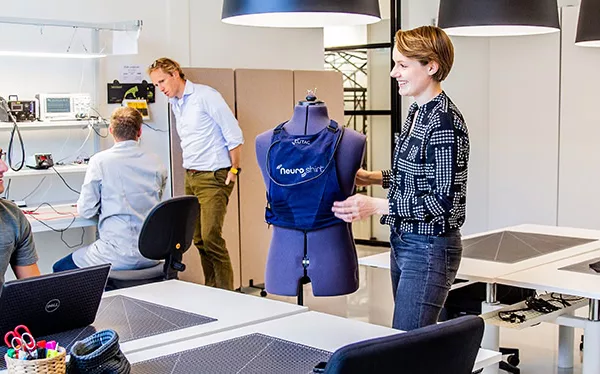
Elitac Wearables provides end-to-end wearable product development services for organisations in the medical, safety, and sports sectors that need a technically capable partner rather than a generic electronics supplier. For CTOs, product directors, and R&D leads who are navigating the complexity described above, the practical value of working with Elitac is straightforward: every discipline needed to take a wearable from concept to certified, market-ready product is available in-house, under one roof, with a single team accountable for the outcome.
What that means in practice:
- Hardware, firmware, textile integration, biosignal sensing, haptics, and human factors expertise are all managed by one team — no handoffs between suppliers, no knowledge gaps at the boundaries
- The proprietary TacOS firmware platform reduces development time and cost for projects that require a reliable embedded operating system purpose-built for wearables
- Certification guidance — including MDR, CE marking, ATEX, and military standards — is integrated into the development process from the feasibility stage, not bolted on at the end
- The 180m² in-house Wearables Lab enables rapid iteration, faster prototyping, and lower client risk at every stage of the development cycle
- Experience across 50+ products and more than a decade of wearable development means the team has encountered and resolved the failure modes that most commonly block projects from reaching production
If your organisation has a wearable development challenge — whether you are starting from an idea, stuck with a prototype that is not production-ready, or navigating a certification requirement you did not anticipate — speak to the Elitac Wearables team to discuss where your project stands and what the right next step looks like.
Related Articles
- What are the biggest challenges in electronics integrated into textiles?
- Are military wearables waterproof and ruggedized for combat?
- How do haptic feedback wearables reduce notification fatigue?
- How do you start developing a wearable product?
- What is the difference between a prototype and an MVP in wearable development?