
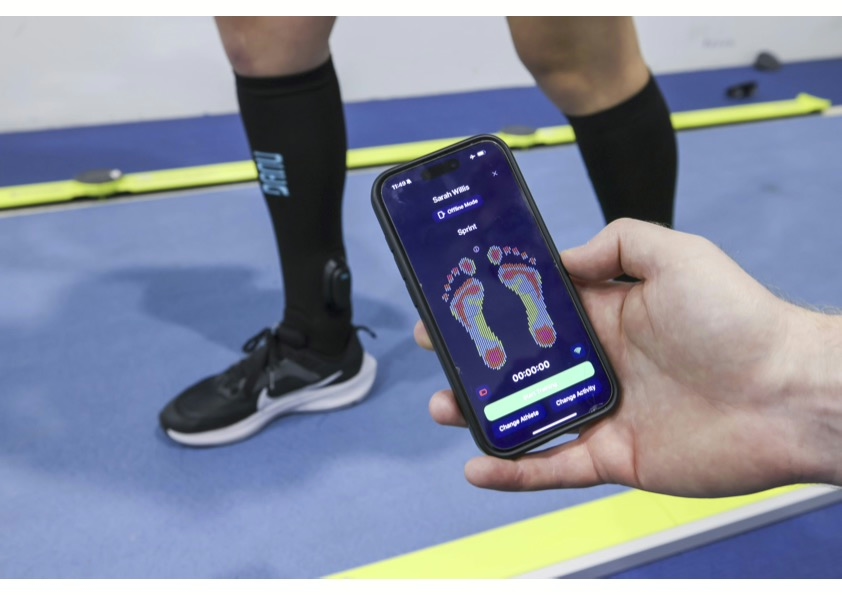
A wearable product developer takes a concept for a body-worn device and turns it into a functioning, market-ready product. That means owning the full development journey: from initial feasibility and proof of concept through prototyping, user testing, certification, and production. For organisations without in-house wearable expertise, a specialist developer is not just a supplier — they are the technical backbone of the entire project.
Wearable development sits at the intersection of electronics, textiles, firmware, human factors, and regulatory compliance. No single discipline is sufficient on its own, which is why the right development partner brings all of them together under one roof. The sections below unpack what that actually looks like in practice — from the stages covered to the deliverables you should expect.
What stages of development does a wearable product developer cover?
A wearable product developer covers every stage from initial concept validation through to scaled production. The full journey typically spans six structured phases: feasibility check, proof of concept, pilot samples, final prototypes, first series production, and scaled manufacturing. Each phase has defined outputs, timelines, and decision points that reduce risk as the project progresses.
The feasibility check is where the developer verifies whether the proposed technology, materials, and form factor are viable for the intended application. This is a critical early gate — it prevents teams from investing months of development budget in a direction that has a fundamental technical flaw. A well-run feasibility check takes one to four weeks and produces a clear go/no-go recommendation.
From there, the proof of concept stage builds a basic functional version using off-the-shelf components and proven building blocks. The goal is not a finished product — it is enough to gather early market feedback and validate core assumptions. Pilot samples then follow, allowing the team to explore form factor and features in controlled user testing environments before committing to final design decisions.
Final prototypes incorporate all required features and the finished form factor, ready for uncontrolled real-world user testing. First series production — typically 30 to 50 units — enables certification, early sales, and market exploration. Scaled production follows once the design is locked and manufacturing documentation is complete. The total timeline from concept to market typically runs between six months and three years, depending on complexity, certification requirements, and how mature the starting concept is.
What disciplines does wearable product development require?
Wearable product development requires expertise across at least six distinct disciplines working in close coordination: haptic feedback systems, electronics-textile integration, biosignal sensing and processing, embedded hardware design, firmware and embedded software, and human factors and UX. Certification guidance and production coordination round out the full capability set needed to bring a compliant, wearable product to market.
The reason multi-disciplinary depth matters so much is that decisions in one layer directly affect every other. A firmware choice affects battery life. A textile construction choice affects how sensors make contact with skin. A component selection affects whether the device can pass MDR or CE certification. When these disciplines are fragmented across separate suppliers, no single party is accountable for the whole — and that is where most wearable projects stall.
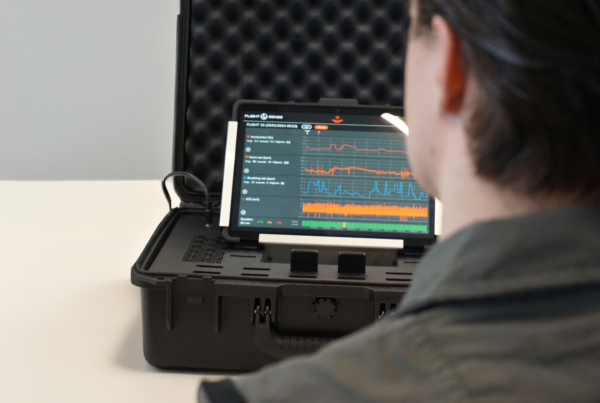
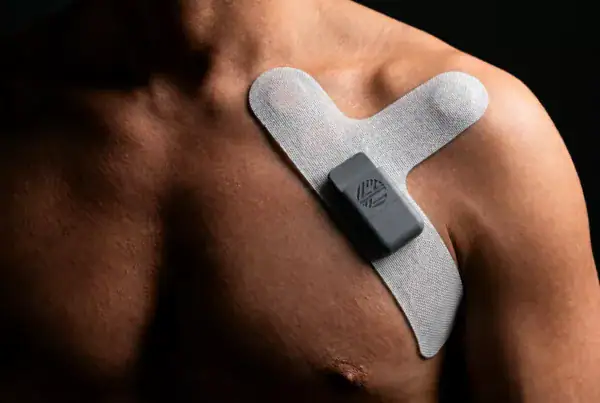
Biosignal sensing is a particularly technical area. Whether the application involves ECG, EMG, EEG, or movement sensing via IMU, the developer must understand how to select appropriate electrodes for the use case, manage motion artefacts in high-movement conditions, and integrate sensors into textile substrates without compromising signal quality or wearer comfort. These are not problems that a general electronics engineer can solve without domain-specific experience.
Haptics adds another layer of specialisation. Selecting between ERM, LRA, and piezo actuators for a body-worn device involves trade-offs in power consumption, form factor, frequency response, and skin perception — decisions that require both engineering knowledge and an understanding of how the human body processes tactile stimulation. Firmware must then be written to drive those actuators in patterns that are meaningful and perceptible to the wearer in real-world conditions.
How is a wearable product developer different from a general hardware engineer?
A wearable product developer is different from a general hardware engineer because wearables introduce constraints that standard electronics development does not face: the device must flex, breathe, wash, conform to the body, stay comfortable during extended wear, and often meet medical or industrial safety certification standards. A hardware engineer who has not worked in this domain will consistently underestimate these constraints.
General hardware engineering optimises for function and manufacturability on a rigid substrate. Wearable development adds the body as a variable. Skin conductivity, sweat, movement, pressure points, and wearer behaviour all affect how a device performs in the field. A sensor that works perfectly on a bench may produce unusable data the moment a person starts moving, sweating, or wearing the device incorrectly — and a wearable developer designs for that from day one.
Electronics-textile integration is a discipline that does not exist in conventional hardware development. Choosing between conductive yarns, printed electronics, and modular attachment systems requires an understanding of washability requirements, mechanical stress during movement, and how textile construction interacts with electronic performance over time. Getting this wrong does not just affect product quality — it can make a device uncertifiable or unsellable.
Battery performance is another area where the gap shows up clearly. In a standard electronics project, battery life is a hardware specification. In wearable development, it is a system-level challenge. Firmware keeping components active longer than necessary, sensors and radios not optimised for real-world usage patterns, and inefficient data handling intervals all drain battery life in ways that only become apparent in extended field use. A specialist developer treats power management as an integrated design problem from the start, not a late-stage fix.
What does the prototyping process look like for a wearable device?
Wearable device prototyping moves through three distinct stages: a proof of concept built with off-the-shelf components to validate core functionality, pilot samples that explore form factor and features in controlled user testing, and final prototypes with all required features and the finished form factor for uncontrolled real-world testing. Each stage produces specific outputs and informs the next round of design decisions.
The proof of concept stage prioritises speed and cost efficiency over refinement. The objective is to answer a specific technical or functional question — does this sensing approach work on the body? Can this haptic pattern be perceived through this textile? Does the device hold charge long enough for a realistic use session? Proprietary firmware platforms, where available, accelerate this stage significantly by providing pre-validated building blocks rather than starting from scratch.
Pilot samples shift the focus toward form factor and user interaction. At this stage, the developer works with two to ten units and introduces real users into the process. Human factors and UX considerations — wearer comfort, donning and doffing, interaction design — become central. Feedback from this phase often drives significant design changes before the team commits to the tooling and component choices required for final prototypes.
Final prototypes, typically five to thirty units, represent the pre-production design. They must perform consistently across all intended use conditions, support the certification testing programme, and be manufacturable at the target cost. At this stage, any remaining technical risks should be resolved. If they are not, they will surface as much more expensive problems during first series production or, worse, in the field.
When should an organisation hire a wearable product development partner?
An organisation should hire a wearable product development partner when the project requires multi-disciplinary expertise that does not exist in-house, when a prototype exists but is not reliable enough for real-world use, or when the project is stuck at the transition to production. Waiting too long — particularly past the proof of concept stage — often means undoing design decisions that were made without wearable-specific knowledge.
The clearest signal that a specialist partner is needed is when the project touches more than one or two of the core disciplines: hardware, firmware, textiles, biosensing, haptics, human factors, and certification. Organisations that are strong in one area — a medical device company with deep regulatory expertise, for example, or a defence contractor with systems engineering capability — frequently underestimate what the wearable layer adds to a project’s complexity.
Another common trigger is a prototype that works in the lab but fails in the field. Motion artefacts in biosensor data, battery life that does not survive a full shift, or a form factor that wearers find uncomfortable within an hour — these are not minor refinements. They are indicators that the device was not designed with real-world use as a primary constraint. A specialist developer can diagnose these issues quickly and restructure the design to address them at the system level.
Organisations that engage a development partner early — at the feasibility or proof of concept stage — consistently achieve faster timelines and lower total development costs than those that bring in external expertise after problems have already accumulated. Early engagement also allows certification requirements to shape hardware and textile choices from the start, rather than forcing expensive redesigns once a regulatory gap is identified late in the programme.
What deliverables should you expect from a wearable product developer?
The deliverables from a wearable product developer depend on the project phase, but across a full engagement you should expect: feasibility reports, functional prototypes at each development stage, user testing documentation, technical specifications, firmware and hardware source files, certification documentation, and production-ready design files. A capable partner also provides project management, risk registers, and clear decision-point reviews throughout the programme.
At the early stages, the primary deliverable is a validated decision. The feasibility report tells you whether your technical approach is sound. The proof of concept tells you whether the core functionality works on the body. These are not just physical artefacts — they are evidence-based recommendations that inform whether and how to proceed, which is exactly what an internal product team or a funding committee needs.
As the project progresses toward final prototypes and first series, deliverables become more concrete:
- Functional prototypes with documented test results from real-world use conditions
- Hardware design files including schematics, PCB layouts, and component specifications
- Firmware source code and documentation, including power management optimisation
- Textile construction specifications and integration technique documentation
- User testing reports from controlled and uncontrolled test phases
- Certification documentation aligned to the applicable regulatory framework (CE, MDR, ATEX, or military standards)
- Production documentation enabling external manufacturing partners to produce at scale
Intellectual property arrangements are also a formal deliverable. By default, IP in the result is owned by the developer, with a non-exclusive licence granted to the client, but exclusive IP transfer is available under a different pricing structure. This should be agreed and documented at the start of the engagement, not negotiated at the end.
How Elitac Wearables supports your wearable product development
Elitac Wearables delivers end-to-end wearable development for organisations that need genuine technical depth, not a generalist electronics house that has added “wearables” to its service list. With over ten years of experience and more than 50 products developed across medical, defence, and sports sectors, the team brings every required discipline in-house: haptic engineering, electronics-textile integration, biosignal sensing, embedded hardware, firmware (including the proprietary TacOS operating system), human factors, and certification guidance.
For decision-makers evaluating a development partner, here is what that means in practice:
- No handoffs between vendors. Hardware, firmware, textiles, and algorithms are developed by a single coordinated team, eliminating the knowledge gaps and accountability gaps that cause most wearable projects to stall.
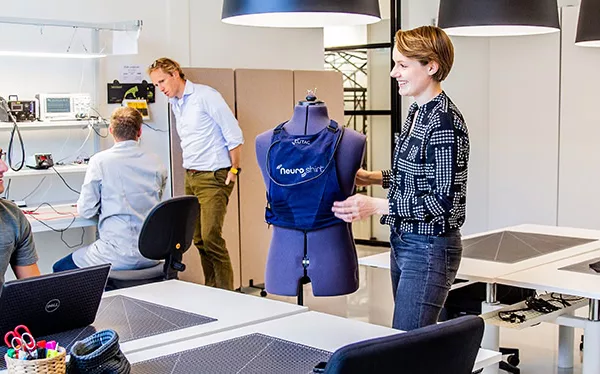
- Faster iteration through in-house infrastructure. The 180m² Wearables Lab in Utrecht, equipped with 3D printers, laser cutters, and permanent software testing set-ups, enables rapid prototyping without external dependencies.
- Certification built in from the start. Whether your product requires CE marking, MDR compliance, ATEX certification, or military qualification, Elitac’s team structures hardware and textile decisions around those requirements from day one.
- Agile delivery with predictable progress. The Agile/Scrum working method ensures regular review points, clear visibility on budget and timeline, and the flexibility to adapt as user testing generates new information.
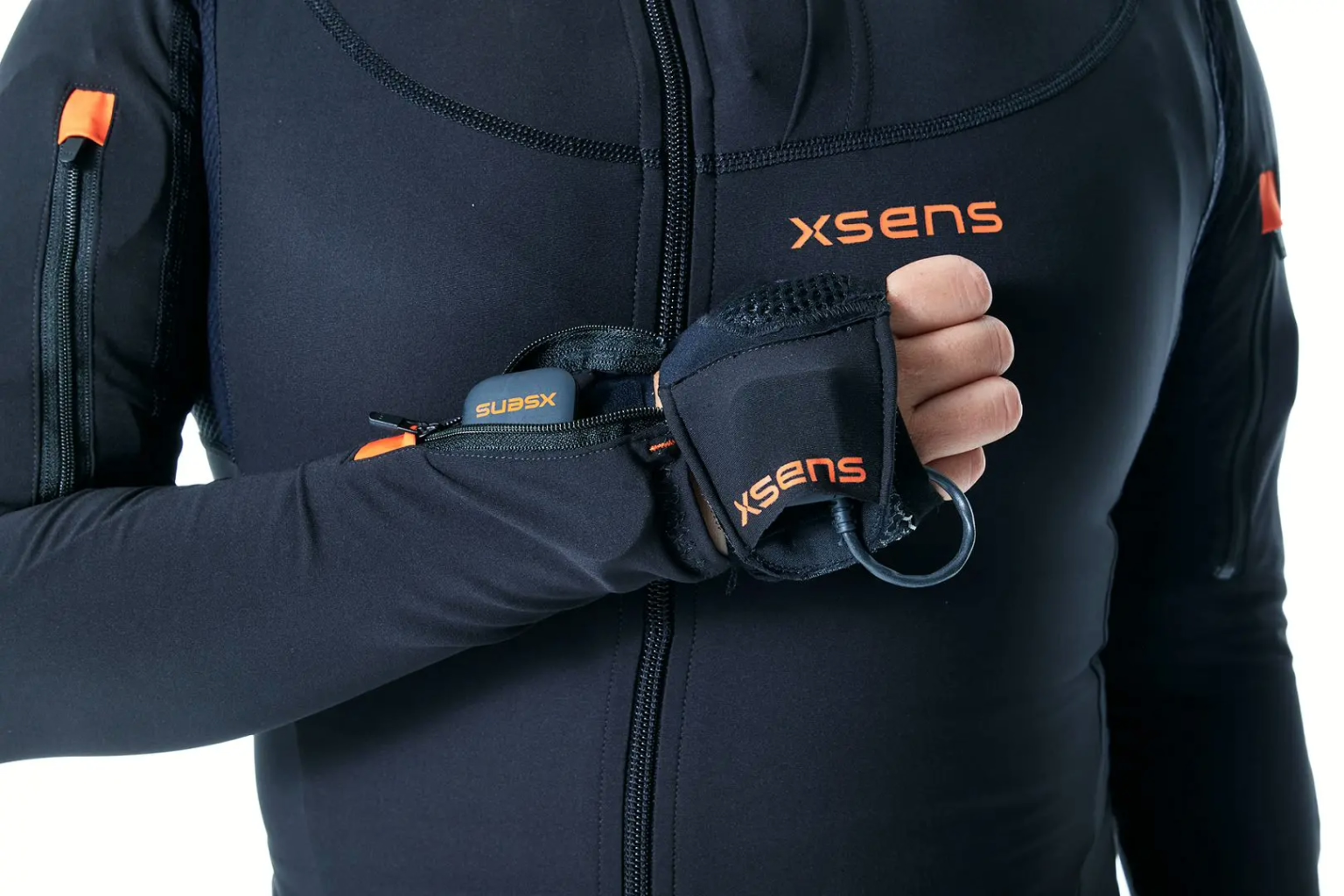
- Proven across complex programmes. Reference projects include the Mission Navigation Belt for the Royal Netherlands Army and motion capture suit development for Xsens, both requiring the kind of multi-disciplinary rigour that standard development houses cannot provide.
If your project is stuck, your prototype is not performing in the field, or you are approaching a development challenge that has no standard solution, contact Elitac Wearables to discuss what the right development path looks like for your specific application.
Related Articles
- What is augmented reality used for in military wearables?
- What is the battery impact of haptic feedback on wearable devices?
- How do haptic feedback wearables reduce notification fatigue?
- What is the role of AI in modern wearable product development?
- What is the difference between wearable and traditional product development?