

Yes, haptic feedback wearables are suitable for enterprise use, and in several industries they are already operating at scale. The key condition is fit: haptic wearables deliver clear, measurable value in environments where visual or audio alerts fail, where hands-free communication matters, or where real-time body-worn feedback improves safety or performance. The sections below break down where they work, what makes deployment complex, and how to evaluate whether the technology is right for your organisation.
What makes haptic feedback wearables different from other enterprise wearables?
Haptic feedback wearables communicate directly through the skin using vibration or pressure, rather than through a screen or speaker. In enterprise contexts, this distinction is significant: the wearer receives information without needing to look at a device or hear an alert, keeping attention where it belongs. Other enterprise wearables, such as smartwatches or GPS trackers, typically relay data to a screen that someone must actively read.
The practical difference becomes clear in demanding environments. A logistics worker wearing a vibrotactile navigation vest receives directional cues through the body. A surgeon wearing a haptic glove gets force feedback during a remote procedure. A soldier using a haptic navigation belt receives compass bearings through coded vibration patterns without breaking situational awareness. None of these interactions require a glance at a screen or a free hand.
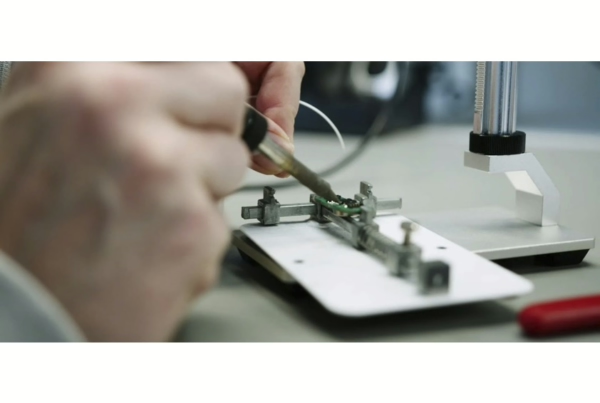
From a technical standpoint, haptic wearables are also more complex to engineer than standard enterprise wearables. The actuators, whether ERM motors, linear resonant actuators, or piezo elements, must be positioned precisely on the body, calibrated for the target sensation, and integrated into a garment or device that remains comfortable and functional under real working conditions. The firmware must control timing and pattern design at a level that most standard electronics suppliers are not equipped to handle. This is why haptic feedback technology sits in a different category from general enterprise wearables: the barrier to entry is higher, and the reward, when it is done well, is proportionally greater.
Which industries are already using haptic wearables at enterprise scale?
Defence, medical rehabilitation, industrial safety, and sports performance are the sectors where haptic wearables have moved beyond pilot programmes into operational use. Each applies the technology differently, but the common thread is an environment where conventional alert systems are insufficient.
Defence and military
Military applications were among the earliest enterprise deployments of haptic feedback technology. Navigation belts that encode compass bearings as vibration patterns allow soldiers to move without consulting a map or device. The Mission Navigation Belt developed for the Royal Netherlands Army is a concrete example: it delivers directional information through coded haptic signals, preserving both hands and visual focus for the task at hand. Ruggedisation, battery performance, and reliability under field conditions are the primary engineering challenges in this sector.
Medical and rehabilitation
Haptic wearables in medical settings serve two distinct functions: providing therapeutic feedback and augmenting clinical procedures. Balance disorder wearables, for instance, use vibrotactile cues to help patients with vestibular impairment maintain stability. In surgical robotics, haptic gloves give surgeons tactile information that camera feeds cannot convey. These applications typically require medical device certification, which adds significant cost and documentation overhead but also opens access to regulated clinical markets.
Industrial safety and workwear
Smart PPE is an emerging but fast-growing application. Haptic alerts embedded in workwear can warn workers of proximity hazards, dangerous posture, or environmental thresholds without requiring them to monitor a device. In high-noise environments such as manufacturing floors or construction sites, vibrotactile warnings outperform audio alerts by a wide margin. Several enterprise safety programmes are currently in late-stage development or early commercial deployment in this space.
Sports and performance
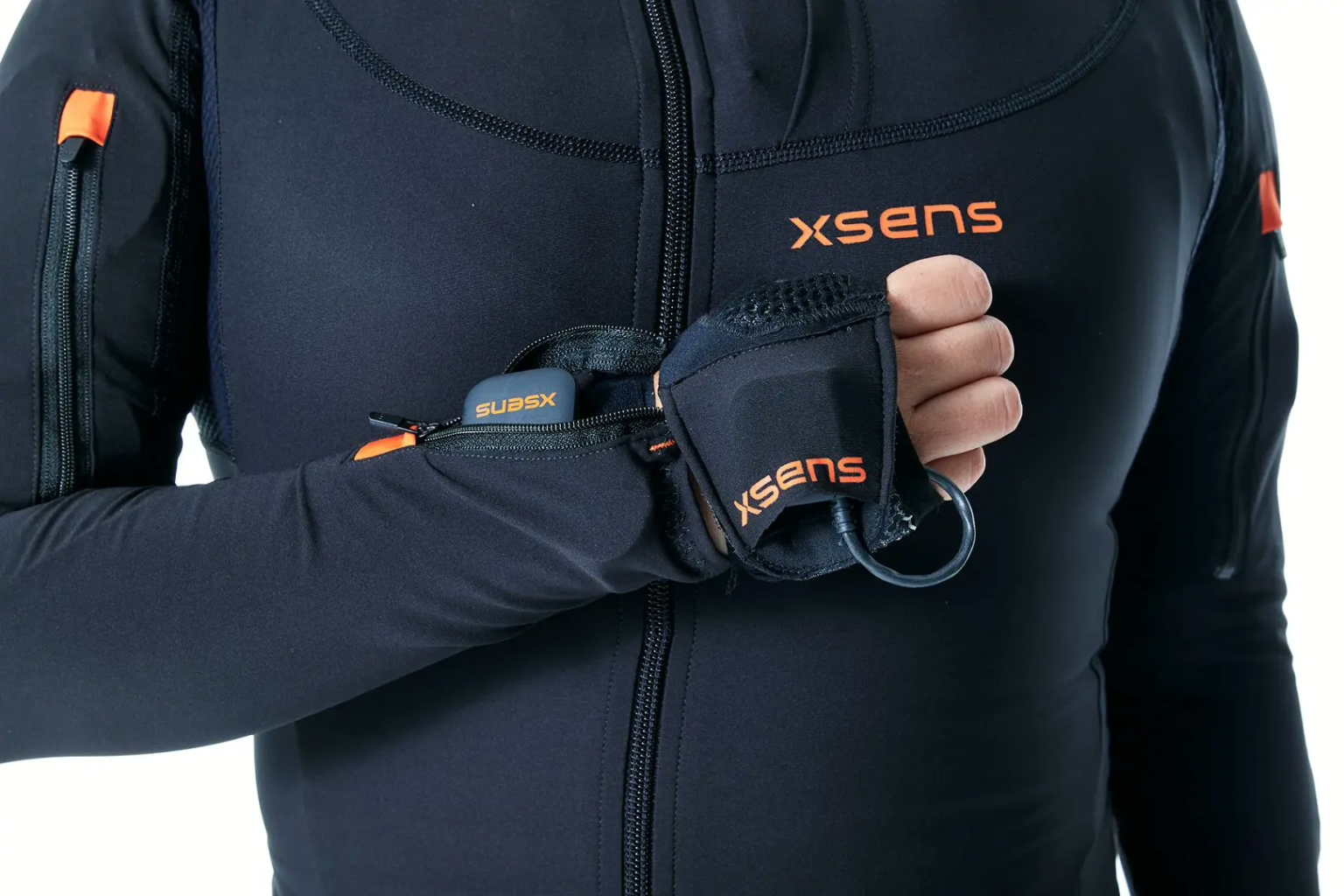
Professional sports teams and sports science institutions use haptic wearables for real-time coaching feedback, movement correction, and biomechanical monitoring. Athletes receive cues during training without interrupting flow, and coaches can programme specific feedback patterns for technique correction. Motion capture suits, such as those developed with Xsens, combine haptic and sensor capabilities for high-fidelity performance analysis.
What are the main technical challenges of deploying haptic wearables in enterprise environments?
The main technical challenges of deploying haptic wearables in enterprise environments are actuator placement and calibration, power management, electronics-textile integration, and firmware reliability under real-world conditions. Each of these can derail a deployment if underestimated during the development phase.
Actuator placement matters more than most teams expect. The body’s sensitivity to vibration varies significantly across locations, and an actuator positioned even a few centimetres from the optimal point can produce ambiguous or ineffective feedback. Getting this right requires user testing across different body types and use cases, not just engineering intuition.
Battery performance is a persistent challenge in enterprise haptic wearables. Actuators draw meaningful current, especially when firing frequently, and the firmware must manage component activation intelligently to avoid draining power mid-shift. Industry experience shows that battery shortfalls late in development are almost always system-level problems, not simply a matter of fitting a larger cell. Optimising across hardware, firmware, and data handling is the more effective path.
Electronics-textile integration is where many enterprise wearable projects stall. Conductive yarns, printed electronics, and modular attachment methods each have different trade-offs for washability, flexibility, and durability. The wrong choice for a given application leads to delamination, signal degradation, or garment failure in the field. This decision requires experience with how textiles behave on moving bodies under real working conditions, not just laboratory testing.
Firmware reliability is the final critical layer. Haptic patterns must fire at the right moment, in the right sequence, with the correct intensity. In safety-critical applications, a missed or mistimed cue is not just a user experience problem. The firmware must be purpose-built for the constraints of wearable hardware, which is why dedicated wearable operating systems, rather than adapted general-purpose code, produce more stable results in enterprise deployments.
How do haptic wearables compare to visual and audio alerts in professional settings?
Haptic wearables outperform visual and audio alerts in professional settings where noise, visual attention demands, or hands-free operation are factors. They underperform where complex information must be conveyed quickly, or where the wearer is not familiar with the feedback vocabulary. The right choice depends on the specific task and environment.
Visual alerts, such as warning lights or screen notifications, require the wearer to look at something. In any task that demands sustained visual focus, this is a meaningful interruption. Audio alerts are masked by industrial noise, headphones, or high-stress situations where auditory processing narrows. Haptic alerts bypass both limitations: they are delivered directly to the body and are perceived even when attention is fully engaged elsewhere.
The limitation of haptic feedback is information density. A vibration pattern can encode direction, urgency, or a small number of predefined states, but it cannot convey the equivalent of a sentence. Enterprise deployments that work well with haptics tend to involve a limited set of clearly defined cues, each mapped to a specific action or response. Deployments that require complex, variable information are better served by visual displays, with haptics as a supplementary attention trigger.
In high-noise industrial environments, the comparison is straightforward: haptic alerts are more reliable than audio. In surgical or clinical settings, they preserve sterility and silence. In military applications, they eliminate the light and sound signatures that visual and audio alerts produce. The pattern across sectors is consistent: haptic wearables earn their place when other alert modalities create operational problems.
What should enterprises evaluate before adopting haptic wearable technology?
Before adopting haptic wearable technology, enterprises should evaluate the specific alert or feedback need, the operating environment, regulatory requirements, integration with existing systems, and the total cost of development or procurement. Skipping any of these creates risk downstream.
- Define the feedback need precisely. What information needs to be communicated, to whom, at what frequency, and with what urgency? Vague requirements produce vague wearables. The more specific the use case, the more likely the haptic design will actually work in practice.
- Assess the operating environment. Temperature extremes, moisture, dust, physical impact, and wash cycles all affect component and textile choices. A wearable that performs well in a lab may fail in the field within weeks if the environment was not part of the design brief.
- Identify regulatory obligations early. Medical device applications in the EU require MDR compliance. Hazardous environment deployments may require ATEX certification. Defence applications carry their own standards. Certification adds cost and time, but discovering this requirement late in development adds far more of both.
- Map integration requirements. Most enterprise haptic wearables need to communicate with an external system, whether a positioning system, a sensor network, or a software platform. The communication protocol, data latency, and security requirements must be defined before hardware is specified.
- Budget realistically. Custom haptic wearable development for enterprise use typically starts in the range of tens of thousands of euros for a proof of concept and scales significantly for certified, production-ready products. Organisations that approach this as a low-cost pilot often find themselves stalled at prototype stage without a clear path to deployment.
When does it make sense to build a custom haptic wearable rather than buy one?
Building a custom haptic wearable makes sense when no commercially available product fits the specific use case, when the application requires regulatory certification, when the wearable must integrate with proprietary systems, or when the enterprise intends to own the product commercially. Off-the-shelf haptic devices exist, but their applicability to genuine enterprise problems is narrow.
The consumer haptic wearable market, dominated by smartwatches and fitness bands, is designed for general notification use. These devices are not engineered for industrial durability, clinical accuracy, or the specific feedback vocabularies that enterprise applications require. Adapting them for professional use typically creates more problems than it solves.
Custom development becomes the logical choice in several scenarios. If the wearable must be worn in a specific way, integrated into existing PPE or workwear, or calibrated for a precise body location, off-the-shelf form factors are a poor starting point. If the application involves medical use or hazardous environments, certification requirements effectively mandate custom development, since consumer devices are not certified for these contexts. If the enterprise plans to commercialise the product or protect it as intellectual property, building a proprietary device is the only viable path.
The honest trade-off is cost and time. Custom development requires a longer runway and a larger budget than procurement. But for organisations where the use case is specific, the environment is demanding, or the commercial opportunity is real, the investment in a purpose-built solution consistently outperforms the compromise of adapting a product that was never designed for the job.
How Elitac Wearables helps enterprises develop haptic wearables
For organisations that have worked through the questions above and concluded that a custom haptic wearable is the right path, the next challenge is finding a development partner with the depth to execute it. This is precisely where Elitac Wearables operates.
As a specialist in haptic feedback wearable development, Elitac brings every required discipline under one roof: actuator selection and placement, electronics-textile integration, embedded hardware, firmware including the proprietary TacOS operating system, and human factors design. The team has delivered enterprise haptic wearables across defence, medical, industrial safety, and sports sectors, which means the hard-won knowledge from each domain informs every new project.
For enterprise clients specifically, this translates into:
- Rapid feasibility assessment to determine whether your use case is technically viable before significant budget is committed
- Structured development from proof of concept through to a certified, production-ready product, with no handoffs between vendors
- Specific expertise in MDR, ATEX, and military certification requirements, built into the development process from the start
- Battery performance optimisation as a system-level discipline, not an afterthought
- A proprietary wearable firmware platform that reduces development time and improves reliability compared to building from scratch
If your organisation is at the stage of evaluating whether a haptic wearable is feasible for your application, or if you are already in development and running into technical obstacles, get in touch with Elitac Wearables for a direct conversation with the specialists who have solved these problems before.
Related Articles
- Are electronics integrated into textiles ready for mass-market adoption in 2026?
- How is AI used in military wearable technology in 2026?
- What is the difference between an exoskeleton and a smart vest?
- How do haptic wearables integrate with existing enterprise software?
- What are the stages of wearable product development?