
Haptic feedback in smartwatches delivers silent, tactile alerts through small vibration motors embedded in the device, allowing the watch to communicate with the wearer through touch rather than sound or screen. This makes it possible to receive notifications, navigation cues, and health alerts without looking at a display or disturbing those around you. The sections below break down exactly how it works, what it is used for, and where the technology is heading.
How does haptic feedback work in a smartwatch?
Haptic feedback in a smartwatch works by driving a small actuator against the wearer’s wrist to produce a controlled vibration or pulse that the skin perceives as a tap, buzz, or rhythmic pattern. The watch’s processor sends a signal to the actuator, which converts electrical energy into mechanical movement in milliseconds, creating a physical sensation the wearer feels without any sound or visual output.
Most consumer smartwatches use one of two actuator types. The first is an ERM (Eccentric Rotating Mass) motor, which spins an off-centre weight to generate vibration. ERMs are inexpensive and reliable, but their spin-up and spin-down time limits the precision of the patterns they can produce. The second is an LRA (Linear Resonant Actuator), which moves a mass back and forth along a single axis at a resonant frequency. LRAs respond faster, consume less power, and produce sharper, more distinct sensations, which is why higher-end smartwatches have largely adopted them.
A third option, piezo actuators, uses piezoelectric material that deforms when voltage is applied. Piezo actuators offer extremely fast response times and fine-grained control, making them particularly suited to applications where subtle, precise feedback matters, such as medical or professional wearables. The choice of actuator, combined with the firmware that controls timing and pattern design, determines how expressive and useful the haptic output actually is.
What types of notifications use haptic feedback in smartwatches?
Virtually every notification category on a modern smartwatch can be assigned a haptic alert, including incoming calls, messages, calendar reminders, app alerts, and alarms. The watch translates each notification type into a distinct vibration pattern, so an experienced wearer can often identify what kind of alert they have received without glancing at the screen.
Common notification types handled through haptic alerts include:
- Incoming calls: typically a continuous or repeating pulse that mimics a ringing pattern
- Text messages and emails: a short double-tap or single buzz to signal new content
- Calendar and meeting reminders: a distinct pattern timed to fire ahead of the event
- App-specific alerts: banking, fitness, and productivity apps can each be assigned unique patterns where the operating system permits
- Alarms and timers: sustained or escalating vibrations designed to wake or prompt the wearer
The effectiveness of these alerts depends heavily on pattern design. A single undifferentiated buzz for every notification quickly becomes meaningless, whereas a thoughtfully designed haptic vocabulary, where each alert type has a recognisable rhythm, allows the wearer to act on information without breaking concentration or reaching for the device.
How is haptic feedback used for navigation on a smartwatch?
Haptic feedback enables turn-by-turn navigation on a smartwatch by delivering directional cues through distinct vibration patterns rather than audio instructions or screen prompts. A common convention uses a double tap to signal a right turn and a sustained pulse to signal a left turn, allowing the wearer to navigate confidently while keeping eyes and attention elsewhere.
This approach is particularly valuable for cyclists, runners, and pedestrians who need directional guidance without staring at a screen or using earphones. It is also the principle behind professional and military navigation wearables, where silent, hands-free guidance is operationally critical. Elitac Wearables developed the Mission Navigation Belt for the Royal Netherlands Army on exactly this premise: delivering GPS navigation through haptic cues worn at the torso, keeping soldiers’ hands, eyes, and ears completely free in the field.
The challenge in haptic navigation is designing patterns that are intuitive under real-world conditions, where the wearer may be moving quickly, wearing gloves, or operating in a high-stress environment. Pattern clarity, actuator placement, and firmware timing all affect whether the cue is understood correctly and acted on in time.
What health and fitness functions rely on haptic alerts?
Smartwatches use haptic alerts to support a wide range of health and fitness functions, including heart rate warnings, inactivity reminders, breathing exercise prompts, workout milestone notifications, and irregular rhythm alerts. These tactile signals allow the device to intervene at the right moment without requiring the wearer to monitor a screen continuously.
Key health and fitness applications include:
- Heart rate zone alerts: a pulse when the wearer moves above or below a target training zone during exercise
- Inactivity reminders: a gentle tap after a set period of sedentary behaviour, prompting movement
- Breathing and mindfulness exercises: rhythmic haptic patterns that guide inhale and exhale timing without audio
- Workout pacing: interval alerts that mark rest and effort periods during structured training
- Irregular heart rhythm detection: a haptic prompt directing the wearer to check their ECG reading when an anomaly is detected
- Sleep tracking boundaries: silent alarms calibrated to vibrate the wearer awake without disturbing a partner
In medical-grade wearables, haptic alerts carry even greater responsibility. A device monitoring a patient with a balance disorder, for instance, must deliver feedback that is both timely and clearly interpretable, because the alert directly influences physical behaviour. This is a fundamentally different design challenge from a consumer fitness reminder, requiring clinical validation of the haptic signal itself alongside the underlying sensor data.
What’s the difference between haptic feedback and a regular vibration alert?
The key difference is precision and intent. A regular vibration alert produces a simple, undifferentiated buzz using a basic motor. Haptic feedback uses controlled actuators and purpose-designed patterns to deliver nuanced, information-rich tactile signals. Haptic feedback communicates; a vibration alert merely interrupts.
A standard vibration motor, typically an ERM, generates a generic buzz that feels roughly the same regardless of what triggered it. The wearer knows something happened but has no tactile way to distinguish a call from a message or a navigation cue from a health alert. This is functional but limited.
True haptic feedback adds two layers on top of basic vibration:
- Actuator quality: LRA and piezo actuators produce faster, cleaner, and more precisely timed sensations than a basic ERM motor. The difference in feel is comparable to the difference between a blunt knock and a deliberate tap.
- Pattern design: haptic feedback systems are programmed with specific rhythms, durations, and intensities that carry meaning. A double-tap means something different from a long pulse or a rapid triple burst. This vocabulary is what elevates haptic feedback from a nuisance into a communication channel.
For professional and medical wearables, this distinction is not cosmetic. When a wearable is guiding a soldier through terrain or alerting a patient to a physiological change, the quality and clarity of the haptic signal have direct consequences for performance and safety.
How is haptic feedback in smartwatches evolving?
Haptic feedback in smartwatches is evolving toward greater expressiveness, contextual intelligence, and physical diversity. In 2026, the direction of development points firmly toward actuators that can simulate a wider range of tactile sensations, firmware that adapts patterns based on context, and form factors that move haptics beyond the wrist.
Several trends are shaping this evolution:
- More sophisticated actuators: piezo and advanced LRA technologies are enabling finer-grained sensations, including textures and directional cues that feel distinctly different from one another
- Context-aware haptic patterns: firmware is becoming smarter about when and how to fire alerts, reducing unnecessary interruptions and reserving stronger signals for genuinely urgent events
- Multi-point haptics: rather than a single vibration point at the wrist, emerging wearables distribute actuators across the body, enabling spatial communication that a single-point device cannot replicate
- Integration with biosignal feedback loops: wearables are beginning to combine sensor data with haptic output in real time, so the device responds not just to software events but to the wearer’s physiological state
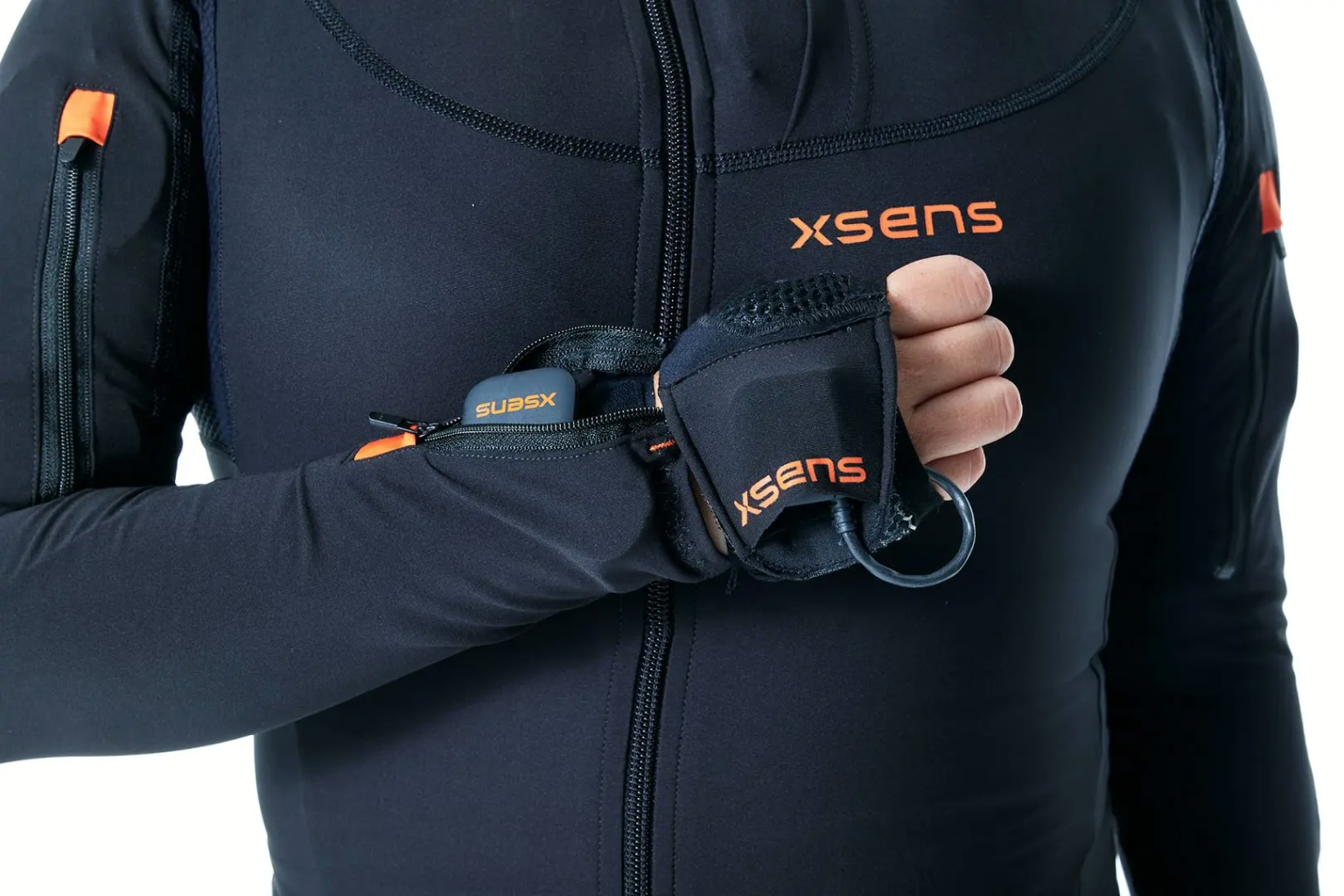
- Soft and textile-integrated actuators: haptic elements embedded directly into garments, rather than housed in a rigid watch case, open up applications in rehabilitation, sports performance, and industrial safety that a wrist-worn device cannot address
The consumer smartwatch represents only one point on the haptic technology spectrum. Professional and medical applications are pushing the boundaries far further, demanding actuator performance, pattern precision, and body placement strategies that mass-market devices have not yet needed to address.
How Elitac Wearables helps with haptic feedback development
For product teams and organisations building wearables where haptic feedback needs to do more than buzz, the engineering challenge goes well beyond selecting an actuator. Pattern design, actuator placement, firmware timing, power management, and human factors testing all interact, and getting any one of them wrong undermines the entire system.
Elitac Wearables provides end-to-end haptic feedback wearable development, covering:
- Actuator selection across ERM, LRA, and piezo technologies matched to the specific application and body location
- Vibration pattern design and optimisation, including firmware-level timing through the proprietary TacOS operating system
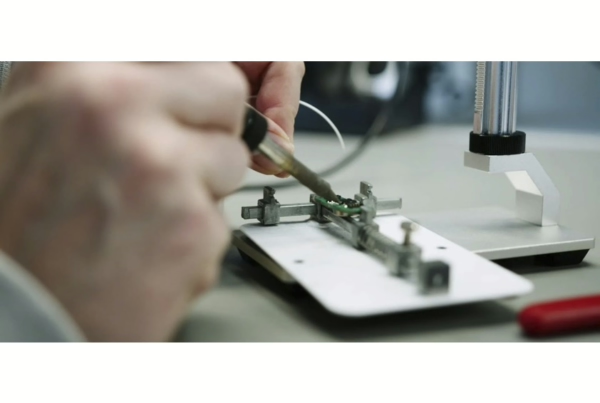
- Full hardware and electronics integration, including PCB design and power management
- Human factors testing to validate that haptic signals are correctly interpreted under real-world conditions
- Certification guidance for medical and professional wearable applications, including MDR compliance for Class I and II devices
Whether you are at the concept stage and need to validate whether haptic feedback is the right interaction model, or further along and facing technical challenges in actuator performance or pattern clarity, the team brings cross-sector experience from medical, military, and sports applications to bear on the specific problem in front of you. If haptic feedback is central to your wearable’s value proposition, speak directly with the engineers who have built it into products already in the field.
Related Articles
- What are the ethical concerns around soldier surveillance via wearables?
- What is the future of military wearable technology?
- How do children and elderly users experience haptic feedback wearables differently?
- What is the role of haptic feedback in fitness wearables?
- How long does wearable product development take?