Defence wearables improve soldier performance by extending human capability in ways that traditional equipment cannot. They deliver real-time physiological monitoring, silent navigation, and situational awareness directly to the body, freeing soldiers to focus on the mission rather than managing information. The sections below unpack the specific technologies involved, how they work, and what it actually takes to build them.
What types of wearable technology are used in defence?
Military wearable technology spans several distinct categories: haptic feedback devices for silent communication, biosignal monitoring systems for health and fatigue tracking, motion capture systems for training and performance analysis, and smart textiles that integrate sensing and communication directly into uniform fabric. Each category addresses a different operational need, and the most capable defence wearables combine several of these functions in a single, ruggedised platform.
The breadth of military wearable technology reflects the complexity of the operational environment. Soldiers operate under conditions that make conventional information delivery unreliable or dangerous. Screens require visual attention. Radios create noise. Physical signals between team members are not always possible. Wearable technology solves each of these problems by moving information delivery directly to the body.
- Haptic navigation belts: Deliver directional cues through vibration patterns, allowing hands-free, eyes-free, and silent navigation in the field
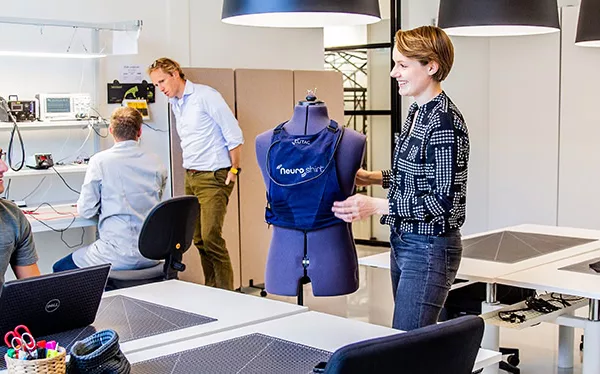
- Biosignal monitoring vests and shirts: Measure heart rate, heart rate variability, respiration, and movement to track physiological load in real time
- Smart textiles: Embed sensors and conductive pathways directly into uniform fabric, removing the need for separate sensor modules
- Exoskeleton and soft robotic systems: Reduce physical strain during load-bearing tasks or rehabilitation after injury
- Motion capture systems: Used in training environments to analyse movement quality, identify injury risk, and improve technique
What unites these categories is a common engineering challenge: electronics must perform reliably on a moving human body, in harsh environmental conditions, without adding meaningful bulk or weight to an already loaded soldier.
How does haptic feedback improve soldier navigation and situational awareness?
Haptic feedback improves soldier navigation by delivering directional information as vibration patterns felt directly on the skin, bypassing the visual and auditory channels that are often occupied or compromised in operational environments. A soldier wearing a haptic navigation belt can receive turn-by-turn guidance without looking at a screen, listening to a radio, or making any visible gesture to teammates.
The operational value of this is significant. In low-visibility conditions, in environments where radio silence is essential, or during high-stress situations where cognitive load is already near its limit, removing the need to consciously process navigation information frees up mental bandwidth for the task at hand. Haptic cues are processed faster than visual or auditory signals in many high-stress scenarios, which matters when seconds count.
A concrete example of this principle in action is the Mission Navigation Belt, developed in collaboration with the Dutch Ministry of Defence. The belt integrates with existing GPS systems and delivers silent, screen-free navigation cues to soldiers through precisely timed vibration patterns. Hands remain free for equipment. Eyes remain on the environment. Ears remain available for command communication. The first order was delivered to the Royal Netherlands Army in 2020, following a development process that began with a Defence Innovation Competition win in 2013.
Beyond navigation, haptic feedback has potential applications in broader situational awareness: alerting soldiers to threats approaching from a specific direction, signalling team commands without verbal communication, or providing feedback during training exercises. The key engineering challenge is designing haptic patterns that are intuitive under stress, distinguishable from each other, and consistent across different body types and clothing layers.
How do wearables monitor soldier health and fatigue in real time?
Wearables monitor soldier health and fatigue in real time by continuously measuring physiological signals including heart rate, heart rate variability, respiration rate, skin temperature, and movement patterns. These signals are processed on-device or transmitted to a command system, where algorithms identify early indicators of heat stress, physical exhaustion, or elevated psychological stress before performance visibly degrades.
The value of real-time monitoring in a military context is not just individual health management. It gives commanders objective data on unit readiness, enabling better decisions about rotation, rest, and mission pacing. A soldier who reports feeling fine but whose physiological data shows elevated stress markers and declining heart rate variability may be approaching a performance cliff that self-reporting would never catch.
Biosignal sensing in military wearables
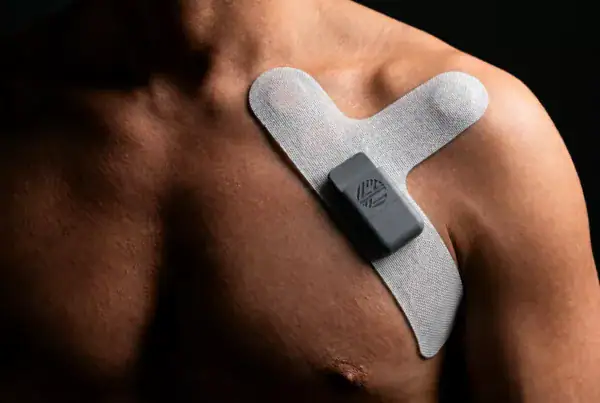
Effective biosignal monitoring in defence wearables relies on dry electrode technology rather than traditional wet electrodes. Wet electrodes require gel application and degrade quickly during physical activity. Dry electrodes can be integrated directly into textiles, maintain contact with the skin during movement, and do not require preparation or maintenance in the field.
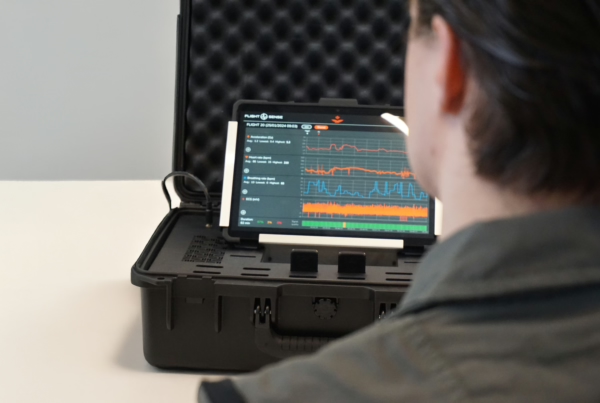
The signals most relevant to military fatigue monitoring include ECG for cardiac load, heart rate variability as a proxy for stress and recovery status, respiration rate as an indicator of physical exertion, and accelerometer data to contextualise the physiological readings against movement intensity. The Flight Sense System, a multi-biosensor wearable developed for military and extreme-condition use, combines all of these in a single platform using dry-electrode technology optimised specifically for high-movement conditions.
The challenge of motion artefacts
The primary technical obstacle in military biosignal monitoring is motion artefact: electrical noise introduced into sensor readings by body movement. A soldier running, crawling, or carrying equipment generates continuous mechanical interference that can corrupt ECG and EMG signals if the sensing system is not designed to handle it. Solving this requires careful electrode selection, precise placement in the garment, and firmware-level signal processing that filters artefacts without discarding genuine physiological data. It is one of the most technically demanding problems in the entire field of wearable biosensing.
What are the biggest technical challenges in developing military wearables?
The biggest technical challenges in developing military wearables are ruggedisation for extreme environments, reliable biosignal acquisition during high-movement activity, battery life under continuous operational use, and seamless integration of electronics into textiles without compromising either the garment’s functionality or the electronics’ performance. Each of these is genuinely difficult to solve, and they often create competing constraints that require careful trade-offs.
Ruggedisation is more demanding in defence than in any other wearable sector. Military wearables must survive temperature extremes, moisture, dust, impact, and electromagnetic interference – sometimes simultaneously. Every component choice, every seam, and every connector must be evaluated against operational conditions that would destroy a commercial wearable within hours.
Battery life is a persistent constraint. Soldiers operate for extended periods without access to charging infrastructure, which means a wearable that cannot sustain continuous operation across a full mission cycle has limited operational value. Increasing battery size is rarely the answer – it adds weight and bulk that directly affects performance. The more effective approach is system-level power optimisation: ensuring that firmware keeps components active only when needed, that sensors and radios are tuned to actual usage patterns, and that data handling is as efficient as possible. This kind of structured optimisation can extend battery life substantially without changing the physical form factor.
Electronics-textile integration presents its own set of challenges. Conductive yarns, printed electronics, and modular attachment systems each have different trade-offs in terms of washability, flexibility, durability, and manufacturing complexity. The right integration technique depends on where the garment is worn, how it is used, and what the maintenance environment looks like in the field. There is no universal answer, and getting it wrong late in development is expensive.
Finally, military wearables must meet certification and procurement requirements that go beyond standard CE marking. Military-specific standards, ATEX certification for hazardous environments, and defence procurement processes all add time and complexity to the development cycle. Teams that do not account for certification requirements from the earliest design stages typically face costly redesigns later.
How do defence wearables differ from commercial fitness wearables?
Defence wearables differ from commercial fitness wearables in three fundamental ways: the operating environment, the performance requirements, and the consequences of failure. A fitness tracker that loses signal during a workout is a minor inconvenience. A navigation wearable that fails during a military operation is a safety-critical failure. This distinction drives every engineering decision from component selection through to final validation.
Commercial fitness wearables are designed for controlled environments, predictable usage patterns, and users who can stop and troubleshoot a problem. Military wearables must function in unpredictable, often hostile conditions, operated by people who cannot pause to deal with a device issue. This means higher environmental ratings, more robust physical construction, and firmware that degrades gracefully under partial failure rather than crashing entirely.
The data requirements are also different. A fitness wearable optimises for consumer-friendly metrics: step count, sleep score, calorie burn. A military biosignal wearable must deliver clinically meaningful physiological data with sufficient accuracy to inform operational decisions. This demands a higher standard of sensor quality, signal processing, and algorithm validation than any consumer product requires.
Form factor constraints are more severe in defence. Military wearables must integrate with existing equipment – body armour, load-bearing vests, helmets – without creating interference or adding meaningful weight. They must also be operable with gloves, in darkness, and under stress. User interface design for defence wearables is an entirely different discipline from consumer UX design.
Finally, the supply chain and certification requirements are categorically different. Defence procurement involves security considerations, military-specific standards, and supply chain requirements that have no equivalent in the consumer wearables market.
What does the development process for a defence wearable look like?
Developing a defence wearable follows a structured progression from feasibility assessment through to a certified, field-ready product. The process typically begins with a technical feasibility check to validate whether the intended sensing, communication, and form factor requirements are achievable within the operational constraints. From there, development moves through proof of concept, prototyping, user validation, and pilot production before reaching full deployment readiness.
The feasibility phase is more important in defence than in almost any other sector. Military wearables face constraints that only become apparent when you interrogate them rigorously: electromagnetic compatibility with existing radio equipment, compatibility with uniform standards, washability requirements, and certification pathways that can take months to navigate. Identifying these constraints early prevents expensive redesigns later.
Prototyping for defence wearables must prioritise field conditions from the outset. A prototype that works in a lab but fails under physical stress, in cold weather, or with gloved hands has not answered the right questions. Validation must include realistic operational scenarios, not just controlled testing environments. This is why building for validation rather than production is a critical discipline: the goal of early prototypes is to surface failure modes and user interaction problems before major tooling investment has been made.
User involvement throughout the development process is essential and often underestimated. Soldiers who will wear the device in the field have knowledge about operational realities that no engineering team can fully anticipate. Their feedback on comfort, usability under stress, and integration with existing kit should shape design decisions at every stage, not just at the end.
Certification for military wearables adds a layer of complexity that must be planned for from the beginning. Requirements vary depending on the application, the environment, and the procurement authority involved. Teams that treat certification as a final step rather than a continuous design constraint routinely discover that their hardware choices or material selections are incompatible with the standards they need to meet.
How Elitac Wearables helps with defence wearable development
Building a defence wearable that actually works in the field requires more than electronics expertise. It requires a team that understands haptics, textile integration, biosignal sensing, firmware, and certification – and can hold all of those disciplines together without handoffs between vendors. That is precisely what Elitac Wearables provides.
The Mission Navigation Belt is the clearest evidence of this capability in the defence sector: a haptic feedback navigation system delivered to the Royal Netherlands Army, developed from a Defence Innovation Competition concept through to operational deployment. The Flight Sense System extends this further into multi-biosensor territory, combining dry-electrode ECG, HRV, respiration, and movement sensing in a platform designed specifically for extreme conditions and military use.
Working with Elitac Wearables on a defence wearable project means:
- A single team accountable for hardware, firmware, textile integration, haptic system design, and certification guidance
- In-house R&D infrastructure that enables faster iteration and lower client risk
- Deep experience with the specific technical challenges of military wearables, including motion artefact management, dry electrode integration, and ruggedisation
- A structured development process that validates the right things at the right stages, preventing costly late-stage redesigns
- Proven experience navigating military procurement and certification requirements
If you are developing a defence wearable and need a partner that has solved these problems before, get in touch with Elitac Wearables to discuss your project.