
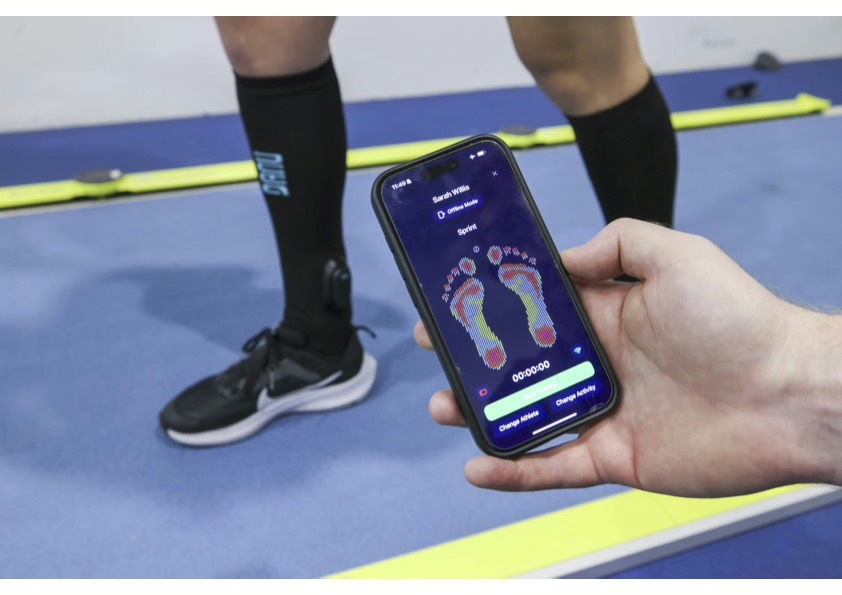
The most common mistakes in wearable product development are validating too late, ignoring end-user needs, fragmenting hardware and software development across separate teams, and leaving regulatory planning until the final stages. These errors compound: a product built without user input, poorly integrated electronics, and no certification strategy is unlikely to survive contact with the real world. The sections below address each failure point directly and explain what a more disciplined approach looks like.
Why do so many wearable products fail before reaching market?
Most wearable products fail before reaching market because teams validate their assumptions too late in the development cycle. By the time a product is tested with real users in real conditions, significant investment has already been committed to hardware design, tooling, and firmware. When the product turns out to be uncomfortable, confusing, or simply not useful enough, there is little budget left to course-correct.
Industry experience with wearable development consistently points to the same root cause: teams treat validation as the final step rather than an ongoing activity. The result is that up to 70% of wearable prototypes never reach production, not because the technology was impossible, but because the wrong product was built with too much confidence and too little feedback.
The compounding factor is cost. Committing to production tooling typically requires investment in the range of hundreds of thousands of euros. If that commitment happens before the product has been tested with genuine end users in realistic conditions, any significant design change becomes extraordinarily expensive. Wearable development teams that build for validation first, and production second, consistently reach market with better products and fewer costly surprises.
What happens when end-user needs are ignored in wearable design?
When end-user needs are ignored in wearable design, the product typically fails on comfort, usability, or adoption, regardless of how technically sophisticated the underlying system is. A wearable that a person refuses to wear, removes after ten minutes, or uses incorrectly delivers no value. Technical performance becomes irrelevant if the human factor has not been addressed.
This problem is especially acute in sectors like medical and defence, where the end user is often not the buyer. A procurement director or R&D manager may sign off on a wearable development project, but the person who actually wears the device is a patient recovering from a balance disorder, or a soldier on a training exercise. Their physical experience, cognitive load, and daily behaviour patterns need to shape design decisions from the earliest stages.
Common consequences of ignoring end-user needs include:
- Form factors that cause skin irritation, pressure points, or restrict movement
- Interaction patterns that require attention the wearer cannot spare
- Charging or maintenance routines that are incompatible with real-world use
- Sensor placement that produces poor signal quality because it was optimised for aesthetics rather than physiology
- Products that pass technical testing but fail in uncontrolled user trials
Integrating human factors and UX thinking from the proof-of-concept stage, rather than treating it as a late-stage refinement, is one of the most reliable ways to avoid these failures. Wearable devices are worn on bodies, in unpredictable environments, by people with their own habits and constraints. That reality needs to be designed for, not accommodated after the fact.
How does poor hardware-software integration derail wearable development?
Poor hardware-software integration derails wearable development by creating a reliability gap: the device works in the lab, under controlled conditions, but fails unpredictably in the field. This gap typically appears late, when the cost of fixing it is highest, and it often stems from hardware and firmware being developed by separate teams without shared ownership of system-level behaviour.
In custom wearable product development, hardware and firmware are deeply interdependent. A sensor that performs well in isolation may produce unusable data when it shares a power rail with a radio module. A firmware routine designed to conserve battery may inadvertently suppress data capture at critical moments. These interactions cannot be fully anticipated in isolation, which is why they need to be managed by a team that understands both layers simultaneously.
Battery performance is one of the clearest examples. Teams that treat battery life as a hardware problem, solved by choosing a larger cell, consistently underperform compared to teams that optimise across the full system. Root causes of poor battery performance in wearables include firmware keeping components active longer than necessary, sensors and radios not configured for actual usage patterns, inefficient data handling, and component selections that were made without reference to real-world duty cycles. None of these can be resolved by a hardware engineer or a firmware developer working independently.
The same principle applies to signal quality in biosignal wearables. Dry electrode placement, motion artefact filtering, and data transmission intervals are all decisions that sit at the boundary of hardware and firmware. When those decisions are made by different teams at different times, the result is a product that requires extensive rework before it can be used in any meaningful clinical or performance context.
When should regulatory and certification planning start in wearable development?
Regulatory and certification planning should start at the beginning of wearable product development, not at the end. For medical wearables subject to EU MDR, or devices requiring ATEX or military certification, the regulatory framework directly affects hardware design choices, material selection, testing protocols, and documentation requirements. Treating certification as a final-stage checklist is one of the most expensive mistakes a development team can make.
The practical reason is straightforward: certification requirements constrain design. A Class II medical wearable under MDR requires clinical evidence, a quality management system, and a technical file that traces every design decision back to safety and performance requirements. If those requirements are not factored in from the start, the team may need to redesign components, repeat validation testing, or rebuild documentation from scratch, adding months and significant cost to the timeline.
Early certification planning also affects component selection. Some components that are perfectly adequate for a consumer or industrial product are not suitable for medical-grade or ATEX-rated applications. Discovering this after PCB design is finalised forces a hardware revision that could have been avoided entirely.
The minimum viable approach is to identify the applicable regulatory pathway during the feasibility phase, before any significant hardware or firmware investment is made. For teams developing medical wearables in Europe, this means understanding MDR classification, notified body involvement, and the clinical evidence requirements that will apply to the finished product, well before the first prototype is built.
What are the most common prototyping mistakes in wearable projects?
The most common prototyping mistakes in wearable projects are building prototypes that are too close to a final product too early, and testing them in conditions that do not reflect real-world use. Both errors waste resources and delay the discovery of problems that would have been cheap to fix at an earlier stage.
Prototyping in wearable development serves a specific purpose at each stage. Early prototypes should answer feasibility questions and gather user feedback on interaction and comfort, not demonstrate final aesthetics or miniaturised electronics. When teams skip straight to high-fidelity prototypes without first validating the core concept with simpler builds, they commit to design decisions before they have the evidence to support them.
Other common prototyping mistakes include:
- Testing only in controlled environments: A wearable that performs well in a lab may fail under sweat, movement, or temperature variation. Uncontrolled user testing needs to happen before the design is locked.
- Neglecting the textile layer: Electronics prototypes often work perfectly on a bench but fail when integrated into a garment. Washability, flexibility, and connector durability under repeated wear are not properties that can be assumed.
- Treating the prototype as a demo rather than a learning tool: Prototypes should be designed to answer specific questions. Teams that build prototypes to impress stakeholders rather than to generate actionable data lose the primary benefit of the prototyping phase.
- Underestimating iteration cycles: Wearable development rarely moves in a straight line. Planning for multiple rounds of prototype refinement, rather than treating the first functional version as near-final, produces better outcomes and fewer surprises.
Building for validation rather than production at the prototype stage allows development teams to gather the user interaction, comfort, and perceived value data they need before committing to tooling costs. This approach does not slow development down, it prevents the far more expensive process of redesigning a product that was built on unvalidated assumptions.
How can wearable development teams avoid scaling too early?
Wearable development teams can avoid scaling too early by treating each development phase as a gate that requires specific evidence before the next phase begins. Scaling production before the product has been validated in uncontrolled real-world conditions, before reliability has been demonstrated over time, and before the regulatory pathway is clear, is a reliable way to produce inventory that cannot be sold or deployed.
The pressure to scale early often comes from external sources: investor timelines, market windows, or competitive anxiety. These are real pressures, but they do not change the underlying risk. A wearable that fails in the hands of real users after a production run is more damaging to a product roadmap than a delayed launch from a team that took the time to validate properly.
The practical safeguards against premature scaling include:
- Completing uncontrolled user testing with final prototypes before committing to a first production series
- Confirming that the regulatory pathway is clear and that the product will meet certification requirements in its current form
- Validating supply chain reliability for all critical components before scaling volume
- Ensuring that firmware and hardware are stable enough to be reproduced consistently across a larger batch
- Reviewing battery performance and long-term reliability data from extended wear testing
A limited first series, typically in the range of 30 to 50 units, serves as the bridge between validated prototype and scaled production. It allows a team to confirm that the manufacturing process produces consistent results, identify any issues that only appear at batch scale, and generate the real-world performance data needed to support a larger production commitment with confidence.
How Elitac Wearables helps you avoid these development mistakes
Every mistake described in this article follows the same pattern: a decision made too early, with too little information, by a team that lacked the cross-disciplinary expertise to see the risk. Elitac Wearables is structured specifically to prevent that pattern from repeating on your project.
As an end-to-end wearable development partner, Elitac brings hardware, firmware, textile integration, biosignal sensing, haptics, human factors, and certification guidance together under one roof, with a single team accountable for the whole. That structure eliminates the handoff gaps where most wearable projects lose time, money, and momentum. Key elements of how Elitac works include:
- Phase-gated development: From feasibility check through to scaled production, each phase is designed to answer specific questions before the next begins, preventing premature commitment to design decisions or tooling
- Build for validation first: Early-stage demonstrators and proof-of-concept builds are scoped to generate user and technical evidence, not to impress stakeholders
- Regulatory planning from day one: For medical, military, and ATEX applications, certification requirements shape hardware and documentation decisions from the feasibility phase
- System-level integration: Hardware and firmware are developed together, preventing the reliability gaps that appear when electronics and software are managed separately
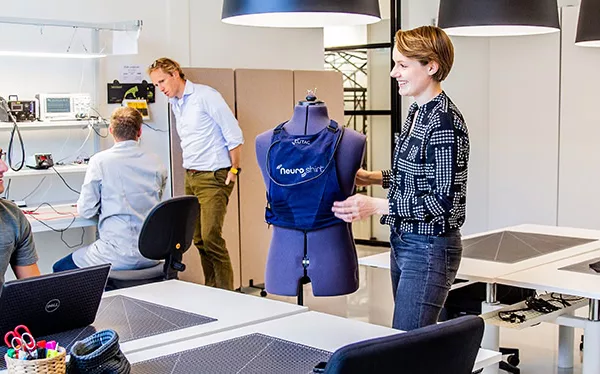
- In-house R&D infrastructure: The 180m² Wearables Lab enables faster iteration, lower client risk, and real-world testing without external dependencies
If your wearable project is stuck, approaching a decision point you are not confident about, or at risk of repeating mistakes you have already made once, the right next step is a direct conversation with a team that has solved these problems before. Reach out to Elitac Wearables to discuss where your project stands and what a structured development partnership could look like.