In 2026, AI is used in military wearable technology primarily to process real-time physiological and environmental data, enabling faster and more accurate decision-making in the field. Applications range from continuous soldier health monitoring and AI-driven haptic navigation to predictive fatigue detection and situational awareness systems. The sections below unpack each of these applications in detail, along with the technical challenges that make military AI wearables genuinely difficult to build.
What types of AI are being integrated into military wearables?
Military wearables in 2026 integrate several distinct categories of AI, including machine learning models for biosignal interpretation, edge AI for on-device inference, and pattern recognition algorithms for movement and situational analysis. These systems run either on embedded hardware within the wearable itself or on connected edge nodes, depending on the operational constraints of the mission environment.
The most commonly deployed AI types across military wearable platforms include:
- Edge inference models: Lightweight neural networks that run directly on the wearable’s processor, enabling real-time decisions without a network connection. This is critical in contested or communications-denied environments.
- Biosignal classification algorithms: AI trained to interpret ECG, heart rate variability, respiration, and electrodermal activity signals, distinguishing normal physiological states from stress, fatigue, or injury.
- Motion and posture recognition: IMU-based AI models that identify movement patterns, detect falls or incapacitation, and assess physical load on the wearer.
- Adaptive haptic feedback systems: AI that adjusts the intensity, timing, and pattern of tactile signals based on context, ambient conditions, and the soldier’s current cognitive load.
- Anomaly detection: Unsupervised learning models that flag deviations from an individual soldier’s baseline, rather than relying on population-level thresholds.
What distinguishes military AI wearable integration from consumer applications is the demand for reliability under extreme conditions. These systems must operate correctly when wet, cold, under physical stress, or in electromagnetically challenging environments. That requirement shapes every design decision, from sensor selection to the architecture of the AI model itself.
How does AI improve soldier health monitoring in the field?
AI improves soldier health monitoring by moving beyond simple threshold alerts to continuous, personalised physiological interpretation. Rather than flagging a high heart rate in isolation, AI models correlate multiple biosignals simultaneously to distinguish genuine physiological distress from the expected response to intense physical exertion, producing far fewer false alerts and far more actionable information.
Traditional wearable health monitors rely on static thresholds. If a soldier’s heart rate exceeds a set value, an alert fires. The problem is that a soldier sprinting under load will routinely exceed that threshold without any medical concern. AI solves this by learning individual baselines and interpreting signals in context.
Physiological parameters AI monitors in military wearables
Modern military health wearables equipped with AI can track and interpret a broad set of physiological signals in real time:
- ECG and heart rate variability, used to assess cardiovascular strain and psychological stress
- Respiration rate and pattern, relevant for detecting respiratory distress or extreme exertion
- Skin temperature and electrodermal activity, which correlate with heat stress and acute stress responses
- Acceleration and movement data, used to assess physical load, detect falls, and identify periods of incapacitation
Predictive fatigue and injury detection
One of the most operationally significant applications is predictive fatigue modelling. AI systems trained on longitudinal physiological data can identify the early signatures of fatigue before a soldier becomes operationally impaired. This allows commanders to make proactive decisions about rotation and rest rather than reacting to incapacitation after it occurs.
Injury detection follows a similar logic. A sudden change in gait pattern detected by IMU sensors, correlated with an elevated stress response in biosignal data, can indicate a musculoskeletal injury even when the soldier has not self-reported one. In high-adrenaline situations, soldiers frequently do not register pain until after the mission. AI-equipped wearables can flag these events in real time.
The challenge, as anyone working in this space knows, is signal quality. Dry electrodes in high-movement conditions generate motion artefacts that can corrupt biosignal data. Building AI that remains accurate despite noisy inputs is a significant technical problem, and one that requires deep expertise in both sensor design and algorithm development.
How is AI used in haptic wearables for military navigation?
AI is used in haptic military navigation wearables to translate complex positional and directional data into precise, context-aware tactile signals that soldiers can interpret without looking at a screen or listening to audio. The AI layer determines what information to communicate, when to communicate it, and how to adapt the haptic pattern based on the soldier’s movement, speed, and environment.
Screen-free, audio-free navigation is a genuine operational requirement. In combat environments, a soldier cannot safely look down at a device or listen to audio instructions. Haptic feedback delivered through a body-worn belt or vest solves this problem by communicating direction and distance through vibration patterns felt against the skin.
The role of AI in this system goes well beyond simply converting GPS coordinates into a vibration. Effective haptic navigation requires the system to:
- Fuse data from GPS, IMU, and potentially environmental sensors to build an accurate real-time picture of the soldier’s position and orientation
- Determine which information is operationally relevant at any given moment and suppress noise
- Adapt haptic signal intensity and pattern based on the soldier’s current activity state, since a signal that is perceptible at rest may be lost during intense physical movement
- Learn individual perceptual thresholds over time, since tactile sensitivity varies between individuals and across body locations
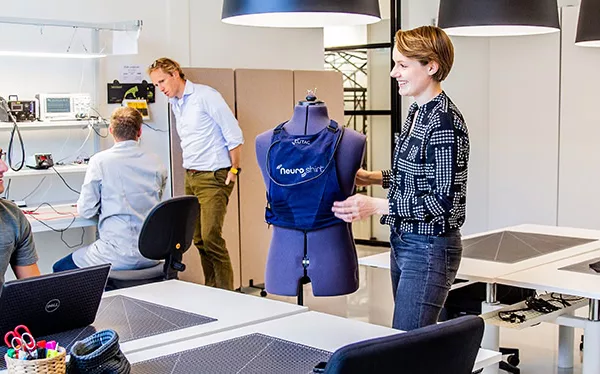
The Mission Navigation Belt developed for the Royal Netherlands Army is a concrete example of this approach in practice. It delivers silent, screen-free navigation information through haptic feedback, keeping the soldier’s hands, eyes, and ears entirely free. Integrating AI into systems like this raises the bar significantly, enabling the wearable to move from fixed vibration patterns to genuinely adaptive communication.
What are the biggest challenges of deploying AI wearables in military environments?
The biggest challenges of deploying AI wearables in military environments are operational reliability under extreme conditions, data security and sovereignty, power constraints, and the difficulty of achieving accurate AI inference with noisy real-world sensor data. Any one of these challenges would be demanding in isolation. Military deployments require solving all of them simultaneously.
Reliability and ruggedisation
Military wearables must function correctly in conditions that would destroy or degrade a standard electronics product. Extreme temperature ranges, moisture, dust, physical impact, and electromagnetic interference are not edge cases in defence deployments. They are baseline operating conditions. AI inference hardware that works well in a laboratory environment may fail entirely when exposed to the physical reality of the field.
This creates a tension between AI capability and hardware robustness. More powerful AI models require more processing capability, which typically means more heat, more power draw, and more complex electronics. All of those factors work against ruggedisation. The engineering challenge is to select or design AI architectures that are genuinely capable while remaining deployable on constrained, hardened hardware.
Power and battery life
AI inference, even on edge-optimised hardware, is computationally intensive relative to simple threshold monitoring. Running continuous AI models on a body-worn device accelerates battery depletion significantly. In military contexts, where a mission may last days without access to charging infrastructure, power management is not a secondary concern. It is a primary design constraint.
Solving this requires treating battery performance as a system-level problem. Firmware must be optimised to keep AI inference active only when necessary, sensors must be duty-cycled intelligently, and data handling must be architected to minimise unnecessary computation. A component-level fix, such as a larger battery, rarely addresses the root cause.
Signal quality and AI accuracy
Military wearables are worn during intense physical activity. Motion artefacts corrupt biosignal data. Sensor contact with skin changes as the wearer moves. Environmental interference degrades signal quality. AI models trained on clean laboratory data frequently fail when deployed against real-world inputs, producing false positives, missed alerts, or degraded navigation accuracy at precisely the moments when accuracy matters most.
Building AI systems that remain robust under these conditions requires extensive real-world validation, not just lab-based testing. It also requires close collaboration between the sensor hardware team and the algorithm development team, since the quality of the AI output is directly constrained by the quality of the sensor input.
Security and data sovereignty
Physiological data collected from soldiers in the field is operationally sensitive. AI systems that transmit data to cloud infrastructure for processing introduce potential interception risks. Edge AI, which processes data entirely on the device without transmission, addresses this concern but adds further constraints to the hardware and model design. Military procurement increasingly requires that AI wearable systems meet strict data sovereignty requirements, which shapes every architectural decision from sensor to output.
How will AI military wearables evolve beyond 2026?
Beyond 2026, AI military wearables will evolve toward greater autonomy, deeper physiological insight, and tighter integration with broader defence systems. The trajectory points to wearables that function not just as monitoring devices but as active decision-support tools, feeding real-time soldier status data into command and control systems and adapting their own behaviour based on mission context.
Several development directions are already visible in research and early-stage programmes:
- Multi-modal sensor fusion: Combining physiological, environmental, and positional data streams with AI to build a richer, more accurate picture of soldier state and context than any single sensor type can provide
- Personalised AI models: Shifting from population-trained models to individually calibrated AI that learns each soldier’s physiological baseline and adapts its interpretation accordingly
- Closed-loop haptic communication: Systems where AI not only interprets incoming data but actively modulates haptic feedback in real time based on the soldier’s cognitive and physical state, ensuring the right information reaches the wearer at the right moment
- Soft robotics integration: AI-controlled textile actuators that can apply dynamic compression or pressure to the body, with applications in injury support, exoskeleton assistance, and physiological intervention
- Interoperability with broader defence platforms: Wearables that feed AI-processed soldier data into squad-level or command-level situational awareness systems, enabling commanders to make informed decisions based on the real-time physiological status of their personnel
The limiting factor in all of these directions is not conceptual. The ideas are well understood. The challenge is engineering systems that deliver on these capabilities reliably, in the field, under real operational conditions, and within the power and form factor constraints of a body-worn device. That engineering gap between laboratory capability and field-ready product is where the most significant work remains to be done.
How Elitac Wearables helps with AI military wearable technology
Building AI-capable military wearables is one of the most technically demanding challenges in wearable development. It requires deep expertise across hardware, firmware, biosignal sensing, haptic systems, and algorithm development, and those disciplines must work together from the earliest design stage, not as separate handoffs.
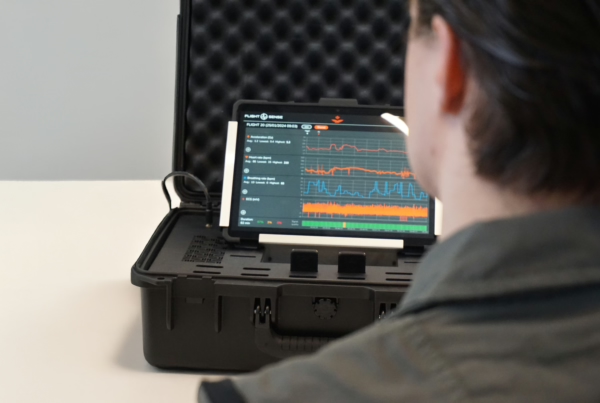
Elitac Wearables brings all of these capabilities under one roof, with a track record that includes the Mission Navigation Belt for the Royal Netherlands Army and the Flight Sense System, a multi-biosensor wearable designed specifically for extreme conditions and military applications. The team’s work spans:
- Haptic feedback system design, including adaptive pattern development and firmware-level timing
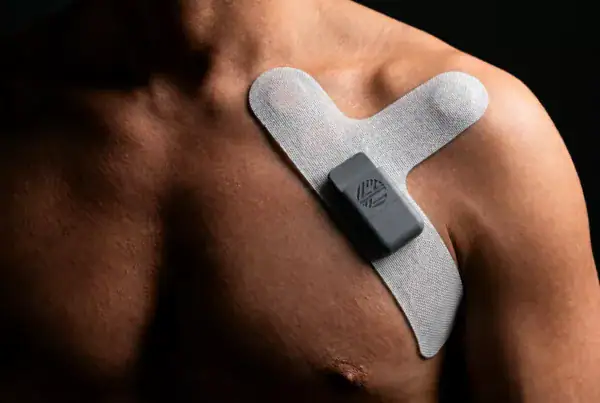
- Dry electrode biosignal sensing optimised for high-movement conditions, addressing the motion artefact challenge directly at the hardware level
- Embedded hardware and firmware development, including the proprietary TacOS operating system built specifically for wearable constraints
- Battery performance optimisation treated as a system-level engineering problem, not a component swap
- Certification guidance for military and medical regulatory requirements
If you are developing an AI-driven military wearable and need a development partner with the technical depth to take it from concept to field-ready product, get in touch with the Elitac Wearables team to discuss your project.
Related Articles
- How do wearables support mental health monitoring in defence personnel?
- What is augmented reality used for in military wearables?
- How do enterprise wearable products differ in development from consumer-facing devices?
- What is the real ROI of investing in a custom wearable product?
- How do you manage battery life constraints in wearable development?