
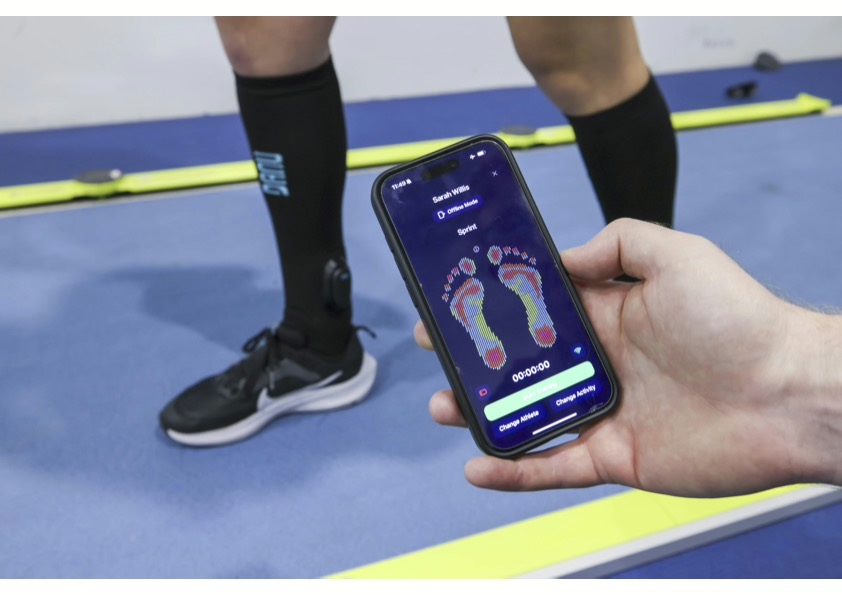
Custom wearable product development typically takes between 12 and 36 months from initial concept to a market-ready product. The exact timeline depends on the complexity of the device, the maturity of the starting concept, and how many development phases are required. This article unpacks the key questions that shape that timeline — so you can plan more accurately and avoid the delays that derail most projects.
What factors affect the wearable development timeline most?
The single biggest driver of wearable development timelines is technical complexity — specifically, how many disciplines need to work together and how well-defined the requirements are at the outset. A wearable that integrates biosensors, embedded electronics, textile construction, and wireless communication will always take longer than one that relies on a single technology. Starting clarity matters just as much as technical scope.
Beyond complexity, the following factors consistently determine whether a project runs on schedule or slips:
- Regulatory requirements: Medical wearables subject to MDR (Medical Device Regulation) require documentation, clinical evidence, and formal certification steps that must be planned from day one — not retrofitted at the end.
- Component availability: Supply chain constraints on sensors, actuators, or specialist textile materials can add weeks or months to a timeline without warning.
- Stakeholder alignment: Projects stall when internal decision-making is slow or requirements shift mid-development. Clear ownership on the client side accelerates everything.
- Starting point on the development curve: A project beginning with a validated proof of concept moves far faster than one that starts with a rough idea and no technical foundation.
- Team structure: Fragmented development — where hardware, firmware, and textile work are handled by separate suppliers — creates coordination overhead and handoff risk that compounds over time.
The degree to which these factors are controlled or left to chance is what separates a 14-month project from a 36-month one.
How long does each stage of wearable development take?
Wearable product development follows a structured sequence of phases, each with a distinct purpose and realistic time investment. While timelines vary by project, the following ranges reflect what a well-managed custom wearable development programme typically requires at each stage.
Feasibility check (approximately 14 weeks)
This is a rapid technical assessment to verify whether the core concept is achievable with current materials, components, and technology. It is not a full build — it is a structured investigation that surfaces blockers early. A good feasibility check saves months of wasted effort downstream and is often the difference between a project that proceeds with confidence and one that stalls at the first prototype.
Proof of concept (approximately 3 to 5 months)
A basic working version is assembled using off-the-shelf components and existing building blocks wherever possible. The goal is to demonstrate the core functionality, gather early user feedback, and validate the technical approach — not to produce something production-ready. This stage is critical for organisations seeking funding or internal sign-off before committing to full development.
Prototype development (approximately 4 to 8 months)
The prototype phase moves from a functional demonstration to a refined, testable device. Electronics are integrated more deliberately, form factor decisions are made, and the wearable begins to resemble what a real user would wear. Multiple iteration cycles are normal here — this is where the most learning happens and where under-resourced teams tend to lose the most time.
Validation and testing (approximately 3 to 6 months)
The validated prototype is tested against real-world conditions: wear comfort, reliability under movement, environmental durability, and — where applicable — clinical or regulatory performance criteria. For medical wearables, this phase feeds directly into the technical file and certification process.
Certification and production preparation (approximately 3 to 12 months)
The length of this stage is almost entirely driven by the regulatory pathway. CE marking for a Class I wearable is far less demanding than MDR conformity for a Class IIa medical device. Production preparation — tooling, supplier qualification, quality management — runs in parallel and should begin well before certification is complete.
Does the type of wearable change how long development takes?
Yes — significantly. The category of wearable, the environment it operates in, and the regulatory classification it falls under all have a direct and substantial effect on development duration. A sports performance tracker and a medical-grade biosensor wearable may share some underlying technology, but they follow very different development and approval paths.
Medical wearables are the most time-intensive category. Any device intended to diagnose, monitor, or treat a health condition must meet MDR requirements in the EU, which demands rigorous documentation, clinical evidence, and formal conformity assessment. Building certification considerations into the hardware and firmware architecture from the earliest stages is not optional — it is the only way to avoid expensive redesigns late in the process.
Defence and industrial safety wearables carry their own demands. Ruggedisation, environmental testing (temperature, vibration, moisture), and in some cases, ATEX compliance for hazardous environments add testing cycles that consumer-grade development simply does not require. The Mission Navigation Belt developed for the Royal Netherlands Army is a clear example of how military-grade requirements shape every design decision from component selection through to field validation.
Sports and performance wearables generally move faster, but only when the technical scope is well-defined. The moment biosignal sensing — such as ECG or EMG — is introduced, the complexity increases sharply. Dry electrode performance in high-movement conditions, motion artefact management, and data accuracy under real sporting conditions all require dedicated engineering effort that adds time.
What causes wearable projects to take longer than expected?
Most wearable development delays share a common root: problems that were discoverable early are found late. Whether that is a hardware-firmware conflict, a textile integration failure, or a certification requirement that forces a redesign, the cost of discovering an issue in the final stages is always greater than catching it in the first.
The most common causes of timeline overrun in custom wearable product development include:
- Scope creep: Requirements that expand mid-project without corresponding adjustments to timeline or budget. This is especially common when internal stakeholders are not aligned before development begins.
- Late integration of disciplines: When hardware, firmware, and textile development are treated as sequential rather than parallel workstreams, problems at the integration point emerge far later than necessary.
- Battery and power issues discovered late: Power management is frequently underestimated. Firmware that keeps components active unnecessarily, sensors not optimised for actual usage patterns, and hardware choices mismatched with real-world use all compound into battery performance failures that require substantial rework.
- Underestimating certification lead time: Regulatory approval is not a rubber stamp. Projects that treat certification as a final step rather than an ongoing design constraint routinely face months of unexpected delay.
- Component obsolescence: In longer development cycles, components specified at the start of a project can become discontinued before production begins, requiring redesign at a critical stage.
None of these are inevitable. They are predictable — and preventable with the right development structure in place from the start.
How can development time be shortened without sacrificing quality?
Development time can be reduced meaningfully by eliminating coordination overhead, using proven building blocks where they exist, and running workstreams in parallel rather than sequentially. Speed in wearable development does not come from cutting corners — it comes from removing the inefficiencies that slow well-intentioned teams down.
The most effective approaches to accelerating wearable product development without compromising the outcome include:
- Starting with a clear feasibility check: Investing two to three weeks upfront to validate technical assumptions prevents months of rework on a flawed foundation.
- Using existing firmware and hardware building blocks: Proprietary platforms built specifically for wearables — with power management, sensor interfacing, and communication protocols already solved — compress development time considerably compared to building from scratch.
- Running disciplines in parallel: Hardware, firmware, textile, and UX development do not need to be sequential. Teams that work across all layers simultaneously — with strong integration checkpoints — consistently deliver faster than those that hand off between specialists.
- Involving certification thinking from day one: Designing for regulatory compliance from the first prototype avoids the most expensive category of delay: late-stage redesign driven by a documentation or performance gap.
- Rapid demonstrator development: For projects with fixed milestones — investor presentations, trade shows, or clinical pilots — a focused demonstrator build can deliver functional wearables within 12 weeks at a fraction of full production cost, without locking in premature design decisions.
When should a company bring in an external wearable development partner?
A company should bring in an external wearable development partner as early as the concept stage — and certainly before a prototype is built on assumptions that have not been validated. The most expensive mistakes in wearable development are the ones made in the first three months, not the last three.
The case for an external partner is strongest when one or more of the following conditions apply:
- The organisation has deep domain expertise — medical, defence, industrial — but lacks in-house wearable engineering capability across hardware, firmware, and textiles.
- A prototype exists but has not performed reliably in real-world conditions, and the internal team cannot diagnose why.
- The project requires regulatory certification, and no one internally has navigated MDR or CE marking for a wearable before.
- The development timeline is fixed — a funding deadline, a product launch, or a procurement window — and internal capacity is insufficient to meet it.
- The project has stalled at the transition from prototype to production, and the gap between “it works in the lab” and “it works in the field” has not been closed.
Bringing in a specialist partner too late — after a prototype has been built in isolation, after a certification path has been chosen without engineering input, or after a supplier has been locked in for a component that does not fit the use case — is where projects become genuinely expensive to rescue.
How Elitac Wearables helps with wearable product development timelines
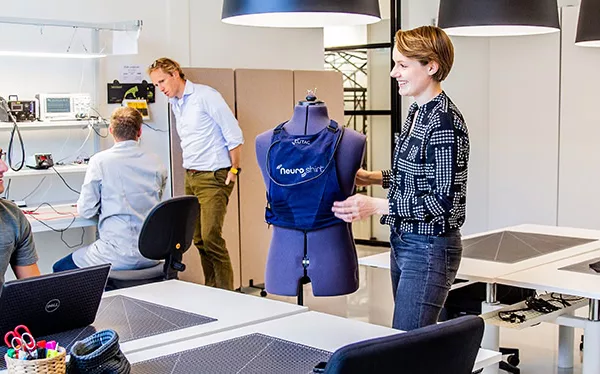
For organisations that cannot afford to lose twelve months to avoidable delays, Elitac Wearables provides end-to-end wearable product development services with every required discipline in-house. From the first feasibility check through to a certified, production-ready product, the same multi-disciplinary team handles hardware, firmware, textile integration, biosignal sensing, haptics, and human factors — with no handoffs between vendors and no knowledge lost between phases.
Concretely, what this means for your project:
- A structured six-phase development process with defined deliverables and realistic timelines at every stage
- TacOS — Elitac’s proprietary wearable firmware platform — reduces firmware development time and resolves common power management problems before they surface
- Agile and Scrum working methods give clients predictable sprint-by-sprint progress and early warning of risk
- In-house 180m² Wearables Lab enables rapid prototyping, iteration, and testing without external dependencies
- Certification guidance from the first design decision, not the last — preventing the redesigns that destroy timelines
- Cross-sector experience across medical, defence, and sports means the team has already solved most of the problems your project will encounter
If your wearable development project is at any stage — from initial concept to a prototype that needs to reach production — contact Elitac Wearables to discuss your timeline, your technical requirements, and where the right entry point is for your project.
Related Articles
- How do defence forces use biometric wearables?
- How do military wearables communicate with command systems?
- How do haptic wearables integrate with existing enterprise software?
- How do haptic feedback wearables support remote collaboration?
- How do data privacy regulations affect wearable product development?