Electronics integrated into textiles are not yet ready for true mass-market adoption in 2026, but the gap is closing faster than most expect. The technology works, proven products exist across medical, defence, and sports sectors, and integration techniques have matured significantly. What remains is solving the durability, washability, and cost challenges that separate specialist applications from everyday consumer shelves. The sections below address the key questions shaping where e-textile development stands right now.
What technical barriers are still slowing down e-textile adoption?
The biggest barriers to widespread e-textile adoption are washability, long-term durability, and the cost of scaling production. Conductive yarns and printed electronics can degrade under repeated mechanical stress and laundering, and the electronics-textile interface remains one of the most failure-prone points in any body-worn product. These are not unsolvable problems, but they require deep, cross-disciplinary engineering to address properly.
Beyond durability, power management is a persistent challenge. Electronics embedded in textiles cannot rely on the large battery packs that a rigid wearable device can accommodate. Every milliwatt matters, and firmware that keeps components active longer than necessary drains a battery that was already small to begin with. Solving this requires treating power as a system-level problem across hardware selection, firmware behaviour, and data architecture, not simply swapping in a larger cell.
Signal quality presents another layer of complexity. Sensors behave differently on a moving, sweating, breathing body than they do on a bench. Motion artefacts in biosignal data, electrode contact variability, and electromagnetic interference from conductive textile structures all compound in ways that are difficult to predict without extensive real-world testing. This is why teams with experience across both electronics and textiles are essential. The two disciplines rarely speak the same engineering language, and when they are fragmented across separate suppliers, integration failures are almost inevitable.
Finally, certification adds a significant layer of complexity for regulated sectors. Medical e-textiles must navigate the EU Medical Device Regulation, and products intended for hazardous environments face ATEX requirements. These frameworks were not written with flexible, washable, body-worn electronics in mind, and interpreting them correctly from the earliest design decisions requires specialist knowledge.
How are electronics currently integrated into textiles?
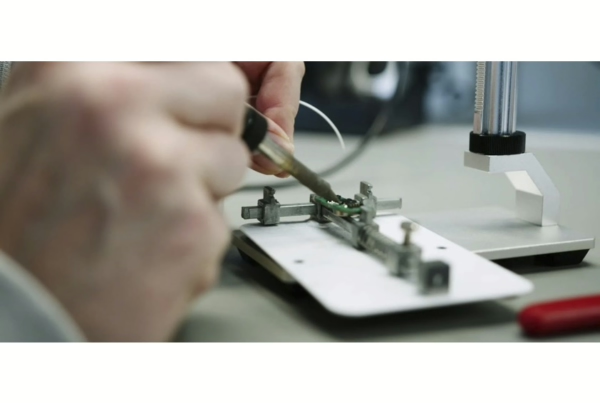
Electronics are currently integrated into textiles using three primary techniques: conductive yarns woven or knitted directly into the fabric structure, printed electronics applied to textile substrates, and modular electronics attached to or embedded within the garment. Each approach involves different trade-offs in flexibility, washability, conductivity, and production scalability, and the right choice depends heavily on the application context.
Conductive yarns
Conductive yarns incorporate metallic fibres, typically silver or stainless steel, into the textile during weaving or knitting. This approach produces garments that feel close to conventional fabric and can achieve good skin contact for biosignal sensing. The challenge is maintaining conductivity after repeated washing and mechanical stress, and managing resistance across longer yarn runs.
Printed electronics
Printed electronics use conductive inks deposited onto textile substrates through screen printing, inkjet printing, or similar processes. This technique allows for complex circuit geometries without adding rigid components, and it integrates well with existing textile manufacturing lines. Durability under washing and flexing remains an active area of development, though advances in stretchable conductive inks have improved performance considerably.
Modular attachment
Modular electronics, where rigid or semi-rigid electronic units are attached to, snapped into, or embedded within a textile carrier, represent the most commercially mature approach today. The electronics can be removed for washing, replaced if they fail, and upgraded independently of the garment. This is the approach behind products like the Mission Navigation Belt and many medical monitoring garments. It sacrifices some elegance for reliability, which in professional and regulated contexts is usually the right trade-off.
Selecting among these techniques requires understanding the full product context: wash cycles, body location, required signal quality, regulatory environment, and production volume. With over ten years of experience across all three methods, the engineering decisions that look simple on paper are rarely straightforward in practice.
What industries are closest to mainstream e-textile deployment?
Medical, defence, and high-performance sports are the industries closest to mainstream e-textile deployment in 2026. These sectors share a common characteristic: the performance benefit justifies the cost and complexity, and the end users are professionals or patients rather than general consumers. Industrial safety and workwear are also advancing, though price sensitivity in procurement has historically slowed adoption there.
In medical applications, e-textiles are already in clinical use for monitoring cardiac signals, supporting rehabilitation, and assisting patients with balance or movement disorders. The BalanceBelt, for example, combines motion sensing with haptic feedback in a wearable that has gone through full MDR compliance and clinical validation. These are not concept demonstrators; they are products in real clinical pathways.
Defence has driven some of the most rigorous e-textile development because the performance requirements are uncompromising. The Mission Navigation Belt, developed for the Royal Netherlands Army, delivers silent, screen-free navigation through haptic feedback integrated into a wearable belt system. Military procurement timelines are long, but once a product is qualified, the deployment volumes and reliability standards it establishes often feed back into adjacent sectors.
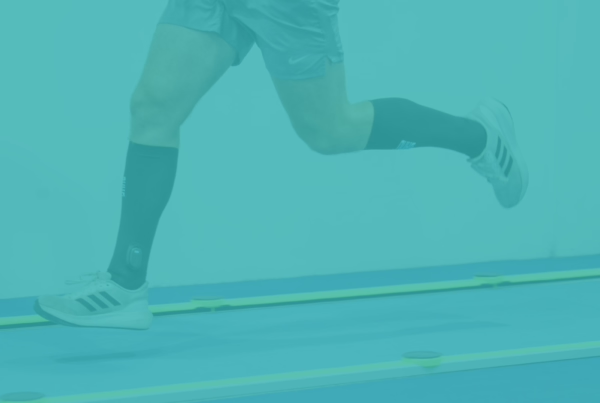
In sports, smart garments and instrumented apparel are increasingly used by professional teams and elite athletes for performance tracking and injury prevention. The Danu Sports SmartSocks, which combine pressure and IMU sensors to deliver real-time coaching insights, represent the level of integration that is now achievable in a product that athletes actually wear during training and competition.
Consumer fashion and everyday workwear remain further behind. The cost-per-unit economics, the expectation of machine-washable durability, and the lower willingness to pay compared to medical or defence procurement all create friction that the technology has not yet fully overcome at scale.
What’s the difference between smart textiles and traditional wearables?
Smart textiles embed electronic functionality directly into the fabric structure itself, whereas traditional wearables are discrete electronic devices worn on or attached to the body. The distinction matters because it changes how the product is designed, manufactured, certified, and used. A smartwatch is a traditional wearable; a garment with woven conductive electrodes that monitors ECG continuously during movement is a smart textile.
Traditional wearables, like fitness trackers or medical monitors in rigid enclosures, rely on established electronics manufacturing processes and materials. Their interaction with the body is limited to the contact points of a band, clip, or patch. Smart textiles, by contrast, can distribute sensors and actuators across a much larger body surface, conform to movement naturally, and collect signals from areas where a rigid device would be impractical or uncomfortable.
This distinction also affects the engineering challenge. A traditional wearable development team can draw on decades of consumer electronics design knowledge. A smart textile project requires that same electronics expertise plus deep knowledge of textile manufacturing, material science, garment construction, and the behaviour of electronic components under repeated flexing, stretching, and washing. These disciplines rarely overlap in a single team, which is precisely why so many e-textile projects stall at the prototype stage.
From a user perspective, the promise of smart textiles is that the technology disappears into clothing people already wear. The reality is that achieving that seamlessness requires solving problems that do not exist in conventional electronics development, and underestimating that gap is one of the most common and expensive mistakes in the field.
Will e-textiles be ready for mass-market consumers by 2026?
E-textiles will not be ready for mass-market consumer adoption in 2026 in any broad sense, but specific product categories are crossing that threshold right now. The technology is mature enough for regulated professional applications and premium consumer products where the value proposition is clear and the buyer accepts a higher price point. True mass-market adoption, meaning affordable, fully washable, reliable e-textile products available to general consumers at scale, is still several years away.
The honest assessment is that the engineering is largely solved at the component level. Conductive yarns, stretchable interconnects, miniaturised electronics, and low-power biosensors all exist and work. What has not yet been solved at scale is the combination of all of these in a single product that costs what a consumer is willing to pay, survives two years of weekly washing, and can be manufactured in the tens of thousands without a quality control failure rate that makes the economics unworkable.
For B2B buyers in medical, defence, and sports sectors, this framing is largely irrelevant. Those markets are already deploying e-textile products, and the question is not whether the technology works but whether the right development partner can bring a specific product to market reliably and within budget. That is a very different challenge from mass-market readiness, and it is one that specialist development teams are solving today.
The most important signal for 2026 is that the gap between “works in the lab” and “works in the field” has narrowed considerably. Products like the Flight Sense System, which measures ECG, HRV, respiration, and acceleration using dry electrodes optimised for high-movement conditions, demonstrate that e-textile biosensing can meet professional-grade performance requirements. The path to mass-market adoption runs through exactly these kinds of demanding applications, where the engineering rigour required forces solutions that eventually become accessible at scale.
How Elitac Wearables helps with electronics-textile integration
Elitac Wearables provides end-to-end development support for organisations building products where electronics and textiles must work together reliably. With over ten years of hands-on experience across conductive yarns, printed electronics, and modular attachment approaches, the team advises on integration technique selection from the earliest feasibility stage, preventing costly decisions that only reveal their problems at prototype or production.
- Full in-house capability across hardware, firmware, textile, biosignal sensing, and haptics, with no handoffs between separate suppliers
- Guidance on washability, durability, and signal quality from teams who have solved these problems across medical, defence, and sports applications
- Certification support for MDR, CE marking, and ATEX requirements, integrated into the design process from the start rather than added at the end
- Rapid demonstrator development: ten functional wearable units delivered in as little as twelve weeks, enabling validation before major tooling investment
- Battery performance optimisation across hardware, firmware, and data architecture, without requiring a product redesign
If your organisation is working on a smart textile development challenge and needs a partner who has navigated this complexity before, speak with the Elitac team to discuss your project.
Related Articles
- How do children and elderly users experience haptic feedback wearables differently?
- What is the difference between haptic feedback and vibration alerts?
- What sensors are used in haptic feedback wearable devices?
- What is the real ROI of investing in a custom wearable product?
- How long does wearable product development take?