
Haptic feedback wearables for navigation work by translating directional information into precisely timed vibration patterns delivered directly to the body, most commonly the torso or wrist. Instead of reading a screen or listening to audio cues, the wearer feels a signal that tells them which way to turn or how far to go. The sections below break down the body locations, actuator types, accuracy, use cases, and technical challenges that define this technology.
What body parts do haptic navigation wearables typically target?
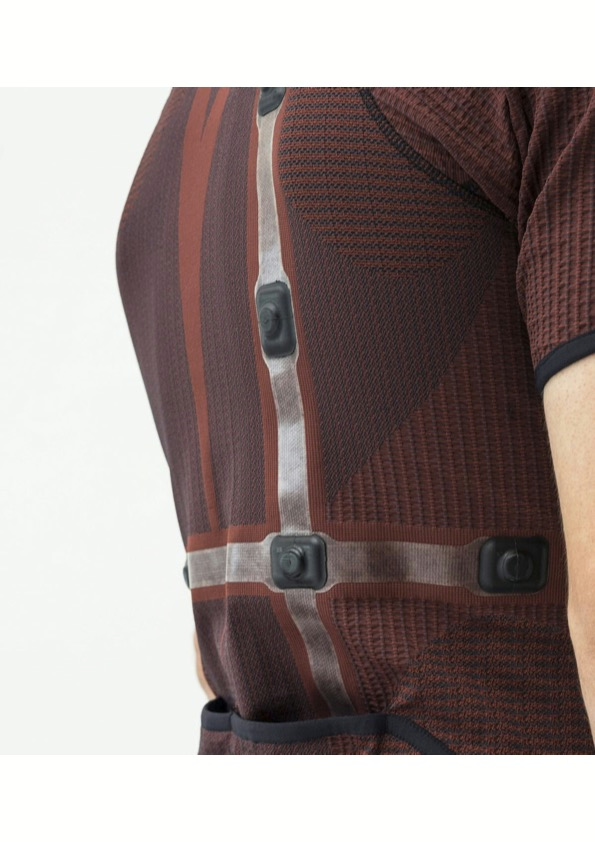
The torso is the most common target for haptic navigation wearables, with the waist and abdomen used most frequently. A belt or vest fitted with an array of vibrating actuators around the midsection gives developers enough spatial resolution to encode direction clearly, while keeping the device discreet and stable on the body. The wrist, upper arm, and fingertips are also used, though each comes with trade-offs in resolution and comfort.
The waist works particularly well for navigation because the body’s sense of direction is naturally oriented around the torso. When a vibration activates at the front-right of a belt, the wearer intuitively understands that they should move in that direction. This makes the learning curve shorter than many people expect.
The wrist is a popular alternative, especially where form factor matters, but the smaller surface area limits how many actuators can be placed and how distinctly they can be felt. Fingertip haptics offer extremely high resolution for fine-grained feedback, but they are impractical for navigation in most real-world conditions because the hands are rarely still. For applications where hands and eyes need to stay free, such as military navigation or industrial inspection, the torso remains the preferred location.
How does a haptic wearable translate direction into vibration?
A haptic navigation wearable translates direction into vibration by mapping spatial position data from a GPS or IMU sensor to a specific actuator location on the body. If the device needs to signal “turn right,” it activates the actuator closest to the wearer’s right side. Timing, intensity, and pattern variations add further layers of meaning, such as distance to a waypoint or urgency of a cue.
The translation process involves several steps working together in real time. A positioning system, typically GPS combined with an inertial measurement unit, determines where the wearer is and which direction they are heading. That data is fed into firmware that calculates the angular difference between the current heading and the desired direction. The firmware then selects which actuator or actuators to trigger and with what pattern.
Pattern design is where much of the nuance lives. A single pulse might mean “you are on course.” A repeating pulse might mean “turn now.” Escalating intensity might communicate proximity. Getting these patterns right requires iterative testing with real users, because what feels intuitive to an engineer in a lab often does not translate to someone navigating under stress or physical exertion. The firmware layer, including how patterns are timed and sequenced, is as important as the hardware itself.
What types of actuators are used in haptic navigation devices?
The three main actuator types used in haptic navigation wearables are ERM motors (Eccentric Rotating Mass), LRAs (Linear Resonant Actuators), and piezo actuators. Each has a distinct performance profile, and the right choice depends on the application’s requirements for response time, frequency range, power consumption, and form factor.
ERM motors
ERM motors are the most widely used haptic actuator because they are inexpensive, mechanically simple, and easy to drive. They produce vibration by spinning an off-centre mass, which creates a rotational force the wearer feels as a buzz. The downside is latency: ERMs take time to spin up and spin down, which limits how precisely patterns can be timed. For basic directional navigation where exact pulse timing is not critical, ERMs are a practical choice.
LRAs
LRAs operate at a resonant frequency and respond much faster than ERMs, making them better suited to applications where crisp, distinct pulses matter. They are more power-efficient at their resonant frequency but perform poorly outside of it, which constrains the range of patterns a developer can produce. LRAs are commonly found in consumer devices and are increasingly used in professional navigation wearables where battery life is a constraint.
Piezo actuators
Piezo actuators offer the widest frequency range, the fastest response, and the most precise control over vibration character. They can produce nuanced sensations that ERMs and LRAs cannot replicate. The trade-off is that they require higher drive voltages and are more complex to integrate into flexible textile-based devices. In demanding environments, such as military or medical applications, the performance advantages of piezo actuators often justify the additional engineering effort.
How accurate is haptic feedback navigation compared to visual GPS?
Haptic navigation is not more spatially precise than visual GPS, but it is faster to act on and less cognitively demanding in many real-world conditions. A screen shows you a map you must interpret; a vibration at your right hip tells you to turn right without any interpretation step. For tasks where attention must stay on the environment rather than a device, haptic navigation consistently outperforms visual cues in reaction time and situational awareness.
The underlying positioning accuracy is the same regardless of output modality. If the GPS has a three-metre margin of error, that error exists whether the cue is visual or tactile. What changes is how quickly and safely the wearer can act on that information. Research in military and emergency response contexts consistently shows that hands-free, eyes-free navigation reduces cognitive load and improves performance in high-stress situations.
The limitation of haptic navigation is resolution. A screen can display a detailed map with multiple layers of information simultaneously. A haptic belt can communicate one primary cue at a time clearly. For complex wayfinding in unfamiliar urban environments, a visual map still has advantages. For linear navigation tasks, following a route, returning to a waypoint, or moving toward a target, haptic feedback performs on par with or better than visual GPS in operational conditions.
What are the main use cases for haptic navigation wearables?
The primary use cases for haptic navigation wearables are military and defence operations, emergency response, navigation assistance for people with visual impairments, and industrial or field service environments where screen use is impractical. Each of these applications shares a common requirement: the user needs reliable directional information without diverting attention from their immediate environment.
In military applications, the value is straightforward. Soldiers operating in low-light or high-noise conditions cannot rely on screens or audio cues without compromising their position or situational awareness. A haptic navigation belt delivers silent, screen-free directional guidance that keeps hands on equipment and eyes on the environment. The Mission Navigation Belt, developed in collaboration with the Dutch Ministry of Defence, is a concrete example of this approach in operational use.
For people with visual impairments, haptic navigation wearables offer a fundamentally different interaction model compared to audio-based navigation tools. Audio cues compete with the ambient sounds a visually impaired person relies on to understand their environment. Tactile cues do not. This makes haptic feedback a genuinely useful modality rather than a novelty.
In industrial settings, workers in logistics, construction, and field maintenance often need to navigate large sites while carrying equipment or wearing protective gear that makes screen interaction difficult or unsafe. A wrist or torso-mounted haptic device can guide them to a location or alert them to a boundary without interrupting their physical task.
What technical challenges arise when developing a haptic navigation wearable?
The core technical challenges in developing a haptic navigation wearable are actuator placement and spatial resolution, firmware-level pattern design, power management, textile integration, and sensor fusion accuracy. None of these problems is insurmountable, but each one requires disciplined engineering across multiple specialisms working together, not sequentially.
Actuator placement determines how clearly the wearer can distinguish between directional cues. Too few actuators and the resolution is too coarse to be useful. Too many and the device becomes expensive, power-hungry, and difficult to manufacture reliably. Finding the right density for a given body location and use case requires user testing, not just simulation.
Power management is a persistent challenge. Navigation wearables often need to run for a full operational shift, which may be eight to twelve hours. Actuators, GPS radios, and IMUs all draw current. Firmware that does not carefully manage when each component is active will drain the battery long before the shift ends. Battery issues at this stage are almost always system-level problems, not hardware problems, and solving them requires coordinated optimisation across firmware, hardware component selection, and real-world usage patterns.
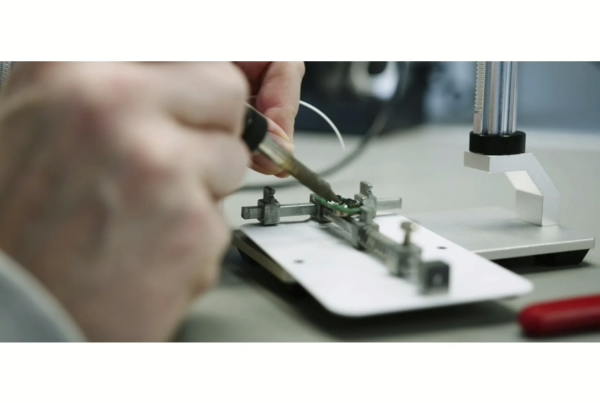
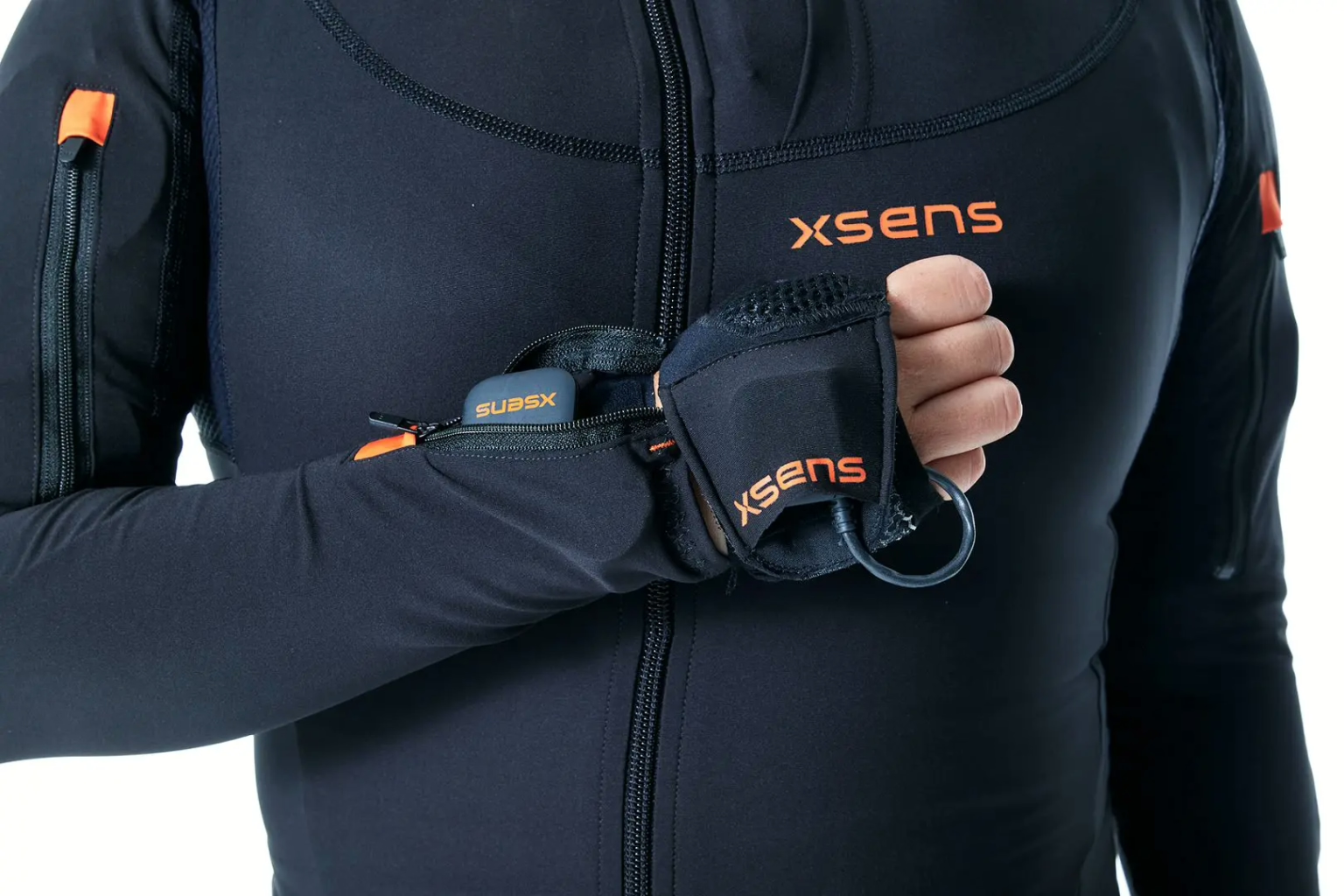
Integrating electronics into a garment that must survive regular use, washing, and physical stress is a discipline in its own right. Conductive yarns, printed electronics, and modular attachment methods each have different durability, flexibility, and washability profiles. Choosing the wrong integration technique for the application is a common source of failure in late-stage development.
Sensor fusion, combining GPS, IMU, and sometimes barometric data into a reliable heading estimate, is the foundation the entire navigation system rests on. Errors in heading estimation produce incorrect haptic cues, which erodes user trust quickly. Getting this right in high-movement conditions, where the device is being worn by someone running, climbing, or working in a vehicle, requires careful algorithm design and extensive field testing.
How Elitac Wearables helps with haptic navigation development
Developing a haptic navigation wearable that actually works in the field means solving all of the challenges above simultaneously, not one at a time. That is where fragmented development approaches consistently fail. Elitac Wearables brings every required discipline in-house: haptic actuator selection and pattern design, embedded hardware and firmware, textile integration, sensor fusion, and human factors. For a CTO or Head of Product evaluating a development partner, that matters because there are no handoffs, no knowledge gaps between vendors, and no single supplier pointing at another when something goes wrong.
Concretely, Elitac’s approach to haptic navigation development covers:
- Actuator selection across ERM, LRA, and piezo technologies matched to the specific body location, use environment, and power budget
- Vibration pattern design and optimisation using the proprietary TacOS firmware platform, purpose-built for wearable haptic systems
- Electronics-textile integration using the right technique for the application, whether conductive yarn, printed electronics, or modular attachment
- Sensor fusion and GPS integration tuned for high-movement real-world conditions
- Battery performance optimisation across hardware, firmware, and usage patterns to hit operational endurance targets without increasing device size
- Human factors testing to validate that directional cues are intuitive and reliable under the stress conditions of the target use case
The Mission Navigation Belt for the Royal Netherlands Army demonstrates what this integrated approach produces: a lightweight, ergonomic haptic belt that delivers silent, screen-free navigation to soldiers in operational conditions, integrating with existing GPS systems and surviving the demands of military use. If you are evaluating whether haptic navigation is the right approach for your product, or you are already in development and running into integration challenges, speak with the Elitac Wearables team directly to discuss your project requirements.