

Yes, haptic feedback wearables can be used in medical applications, and they already are. From balance rehabilitation to pain management and neurological support, haptic wearables are being developed and deployed across a growing range of clinical contexts. The key is that these devices must meet a fundamentally different standard than consumer wearables: they need to be clinically effective, reliably built, and certified under medical device regulations. This article unpacks the most important questions any organisation should understand before building or commissioning a haptic wearable for healthcare.
What medical conditions can haptic wearables help treat?
Haptic wearables are being applied to conditions where the body needs an alternative or supplementary sensory signal to guide movement, restore function, or deliver therapeutic stimulation. Balance disorders, Parkinson’s disease, stroke rehabilitation, and chronic pain are among the most clinically active areas. The common thread is that haptic feedback can substitute for or reinforce sensory information the body is no longer receiving or processing correctly.
In balance rehabilitation, vibrotactile feedback delivered through a belt or insole can prompt the wearer to correct posture in real time. Elitac Wearables developed the BalanceBelt precisely for this application, using haptic cues to support people with vestibular disorders. In stroke rehabilitation, haptic wearables are being explored to guide limb movement during physiotherapy, giving patients a physical cue that helps re-establish motor pathways. For Parkinson’s patients, rhythmic haptic stimulation has shown potential for reducing freezing of gait, a debilitating symptom where movement suddenly stops.
Pain management represents another growing area. Transcutaneous electrical nerve stimulation (TENS) has long been used in this space, and newer haptic wearables are exploring vibrotactile and pressure-based approaches as non-pharmacological alternatives. Prosthetics and orthotics are also incorporating haptic feedback to give users sensory information about grip strength or limb position that they would otherwise lack entirely.
How does haptic feedback work as a therapeutic mechanism?
Haptic feedback works therapeutically by delivering controlled mechanical stimulation to the skin and underlying tissue, which the nervous system interprets as a sensory signal. In a medical context, this signal is designed to replace missing proprioceptive input, prompt a motor response, or modulate pain perception. The therapeutic effect depends entirely on how precisely that stimulation is timed, located, and calibrated to the individual’s condition.
The three main actuator types used in haptic wearables each produce stimulation differently. ERM (Eccentric Rotating Mass) motors generate a broad, diffuse vibration and are the most common in entry-level devices. LRA (Linear Resonant Actuator) units produce cleaner, more localised pulses with better frequency control. Piezo actuators offer the highest precision, fastest response times, and finest spatial resolution, making them particularly suitable for applications where the body needs to distinguish between distinct signals in close proximity, such as on the fingertip or forearm.
For rehabilitation applications, the timing of the haptic signal relative to movement is critical. A cue delivered too early or too late can disrupt motor learning rather than support it. This is why firmware-level control of haptic patterns, not just the hardware choice, determines whether a therapeutic device actually works in practice. The full system, from actuator selection through to the algorithm that decides when to fire a cue, needs to be designed as a single integrated solution.
What’s the difference between haptic wearables and traditional medical devices?
The key difference between haptic wearables and traditional medical devices is that haptic wearables deliver therapeutic or informational output through the body’s surface using mechanical stimulation, whereas most traditional devices either measure physiological signals passively or deliver pharmacological or electrical interventions. Haptic wearables are active, body-worn, and designed to be used continuously during daily life, not just in clinical settings.
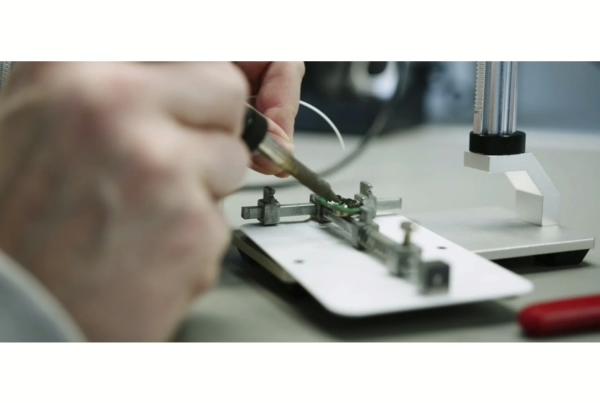
Traditional medical devices such as ECG monitors or infusion pumps are typically stationary or handled by clinicians. A haptic wearable is worn by the patient and must function reliably across a full range of real-world conditions: movement, sweat, varying skin contact, and unpredictable environments. This changes the engineering requirements substantially. The device must be flexible enough to move with the body, robust enough to survive daily wear, and precise enough to deliver consistent stimulation regardless of how the garment sits on the wearer at any given moment.
There is also a human factors dimension that traditional devices rarely face in the same way. A haptic wearable must be comfortable enough that a patient will actually wear it, discreet enough that they will wear it in public, and intuitive enough that the feedback signals are understood without training. These are design and UX challenges that sit entirely outside the scope of most conventional medical device development, and they require a different kind of multidisciplinary expertise.
What regulatory requirements apply to medical haptic wearables?
Medical haptic wearables sold in the European Union must comply with the EU Medical Device Regulation (MDR), which replaced the older Medical Device Directive in 2021. The classification of the device, Class I, IIa, IIb, or III, determines the depth of conformity assessment required. Most haptic wearables that deliver therapeutic stimulation fall into Class IIa or above, which requires involvement from a Notified Body and substantially more documentation than a self-declared Class I product.
MDR compliance requires clinical evidence that the device performs as intended and does not pose unacceptable risks. For a haptic wearable, this typically means demonstrating that the stimulation parameters are safe for continuous skin contact, that the device performs consistently across the intended user population, and that any software controlling the haptic output is validated under the relevant software lifecycle standards. If the device includes biosensing capabilities, those components carry their own compliance requirements.
Certification strategy should not be an afterthought. Decisions made early in the hardware design, such as which actuator type to use, how the electronics are integrated into the textile, and what data the firmware logs, can significantly affect the certification pathway. Organisations that begin thinking about MDR compliance late in development often face expensive redesigns. The right approach is to factor regulatory requirements into the design brief from day one, which is why working with a development partner experienced in medical wearable certification is worth the investment.
Who is developing haptic wearables for medical use?
Medical haptic wearable development is happening across a mix of university spin-outs, specialist development companies, and established medtech firms exploring adjacent innovation. In Europe, several research institutes and applied science organisations are active in this space, often in collaboration with hospitals and rehabilitation centres. The technology is mature enough that clinical pilots are underway, but the path from a research prototype to a certified, scalable product remains a significant challenge for most teams.
Academic institutions such as Maastricht University, UMC Utrecht, and the Donders Institute are among the research partners actively working in areas relevant to haptic and sensory wearables. These collaborations are valuable for generating clinical evidence and refining therapeutic protocols, but they typically require a dedicated engineering partner to translate research outcomes into manufacturable, certified devices.
On the engineering side, specialist wearable development companies are the organisations most likely to bridge the gap between clinical concept and market-ready product. Elitac Wearables, for example, has developed medical wearables including the BalanceBelt, a haptic feedback device for people with balance disorders, and works with partners including UMC Utrecht and Maastricht UMC+ on health-related wearable projects. The distinction between a research prototype and a device that can be reliably produced and certified is where specialist engineering capability becomes decisive.
What are the biggest challenges in building a medical haptic wearable?
Building a medical haptic wearable is genuinely difficult, and most teams underestimate how many distinct disciplines need to work together for the device to succeed. The challenges span engineering, regulation, clinical validation, and user experience, and a failure in any one of these areas can stall or kill the project. Understanding these challenges upfront is the most effective way to avoid them.
Engineering and integration complexity
Integrating haptic actuators into a garment or body-worn device is not simply a matter of attaching electronics to fabric. The actuator must maintain consistent contact with the skin across movement, the textile must survive washing and daily wear without degrading the electronics, and the firmware must deliver precise timing that holds up in real-world conditions rather than just on a test bench. ERM, LRA, and piezo actuators each behave differently when embedded in soft materials, and the right choice depends heavily on the body location, the therapeutic signal required, and the power budget available.
Power management is a recurring challenge in medical wearables. A device that runs out of charge mid-session, or that requires daily charging, is unlikely to achieve consistent patient compliance. Battery performance is a system-level problem, not a component problem. Firmware that keeps sensors active longer than necessary, or communication protocols that transmit more data than needed, can drain a battery far faster than the hardware specification suggests.
Regulatory and clinical validation demands
As covered above, MDR compliance sets a high bar. But beyond the regulatory documentation, medical haptic wearables also need clinical evidence that the device actually achieves its therapeutic intent. Generating that evidence requires structured studies, which take time and budget that many development teams do not account for in their initial planning. The clinical validation process and the engineering development process need to run in parallel, informed by each other, rather than sequentially.
Up to 70% of wearable prototypes never reach production, and in the medical sector the proportion that stall before certification is even higher. The most common reason is not technical failure, but assumptions made early in development that prove incorrect once real users interact with the device under real conditions. Validating early, with functional demonstrators rather than polished prototypes, is a far more cost-effective way to surface those assumptions before they become expensive problems.
How Elitac Wearables helps with medical haptic wearable development
Developing a medical haptic wearable requires every discipline to work together from the start, and that is exactly what Elitac Wearables is built to deliver. For CTOs, product leads, and R&D directors who need a development partner rather than a component supplier, Elitac brings the full stack in-house: actuator selection and haptic system design, electronics-textile integration, firmware development including the proprietary TacOS platform, biosignal sensing, human factors, and MDR certification guidance. There are no handoffs between vendors, no knowledge gaps at the seams, and no assumptions left unchallenged.
Specifically, Elitac Wearables supports medical haptic wearable projects by:
- Advising on actuator selection (ERM, LRA, or piezo) based on body location, therapeutic signal requirements, and power constraints
- Designing and validating haptic patterns at the firmware level for clinical precision
- Integrating electronics into textiles for washable, body-conforming, long-wear devices
- Building functional demonstrators early in the process to validate clinical assumptions before major investment
- Guiding MDR compliance strategy from the design brief through to certification
- Coordinating production for first series and scaled manufacturing through a trusted global network
If your organisation is developing a haptic feedback wearable for a medical application and needs a partner with the technical depth to take it from concept to certified product, speak with the Elitac Wearables team. The earlier that conversation happens, the more it shapes a development path that actually reaches the market.
Related Articles
- What are the biggest challenges in developing military wearables?
- What should a Head of Product demand from a wearable development partner at each project milestone?
- How long does wearable product development take?
- What software platforms are used in wearable product development?
- What is wearable product development?