
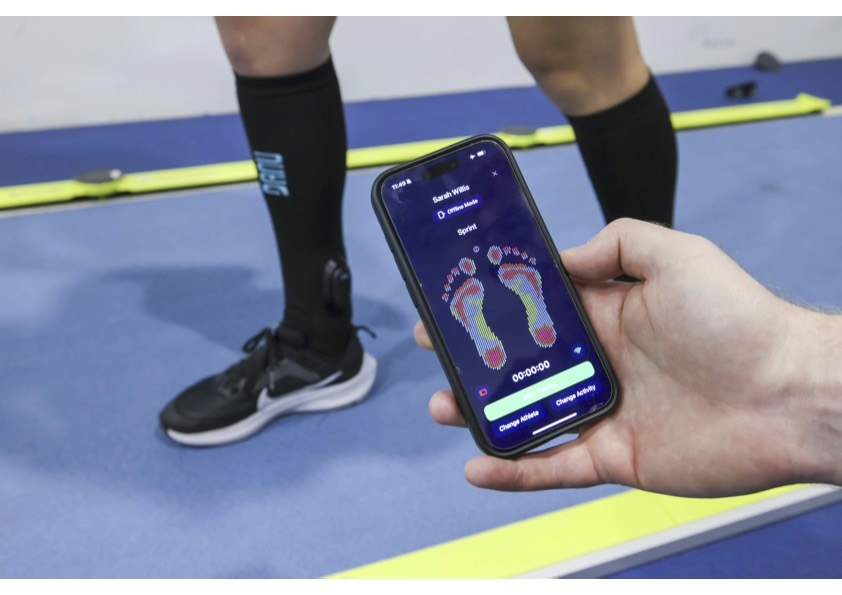
Wearable product development involves a broad stack of software platforms working in parallel across firmware, mobile, data processing, cloud infrastructure, and hardware design. No single tool covers everything — successful development depends on selecting the right platform for each layer and ensuring they integrate cleanly. For teams building custom wearable product development solutions in medical, safety, or defence contexts, the software decisions made early in the process have significant downstream consequences for performance, certification, and scalability.
What types of software are involved in wearable product development?
Wearable product development requires software across at least five distinct layers: embedded firmware running on the device itself, mobile or companion applications, sensor data processing and algorithm pipelines, cloud and data management infrastructure, and hardware design tooling. Each layer has its own tooling requirements, and they must all communicate reliably with each other for the product to function as intended.
This is one of the reasons custom wearable product development is significantly more complex than standard electronics work. A fitness tracker and a medical-grade biosignal wearable might both measure heart rate, but the software stack behind each is fundamentally different in terms of precision requirements, regulatory compliance, power management, and data handling. Understanding which software domains are involved helps development teams scope projects accurately and avoid late-stage surprises.
- Firmware and embedded software: The code running directly on the microcontroller or processor inside the wearable device
- Mobile application platforms: iOS and Android development environments for companion apps that communicate with the device
- Signal processing and algorithm tools: Platforms for cleaning, analysing, and extracting meaning from raw sensor data
- Cloud and data infrastructure: Backend systems for storing, processing, and serving data at scale
- Hardware design software: CAD, PCB design, and simulation tools used during the physical development process
What platforms are used for firmware and embedded software in wearables?
Firmware for wearables is most commonly developed using C or C++ in environments such as Keil MDK, IAR Embedded Workbench, or the vendor-specific SDKs provided by chipset manufacturers like Nordic Semiconductor, STMicroelectronics, or NXP. For devices using Bluetooth Low Energy, Nordic’s nRF Connect SDK and Zephyr RTOS are widely adopted. The choice of platform is typically dictated by the chosen microcontroller and the real-time performance requirements of the application.
Real-time operating systems (RTOS) are common in wearables where timing matters — for example, in haptic feedback delivery or biosignal sampling. FreeRTOS and Zephyr are the most frequently used open-source options. For teams building proprietary solutions, a custom RTOS layer is sometimes developed to provide tighter control over power management and hardware interaction.
Power consumption is one of the most critical constraints in wearable firmware design. Poorly written firmware keeps radios, sensors, and processors active longer than necessary, which is one of the most common root causes of battery life failures in wearable development. Firmware-level optimisation — including interrupt-driven architectures, sleep state management, and communication interval tuning — can dramatically extend battery life without changing any hardware.
For development teams building haptic wearables specifically, firmware must also handle actuator timing, pattern sequencing, and body-location-specific calibration. This is a technically demanding area where general-purpose embedded platforms often fall short without significant customisation.
Which mobile app development platforms are commonly used with wearables?
The most common mobile development platforms used alongside wearables are React Native, Flutter, and native iOS (Swift/Xcode) and Android (Kotlin/Android Studio) environments. Cross-platform frameworks like React Native and Flutter are popular for reducing development time when both iOS and Android support is needed, while native development is preferred when Bluetooth stack performance, background processing, or platform-specific health APIs are critical.
For wearables that connect via Bluetooth Low Energy, the mobile app is responsible for device discovery, pairing, connection management, and data transfer. This requires careful handling of the BLE stack on both platforms, which behaves differently between iOS and Android in ways that frequently cause integration problems late in development.
Several platform-specific health frameworks also come into play depending on the application:
- Apple HealthKit and Core Bluetooth: Used for health data integration and BLE device management on iOS
- Android Health Connect and Bluetooth GATT APIs: The equivalent stack on Android, with more variability across device manufacturers
- Google Fit API: Used when integrating with broader fitness data ecosystems, though its relevance has shifted with the introduction of Health Connect
For medical-grade wearable product development, the mobile app may also need to comply with data protection requirements under GDPR or medical device software regulations, which affects architectural decisions around data storage, transmission, and access control.
What tools are used for sensor data processing and algorithm development?
Sensor data processing in wearables is most commonly developed using Python, MATLAB, or C/C++ depending on the stage of development and the deployment target. Python with libraries such as NumPy, SciPy, and MNE is the standard choice for exploratory signal processing and algorithm development, particularly for biosignals like ECG, EMG, EEG, and EDA. MATLAB remains common in academic and medical research contexts. Once algorithms are validated, they are typically re-implemented in C or C++ for deployment on embedded hardware.
The challenge in wearable signal processing is that sensors behave differently on a moving body than they do in a lab. Motion artefacts — interference caused by body movement — are a persistent problem in biosignal wearables, and managing them requires both hardware choices (dry vs. wet electrodes, sensor placement) and software approaches (filtering, artefact rejection algorithms, and in some cases machine learning models trained on real-world movement data).
For teams working on movement sensing using IMUs or accelerometers, sensor fusion algorithms are essential. These combine data from multiple sensors — typically an accelerometer, gyroscope, and magnetometer — to produce accurate orientation and position estimates. Madgwick and Mahony filters are widely used open-source options, while more complex applications may require Kalman filtering or proprietary fusion algorithms.
Machine learning is increasingly used in biometric wearable product development for classification tasks — detecting falls, identifying gait abnormalities, recognising activity types, or flagging physiological anomalies. TensorFlow Lite and Edge Impulse are the most common platforms for deploying lightweight ML models on embedded wearable hardware.
How do cloud and data platforms fit into wearable development?
Cloud platforms in wearable development handle data storage, remote processing, user account management, firmware update delivery, and analytics dashboards. The most commonly used cloud infrastructure providers are AWS, Google Cloud, and Microsoft Azure, each of which offers IoT-specific services designed to handle the device connectivity, message queuing, and data pipeline requirements typical of wearable deployments.
For medical and safety wearables, cloud architecture decisions carry regulatory weight. Data sovereignty, encryption in transit and at rest, access logging, and audit trails are not optional features — they are compliance requirements under GDPR and, for medical devices, under frameworks like the EU Medical Device Regulation (MDR). Building these into the architecture from the start is significantly less costly than retrofitting them after a product is in the field.
Common cloud services used in wearable product development include:
- AWS IoT Core / Azure IoT Hub: Device connectivity and message routing at scale
- Time-series databases (InfluxDB, TimescaleDB): Optimised for the high-frequency, timestamped data streams that wearables generate
- Firebase / Supabase: Used in lighter-weight consumer or research wearable applications for real-time data sync and user authentication
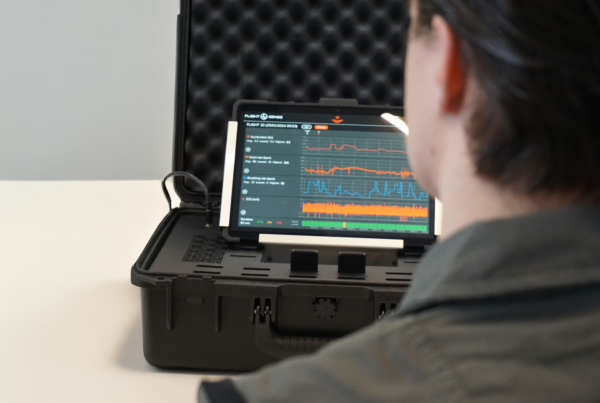
- Grafana / Kibana: Visualisation and monitoring dashboards for sensor data streams
For smaller-scale deployments or research applications, cloud infrastructure can be kept relatively simple. For products scaling to thousands of users, backend architecture becomes a significant engineering challenge in its own right and should be scoped as part of the overall wearable development services plan.
What software tools support hardware design and prototyping in wearables?
Hardware design for wearables relies on PCB design software, mechanical CAD tools, and simulation environments. Altium Designer and KiCad are the most widely used PCB design platforms, with Altium preferred in professional and commercial development contexts. Eagle (now part of Autodesk Fusion 360) is common in earlier-stage or lower-volume projects. For mechanical enclosure design and textile integration planning, tools like SolidWorks, Fusion 360, and Rhino are used depending on the form factor requirements.
Simulation tools play an important role in reducing physical prototyping iterations. SPICE-based circuit simulators help validate power management and signal integrity before committing to a PCB layout. For RF-sensitive wearables — particularly those using Bluetooth or other wireless protocols — antenna simulation tools such as ANSYS HFSS are used to model performance in proximity to the human body, which significantly affects antenna behaviour.
For wearables that integrate electronics into textiles, additional tooling is needed to plan and validate the physical integration. This includes CAD tools adapted for garment construction, as well as custom jigs and test fixtures developed in-house to validate electrical performance across flex cycles, washing, and body movement. This is an area where off-the-shelf software rarely covers the full requirement, and development teams typically build their own validation processes around their specific integration techniques.
How Elitac Wearables supports your software stack decisions
Choosing the right software platforms is not a checklist exercise — it is an engineering decision with direct consequences for development speed, product reliability, certification readiness, and long-term maintainability. For organisations without in-house wearable expertise, these decisions are often made too late or with insufficient context, leading to costly rework mid-project.
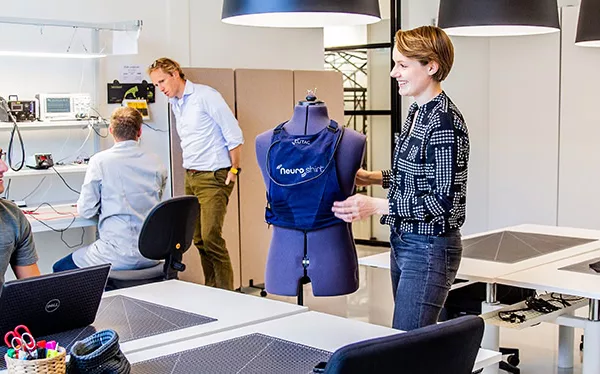
Elitac Wearables brings the full software stack in-house, which means clients do not have to coordinate between separate firmware, app, and algorithm suppliers. The team covers embedded firmware development, biosignal algorithm design, and mobile integration under one roof, supported by TacOS — a proprietary wearable operating system that accelerates firmware development and reduces the risk of power management failures that commonly derail wearable projects late in the cycle. This matters particularly for teams building medical, safety, or defence wearables where software reliability is non-negotiable.
For product managers, CTOs, and R&D directors evaluating a wearable development partner, the software capability question is often the one that separates generalist electronics houses from genuine wearable specialists. Elitac’s approach covers:
- Firmware architecture and power optimisation from the earliest prototype stage
- Sensor data processing and algorithm development for biosignal and movement applications
- Mobile app integration across iOS and Android, including BLE stack management
- Cloud architecture guidance aligned with GDPR and MDR compliance requirements
- Hardware design tooling integrated with the physical prototyping process in the in-house Wearables Lab
If your team is navigating a complex wearable development challenge and the software stack is one of the open questions, get in touch with Elitac Wearables for a direct conversation about where you are in the development cycle and what the right next step looks like.
Related Articles
- How do smart uniforms work in military applications?
- What sensors are used in haptic feedback wearable devices?
- What should a Head of Product demand from a wearable development partner at each project milestone?
- How do data privacy regulations affect wearable product development?
- How do you future-proof a wearable product during the development phase?