

Haptic wearables are significantly harder to engineer than standard wearables because they combine the complexity of precise mechanical actuation with the constraints of body-worn electronics, flexible materials, and real-time signal processing. Unlike a smartwatch that displays data, a haptic wearable must physically interact with the wearer’s body in a way that is meaningful, comfortable, and reliable. The sections below break down the specific design challenges that make haptic wearable development genuinely difficult.
Why are haptic wearables harder to engineer than standard wearables?
Haptic wearables are harder to engineer than standard wearables because they must do two things simultaneously: sense or compute information and then physically deliver it to the body in a controlled, interpretable way. That delivery mechanism adds layers of mechanical, electrical, and perceptual complexity that a display-based wearable simply does not face.
A fitness tracker measures and displays. A haptic wearable must also act. That action involves moving parts or pressure-generating components, which introduces vibration interference, heat, power draw, and mechanical wear into a system that is already constrained by the need to be lightweight, flexible, and comfortable. Every additional actuator in the design multiplies these challenges.
The integration problem is also structural. Electronics in standard wearables can be housed in rigid enclosures. In haptic wearables, particularly those built into garments or soft form factors, electronics must bend, stretch, and survive repeated mechanical stress while still maintaining precise timing and signal integrity. Achieving this reliably across a range of body types, movement patterns, and environmental conditions is a fundamentally different engineering challenge.
How do you fit actuators and electronics into a wearable form factor?
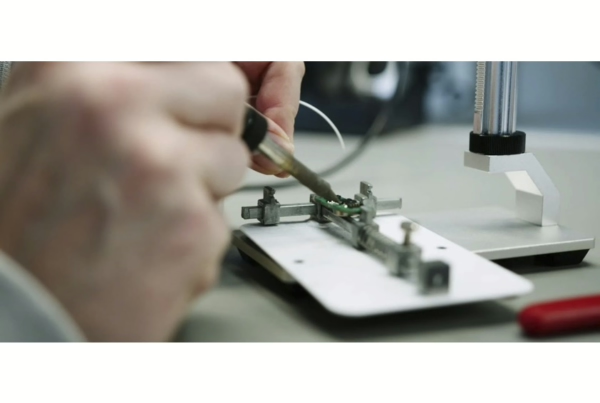
Fitting actuators and electronics into a wearable form factor requires careful decisions about actuator type, placement, mounting method, and interconnection strategy. The goal is to preserve function while keeping the device lightweight, flexible enough to move with the body, and comfortable enough to wear for extended periods.
Choosing the right actuator for the application
The three main actuator types used in haptic wearables are ERM (Eccentric Rotating Mass) motors, LRA (Linear Resonant Actuator) units, and piezo actuators. Each has a different size, power profile, frequency response, and mechanical behavior. ERMs are low-cost and widely available but have slower response times and produce omnidirectional vibration, which can bleed into adjacent body areas. LRAs are more precise and energy-efficient but operate at a fixed resonant frequency, limiting the range of sensations they can produce. Piezo actuators are thin and fast-responding, making them well-suited to high-density arrays, but they require higher drive voltages and more complex driver circuits.
Selecting the wrong actuator for a given body location or use case is one of the most common and costly mistakes in haptic wearable development. An actuator that performs well on the wrist may produce an entirely different sensation on the torso, where tissue density, curvature, and movement patterns differ significantly.
Integrating electronics without compromising wearability
Once actuators are selected, the challenge shifts to interconnection. Rigid PCBs connected by standard cables fail quickly when subjected to repeated bending and stretching. Practical solutions include conductive yarns woven into the textile substrate, printed electronics applied directly to fabric, and modular electronics attachment systems that allow rigid components to be positioned in low-movement zones while flexible interconnects span the areas that flex most during use. Each approach involves trade-offs between durability, washability, manufacturing complexity, and cost. There is no universal answer; the right integration technique depends on the specific garment architecture and the end-use environment.
What makes power management so difficult in haptic wearables?
Power management in haptic wearables is difficult because actuators are power-hungry, battery space is severely constrained, and the system must deliver consistent haptic output across the full discharge cycle without becoming unreliable or uncomfortable as voltage drops. Managing all of this within a body-worn form factor leaves very little margin for error.
Actuators draw current in sharp bursts, particularly at activation. If multiple actuators fire simultaneously, the peak current demand can spike well beyond what the battery or power delivery circuit is designed to sustain, causing voltage sag that affects the entire system. This is not just a battery sizing problem; it is a firmware and hardware architecture problem that requires careful scheduling of actuator activation patterns alongside optimization of how sensors, radios, and microcontrollers enter and exit low-power states.
A common mistake is treating power management as a late-stage hardware decision. In practice, battery performance is a system-level outcome. Firmware that keeps components active longer than necessary, sensors that poll at higher rates than the application requires, and communication protocols that transmit data inefficiently all drain the battery independently of the actuators. Addressing these issues requires a coordinated review across hardware selection, firmware logic, data architecture, and real-world usage patterns. Teams that approach it as a single-component swap consistently run into the same problem later in development.
How does skin contact affect haptic feedback performance?
Skin contact directly affects haptic feedback performance because the human body is not a uniform transmission medium. Tissue type, skin tension, subcutaneous fat, and body hair all influence how vibration propagates from an actuator surface into the mechanoreceptors responsible for tactile perception. A signal that is clearly perceptible on one body location may be nearly imperceptible on another, even at the same amplitude and frequency.
Coupling quality is the critical variable. If an actuator is not held firmly against the skin, air gaps form between the actuator surface and the body, and vibration energy is lost before it reaches the skin. This is a particular challenge in garment-based haptic wearables, where fit varies between wearers and changes with movement. Loose fabric, incorrect sizing, or garment stretch that pulls an actuator away from the skin can degrade feedback quality significantly, even if the electronics and firmware are functioning perfectly.
The body’s own mechanoreceptors add further complexity. Different receptor types respond to different frequency ranges. Meissner’s corpuscles respond best to low-frequency stimulation, while Pacinian corpuscles are most sensitive to higher frequencies, typically in the range associated with LRA and piezo actuators. Designing haptic patterns without accounting for receptor frequency sensitivity produces feedback that may feel weak, unclear, or inconsistent, even when the hardware is performing to specification. Effective haptic wearable design requires understanding both the mechanical coupling between device and body and the perceptual biology of the skin itself.
What are the certification and safety hurdles for haptic wearables?
Certification and safety hurdles for haptic wearables depend heavily on the application domain, but they are consistently more demanding than for passive wearables because haptic devices actively interact with the body. Medical, military, and industrial safety applications each carry distinct regulatory requirements that must be designed in from the start, not retrofitted at the end of development.
For medical haptic wearables, the EU Medical Device Regulation (MDR) is the primary framework. Classification as a Class I or Class II device determines the depth of technical documentation, clinical evidence, and conformity assessment required. Class II devices require involvement of a notified body, which adds both cost and timeline. The key risk in medical haptic development is treating certification as a documentation task rather than a design constraint. MDR compliance shapes decisions about materials, software validation, usability testing, and post-market surveillance from the earliest stages of development.
For industrial and hazardous environment applications, ATEX certification applies where devices may be used in explosive atmospheres. This places strict limits on electrical energy levels, enclosure integrity, and component selection. Military applications bring their own qualification standards, which typically include environmental stress testing, electromagnetic compatibility requirements, and ruggedization criteria that go well beyond consumer or commercial medical standards.
Across all domains, electromagnetic compatibility (EMC) testing is mandatory for CE marking and is frequently underestimated. Haptic actuators, particularly ERMs, generate electromagnetic noise that can interfere with onboard sensors and wireless communication. Designing for EMC compliance from the circuit level outward avoids expensive redesigns late in the certification process.
How do you design haptic patterns that users can actually interpret?
Designing haptic patterns that users can reliably interpret requires treating haptic communication as a language design problem, not a hardware problem. Patterns must be distinctive enough that users can tell them apart under real-world conditions, simple enough to learn quickly, and robust enough to remain recognizable when the wearer is moving, stressed, or distracted.
The foundational principle is perceptual distinctiveness. Two patterns that appear different on an oscilloscope may feel identical to a user if they share similar rhythm, intensity, or location. Effective haptic vocabulary is built by varying multiple dimensions simultaneously: duration, frequency, rhythm, spatial location, and intensity. The Mission Navigation Belt, developed by Elitac Wearables for the Royal Netherlands Army, is a direct example of this challenge applied in a high-stakes operational context, where directional navigation cues must be immediately understood without visual or auditory attention.
User testing is not optional in haptic pattern design. Laboratory performance rarely predicts field performance. Patterns that users interpret correctly in a quiet test environment frequently become ambiguous when the wearer is physically active, wearing additional clothing layers, or cognitively loaded with other tasks. Iterative testing in conditions that reflect actual use is the only reliable method for validating that a haptic interface works as intended. This is one of the reasons haptic wearable development takes longer and costs more than teams often anticipate at the outset.
How Elitac Wearables helps with haptic wearable design challenges
Every challenge described in this article represents a decision point where the wrong call costs time, budget, and credibility. Elitac Wearables is built to navigate exactly these decisions, with all the disciplines required to do so sitting under one roof in Utrecht.
- Actuator selection and system design: The team advises on ERM, LRA, and piezo actuator selection based on body location, use case, and performance requirements, then designs the full haptic system including driver circuits and firmware-level timing.
- Electronics-textile integration: With over ten years of experience across conductive yarns, printed electronics, and modular attachment systems, the team selects the integration approach that fits the garment architecture and end-use environment.
- Power optimization: Battery performance is treated as a system-level problem. Elitac has helped multiple development teams extend battery life significantly by reviewing firmware, sensor polling, communication intervals, and component selection together rather than in isolation.
- Skin contact and haptic pattern design: Human factors and UX expertise are embedded in the development process, covering actuator placement, coupling strategy, and iterative user testing of haptic vocabularies in real-world conditions.
- Certification guidance: The team has direct experience with MDR for Class I and Class II medical devices, CE marking, ATEX, and military qualification requirements, and builds compliance into the design process from the start.
If your organisation is developing a haptic wearable and has hit a wall on any of these challenges, or wants to avoid them before they become expensive, the right starting point is a conversation with a team that has solved them before. Get in touch with Elitac Wearables to discuss your project.
Related Articles
- Can wearables detect soldier fatigue in real time?
- How does wearable technology reduce casualties in combat?
- Why are wearables becoming essential in modern defence?
- How do you test a wearable device before launch?
- How do you choose between building an in-house wearable team versus outsourcing development?