
Wearable product development is the end-to-end process of turning a concept for a body-worn device into a functional, market-ready product. It spans hardware design, firmware, textile integration, user testing, and regulatory certification — often simultaneously. The process demands multidisciplinary expertise that few organisations can build in-house, which is why specialist development partners exist. The sections below unpack what that process actually involves, what expertise it requires, and when it makes sense to bring in outside help.
What does the wearable product development process involve?
Wearable product development involves a structured series of phases that take a product from early concept through to certified, scalable production. Unlike conventional electronics development, wearables must solve for form factor, body contact, movement, and real-world wear simultaneously — which makes every phase more interdependent than it appears.
In practice, the process moves through several distinct stages:
- Feasibility and concept definition: Clarifying what the product needs to do, which technologies can achieve it, and what constraints exist around size, power, cost, and certification.
- Proof of concept (PoC): A functional but rough demonstrator that validates core technical assumptions — typically completed in under a month and used to de-risk the project or secure funding.
- Pilot samples: Two to ten functional units that explore features and form factor in controlled user tests, typically delivered within two months.
- Final prototypes: Five to thirty units incorporating all required features and the final form factor, used for uncontrolled user testing over a two to twelve month period.
- First series production: A limited run of thirty to fifty units suitable for certification, early sales, and market exploration.
- Scaled production: Design of peripherals, documentation, and manufacturing handover for unlimited external production.
Total end-to-end development typically takes between six months and three years. If a client arrives with an existing prototype or proof of concept, both time and cost can be reduced significantly. Conversely, introducing new technologies, full miniaturisation, or medical-grade or ATEX certification adds complexity and extends timelines.
What types of expertise are needed to develop a wearable product?
Developing a wearable product requires expertise across at least six distinct technical disciplines working in close coordination. No single discipline is sufficient on its own — a wearable that works electronically but fails at the textile interface, or that drains its battery in two hours, is not a viable product.
The core disciplines involved in custom wearable product development include:
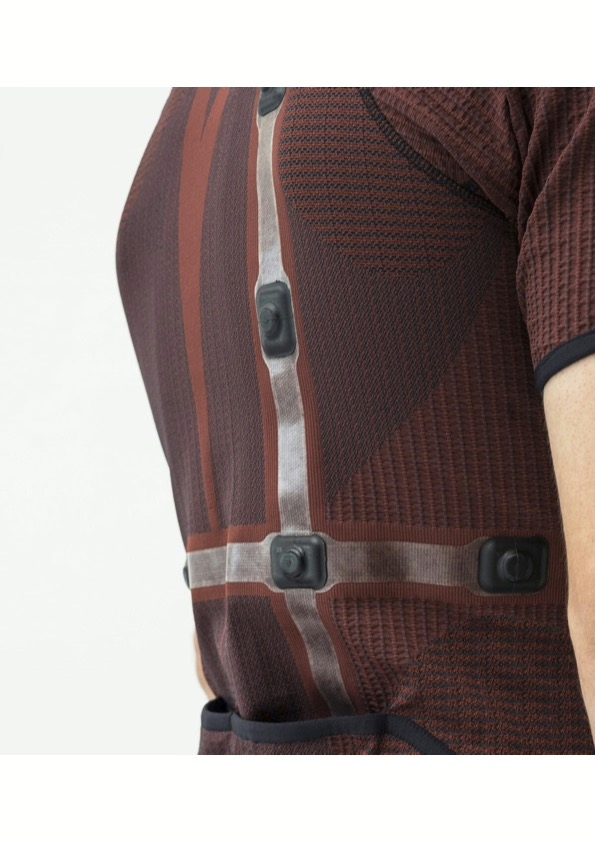
- Electronics and textile integration: Selecting the right approach — conductive yarns, printed electronics, or modular attachment — for a product that must remain functional through movement, washing, and extended body contact.
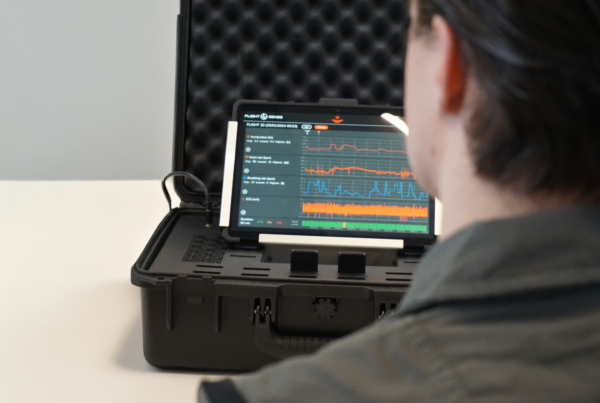
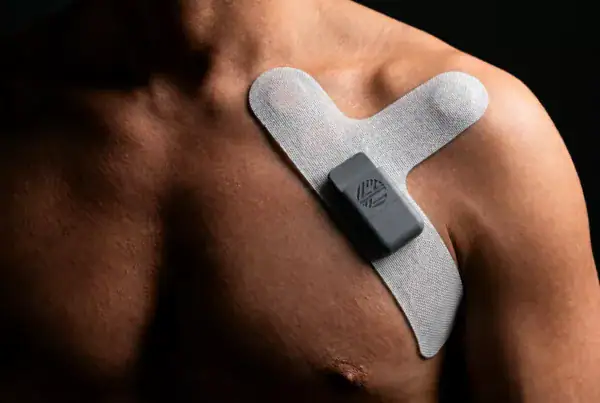
- Biosignal sensing and processing: Designing for ECG, EMG, EEG, EDA, or movement data (via IMU or accelerometers), with careful attention to dry electrode selection and motion artefact reduction in high-movement conditions.
- Embedded hardware design: Custom PCB design, component selection, and power management — all sized and optimised for wearable constraints.
- Firmware and embedded software: Writing firmware that aligns with hardware limitations and real-world usage patterns, including power states, communication intervals, and sensor scheduling.
- Human factors and UX: Designing for wearer comfort, interaction patterns, and real-world behaviour — because a wearable that users find uncomfortable or confusing will not succeed regardless of its technical performance.
- Certification and regulatory compliance: Navigating MDR (Medical Device Regulation) for Class I and II medical wearables, CE marking, ATEX requirements for hazardous environments, and military certification standards.
For biometric wearable product development specifically, biosignal expertise must be combined with hardware and firmware knowledge to address the signal quality challenges that arise when sensors move with the body. This is a niche within a niche, and it is where fragmented supplier chains most commonly fail.
How long does wearable product development take?
Wearable product development typically takes between six months and three years from concept to market-ready product. The range is wide because timelines depend heavily on the starting point, technical complexity, certification requirements, and how many development phases need to be completed from scratch.
A rough guide by phase:
- Proof of concept: Under one month
- Pilot samples (2 to 10 units): Under two months
- Final prototypes (5 to 30 units): Two to twelve months
- First series (30 to 50 units): One to five months
- Scaled production (50+ units): One to five months
The most significant timeline drivers are certification requirements and novel technology. A product requiring ATEX or medical-grade certification carries substantial additional documentation, testing, and review time. Introducing a new sensing modality or pursuing full miniaturisation adds development cycles that cannot easily be compressed. Organisations that arrive with a working prototype or proof of concept in hand can skip the earliest phases entirely — a meaningful advantage when time to market matters.
What’s the difference between a wearable prototype and a market-ready product?
A wearable prototype demonstrates that a concept works under controlled conditions. A market-ready product works reliably across all real-world conditions, meets regulatory requirements, can be manufactured consistently, and is designed for the actual end user — not just the development team. The gap between the two is where most wearable projects stall.
Prototypes are built to answer technical questions. They may use off-the-shelf components, exposed PCBs, borrowed enclosures, or manual assembly. They serve their purpose — validating feasibility, securing stakeholder buy-in, or supporting user research. But they are not products.
Moving from prototype to market-ready involves several layers of work that are frequently underestimated:
- Reliability engineering: Components and firmware must perform consistently across temperature ranges, movement patterns, sweat exposure, and extended use — not just in a lab session.
- Power optimisation: Battery life that is acceptable during a short test may be completely inadequate in real-world use. Optimising power consumption across firmware, sensors, and communication protocols is a dedicated engineering task.
- Manufacturability: A prototype hand-assembled by an engineer cannot be replicated at scale without design-for-manufacture review, component standardisation, and production documentation.
- Certification: Medical, safety, or military applications require formal evidence of compliance — testing, documentation, and in some cases third-party audit — before a product can be sold or deployed.
- User experience refinement: Form factor, comfort, donning and doffing, and interaction design all need to be validated with real users in real conditions before a product is ready for market.
The prototype-to-product gap is not a minor polish step. It is a full engineering programme in its own right, and treating it as anything less is one of the most common and costly mistakes in wearable product development.
When should a company partner with a wearable development specialist?
A company should partner with a wearable development specialist when the technical complexity of the product exceeds what the in-house team can deliver within the required timeframe or budget — or when the cost of getting it wrong is too high to learn through trial and error. For most organisations, this is earlier in the process than they expect.
The clearest indicators that a specialist partner is needed include:
- The product requires disciplines the internal team does not cover — such as electronics-textile integration, haptic feedback systems, or biosignal processing
- Regulatory certification (MDR, CE, ATEX, military) is required and the organisation has no prior experience navigating it
- Time pressure is real — an event deadline, a funding milestone, or a competitive window that cannot slip
- A previous development attempt has stalled, failed a user test, or produced a prototype that cannot be scaled
- The product sits at the intersection of multiple disciplines — for example, a medical wearable that combines biosensing, textile integration, and wireless data transmission
Partnering early is almost always more efficient than partnering late. Decisions made at the concept and feasibility stage — component selection, sensing approach, form factor, certification pathway — shape everything that follows. Reversing them mid-development is expensive. A specialist partner who identifies a flawed architecture at week two saves far more than one called in at month twelve to fix it.
What are the most common challenges in wearable product development?
The most common challenges in wearable product development are power management, electronics-textile integration, signal quality in biosensing applications, and the complexity of regulatory certification. These are not niche edge cases — they appear in almost every serious wearable development programme and are responsible for the majority of project delays and cost overruns.
Power management and battery performance
Battery life is consistently one of the hardest problems in wearable development because it is a system-level challenge, not a component-level one. Swapping to a larger battery or a more efficient chip rarely solves it. The root causes are typically firmware keeping components active longer than necessary, sensors and radios not optimised for actual usage patterns, inefficient data handling, and hardware components mismatched with real-world use. Solving it requires coordinated optimisation across hardware, firmware, and data architecture.
Electronics-textile integration
Integrating electronics into garments or flexible substrates introduces failure modes that conventional electronics development does not prepare teams for. Conductive yarns, printed electronics, and modular attachment each carry different trade-offs around washability, flexibility, durability, and manufacturing complexity. Selecting the wrong approach for a given application results in products that degrade in use, fail at connection points, or cannot be manufactured at scale.
Signal quality in biosensing applications
For biometric wearable product development, motion artefacts are a persistent challenge. When sensors move with the body — as they must in any wearable — the signal quality degrades in ways that can make the data clinically or analytically unreliable. Addressing this requires careful dry electrode selection, sensor placement strategy, and firmware-level filtering, all of which depend on understanding the specific use case and movement profile.
Regulatory certification
Certification is underestimated in almost every first-time wearable development programme. Medical Device Regulation (MDR) for Class I and II devices, ATEX for hazardous environments, and military certification standards each require documentation, testing, and in some cases third-party review that adds months and significant cost. Building the certification pathway into the development process from the start — rather than treating it as a final step — is the only reliable way to avoid it becoming a project-stopping bottleneck.
How Elitac Wearables helps with wearable product development
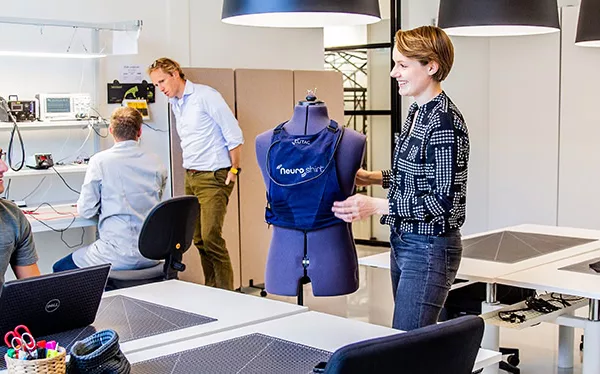
Elitac Wearables provides end-to-end wearable product development services for organisations in the medical, safety, and sports sectors — taking products from initial concept through to certified, market-ready production. The team operates from a 180m² in-house Wearables Lab in Utrecht, with all core disciplines under one roof: hardware, firmware (including the proprietary TacOS operating system), electronics-textile integration, biosignal sensing, haptics, human factors, and certification guidance.
For B2B clients evaluating a development partner, the practical implications are:
- No handoffs between vendors: Hardware, firmware, textile, and algorithm decisions are made by one integrated team — eliminating the knowledge gaps and accountability gaps that fragment most wearable development programmes
- Faster iteration: In-house R&D infrastructure means prototypes and design changes happen in days, not weeks waiting on external suppliers
- Regulatory experience built in: MDR, CE, ATEX, and military certification pathways are part of the development process from the start, not a last-minute addition
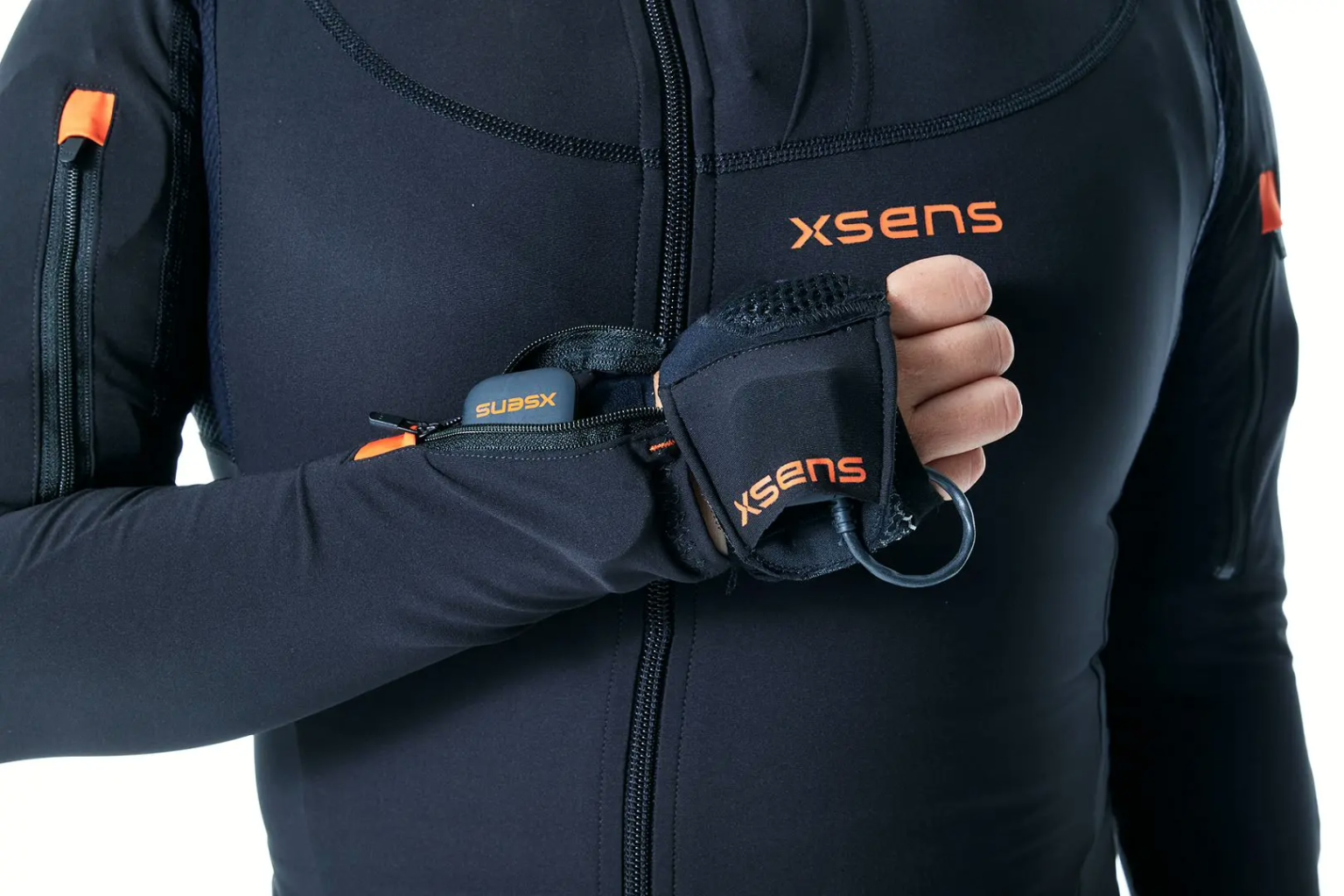
- Proven cross-sector track record: Projects include the Mission Navigation Belt for the Royal Netherlands Army, the BalanceBelt for vestibular disorder patients, and motion capture suit development for Xsens
- Flexible entry point: Whether a client needs a proof of concept to secure funding, a rapid demonstrator for a fixed deadline, or a fully certified first series, the engagement can be scoped accordingly
If your organisation is evaluating a wearable development programme and needs a partner with the technical depth to take it from concept to certified product, contact Elitac Wearables to discuss your project.
Related Articles
- Should you prototype electronics integrated into textiles in-house or outsource?
- What are the benefits of electronics integrated into textiles?
- What role do wearables play in special forces operations?
- How long does wearable product development take?
- What software platforms are used in wearable product development?