

Wearable product development typically involves six stages: feasibility check, proof of concept, pilot samples, final prototypes, first series production, and scaled production. Most projects move through these phases sequentially, though the starting point depends on how mature your concept already is. The sections below answer the most common questions buyers have before committing to a development programme.
How many stages does wearable product development typically involve?
A structured wearable product development process runs through six distinct stages, from initial feasibility through to scaled production. Each stage has a defined output, a realistic duration, and a clear decision point before the next phase begins. Skipping stages is one of the most common reasons wearable projects stall or fail to reach market.
The six stages are:
- Feasibility Check — A rapid technical verification of whether the proposed approach is viable, typically completed within 14 weeks. This is where materials, techniques, and key assumptions are stress-tested before significant investment is committed.
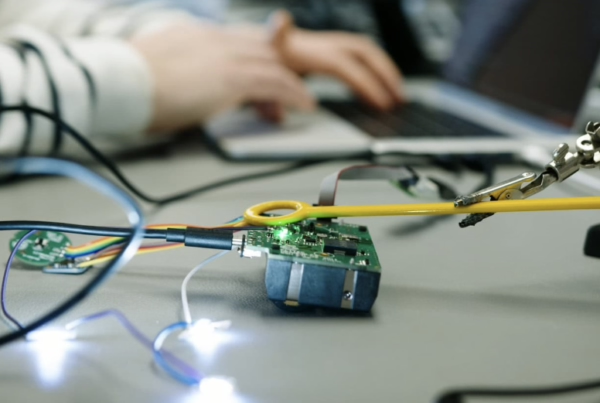
- Proof of Concept (PoC) — A basic working version built with off-the-shelf components to gather early market and user feedback. Duration is usually under one month.
- Pilot Samples (2 to 10 units) — Functional samples used to explore features and form factor in controlled user tests, typically delivered within two months.
- Final Prototypes (5 to 30 units) — Prototypes with all required features and the final form factor, used in uncontrolled user testing. This phase can run from two to twelve months depending on complexity.
- First Series (30 to 50 units) — A limited production run suitable for certification, early sales, and market exploration. Duration is typically one to five months.
- Scaled Production (50+ units) — Design of peripherals, documentation, and manufacturing handover for unlimited external production.
Total end-to-end custom wearable product development typically takes between six months and three years. If a client enters with an existing prototype or proof of concept, both time and cost can be significantly reduced. Projects requiring new technology development, full miniaturisation, or regulatory certification at the higher end of the complexity scale will naturally sit toward the longer end of that range.
What happens during the concept and feasibility stage?
The feasibility stage is a structured technical investigation that determines whether your wearable concept can actually be built as envisioned, within realistic constraints of cost, size, power, and materials. It is not a design sprint or a workshop — it is a rigorous check of the assumptions your project depends on before any serious development spend begins.
During this phase, a capable development team will typically examine:
- Technical viability — Can the required sensors, actuators, or haptic components perform reliably in a body-worn context? What are the real-world constraints around movement, sweat, and wash cycles?
- Electronics-textile integration — Which integration approach is appropriate: conductive yarns, printed electronics, or modular attachment? Each has different implications for durability, washability, and cost.
- Power and battery requirements — What is the realistic power budget for the intended use case? Battery performance is a system-level problem, not a component choice, and it needs to be scoped early.
- Regulatory landscape — Does the product fall under medical device regulation, ATEX requirements for hazardous environments, or military certification standards? Identifying this at feasibility prevents expensive redesigns later.
- Component availability and risk — Are the key components available, and what is the obsolescence risk over the product’s intended lifecycle?
The output of a well-executed feasibility check is a clear go/no-go recommendation with a defined development path, realistic cost ranges, and an honest assessment of the technical risks ahead. For organisations without in-house wearable expertise, this stage is particularly valuable because it prevents a significant budget being committed to a direction that an experienced team would have flagged as problematic from the outset.
How does prototyping work in wearable development?
Prototyping in wearable product development is not a single event — it is a progression through three increasingly refined stages, each designed to answer specific questions before moving forward. The goal at each stage is to reduce uncertainty, not to build the final product prematurely.
Proof of concept to pilot samples
The proof of concept uses off-the-shelf components and existing building blocks to demonstrate that the core functionality works. It is deliberately rough — the point is speed and learning, not polish. From there, pilot samples (typically two to ten units) are built to explore the form factor and key features in controlled conditions with real users. These are functional enough to generate meaningful feedback, but not yet optimised for production.
Final prototypes and what they must achieve
Final prototypes carry all required features in the intended form factor and are used in uncontrolled user testing — meaning real-world conditions, not a lab. This is the stage where wearable-specific challenges become most visible: motion artifacts in biosignal sensing, comfort issues over extended wear, battery drain under actual usage patterns, and the durability of electronics-textile integration under repeated movement. A final prototype that performs well in uncontrolled testing is the strongest signal that a product is ready for first series production.
One practical consideration for buyers: delivering functional wearable demonstrators quickly is achievable when the development team has the right infrastructure. Rapid prototyping with in-house 3D printing, laser cutting, and software testing capabilities can compress timelines considerably compared to projects that depend on external suppliers for each iteration.
What certifications does a wearable product need before launch?
The certifications required before a wearable product can be launched depend on its intended use, the market it will be sold into, and what claims the product makes. There is no single universal certification — the regulatory path is determined by the product category and end-user context.
The most common certification requirements in wearable product development are:
- CE marking — Required for products sold in the European market. This covers a broad range of product categories and is a baseline requirement for most consumer and professional wearables.
- Medical Device Regulation (MDR) — Applies to wearables that make medical claims or are used in clinical contexts. Class I medical wearables have lighter documentation requirements than Class II, which require notified body involvement and substantially more testing evidence. MDR compliance is one of the most significant cost and timeline drivers in biometric wearable product development.
- ATEX certification — Required for wearables intended for use in potentially explosive atmospheres, such as industrial or oil and gas environments. This certification imposes strict constraints on electronics design and materials.
- Military certification — Defence wearables must meet specific environmental and performance standards depending on the procuring nation and intended operational context.
Certification is not something to plan for at the end of development — it must be designed in from the feasibility stage. Products that reach the certification phase without having considered regulatory requirements often require significant and costly redesign. The documentation burden alone for MDR Class II or ATEX products can add months and substantial cost to a programme.
How long does wearable product development take from idea to production?
From a standing start — a concept with no existing prototype — full wearable product development through to scaled production typically takes between one and three years. The range is wide because the timeline is driven by technical complexity, regulatory requirements, and how much of the development infrastructure already exists at the outset.
The key factors that compress or extend the timeline are:
- Starting point maturity — A client who arrives with a validated proof of concept can bypass the earliest phases. A client with only an idea begins with the feasibility check.
- Technology novelty — Products requiring new materials, new sensing modalities, or full miniaturisation take longer. Off-the-shelf components and established integration techniques accelerate development.
- Certification requirements — MDR Class II and ATEX certification add substantially to both timeline and cost due to documentation, testing, and notified body review cycles.
- Development team capability — Fragmented development across multiple suppliers, each responsible for a different discipline, introduces coordination overhead and handoff risk that extends timelines significantly. A team with all disciplines in-house moves faster and with fewer knowledge gaps between phases.
- User testing outcomes — If uncontrolled user testing in the final prototype phase surfaces significant issues, iteration time is added before first series production can begin.
A rough orientation: a straightforward single-garment textile wearable without medical certification can reach first series within twelve to eighteen months. A complex multi-sensor medical wearable requiring MDR compliance may take two to three years. Military or ATEX-rated products sit at the longer and more costly end of the spectrum.
When should a company bring in an external wearable development partner?
The right time to bring in an external wearable development partner is before the project stalls — not after. The four situations where external expertise adds the most value are: when there is no in-house wearable capability, when the technical complexity exceeds what a single-discipline supplier can handle, when a prototype exists but is not reliable enough for real-world use, and when a project is stuck at the transition from prototype to production.
Each of these situations reflects a different stage of the development cycle, but they share a common thread: the problem cannot be solved by adding more of the same resource. Wearable development fails at the intersections — between hardware and firmware, between electronics and textiles, between a working prototype and a certifiable product. A development partner that covers all of those intersections under one roof eliminates the coordination risk that causes most projects to stall.
Companies that benefit most from an external partner are typically those with a strong domain understanding of their end user — a medical device company that understands clinical workflows, a defence organisation that understands operational requirements, a sports brand that understands athlete performance — but without the multi-disciplinary engineering depth to translate that knowledge into a certified, manufacturable product.
The decision to bring in a partner earlier rather than later also has a direct financial logic. Problems identified at the feasibility stage cost a fraction of what they cost to fix after tooling has been committed or a regulatory submission has been prepared. The earlier the right expertise is in the room, the fewer expensive course corrections are required downstream.
How Elitac Wearables helps with wearable product development
Elitac Wearables is a Netherlands-based end-to-end wearable development partner for organisations that need more than a generalist electronics house. The team covers every discipline required to take a wearable from concept to certified, manufacturable product — hardware design, firmware, electronics-textile integration, biosignal sensing, haptic feedback, human factors, and certification guidance — without handoffs between vendors.
For buyers evaluating a development partner, the practical advantages are:
- Six-phase structured development process with defined outputs and decision points at each stage, reducing risk and keeping programmes on track
- Proprietary TacOS firmware platform, purpose-built for wearables, which accelerates development and reduces the firmware risk that derails many projects
- 180m² in-house Wearables Lab with 3D printers, laser cutters, and permanent software testing set-ups for faster iteration without external dependencies
- Certification experience across MDR (Class I and II), CE marking, ATEX, and military standards — built into the development process from the start, not bolted on at the end
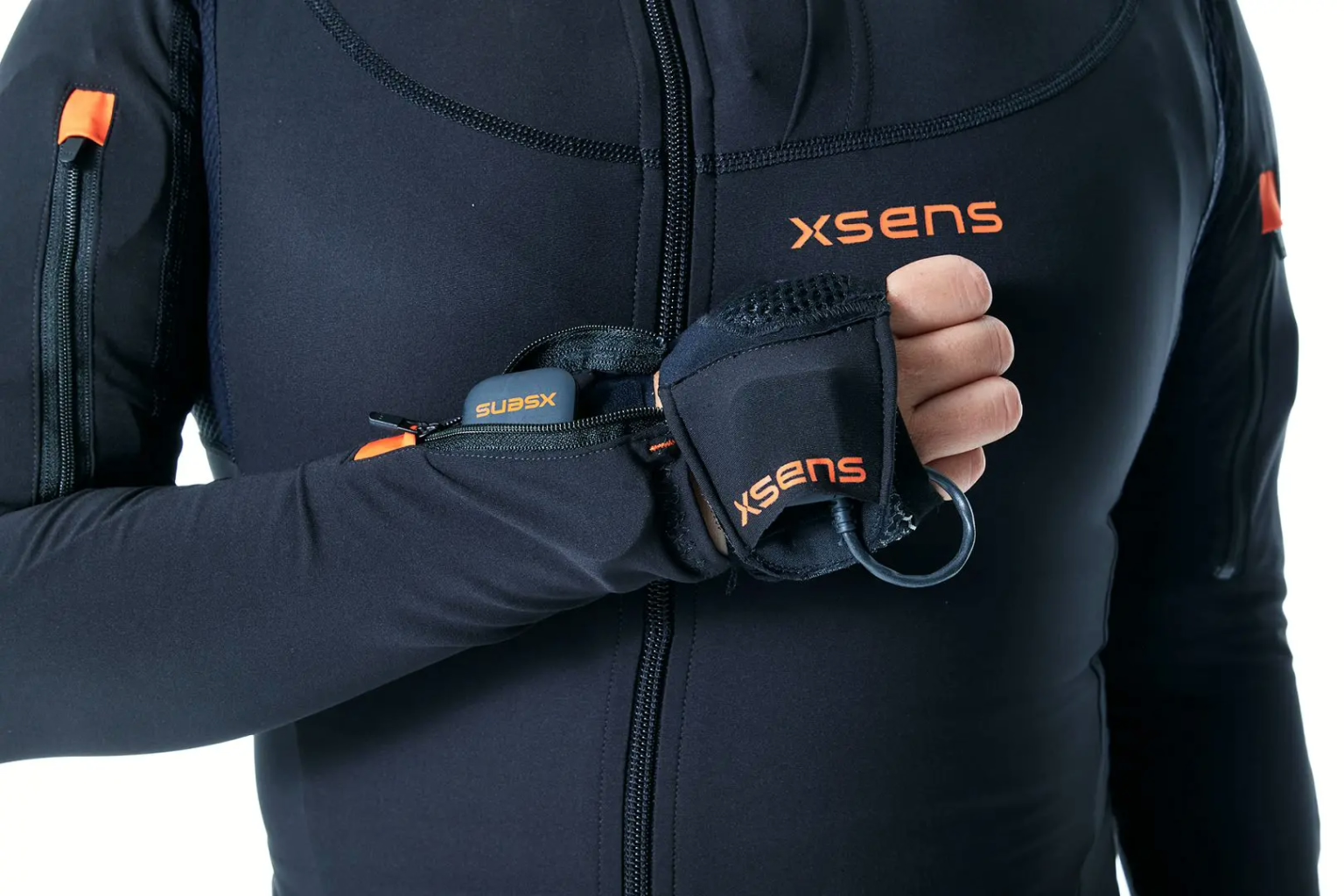
- Cross-sector track record spanning medical, defence, sports, and industrial safety, including the Mission Navigation Belt for the Royal Netherlands Army and motion capture suit development for Xsens
If your organisation is facing a wearable development challenge that standard solutions cannot solve, speak directly with the Elitac Wearables team. Whether you are at the idea stage, stuck with an unreliable prototype, or navigating the transition to production, the starting point is a direct conversation about your specific problem.
Related Articles
- How do you build a wearable product business case that gets board-level buy-in?
- How do you manage battery life constraints in wearable development?
- How do you choose the right hardware for a wearable device?
- What software platforms are used in wearable product development?
- How do you align your wearable product development with your go-to-market strategy?