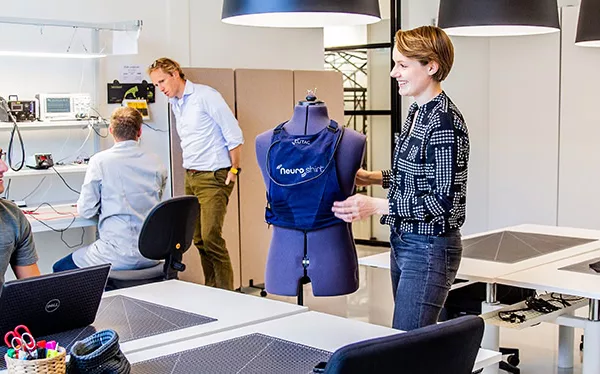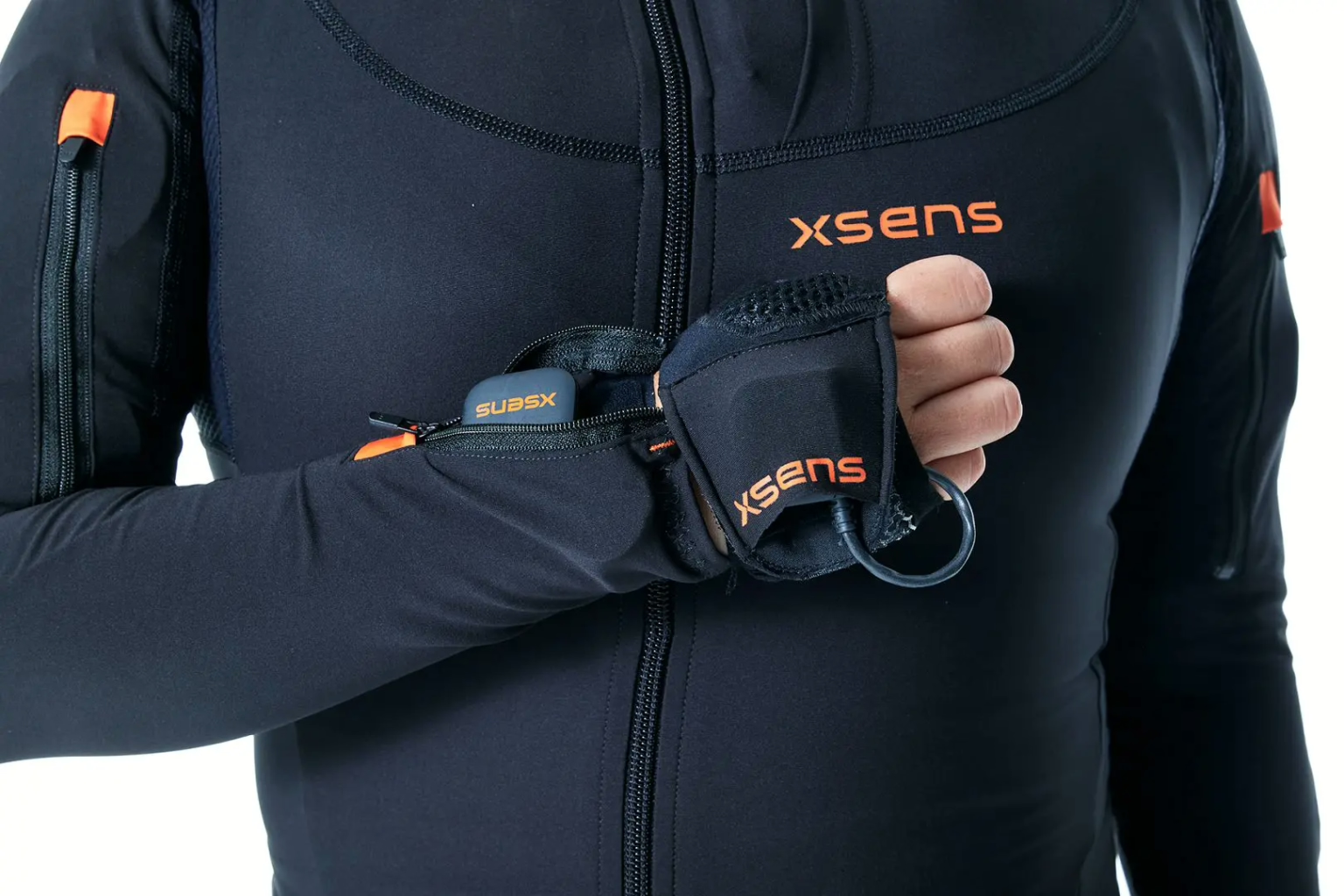

Choosing the right hardware for a wearable device comes down to matching your technical components — sensors, actuators, processors, and power systems — to the specific demands of the application, the wearer’s body, and the environment the device will operate in. There is no universal hardware stack for wearables: a medical ECG monitor worn during sleep has fundamentally different requirements than a haptic navigation belt used by a soldier in the field. The sections below walk through the key decisions, from sensor selection to when you should bring in specialist support.
What factors determine the right hardware for a wearable device?
The right hardware for a wearable device is determined by four core factors: the intended use case, the body location, the environment of use, and the regulatory context. Every hardware decision — from component selection to PCB layout — flows from these constraints. Getting them wrong early creates expensive problems later, particularly when certification or production is involved.
The use case is the starting point. A device that monitors vital signs in a clinical setting needs high signal fidelity and regulatory compliance. A device that delivers haptic alerts to a warehouse operative needs durability, washability, and low latency. These requirements pull hardware choices in completely different directions.
Body location adds another layer of complexity. Wearables worn close to the skin must account for sweat, movement, and varying skin conductivity. Devices integrated into garments need flexible or modular electronics that survive repeated bending and washing. The body is not a stable mounting surface — hardware that works on a bench will often behave differently when attached to a moving person.
Environmental conditions matter too. Military and industrial wearables must withstand impact, moisture, temperature extremes, and electromagnetic interference. Medical wearables may need to function in clinical environments with strict EMC requirements. And if your device falls under the EU Medical Device Regulation or requires CE marking, those certification requirements will shape hardware choices from the earliest design stage — not as an afterthought.
What types of sensors are commonly used in wearable devices?
The most commonly used sensors in wearable devices include inertial measurement units (IMUs), electrodes for biosignal capture, optical sensors for heart rate monitoring, and pressure sensors. The right sensor type depends on what physiological or environmental data the device needs to capture, and under what movement conditions it will operate.
Motion and movement sensors
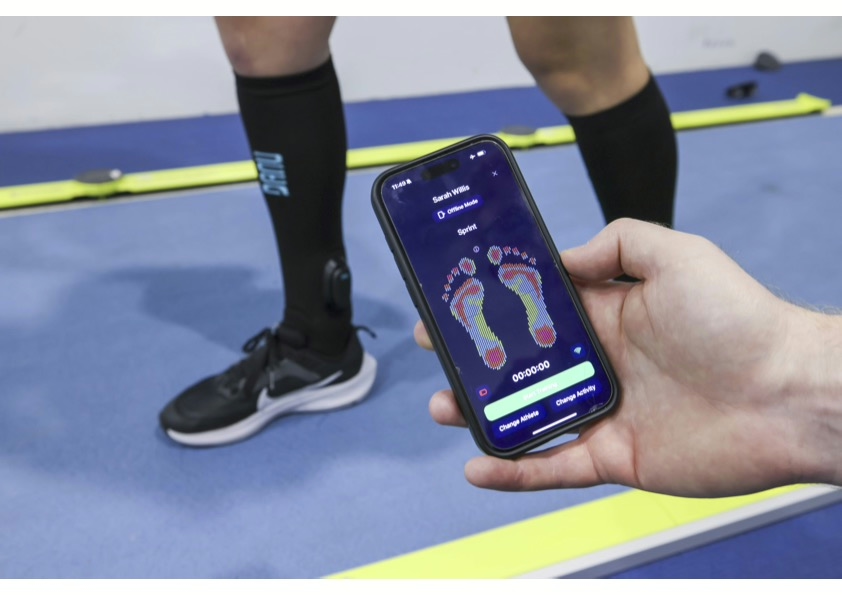
IMUs — combining accelerometers, gyroscopes, and sometimes magnetometers — are among the most widely used sensors in wearables. They track orientation, movement, and activity patterns. In sports and rehabilitation contexts, IMUs provide the raw data for gait analysis, posture monitoring, and performance coaching. Elitac’s work on the Danu Sports SmartSocks, for example, combined pressure sensors with IMUs to deliver real-time athletic performance insights.
Biosignal sensors
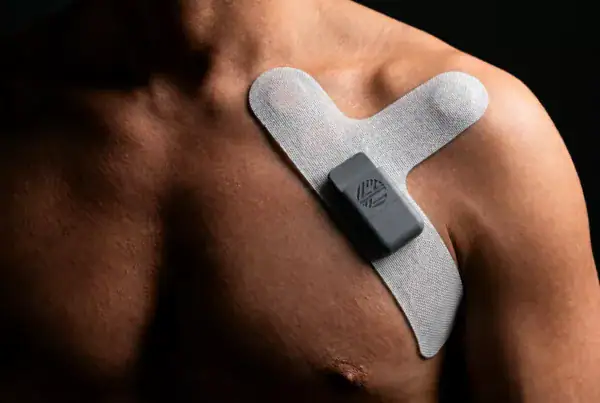
Biosignal sensing covers ECG (heart activity), EMG (muscle activity), EEG (brain activity), EDA (electrodermal activity for stress monitoring), and respiration. Each of these requires electrodes — and the choice between wet and dry electrodes is one of the most consequential hardware decisions in wearable biosensing. Wet electrodes deliver cleaner signals but are impractical for long-term or high-movement wear. Dry electrodes sacrifice some signal quality for comfort and practicality, but require careful optimisation to manage motion artefacts — signal noise caused by the electrode moving against the skin during activity. In high-movement applications like sports or military use, dry electrode design is a specialist discipline in itself.
Optical sensors, which use photoplethysmography (PPG) to detect blood volume changes through the skin, are widely used for heart rate monitoring. They are easier to integrate into consumer-grade wearables but are more susceptible to motion artefacts than electrode-based systems, making them less reliable for clinical-grade applications.
How do actuators and haptic components differ across wearable applications?
Actuators in wearable devices produce a physical output — most commonly vibration or pressure — to communicate information to the wearer without visual or auditory signals. The three main types used in haptic wearables are ERM (Eccentric Rotating Mass), LRA (Linear Resonant Actuator), and piezo actuators, and they differ significantly in how they feel, how they respond, and how much power they consume.
ERM actuators are the most common and lowest cost. They produce vibration by spinning an off-centre mass, which creates a buzzing sensation. The drawback is latency — they take time to spin up and slow down, which limits the precision of haptic patterns. For simple alert-style feedback, ERMs are adequate. For nuanced, directional, or time-critical haptic communication, they fall short.
LRA actuators use a magnetic voice coil to produce linear vibration. They respond faster than ERMs, consume less power, and can deliver more precisely controlled haptic patterns. They are the preferred choice for applications where feedback quality matters — such as a balance disorder wearable that needs to communicate subtle directional cues to the wearer’s body in real time.
Piezo actuators operate on a different principle entirely, using piezoelectric materials that deform when voltage is applied. They respond almost instantaneously, can produce a wide range of sensations, and are well suited to thin, flexible form factors. The trade-off is that they typically require higher drive voltages, which adds complexity to the power circuit.
Beyond vibration, some wearable applications use pneumatic or hydraulic actuators embedded in textiles to create compression or pressure effects — relevant in medical rehabilitation and soft robotics contexts. The choice of actuator type shapes not just the user experience but the entire hardware and firmware architecture around it, including driver circuits, timing control, and power management.
How does power supply affect wearable hardware choices?
Power supply is one of the most constraining factors in wearable hardware design. Every component choice — sensor, actuator, processor, radio — has a power cost, and in a body-worn device, the battery size is limited by weight, flexibility, and form factor. Poor power management is the most common reason wearable devices fail to meet their real-world battery life targets.
The mistake most development teams make is treating battery performance as a hardware problem — specifically, a battery-size problem. In practice, battery life shortfalls are almost always system-level inefficiencies. Common root causes include firmware that keeps components active longer than necessary, sensors and radios running at intervals that don’t match actual usage patterns, and hardware components that are technically capable but mismatched to the real-world duty cycle of the device.
Increasing battery size to compensate triggers a cascade of consequences: a larger battery requires a bigger enclosure, which may require new tooling, which delays the project and adds cost. The more effective approach is structured optimisation across hardware selection, firmware behaviour, data handling, and communication intervals — treating power as a system property rather than a component specification.
Wireless communication is a particular drain. Bluetooth Low Energy, ANT+, and other protocols used in wearables have very different power profiles depending on how they are configured. Transmission frequency, packet size, and connection intervals all affect battery draw significantly. These decisions need to be made with power budgets in mind from the earliest stages of hardware design, not retrofitted once a prototype is running.
What’s the difference between off-the-shelf and custom hardware for wearables?
Off-the-shelf hardware refers to commercially available components and development modules that can be integrated into a wearable without custom design work. Custom hardware is designed specifically for the application — optimised for size, power, performance, and form factor. The right choice depends on the stage of development and the long-term requirements of the product.
In the early stages of wearable product development, off-the-shelf components are almost always the right call. They reduce cost and time during prototyping and proof-of-concept phases, allowing teams to validate whether the core concept works before committing to custom design. Elitac’s own development process uses proprietary building blocks — including the TacOS firmware platform — alongside commercial components to accelerate early-stage work without sacrificing technical quality.
The case for custom hardware grows as the product matures. Off-the-shelf modules are rarely optimised for the constraints of a body-worn device: they tend to be larger, more power-hungry, and less flexible than a purpose-designed PCB. When a device needs to be small enough to integrate into a garment, light enough to wear all day, or reliable enough to meet medical certification standards, custom hardware design becomes necessary.
Custom hardware also enables better integration between components. A purpose-designed board can place sensors, processors, and radio modules in configurations that reduce interference, shorten signal paths, and improve overall performance. This matters most in biosignal applications, where noise introduced by suboptimal component placement can degrade signal quality significantly.
The transition from off-the-shelf to custom is one of the most technically demanding steps in wearable development — and one of the most common points where projects stall. It requires expertise across PCB design, component selection, power management, and firmware integration simultaneously.
When should you involve a hardware specialist in wearable development?
You should involve a hardware specialist as early as possible in wearable development — ideally at the feasibility stage, before any significant design decisions have been locked in. The later a specialist is brought in, the more expensive it becomes to correct assumptions that were baked into the architecture early on.
The most costly mistakes in wearable hardware development share a common cause: teams make component or architecture decisions based on what works in a controlled environment, without accounting for the realities of body-worn use. A sensor that performs well on a test bench may produce unusable data when mounted on a moving limb. A battery that meets the spec on paper may fall short in a device that runs warm or has poorly optimised firmware. A haptic actuator chosen for its catalogue specifications may deliver the wrong sensation in the intended body location.
Hardware specialists bring three things that are difficult to replicate without deep experience: knowledge of how components behave on the body rather than on a bench, familiarity with the integration challenges specific to wearables (flexible electronics, textile compatibility, washability), and the ability to anticipate certification requirements that will affect design choices. Involving them early means those constraints are built in from the start, not bolted on at the end.
For teams that have domain expertise — in medical devices, defence systems, or sports technology — but have not previously developed wearables, the gap is rarely about understanding the end application. It’s about knowing how to translate that application into a hardware architecture that will survive real-world use, pass regulatory scrutiny, and scale to production.
How Elitac Wearables helps with wearable hardware selection and development
Hardware selection for a wearable is not a component catalogue exercise — it’s a system-level engineering challenge that touches firmware, textiles, power management, human factors, and certification simultaneously. That’s where having every discipline under one roof makes a measurable difference.
Elitac Wearables works with B2B clients across medical, defence, and sports sectors to navigate exactly these decisions — from initial feasibility through to certified, production-ready products. For organisations that have deep domain expertise but have not yet built the wearable layer, the team acts as a direct extension of the client’s own engineering function. Specific areas where Elitac adds value in hardware selection and development include:
- Actuator selection for haptic applications — advising on ERM, LRA, and piezo options based on body location, feedback requirements, and power constraints
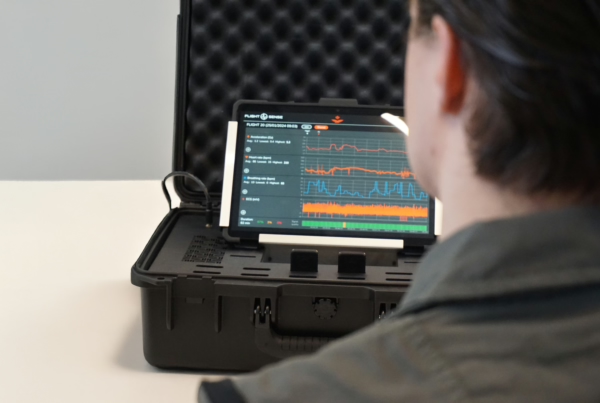
- Sensor and electrode selection — including dry electrode optimisation for high-movement biosignal capture, as demonstrated in the Flight Sense System
- Custom PCB and embedded hardware design — purpose-built for the size, power, and integration requirements of body-worn devices
- Battery performance optimisation — structured across hardware, firmware, and data architecture to extend battery life without redesigning the enclosure
- Certification-aware design — MDR, CE marking, and ATEX requirements built into hardware decisions from the earliest stage
- Rapid prototyping and validation — functional demonstrators delivered quickly to validate hardware choices before committing to custom tooling
If you’re at the point where hardware decisions are becoming critical — or where a prototype isn’t performing as expected in real-world conditions — the right next step is a technical conversation with a team that has solved these problems before. Get in touch with Elitac Wearables to discuss your project and find out where specialist support would have the most impact.
Related Articles
- What certifications does a wearable product need in 2026?
- How is GPS integrated into military wearable devices?
- Can wearables detect soldier fatigue in real time?
- How do you transition a wearable product from development to a sustainable, scalable business?
- What are the hidden costs of wearable product development that most vendors won't tell you?