

An exoskeleton and a smart vest are fundamentally different types of wearable technology. An exoskeleton is a rigid, mechanical structure worn around the body to augment physical strength or support movement, while a smart vest is a soft, textile-based garment embedded with sensors, electronics, or haptic actuators to monitor, communicate, or deliver feedback. The distinction matters enormously when you are deciding which technology fits your application, your user, and your development budget.
Both fall under the broader category of wearable technology, but they solve different problems in different ways. The sections below unpack how each works, where they are used, and how to choose between them.
How does an exoskeleton work?
An exoskeleton is a wearable mechanical framework, typically made from rigid materials such as metal or hard polymers, that attaches to the outside of the human body to assist, augment, or resist movement. It works by transferring force between the wearer and an external structure, either reducing strain on the body or amplifying the user’s physical output.
There are two main categories. Passive exoskeletons use springs, counterweights, or elastic elements to redistribute load without any power source. A worker lifting heavy components overhead, for example, might wear a passive shoulder exoskeleton that offloads strain onto the torso. Powered exoskeletons use motors, hydraulics, or pneumatics driven by onboard electronics to actively support or enhance movement. These are more complex, heavier, and significantly more expensive to develop and certify.
The engineering challenge with exoskeletons is alignment. The mechanical joints must track the natural movement of the human body precisely, or the device creates new injury risks rather than preventing them. Getting that alignment right across different body sizes, postures, and movement patterns is one of the core technical problems in exoskeleton development. Add in power management, control software, and the ergonomics of wearing a rigid structure for a full working shift, and the complexity becomes clear.
What does a smart vest actually do?
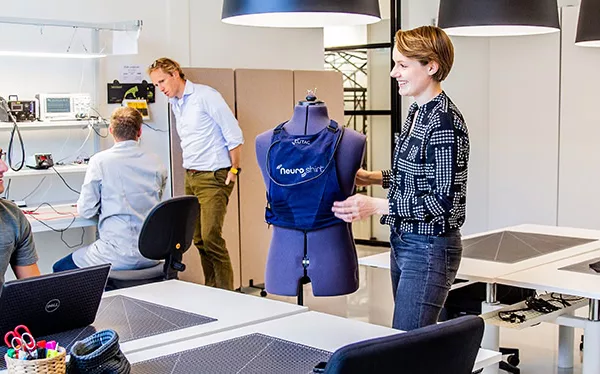
A smart vest is a soft, body-worn garment that integrates electronics, sensors, or actuators directly into or onto the textile. Unlike an exoskeleton, it does not apply mechanical force to the body. Instead, it collects data, delivers feedback, or communicates information through the wearer’s skin or senses, all while remaining flexible, lightweight, and comfortable enough for extended wear.
The functions a smart vest can perform depend entirely on what is embedded in it. Common capabilities include:
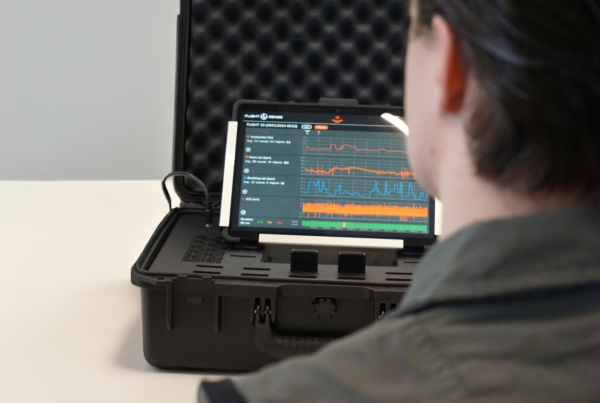
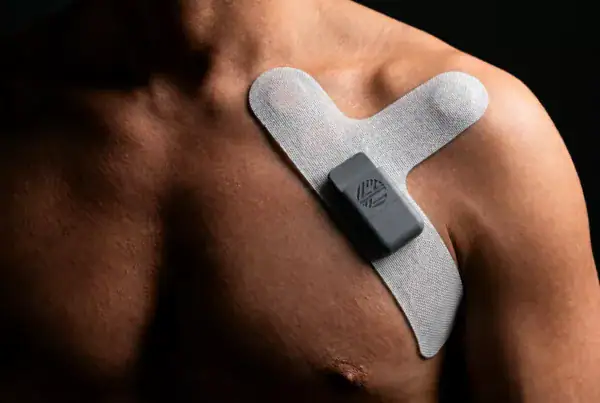
- Biosignal monitoring — ECG, heart rate, respiration, and skin conductance measured via electrodes integrated into the fabric
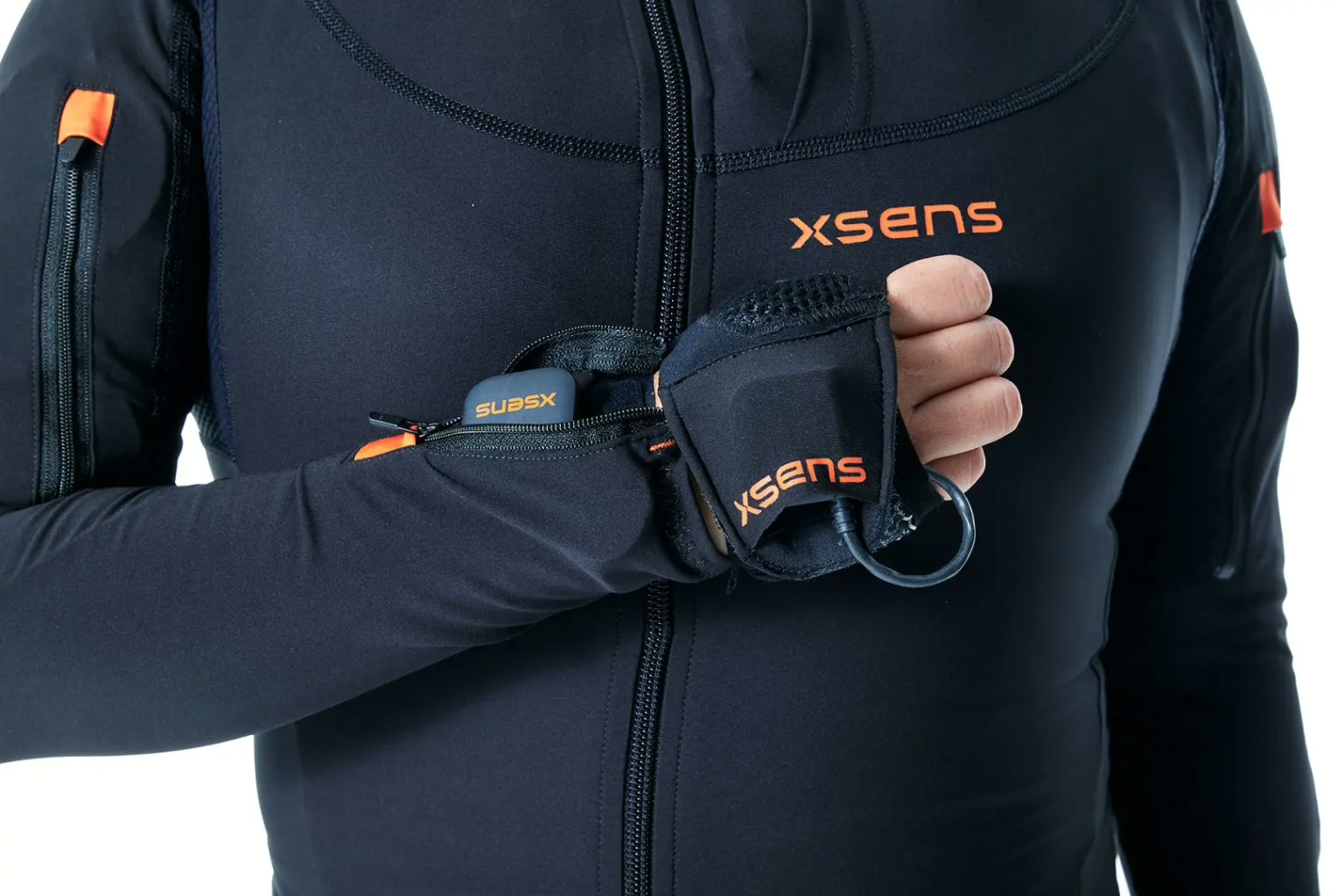
- Movement tracking — IMU sensors and accelerometers capturing posture, gait, or gesture data
- Haptic feedback — vibrotactile actuators delivering directional cues, alerts, or navigation signals through the skin
- Environmental sensing — temperature, gas, or proximity sensors embedded for safety applications
- Data transmission — onboard wireless modules sending real-time data to a connected device or cloud platform
The engineering challenge here is different from an exoskeleton. Soft, flexible garments flex, stretch, and are washed. Electronics do not naturally tolerate any of those things. Getting sensors to perform reliably on a moving body, managing motion artefacts in biosignal data, and selecting integration techniques that survive real-world use are the core technical problems in smart vest development. This is the domain of electronics-textile integration, a discipline that requires expertise across hardware, firmware, textile construction, and human factors simultaneously.
What is the key difference between an exoskeleton and a smart vest?
The key difference between an exoskeleton and a smart vest is the nature of the interaction with the body. An exoskeleton acts on the body mechanically, applying physical force to support or augment movement. A smart vest communicates with the body electronically, using sensors to read physiological signals or actuators to deliver feedback, without any mechanical load transfer.
Put simply: an exoskeleton changes what the body can do physically. A smart vest changes what the wearer knows or feels.
This distinction drives every downstream decision in development. Exoskeletons require mechanical engineering, structural materials, and joint design expertise. Smart vests require electronics-textile integration, signal processing, firmware development, and often haptic engineering. The certification pathways differ too. A powered exoskeleton used in a medical rehabilitation context faces a very different regulatory landscape than a biosignal-monitoring vest, even if both are worn on the torso.
There is also a significant difference in wearability. Exoskeletons are inherently bulky and rigid. Smart vests can be indistinguishable from ordinary clothing. For applications where the wearer needs to move freely, work unimpeded, or wear the device for hours at a time, that difference is often decisive.
Which industries use exoskeletons versus smart vests?
Exoskeletons and smart vests have found distinct homes across industries, shaped by the type of problem each technology solves best.
Where exoskeletons are deployed
Exoskeletons are most commonly used where the primary challenge is physical load or movement impairment. Industrial manufacturing environments, particularly automotive and logistics, have adopted passive exoskeletons to reduce musculoskeletal injury risk among workers performing repetitive overhead or heavy-lifting tasks. In medical rehabilitation, powered exoskeletons help patients with spinal cord injuries or stroke-related paralysis relearn walking patterns. Defence research has explored powered exoskeletons for load-carrying augmentation, though field deployment remains limited by weight and battery constraints.
Where smart vests are deployed
Smart vests are more widely deployed across a broader range of sectors, precisely because they are less intrusive and easier to integrate into existing workflows. In defence and military operations, haptic feedback vests deliver silent navigation cues, keeping a soldier’s hands, eyes, and ears free. A real example of this is the Mission Navigation Belt developed for the Royal Netherlands Army, which delivers directional information through vibrotactile feedback without requiring the wearer to look at a screen. In medical and health monitoring, smart vests capture continuous biosignal data for clinical research or remote patient monitoring. In sports performance, they track movement quality and physiological load in real time. In industrial safety, they can detect dangerous postures, monitor fatigue indicators, or alert workers to environmental hazards.
Can an exoskeleton and a smart vest be combined?
Yes, an exoskeleton and a smart vest can be combined, and in some advanced applications this integration is already happening. A powered exoskeleton that reads biosignals from an embedded textile layer to adapt its assistance in real time is one example of what this looks like in practice. The exoskeleton provides the mechanical output; the smart textile provides the sensing input.
This kind of integration is technically demanding. The rigid structure of an exoskeleton and the flexible, body-conforming nature of smart textiles create real engineering conflicts. Sensor placement must survive the mechanical motion of the exoskeleton without losing signal quality. Electronics must be routed in ways that do not interfere with joint movement or create pressure points. Power systems must be shared or coordinated between two complex subsystems.
The more realistic near-term combination is a smart vest used alongside an exoskeleton, rather than fully integrated with one. The vest monitors the wearer’s physiological state or posture, and that data informs how the exoskeleton behaves, without requiring the two systems to share a single enclosure. This modular approach is more practical to develop, certify, and maintain.
Which type of wearable is right for your application?
The right choice between an exoskeleton and a smart vest depends on what problem you are actually trying to solve. If the goal is to reduce physical load, prevent musculoskeletal injury, or restore lost motor function, an exoskeleton is likely the correct technology. If the goal is to monitor physiological state, deliver feedback, track movement quality, or communicate information hands-free, a smart vest is almost certainly the better fit.
A few questions that help clarify the decision:
- Does the device need to apply force to the body? If yes, you are in exoskeleton territory. If no, a smart vest is likely sufficient.
- How long will the wearer use it per session? Comfort and wearability favour soft textile solutions for extended wear.
- What is the regulatory pathway? Both categories can require medical device certification, but the specific requirements differ significantly depending on function and risk class.
- What is the development budget and timeline? Exoskeletons are typically more expensive and slower to develop due to mechanical complexity. Smart vests can often reach a functional prototype faster.
- Does the wearer need to move freely? Rigid structures always constrain movement to some degree. Soft wearables do not.
In many cases, organisations discover that what they initially imagined as an exoskeleton problem is actually a sensing and feedback problem, one that a well-engineered smart vest can solve at a fraction of the cost and complexity.
How Elitac Wearables helps with exoskeleton and smart vest development
Choosing between an exoskeleton and a smart vest is only the first decision. Getting from that choice to a working, validated, market-ready product is where most development programmes stall. That is the problem Elitac Wearables is built to solve.
As a specialist wearable development partner, Elitac Wearables brings every relevant discipline in-house: haptic feedback engineering, electronics-textile integration, biosignal sensing, embedded hardware design, firmware development, and human factors. For smart vest development in particular, this multidisciplinary depth is decisive. Integrating sensors and actuators into a soft textile that performs reliably on a moving body, in real-world conditions, is not a problem any single-discipline supplier can solve alone.
Specifically, Elitac Wearables can support your project with:
- Technology selection and feasibility assessment to confirm whether your application needs an exoskeleton, a smart vest, or a combination of both
- End-to-end development from proof of concept through to a certified, production-ready product using an Agile development process and the proprietary TacOS firmware platform
- Haptic system design, including actuator selection, placement, and firmware-level pattern development for applications requiring tactile feedback
- Electronics-textile integration across conductive yarns, printed electronics, and modular attachment techniques, with over ten years of experience across washable and body-worn contexts
- Certification guidance for MDR, CE marking, and sector-specific requirements, integrated into the development process from the start rather than added at the end
If you are working on a wearable application and are not yet certain which technology direction is right, or if you have a concept that is stuck at the proof-of-concept stage, the most useful next step is a direct conversation with a team that has solved these problems before. Get in touch with Elitac Wearables to discuss your project.