
Wearable product development is the process of taking a wearable concept from an initial idea through engineering, prototyping, testing, and certification to a commercially viable product. It involves integrating electronics, firmware, textiles, and human factors into a single body-worn device that performs reliably in real-world conditions. The sections below answer the most common questions organisations face when embarking on a wearable development project.
What are the main stages of wearable product development?
Wearable product development typically follows six structured stages: feasibility check, proof of concept, pilot samples, final prototypes, first series production, and scaled production. Each stage builds on the last, reducing technical risk before committing to greater investment. Skipping stages is the single most common reason wearable projects stall or fail.
Here is what each stage involves in practice:
- Feasibility Check — A rapid verification of whether the core techniques and materials required are viable for the intended application. This typically takes around 14 weeks and surfaces blockers before a significant budget is committed.
- Proof of Concept (PoC) — A basic, working version built with off-the-shelf components to validate the core idea and gather early market feedback. Duration is usually under one month.
- Pilot Samples (2 to 10 units) — Functional samples used to explore features and form factor in controlled user tests. Completed in under two months.
- Final Prototypes (5 to 30 units) — Fully featured prototypes in their final form factor, ready for uncontrolled user testing. This phase takes two to twelve months depending on complexity.
- First Series (30 to 500 units) — A limited production run suitable for certification, early sales, and market exploration. Typically one to five months.
- Scaled Production (500+ units) — Design of production documentation and peripherals for unlimited external manufacturing. Also one to five months.
The total journey from concept to market-ready product typically spans six months to three years. If a client already has a working prototype at the start of the engagement, both time and cost can drop significantly. Conversely, novel technologies, full miniaturisation, or regulatory requirements such as medical device certification add time and cost at specific stages.
How long does it take to develop a wearable product?
End-to-end custom wearable product development typically takes between six months and three years, depending on the starting point, technical complexity, and certification requirements. A simple wearable built on existing components and entering at the pilot sample stage can reach market in under a year. A fully custom medical-grade wearable built from scratch will take considerably longer.
Several factors have the greatest influence on timeline:
- Starting point: Entering the process with a validated proof of concept removes the earliest and most uncertain phases. Entering with only an idea means working through feasibility and PoC first.
- Technology novelty: Using established components and integration techniques is faster. Developing new sensor types, custom PCBs from scratch, or novel textile actuators adds months.
- Miniaturisation requirements: Shrinking electronics to fit a wearable form factor is one of the most time-intensive engineering challenges in the field.
- Certification path: CE marking is relatively straightforward. ATEX certification for hazardous environments, MDR compliance for Class I or Class II medical devices, or military qualification standards all add substantial documentation, testing, and review time.
- Team structure: Fragmented development across multiple suppliers introduces coordination delays at every handoff. An integrated team working under one roof compresses those gaps significantly.
Realistic planning should account for iteration. User testing at the pilot sample stage frequently surfaces usability issues that require design changes before moving to final prototypes. Building that iteration time into the schedule from the outset is far less disruptive than discovering it mid-project.
What disciplines are involved in wearable development?
Custom wearable product development requires expertise across at least six distinct disciplines: electronics-textile integration, biosignal sensing, embedded hardware design, firmware and software, human factors and UX, and haptic feedback systems. Most wearable projects fail not because any single discipline is missing, but because these disciplines are siloed across different suppliers with no unified accountability.
Each discipline contributes something the others cannot replace:
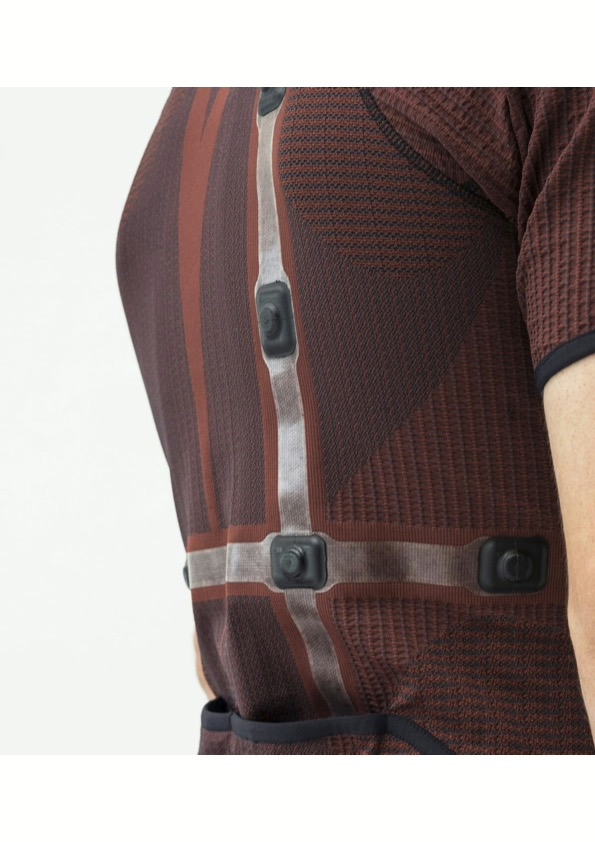
- Electronics-textile integration determines how electronic components are attached to or embedded in fabric — whether through conductive yarns, printed electronics, or modular attachment systems. The choice affects washability, flexibility, durability, and cost.
- Biosignal sensing and movement covers ECG, EMG, EEG, EDA, and motion sensing via IMU and accelerometers. In wearables, the challenge is not just sensing — it is filtering out motion artefacts and selecting dry electrodes that maintain signal quality during physical activity.
- Embedded hardware design involves custom PCB design, component selection, and power management. Battery life is consistently one of the most underestimated challenges in wearable hardware — it is a system-level problem, not a component-swap problem.
- Firmware and embedded software governs how the hardware behaves in real-world conditions. Good firmware keeps components in low-power states when not needed, manages data handling efficiently, and aligns with actual usage patterns rather than theoretical ones.
- Human factors and UX ensures the device is comfortable, intuitive, and usable by real people in real environments. A technically perfect wearable that no one wants to wear is a failed product.
- Haptic feedback systems translate data into physical sensations — vibration patterns, pressure, or directional cues. This is a genuinely specialist area that requires both hardware and algorithm expertise to deliver feedback that is meaningful rather than distracting.
Certification guidance sits across all of these disciplines. Understanding how design decisions affect regulatory compliance — from electrode placement to enclosure materials — must be part of the conversation from day one, not retrofitted at the end.
What is the difference between a proof of concept and a prototype in wearables?
A proof of concept (PoC) in wearable development is a basic, often rough build that demonstrates whether the core idea is technically feasible. A prototype is a more refined, fully featured version of the product built to validate performance, usability, and form factor under realistic conditions. The two serve different purposes and should never be confused in project planning.
The distinction matters because the decisions made at each stage are different:
What a proof of concept is for
A PoC answers one question: can this work? It is typically built with off-the-shelf components, may look nothing like the final product, and is not intended for end-user testing. Its purpose is to validate a technical hypothesis quickly and cheaply before committing to a full development budget. For organisations seeking funding or internal sign-off, a working PoC is often the minimum viable artefact needed to make the case.
What a prototype is for
A prototype answers a different set of questions: does this work well enough, and does it work for real users in real conditions? Final prototypes include all required features and the final form factor. They are built for uncontrolled user testing — meaning they go into the hands of actual users in actual environments. Issues discovered at this stage are expected and manageable. Issues discovered after first series production are expensive and sometimes fatal to a product launch.
Between PoC and final prototype, pilot samples serve as an intermediate step — functional enough to explore features and gather feedback, but not yet at production-level specification. This staged approach is not bureaucratic caution; it is how technical risk is systematically reduced without wasting budget on premature decisions.
What certifications does a wearable product need before it can be sold?
The certifications a wearable product requires before it can be sold depend on its intended use, the markets it will enter, and the environment in which it will be used. At minimum, most wearables sold in Europe require CE marking. Medical wearables must comply with the EU Medical Device Regulation (MDR). Wearables intended for hazardous environments require ATEX certification. Defence and military wearables are subject to additional qualification standards.
Here is a breakdown of the most relevant certification pathways:
- CE marking is the baseline requirement for most electronic products sold in the European Economic Area. It covers electromagnetic compatibility, electrical safety, and radio equipment directives. For consumer and professional wearables without a medical claim, CE marking is typically the primary hurdle.
- EU MDR (Medical Device Regulation) applies to any wearable making a medical claim — for example, a device that monitors heart rate for diagnostic purposes rather than general wellness. Class I devices carry lower documentation burdens; Class II devices require notified body involvement and substantially more testing and clinical evidence. MDR compliance adds significant cost and time, but is non-negotiable for market access.
- ATEX certification is required for wearables used in potentially explosive atmospheres — oil and gas, mining, chemical processing, and similar industrial environments. The documentation and testing requirements are extensive, and ATEX-rated products command a price premium that reflects this.
- Military qualification standards vary by country and procurement programme but typically include environmental testing for temperature, humidity, shock, and vibration, as well as interoperability requirements specific to the platform or system the wearable integrates with.
Certification is not a final step to be bolted on after development is complete. Design decisions made early — choice of materials, enclosure ratings, electrode configurations, communication protocols — directly affect which certification pathways are open and how costly they will be. Engaging certification expertise at the feasibility stage, not the prototype stage, prevents expensive redesigns later.
When should a company partner with a wearable development specialist?
A company should partner with a wearable development specialist when the technical complexity of the project exceeds what can be managed through a combination of internal resources and generalist suppliers. In practice, this applies to most serious wearable development projects — because wearables sit at the intersection of multiple disciplines that rarely coexist in a single organisation or a single vendor.
There are four situations where the case for a specialist partner is clearest:
- No in-house wearable expertise: If your organisation has a strong product vision but lacks hardware engineers, textile specialists, or firmware developers with wearable experience, building that capability from scratch is slower and riskier than partnering with a team that already has it.
- Standard components or single-discipline suppliers are insufficient: Many wearable projects begin with off-the-shelf components and a single engineering supplier. This works until the project requires custom sensor integration, electronics-textile fusion, or haptic feedback — at which point a generalist supplier reaches the edge of its capability.
- A prototype exists but is not reliable enough for real-world use: This is one of the most common entry points for specialist engagement. A working prototype in a lab environment and a product that performs consistently on a moving human body in variable conditions are two very different things. Bridging that gap requires specific expertise in motion artefact management, power optimisation, and human factors.
- The project is stuck at the transition to production: The step from final prototype to first series is where many wearable projects stall. Manufacturing tolerances, component sourcing, quality assurance, and certification documentation all converge at this point. A development partner with production experience navigates this transition; a pure R&D supplier often cannot.
Engaging a specialist earlier in the process — ideally at the feasibility or PoC stage — reduces the risk of costly redesigns and delays downstream. The earlier the specialist is involved, the more influence they can have on decisions that determine whether the product reaches market on time and within budget.
How Elitac Wearables helps with wearable product development
Elitac Wearables is a Netherlands-based development partner that takes wearable products from initial concept to a certified, market-ready device — without handing the project off between vendors. For product managers, CTOs, and heads of product who need a technically rigorous partner rather than a generalist electronics house, the difference is significant.
Here is what working with Elitac Wearables looks like in practice:
- All disciplines under one roof: Hardware, firmware, electronics-textile integration, biosignal sensing, haptic feedback, and human factors are managed by a single integrated team. No coordination gaps, no knowledge lost between handoffs.
- Proprietary TacOS firmware platform: Elitac’s own wearable operating system reduces firmware development time and de-risks the embedded software layer — particularly valuable for projects with tight timelines or complex power management requirements.
- Six-phase structured process: From feasibility check through to scaled production, each phase has defined outputs and durations. Clients know what they are getting and when, with actual hours never exceeding the estimate by more than 10% without prior consultation.
- Certification experience across MDR, ATEX, CE, and military standards: Regulatory requirements are factored into design decisions from day one, not treated as a final checklist.
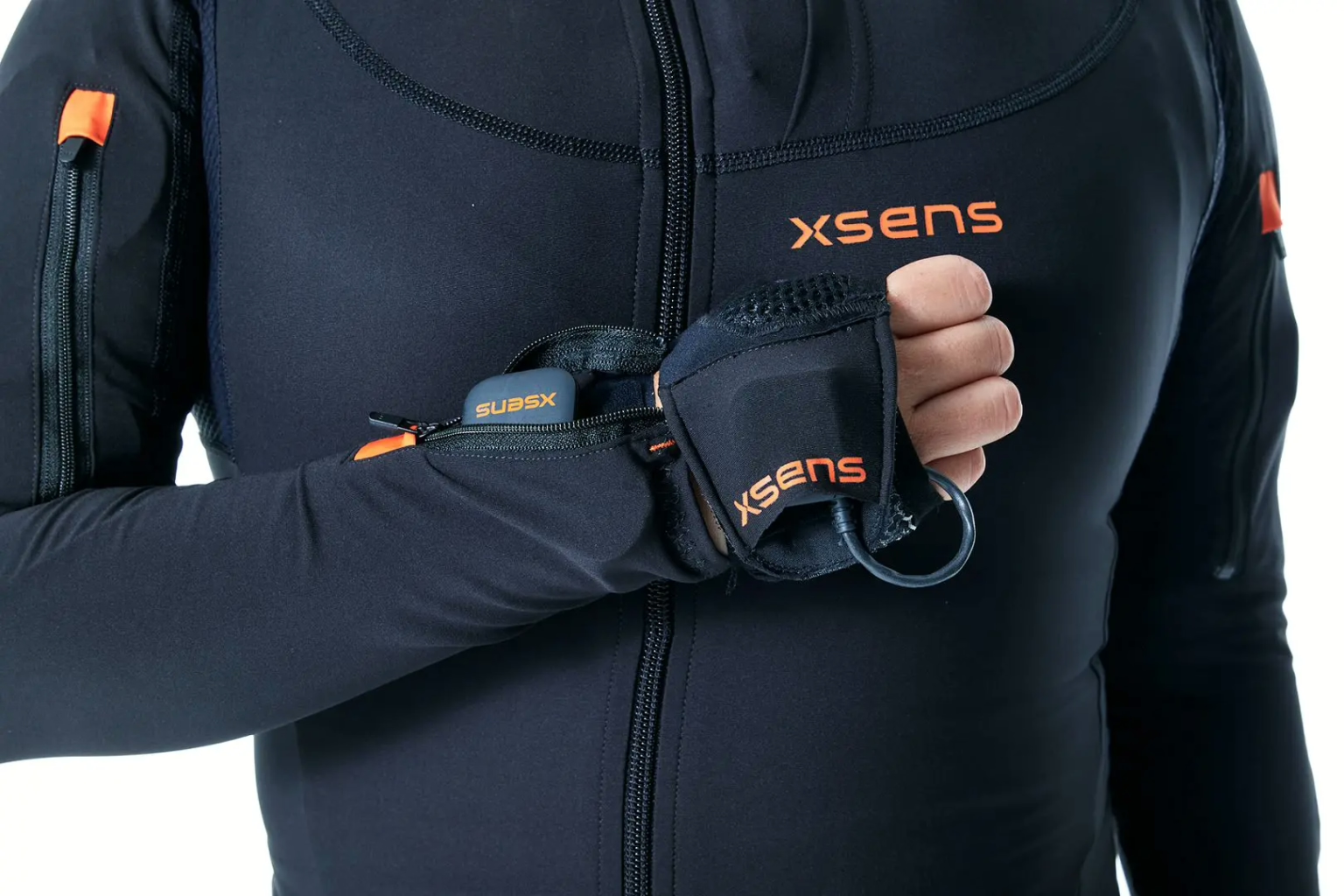
- 50+ products developed across medical, defence, sports, and industrial safety sectors: Including the Mission Navigation Belt for the Royal Netherlands Army and motion capture suits for Xsens. That breadth of reference means fewer surprises on your project.
If your wearable development project has hit a wall — technically, organisationally, or at the transition to production — contact Elitac Wearables to discuss where the project stands and what a structured path forward looks like.
Related Articles
- What certifications does a wearable product need in 2026?
- How do you transition a wearable product from development to a sustainable, scalable business?
- What does a wearable product development contract actually need to cover?
- How do you choose between building an in-house wearable team versus outsourcing development?
- What does a wearable product developer do?