
The decision between building an in-house wearable team and outsourcing development depends primarily on the complexity of the technology you need and the timeline you are working to. For most organisations entering wearable product development for the first time, outsourcing to a specialist partner is faster, lower risk, and significantly more cost-effective than assembling a multidisciplinary team from scratch. That said, the right answer is rarely binary. The sections below unpack the key factors, from real cost comparisons to what genuine wearable expertise actually looks like, so you can make an informed decision for your specific situation.
What are the real costs of building an in-house wearable team?
Building an in-house wearable development team typically requires a sustained investment of several hundred thousand euros per year before a single product reaches market. Wearable development is not a single discipline. It spans hardware engineering, firmware development, textile integration, human factors, and often regulatory expertise. Each of these requires a dedicated specialist, and the combined salary cost alone is substantial before accounting for tooling, lab equipment, and the inevitable learning curve.
Consider what a realistic team structure looks like for custom wearable product development:
- Hardware engineer for PCB design, component selection, and power management
- Firmware developer for embedded software, sensor integration, and real-time performance
- Textile or soft goods specialist for electronics-textile integration, garment construction, and washability
- Human factors or UX designer to ensure the device is actually wearable in real-world conditions
- Regulatory or certification specialist if you are targeting medical, defence, or ATEX environments
That is five distinct roles, each requiring deep domain knowledge. Recruiting across all of them simultaneously is difficult in a market where wearable specialists are scarce. And once hired, these individuals need the right equipment around them: prototyping tools, 3D printers, laser cutters, and software testing environments. Setting up even a modest in-house R&D facility adds significant capital cost on top of headcount.
There is also a less visible cost: time lost to inexperience. Teams building their first wearable consistently underestimate how differently electronics behave on a moving body compared to a static enclosure. Sensors drift, flexible substrates delaminate, and battery life collapses under real-world usage patterns. These are not theoretical risks. They are the reason up to 70% of wearable prototypes never reach production. An in-house team encountering these problems for the first time will spend months solving challenges that an experienced partner has already solved repeatedly.
What expertise does wearable development actually require?
Wearable product development requires a combination of disciplines that rarely coexist in a single organisation: electronics hardware, embedded firmware, textile engineering, haptic systems design, biosignal processing, human factors, and certification knowledge. The critical point is that these disciplines must work together simultaneously, not sequentially. A hardware decision made without textile input creates integration failures later. A firmware architecture chosen without power management expertise leads to battery performance problems that are expensive to fix.
This is the fundamental challenge that makes wearable development harder than it looks from the outside. Each discipline is deep in its own right, and the intersections between them are where most projects fail.
Electronics and textile integration
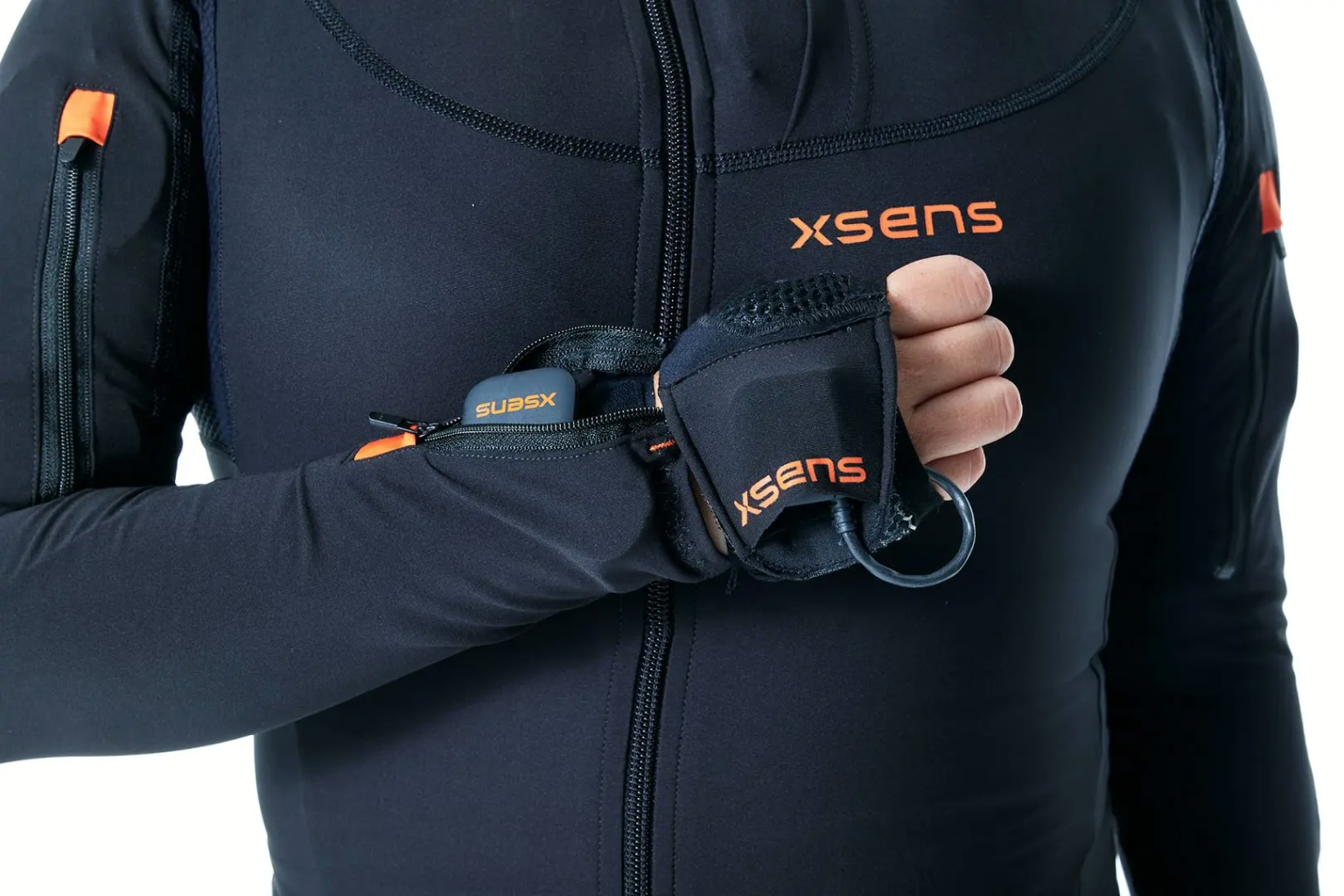
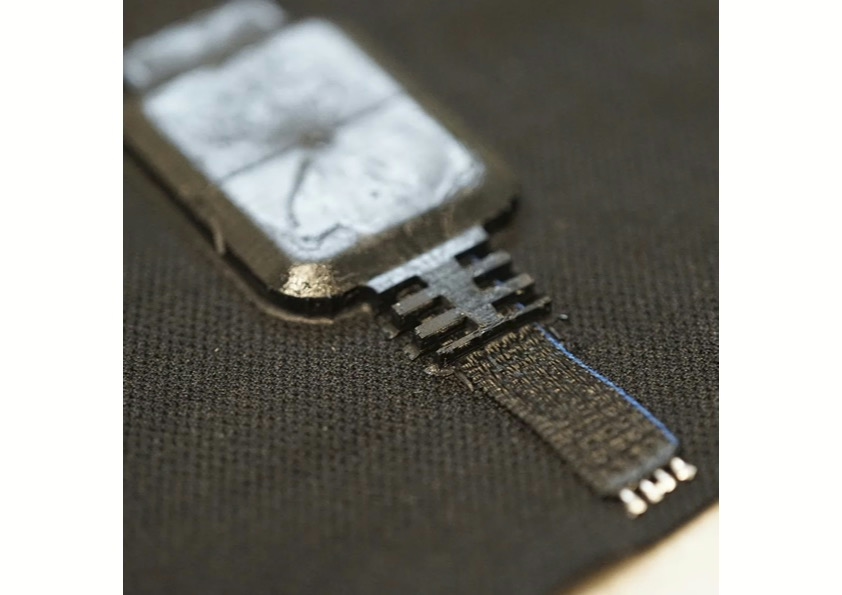
Embedding electronics into a garment or body-worn device is not simply a matter of attaching a PCB to fabric. The integration technique, whether conductive yarns, printed electronics, or modular attachment systems, must be chosen based on the specific application, the washing and durability requirements, and the form factor. A washable medical wearable demands different integration choices than a military navigation device. Getting this wrong at the design stage means redesigning at the prototype stage, which is costly.
Haptic feedback design
Haptic feedback is a specialised engineering domain that most electronics teams have no experience with. Selecting between ERM, LRA, and piezo actuators is not just a component choice. It determines the feel, the power consumption, the firmware timing architecture, and the physical integration into the wearable. Designing a haptic pattern that communicates meaningfully to a user in a high-stress environment, as Elitac Wearables did for the Mission Navigation Belt used by the Royal Netherlands Army, requires both hardware and human factors expertise working in concert.
When does outsourcing wearable development make more sense?
Outsourcing wearable development makes more sense when your organisation lacks one or more of the core disciplines required, when your timeline cannot accommodate a multi-year team build, or when the wearable is not your core business and you cannot justify the ongoing overhead. For most companies entering biometric wearable product development or custom wearable product development for the first time, outsourcing to a specialist partner reduces both cost and risk significantly.
Specific situations where outsourcing is clearly the stronger choice include:
- Your team has strong domain expertise, for example in medical devices or industrial safety, but has never built a wearable layer before
- You have a concept or early proof of concept but need to validate it with real users before committing to tooling costs of 100K or more
- You are facing a fixed deadline, such as an investor demo, a regulatory submission, or a market launch window
- Your product requires certification under MDR, ATEX, or military standards, and your team has no prior experience with those frameworks
- You need to move from TRL 3 to a market-ready product without the budget to staff every discipline permanently
The economics are also worth examining directly. A specialist wearable development partner brings a fully equipped R&D facility, an experienced multidisciplinary team, and proprietary tools that reduce iteration time. Accessing that capability on a project basis is almost always cheaper than replicating it in-house, particularly for organisations that may only develop one or two wearable products over several years.
When is building an in-house wearable team the right call?
Building an in-house wearable team is the right call when wearable technology is central to your long-term business model, when you anticipate a continuous pipeline of wearable products over many years, and when protecting proprietary development knowledge is a strategic priority. For organisations where wearable prototyping and production services represent a core and sustained competitive advantage, the investment in internal capability can be justified over a long enough horizon.
The clearest cases for in-house investment tend to share a few characteristics:
- The organisation plans to release multiple wearable products across several years, not a single device
- The wearable technology itself is the product, not a feature added to an existing offering
- The company has the budget and timeline to recruit, onboard, and retain specialists across all required disciplines
- Competitive differentiation depends on keeping development knowledge entirely internal
Even in these cases, most organisations find that building in-house capability alongside an external specialist partner, rather than instead of one, produces better outcomes. An experienced partner can accelerate the early phases, transfer knowledge to the internal team, and provide specialist support on technically demanding problems that fall outside the in-house team’s experience.
What should you look for in a wearable development partner?
A strong wearable development partner should have all critical disciplines in-house under a single roof, a track record of taking products from concept to market in your target sector, and the ability to support certification requirements relevant to your application. The most important factor is integration. A partner that handles hardware but hands off textile work to a separate supplier, or that delivers a prototype but cannot support you through production, creates coordination risk and knowledge gaps that slow you down.
When evaluating wearable product development services, assess the following:
- Multidisciplinary coverage: Does the partner have hardware, firmware, textile, haptics, and human factors expertise in-house, or do they subcontract key disciplines?
- Sector-relevant experience: Have they delivered certified products in your domain? Medical, military, and industrial safety wearables each carry distinct regulatory requirements that a generalist electronics house will not be equipped to navigate.
- End-to-end capability: Can they take you from feasibility check through to first production series, or do they stop at prototype?
- Proprietary tooling: Partners with purpose-built firmware platforms or proprietary development infrastructure can move faster and with less risk than those building from scratch on every project.
- Transparency on cost and timeline: A credible partner will give you a realistic cost range by development phase and will be honest about the factors that increase complexity and cost.
Be cautious of partners who underestimate the difficulty of wearable integration, promise unusually fast timelines, or lack direct experience with the specific challenges of your application. The further along a project gets, the more expensive it is to change partners or correct foundational design decisions.
Can you combine in-house staff with an external wearable development partner?
Yes, and for many organisations this hybrid model is the most effective approach. Combining in-house domain expertise with an external wearable development partner allows you to retain control over your core product knowledge while accessing specialist capabilities you do not have internally. The external partner acts as an extension of your team, contributing the disciplines you lack rather than replacing the expertise you already have.
This model works particularly well when your internal team understands the application deeply but lacks wearable-specific engineering skills. A medical device company with strong clinical knowledge and regulatory experience, for example, may have no experience with electronics-textile integration or haptic feedback design. An external partner fills that gap without requiring you to build and maintain those capabilities permanently.
The collaboration is most effective when roles are clearly defined from the start. Your team owns the domain requirements, the user knowledge, and the commercial decisions. The development partner owns the technical execution across the wearable-specific disciplines. Regular integration points and shared project management prevent the coordination failures that typically occur when development is fragmented across multiple suppliers with no single accountable party.
How Elitac Wearables helps with wearable product development
Elitac Wearables is a Netherlands-based specialist in end-to-end wearable product development, working with organisations in the medical, safety, defence, and sports sectors that need deep technical expertise rather than off-the-shelf solutions. For companies weighing the in-house versus outsourcing decision, Elitac functions as a complete development team, covering every discipline required to take a wearable from concept to certified, market-ready product.
What that looks like in practice:
- Full multidisciplinary coverage in-house: Hardware, firmware, textile integration, haptic systems, biosignal sensing, human factors, and certification guidance, all under one roof in a 180m² Wearables Lab in Utrecht
- Proprietary development infrastructure: The TacOS firmware platform and an Agile development process reduce iteration time and cost across every phase of development
- Phased development approach: From a rapid feasibility check through to scaled production, with transparent cost ranges and no handoffs between vendors
- Validation-first methodology: Functional demonstrators delivered in weeks allow clients to validate user interaction and perceived value before committing to tooling investment
- Sector-proven experience: Over 50 products developed across medical, military, and sports applications, including the Mission Navigation Belt for the Royal Netherlands Army and the BalanceBelt medical wearable
If your organisation is at the point of deciding how to resource a wearable development project, whether that means full outsourcing, a hybrid model, or understanding what in-house capability you would actually need, the most useful next step is a direct conversation. Speak with the Elitac team to discuss your project, your current stage, and the most effective path forward.