
The hidden costs of wearable product development include certification documentation, late-stage hardware redesigns, textile-electronics integration failures, battery performance rework, and compliance testing — none of which appear on a typical vendor quote. These costs are not edge cases; they are structural features of custom wearable development that surface when technical decisions made early in a project have not accounted for the full development lifecycle. Understanding where budget overruns actually come from is the difference between a project that reaches market and one that stalls at prototype.
What budget surprises do wearable development projects typically run into?
The most common budget surprises in wearable product development are late-stage redesigns driven by decisions made too early without full system visibility. A component chosen for cost or availability in week two can force a hardware respin in month eight. Certification requirements discovered after the design is locked can require new materials, new testing, and new documentation. These are not random misfortunes — they follow predictable patterns that experienced teams anticipate and budget for from the start.
The surprises tend to cluster around a few recurring problem areas:
- Certification costs discovered late: Teams that do not design for regulatory compliance from day one often face expensive redesigns once they engage a notified body or regulatory consultant.
- Battery performance rework: Battery life rarely meets real-world targets when it is treated as a hardware specification rather than a system-level challenge involving firmware, sensors, and usage patterns.
- Integration failures between textiles and electronics: Conductive yarns, printed electronics, and modular attachment systems behave differently in wash cycles, stretch, and sweat than they do on a workbench.
- Scope creep from user testing: Uncontrolled user tests routinely surface comfort, wearability, and interaction issues that require form factor changes — changes that cost significantly more at the prototype stage than at the concept stage.
- External supplier coordination overhead: When hardware, firmware, and textile work are split across separate vendors, integration failures become expensive to diagnose and even more expensive to resolve.
The common thread is fragmentation — technical decisions made in isolation, without a team that sees the full system at once.
Why does certification add so much to wearable development costs?
Certification adds substantially to wearable development costs because it imposes documentation, testing, and design requirements that touch every layer of the product — hardware, firmware, materials, and the manufacturing process. For medical wearables under EU MDR, or products destined for hazardous environments under ATEX, certification is not a final step. It is a design constraint that must be active from the earliest hardware decisions.
When certification is treated as a late-stage activity, the costs compound in several ways. A material that was not selected with biocompatibility in mind may need to be replaced. A firmware architecture that was not built with audit trails may need to be restructured. A manufacturing process that was not documented to the required standard may need to be repeated under controlled conditions. Each of these corrections is far more expensive after the design is locked than it would have been if addressed during the feasibility or proof-of-concept phase.
For medical Class II wearables or ATEX-certified products, total development costs can reach between €350,000 and €775,000 — a range that reflects the genuine weight of regulatory compliance when it is properly integrated into the development process rather than bolted on at the end. Military certification carries its own documentation burden, with specific standards for environmental resilience, electromagnetic compatibility, and operational reliability that require dedicated testing time and specialist knowledge.
The practical implication is straightforward: any budget for custom wearable product development that does not include a certification strategy from phase one is almost certainly underestimated.
How does hardware component selection affect long-term development spend?
Hardware component selection has a disproportionate impact on long-term development spend because the wrong component choice early in a project creates cascading costs — in power consumption, firmware complexity, form factor constraints, and eventually in production reliability. A sensor that draws more current than necessary will drive battery redesign. A radio module that was not evaluated for the actual usage pattern will require firmware rework. A component that goes end-of-life before production scales will force a hardware respin at the worst possible moment.
The challenge is that component selection decisions are made under uncertainty. At the feasibility stage, the full system requirements are rarely defined. Teams often default to familiar components, the cheapest available parts, or whatever is in stock — and those decisions become load-bearing walls in the architecture. Changing them later is expensive, time-consuming, and sometimes forces a return to an earlier development phase.
Power management is where this plays out most visibly. Battery performance problems in wearables are rarely caused by the battery itself. Root causes typically include firmware keeping components active longer than necessary, sensors and radios not configured for actual usage patterns, and hardware choices that were mismatched with real-world conditions from the outset. Resolving these issues after the product has reached the prototype stage requires system-level optimisation across hardware, firmware, and data architecture — work that is significantly more expensive than designing for it correctly at the start.
Component obsolescence is a separate but related risk. In biometric wearable product development, where production volumes are often low and development timelines are long, the gap between component selection and scaled production can span two or three years. Obsolescence planning — identifying second-source options and designing for component flexibility — is a cost that rarely appears in early budget estimates but consistently appears in late-stage projects.
What are the real costs of integrating haptic feedback into a wearable?
Integrating haptic feedback into a wearable carries costs well beyond the price of an actuator. The real costs lie in actuator selection for the specific body location and use case, firmware-level timing and pattern design, power budget management, and the user testing required to validate that the feedback is actually perceived correctly in real-world conditions. These are specialist activities, and underestimating them is one of the most common reasons haptic wearable projects run over budget.
Actuator selection and system design
The choice between ERM (Eccentric Rotating Mass), LRA (Linear Resonant Actuator), and piezo actuators is not simply a hardware decision — it determines the power envelope, the firmware architecture, the form factor constraints, and the quality of the tactile experience. ERMs are low-cost and widely available but imprecise in timing. LRAs offer better control but require careful frequency matching. Piezo actuators provide the highest precision but introduce complexity in driver electronics. Each choice has downstream cost implications that compound through the development cycle.
Pattern design and user validation
Haptic pattern design is iterative. The patterns that feel intuitive in a lab rarely survive first contact with real users in real environments. Vibration patterns that work well on a wrist may be imperceptible on the torso. Patterns that are clear in quiet conditions may be missed under physical exertion or when wearing additional clothing. User testing to validate haptic feedback is not optional — it is the only way to confirm the system works as intended. That testing takes time and budget, and it often surfaces changes that require firmware updates, actuator repositioning, or pattern redesign.
For projects where haptic feedback is the primary interaction mechanism — navigation, alerts, biofeedback — the cost of getting this wrong is not just a budget line. It is the difference between a product that works and one that does not.
How do textile and electronics integration costs compound over a project?
Textile and electronics integration costs compound because every design iteration that changes the electronics layer has implications for the textile layer, and vice versa. A change to PCB dimensions affects the garment pattern. A change to the garment material affects the performance of conductive yarns or printed traces. A decision to make the product washable introduces a set of constraints — encapsulation, connector sealing, material compatibility — that must be re-evaluated every time the design changes. In projects where textiles and electronics are developed in parallel by separate teams, these dependencies create expensive rework cycles.
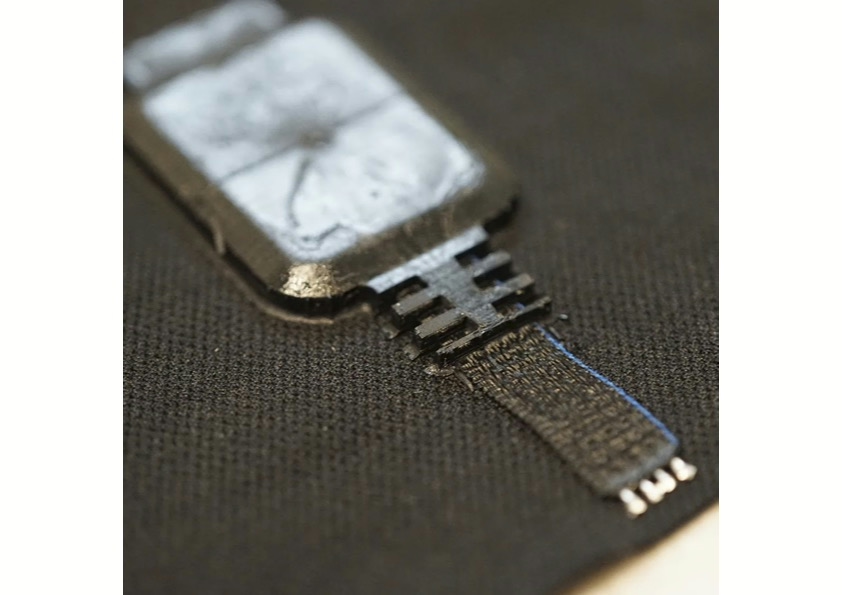
The integration technique chosen early in the project also locks in a cost structure. Conductive yarns woven into the base fabric offer excellent flexibility and comfort but require specialist manufacturing and are difficult to modify post-production. Printed electronics offer design freedom but introduce questions about durability, washability, and conductivity over time. Modular electronics attachment — snap connectors, embedded pockets — offers repairability and component replacement but adds bulk and potential failure points at the connection interface.
Each of these techniques requires different manufacturing partners, different tooling, and different quality control processes. When the integration approach is selected without full visibility of the production pathway, the transition from prototype to first series frequently surfaces manufacturing constraints that were not visible at the workbench. Resolving them at that stage is costly — not because the problems are technically difficult, but because they require design changes after significant investment has already been made.
For full textile-plus-hardware-plus-software projects, total development investment typically ranges from €230,000 to €400,000. That range exists because integration complexity is one of the most variable cost drivers in the entire development process.
What should a wearable development budget actually include from day one?
A realistic wearable development budget should include certification strategy costs, user testing across multiple phases, integration engineering for both textiles and electronics, firmware development including power optimisation, and a contingency for component obsolescence and late-stage redesign. Most vendor quotes cover only the visible work — design hours, materials, prototyping — and omit the structural costs that determine whether a product actually reaches market.
From the first day of a project, the budget should account for:
- Feasibility and certification alignment: Regulatory requirements should be mapped before hardware is selected, not after. This is a billable activity, but it prevents costs that are orders of magnitude larger later.
- Multi-phase user testing: Pilot samples, final prototypes, and first series each require structured user testing. Skipping any phase increases the risk of late-stage form factor changes.
- Power and firmware optimisation: Battery performance should be designed for from the start, not optimised as a remediation activity after the product fails real-world testing.
- Integration engineering: The cost of connecting electronics to textiles — and keeping that connection reliable through wash cycles, stretch, and daily wear — should be a named line item, not absorbed into general engineering hours.
- Obsolescence and supply chain planning: For low-volume wearable production, component availability over a multi-year development window is a real risk that deserves budget allocation.
- Project management overhead: Coordinating multi-disciplinary development requires dedicated project management. A rough guide is to add approximately 10% to core development hours to account for coordination, meetings, and sprint planning.
The projects that stay within budget are almost never the ones that started with the lowest initial quote. They are the ones where the full cost of development was understood before work began — and where a single team held accountability for the entire system.
How Elitac Wearables helps you avoid hidden development costs
For CTOs, heads of product, and R&D directors who have seen wearable budgets expand unexpectedly, the structural cause is almost always the same: decisions made without full system visibility, by teams that do not own the whole problem. Elitac Wearables is built to eliminate that risk.
As an end-to-end wearable development partner, Elitac brings every discipline in-house — hardware, firmware, textile integration, haptic systems, biosignal sensing, human factors, and certification guidance. There are no handoffs between vendors, no knowledge gaps at discipline boundaries, and no single supplier that can blame another when integration fails. The team works as an extension of your own, using an Agile development process and the proprietary TacOS firmware platform to reduce iteration time and keep costs predictable.
Specifically, working with Elitac Wearables means:
- Certification requirements are mapped at the feasibility stage, not discovered at prototype
- Hardware component selection is evaluated against the full system — including power budget, firmware architecture, and production pathway
- Textile and electronics integration is designed as a unified system, not reconciled after the fact
- Battery performance is treated as a system-level challenge from day one
- User testing is structured across phases, with findings feeding back into design before costs compound
If your wearable project is at any stage — from a concept that needs validation to a prototype that is not performing as expected — speak to the Elitac Wearables team. A direct conversation about where your project stands is the fastest way to understand what it will actually cost to reach market, and how to get there without the surprises.
Related Articles
- What is the role of haptic feedback in fitness wearables?
- What happens when wearable product development goes over budget, and how do you prevent it?
- How do you future-proof a wearable product during the development phase?
- What is the cost of developing a wearable product from scratch?
- What is the difference between wearable and traditional product development?