
Haptic wearables and force feedback devices both deliver physical sensations to the user, but they work in fundamentally different ways and serve distinct purposes. Haptic wearables use lightweight actuators embedded in garments or body-worn devices to communicate information through touch, while force feedback devices apply mechanical resistance or physical loads to replicate the feeling of interacting with a real object. Understanding the distinction matters enormously when you are deciding which technology to build into your product.
The two technologies share a common ancestor in tactile engineering, but they have diverged significantly in terms of hardware, application context, and development complexity. The sections below address the most common questions product teams ask when evaluating these two approaches.
What types of sensations do haptic wearables actually produce?
Haptic wearables produce vibrotactile sensations, meaning they stimulate the skin’s mechanoreceptors through controlled vibration, pressure, or gentle electrical impulses. The goal is not to simulate physical resistance, but to deliver information, alerts, or navigational cues through the sense of touch in a way that is discreet, hands-free, and body-worn.
The specific sensations depend on the actuator type and how the haptic system is designed. The three most widely used actuator technologies in wearable haptics are:
- ERM (Eccentric Rotating Mass) motors: These produce a buzzing vibration by spinning an off-centre weight. They are low-cost and widely available, but offer limited precision over frequency and amplitude.
- LRA (Linear Resonant Actuators): These vibrate along a single axis at a specific resonant frequency, producing cleaner, more controllable tactile pulses. They are better suited to nuanced pattern design.
- Piezo actuators: These use piezoelectric materials that deform when voltage is applied. They respond extremely quickly, can be made very thin, and are well-suited to high-precision or medical-grade haptic applications where form factor is constrained.
Beyond simple vibration, more advanced haptic wearables can produce spatial sensations by firing multiple actuators in sequence across the body surface, creating the perception of movement or directional cues. This is how devices like navigation belts communicate compass direction without requiring the wearer to look at a screen. The sensation is not powerful, but it does not need to be. The skin is remarkably sensitive, and well-designed haptic patterns can convey complex information reliably even in high-noise environments.
How does force feedback work in physical devices?
Force feedback devices work by applying physical resistance, torque, or mechanical load to the user’s body, typically through a handheld controller, robotic arm, or exoskeletal structure. The system detects what the user is doing and pushes back against that movement in a way that simulates contact with a virtual or remote physical object.
The underlying mechanism usually involves motors or actuators connected to rigid mechanical linkages. When a user grips a surgical training device and attempts to cut through simulated tissue, the force feedback system resists the movement proportionally, reproducing the mechanical feel of real tissue. The same principle applies in industrial robotic teleoperation, flight simulators, and gaming peripherals like steering wheels with resistance.
Force feedback requires a physical anchor point. The device must push against something, and that something is usually the user’s hand, arm, or the seat they are sitting in. This is why force feedback systems are almost always tethered, grounded, or structurally rigid. A device that floats freely on the body cannot generate meaningful opposing force without an external reference point, which is the core engineering constraint that separates force feedback from wearable haptics.
The computational side of force feedback is also demanding. The system must calculate forces in real time, often at update rates of one kilohertz or higher, to avoid the sensation from feeling laggy or artificial. This requires significant processing power and tight integration between the simulation environment and the physical actuation layer.
What are the key technical differences between haptic wearables and force feedback?
The key technical difference is mechanical architecture. Haptic wearables generate sensation by stimulating the skin’s surface receptors through vibration or pressure, requiring only small, lightweight actuators with low power draw. Force feedback devices generate sensation by mechanically resisting or driving the user’s limb movement, requiring rigid structures, high-torque actuators, and a grounded reference point.
This single architectural difference cascades into a wide range of practical distinctions:
- Form factor: Haptic wearables can be integrated into soft garments, flexible substrates, or slim wristbands. Force feedback devices require rigid frames, motors, and structural components that add significant weight and bulk.
- Power consumption: Vibrotactile actuators draw milliwatts. Force feedback motors can draw watts to tens of watts, making battery-powered, untethered operation difficult for anything beyond simple controllers.
- Body coverage: Haptic wearables can address the torso, limbs, hands, and feet simultaneously with arrays of actuators. Force feedback is typically constrained to the point of mechanical contact, most often the hand or arm.
- Fidelity type: Force feedback excels at replicating the mechanical properties of objects, including stiffness, texture, and weight. Haptic wearables excel at communicating discrete signals, directional cues, and attention-grabbing alerts.
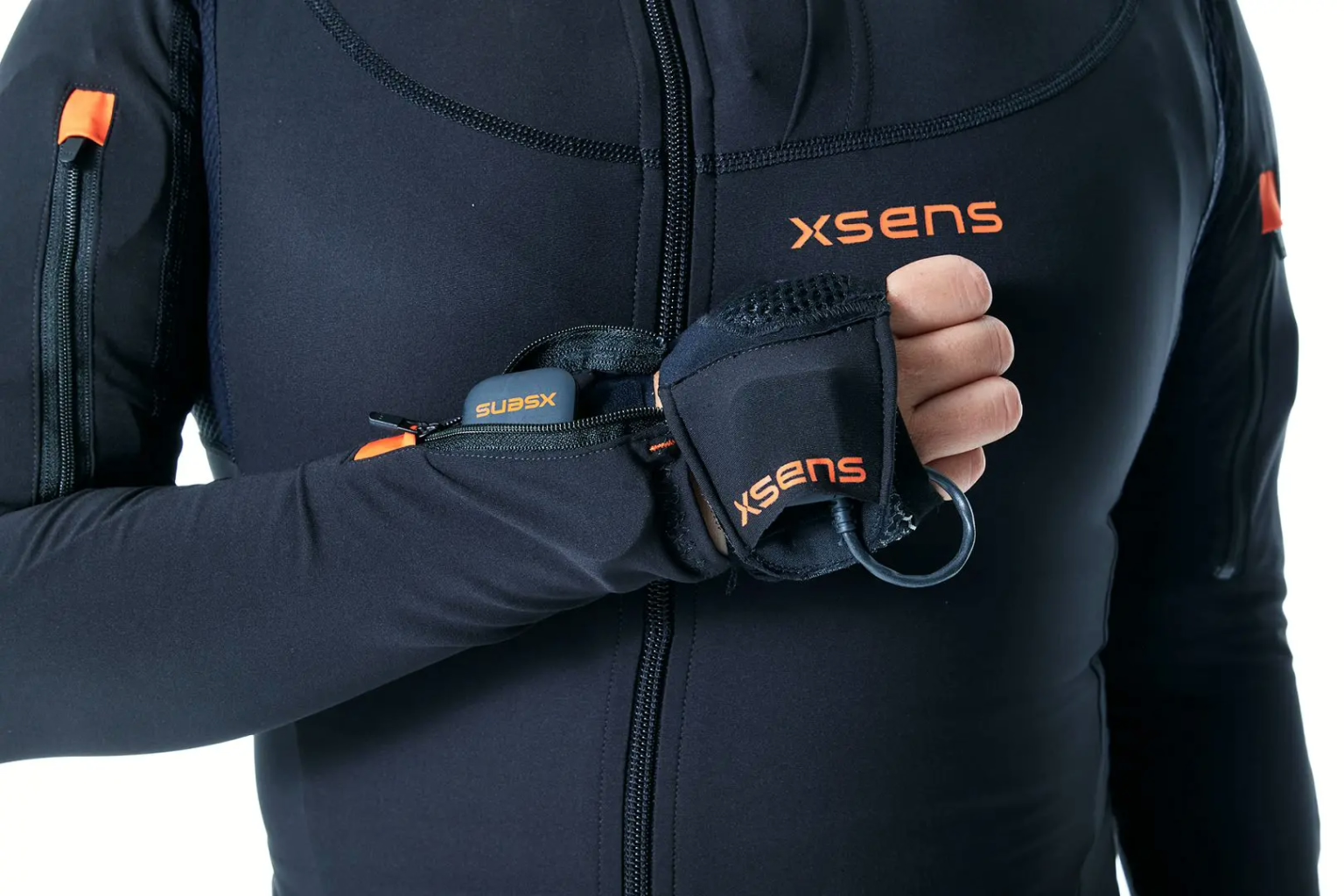
- Integration complexity: Embedding haptic actuators into a textile or wearable enclosure is a significant engineering challenge, particularly for washable or body-worn contexts. Force feedback integration is complex in a different way, involving mechanical tolerances, joint kinematics, and safety limits on applied force.
Which applications use haptic wearables versus force feedback devices?
Haptic wearables are used in applications where the wearer needs to receive information hands-free, remain mobile, and operate in real-world environments. Force feedback devices are used in applications where the goal is to simulate physical interaction with an object, typically in training, teleoperation, or immersive simulation contexts.
Typical haptic wearable applications
Haptic wearables appear across medical, military, sports, and industrial domains wherever touch-based communication adds value without restricting movement. Examples include navigation systems for soldiers or visually impaired users, balance rehabilitation devices for patients with vestibular disorders, biofeedback systems for athletes monitoring muscle activation, and alert systems for workers in high-noise environments where audio cues are unreliable. The Mission Navigation Belt developed for the Royal Netherlands Army is a direct example: soldiers receive directional cues through vibrotactile patterns on the torso, keeping their hands free and eyes forward.
Typical force feedback applications
Force feedback is the dominant technology in surgical simulation, where trainees need to feel tissue resistance. It also appears in industrial robotic teleoperation, where an operator controls a remote arm and needs to sense contact forces, and in high-fidelity gaming and virtual reality peripherals where physical immersion is the primary goal. These applications share a common trait: the user is stationary or semi-stationary, and the goal is to reproduce physical interaction rather than communicate information.
Can haptic wearables and force feedback be combined in one system?
Yes, haptic wearables and force feedback can be combined in a single system, and in some advanced applications this combination produces richer user experiences than either technology alone. The most common approach is to use force feedback at the hand or arm to simulate object interaction, while haptic wearables elsewhere on the body deliver supplementary spatial or contextual information.
In a surgical robotics context, for example, a force feedback handle could reproduce the resistance of tissue while a wearable haptic sleeve alerts the surgeon to proximity warnings or instrument orientation data. In military or industrial training, a force feedback exoskeleton could simulate load resistance while a haptic vest communicates situational awareness cues. These hybrid configurations are technically demanding because they require coordinating two different actuation systems with different latency profiles, power requirements, and body attachment strategies. Getting the timing right across both channels is critical, since conflicting or asynchronous signals can confuse the user rather than inform them. Development teams exploring this path should expect significant integration work at both the hardware and firmware level.
When should a product development team choose haptic wearables over force feedback?
Choose haptic wearables when your users need to receive tactile information while moving freely in real-world environments, and when the goal is communication rather than physical simulation. Choose force feedback when your application requires the user to feel the mechanical properties of an object and the system can accommodate a rigid, grounded structure.
In practice, several factors point clearly toward haptic wearables:
- The user will be mobile, active, or operating in the field rather than seated at a workstation
- The device must be worn continuously for extended periods, making weight and comfort critical
- The application involves alerting, guiding, or providing biofeedback rather than simulating physical contact
- Battery life and wireless operation are requirements
- The device must integrate with clothing or be discreet enough for everyday or clinical use
- The target population includes medical patients, athletes, or workers who cannot operate handheld controllers
Force feedback becomes the better choice when the fidelity of physical simulation is the core product value, the user is stationary, power and tethering constraints are acceptable, and the application is training, teleoperation, or immersive virtual interaction.
One practical consideration that is often underestimated: haptic wearables are considerably harder to develop than they appear. Integrating actuators into soft, flexible, body-worn structures while maintaining consistent vibration performance, washability, and long-term reliability is a multidisciplinary engineering challenge that spans electronics, textiles, firmware, and human factors. Many development teams underestimate this complexity until they are deep into a prototype cycle.
How Elitac Wearables helps with haptic wearable development
For product teams that have identified haptic wearables as the right technology but are unsure how to build one that actually works in the field, Elitac Wearables provides end-to-end development capability across every discipline the project requires. This is not a consultancy that hands off to a manufacturer. It is a team that owns the entire challenge from actuator selection through to a certified, production-ready product.
Specifically, Elitac Wearables supports haptic wearable development with:
- Actuator selection and haptic system design: Expert guidance on whether ERM, LRA, or piezo actuators fit your application, body location, power budget, and form factor requirements, with full firmware-level pattern design included
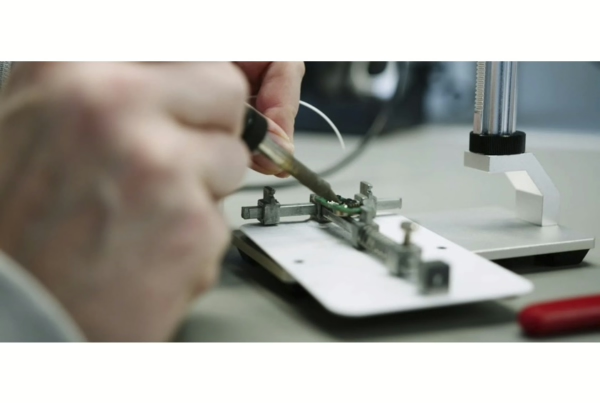
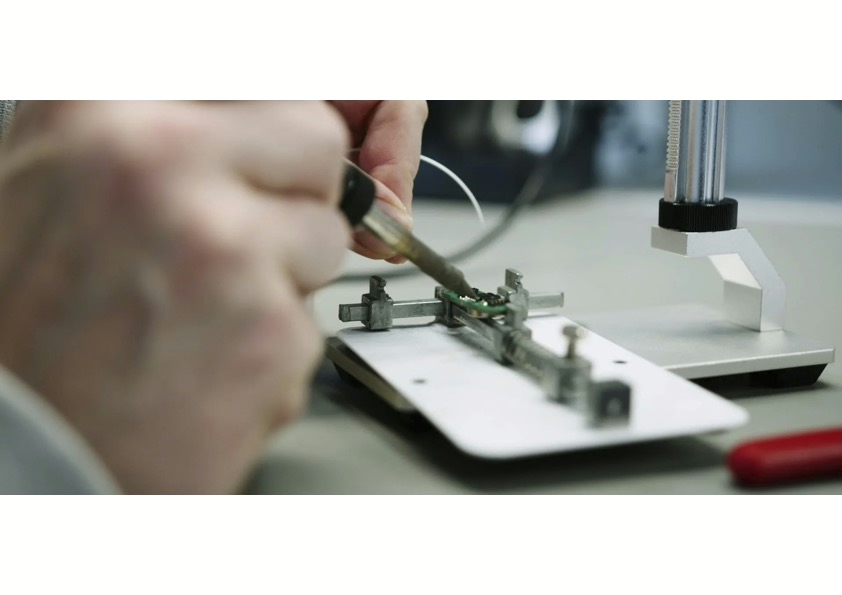
- Electronics-textile integration: Over ten years of hands-on experience embedding electronics into washable, flexible, body-worn garments across medical, military, and sports contexts
- TacOS firmware platform: A proprietary operating system built specifically for wearables, reducing development risk and accelerating timelines from proof of concept to production
- Human factors and UX: Haptic patterns that feel intuitive to real users in real conditions, not just in a lab
- Certification guidance: MDR compliance, CE marking, and military certification requirements addressed from the earliest design decisions, not retrofitted at the end
If your team is evaluating haptic wearables for a medical, defence, sports, or industrial application and you need a development partner that has solved these problems before, contact Elitac Wearables to discuss your project requirements.
Related Articles
- Why is end-user testing critical in smart textile development?
- What are the biggest challenges in electronics integrated into textiles?
- How do wearables support mental health monitoring in defence personnel?
- What should a Head of Product demand from a wearable development partner at each project milestone?
- How do you future-proof a wearable product during the development phase?