Soldiers should have meaningful, structured access to their own wearable data — but not unconditional control. The right balance depends on what data is collected, when it is accessed, and what operational constraints apply. Military organisations that ignore this question entirely risk undermining trust, performance, and the long-term adoption of wearable technology in the field. This article works through the key questions defence teams, procurement leads, and wearable developers need to answer before deploying soldier-worn systems.
Who owns the data collected by military wearables?
In most defence contexts, the military organisation owns the data collected by soldier wearables — not the individual soldier. Data generated during operations, training, or duty is typically classified as institutional data under the terms of service and applicable defence regulations. The soldier wearing the device is the subject of the data, but rarely its legal owner.
This differs significantly from civilian wearables, where consumer data protection laws in jurisdictions like the EU give individuals explicit rights over their personal data. In military settings, those rights are typically subordinated to operational requirements, national security considerations, and the chain of command.
That said, ownership is not a simple binary. Many defence organisations are beginning to draw a distinction between operational data — movement patterns, mission-critical biometrics, tactical positioning — and personal health data generated during routine training or off-duty monitoring. The argument is that a soldier’s resting heart rate during a morning run is categorically different from their physiological state during a live operation, and the two warrant different treatment.
The practical reality is that ownership frameworks for military wearable data are still evolving. Most existing defence procurement contracts were not written with continuous biometric monitoring in mind, and the legal structures have not kept pace with the technology.
What types of data do soldier wearables actually collect?
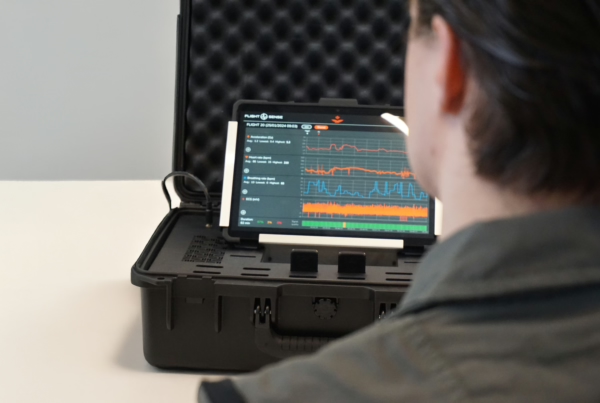
Modern soldier wearables collect a wide range of physiological, positional, and behavioural data. The specific data types depend on the sensors embedded in the device, but the most common categories include biometric signals, movement and location data, and environmental exposure metrics.
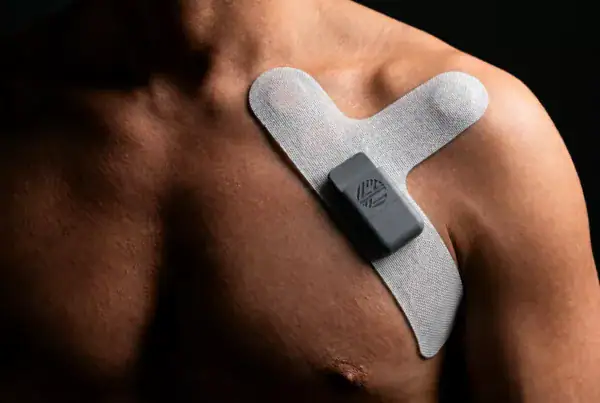
- Biometric signals: Heart rate, heart rate variability (HRV), respiration rate, skin temperature, and electrodermal activity (EDA) — all of which can indicate stress, fatigue, or physiological strain in real time.
- Movement and posture data: Captured via inertial measurement units (IMUs) and accelerometers, these reveal gait patterns, physical exertion levels, and body orientation.
- Location and navigation data: GPS-derived positional data, often integrated with tactical navigation systems such as haptic navigation belts that deliver silent directional cues.
- Environmental data: Exposure to heat, noise, or hazardous conditions, captured by sensors designed for extreme operational environments.
- Cognitive and alertness indicators: Emerging systems are beginning to infer cognitive load and alertness from combinations of the above signals.
The aggregation of these data types creates a detailed, continuous profile of the soldier’s physical and psychological state. When combined over time, even individually innocuous data points can reveal sensitive patterns — injury risk, stress response under specific conditions, or performance degradation. This is why the question of data control carries real weight.
Why is wearable data control different in military versus civilian contexts?
Wearable data control in military contexts is fundamentally different from civilian settings because operational security, command authority, and the nature of risk are all categorically different. In civilian life, data privacy is primarily an individual right. In military operations, data access and control are matters of mission success and, in extreme cases, survival.
Several factors make the military context distinct:
- Adversarial risk: Biometric and positional data from soldiers can be exploited by adversaries. A pattern of elevated heart rate signals at a specific location, for instance, could reveal tactical behaviour. This is a threat that civilian fitness trackers simply do not face.
- Chain of command authority: Military organisations operate on hierarchical command structures where individual autonomy is deliberately constrained for collective effectiveness. Data access rights follow the same logic.
- Duty of care obligations: Commanders have a legal and ethical duty to protect the health and welfare of their personnel. Access to real-time biometric data supports that duty — but only if the data is used responsibly.
- Consent frameworks: Civilian wearable users typically provide informed, voluntary consent. Soldiers operating under orders occupy a different consent position, which raises genuine ethical questions about data collected from personnel who cannot meaningfully refuse to wear the device.
These differences do not make soldier data rights irrelevant — they make them more complex. The civilian frameworks of GDPR or HIPAA provide useful reference points, but they were not designed for the operational realities of defence environments.
What are the risks of soldiers having no control over their wearable data?
When soldiers have no visibility or control over their own wearable data, several serious risks emerge — for the individual, for unit cohesion, and for the long-term adoption of wearable technology in defence. The most immediate risk is a breakdown of trust between personnel and their institution.
If soldiers believe their biometric data is being used to assess performance, inform promotion decisions, or monitor behaviour beyond operational necessity, they will resist wearing the devices. Resistance may be passive — removing the device when possible, or wearing it incorrectly — but the result is the same: degraded data quality and failed technology adoption.
Beyond trust, there are concrete individual risks:
- Misinterpretation of health data: Biometric signals require clinical context to interpret accurately. A soldier flagged as high-stress based on HRV data alone may simply be recovering from intense physical training. Without access to their own data, they cannot contest or contextualise the reading.
- Lack of personal health insight: Soldiers exposed to cumulative physiological strain — heat, sleep deprivation, physical load — could benefit from their own data to manage recovery. Denying access removes a tool that serves their welfare.
- Data security vulnerabilities: Centralised data stores with no individual access rights are not inherently more secure. In fact, broad institutional access with no audit trail creates greater exposure than a well-designed tiered access system.
- Ethical and legal exposure: As international norms around biometric data rights evolve, defence organisations that collect continuous physiological data from personnel without any transparency framework face growing legal and reputational risk.
Should military organisations grant soldiers any data access rights?
Yes — military organisations should grant soldiers structured, contextually appropriate access to their own wearable data. The argument is not that soldiers should have unrestricted control, but that zero access is both ethically indefensible and practically counterproductive. A tiered access model, where the type and timing of data access depends on operational context, is the most defensible position.
There are strong practical reasons to support this view:
- Informed self-management: Soldiers who can see their own health and recovery data make better decisions about nutrition, rest, and injury prevention. This serves both the individual and operational readiness.
- Increased device adoption: Personnel who understand what data is collected and have some stake in it are more likely to wear devices correctly and consistently.
- Ethical legitimacy: Granting soldiers access to their own health data — particularly non-operational data generated during training — aligns with broader human rights principles and strengthens institutional trust.
The key distinction is between real-time operational data and historical health data. Positional data during a live mission is clearly sensitive and should remain under command control. A soldier’s aggregated physiological health record from the past six months of training is a different matter. Most ethicists and defence health professionals who have examined this question conclude that the latter category warrants personal access rights.
How can wearable systems be designed to balance data control and operational security?
Wearable systems for military use can be designed from the ground up to balance individual data access with operational security requirements. The answer lies not in choosing one over the other, but in building access control, data tiering, and privacy architecture into the system architecture before a line of firmware is written.
Design data tiering into the system architecture
Not all data collected by a soldier wearable carries the same sensitivity. A well-designed system classifies data at the point of collection and applies different access rules to each tier. Operational location data during a live exercise sits in a restricted tier accessible only to command systems. Resting biometric data from a recovery period sits in a personal health tier that the soldier can access via a secure interface. This is not a technical compromise — it is sound system design.
Build access controls into firmware, not policy documents
Relying on policy to govern data access is fragile. The more robust approach is to encode access rules directly into the device firmware and the data architecture. This means that even if a device is captured or a system is breached, the data remains segmented and protected by design rather than by procedure alone. Firmware-level control also makes audit trails automatic, which supports both accountability and trust.
Separate storage for personal versus operational data
Where possible, personal health data and operational data should be stored separately, with different encryption keys and access pathways. This allows a soldier to access their own health record without that access pathway touching operationally sensitive data stores. It also simplifies compliance with evolving data protection norms, because the data categories are cleanly separated from the outset.
The principle that runs through all of these design decisions is that privacy and security are not opposites — they are complementary system properties. A wearable that soldiers trust is a wearable they will wear correctly, which means better data quality and better operational outcomes for everyone.
How Elitac Wearables helps with military wearable data design
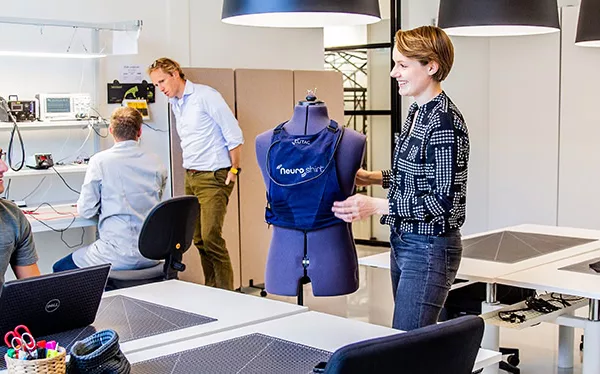
Designing a military wearable that collects meaningful data while respecting both operational security and individual data rights is exactly the kind of problem that has no standard solution. Elitac Wearables has direct experience building in this space — most notably through the Mission Navigation Belt developed for the Royal Netherlands Army, a haptic feedback system that delivers silent, screen-free navigation to soldiers while keeping sensitive positional data under command control.
When organisations come to Elitac Wearables with a defence or safety wearable challenge, the team brings together every discipline needed to get the architecture right from day one:
- Firmware and embedded software design, including the proprietary TacOS platform, built to manage data handling, power, and access control at the device level.
- Biosignal sensing expertise across ECG, HRV, respiration, and movement — with specific experience in high-movement, extreme-environment conditions.
- Hardware design that integrates sensors, actuators, and communication systems into a form factor that works in the field.
- Certification guidance for military and safety-critical applications, ensuring the system meets the regulatory and procurement requirements of defence clients.
If your organisation is developing a soldier wearable and needs a development partner that understands both the technical depth and the operational context, contact Elitac Wearables to discuss your project.