Haptic feedback wearable technology in 2026 has advanced significantly beyond simple vibration alerts, with devices now delivering nuanced, body-worn tactile communication across medical, military, sports, and industrial applications. The most notable developments centre on actuator miniaturisation, AI-driven feedback personalisation, and tighter integration between haptic systems and real-time sensor data. The sections below unpack the key questions any serious development team or procurement lead should understand before investing in haptic wearable technology this year.
How has haptic feedback wearable technology evolved recently?
Haptic feedback wearables have evolved from single-motor vibration devices into sophisticated, multi-actuator systems capable of delivering spatially precise, context-aware tactile signals across the body. The shift has been driven by advances in actuator miniaturisation, flexible electronics, and firmware capable of coordinating complex vibration patterns in real time. This is no longer niche research territory — it is active product development across multiple sectors.
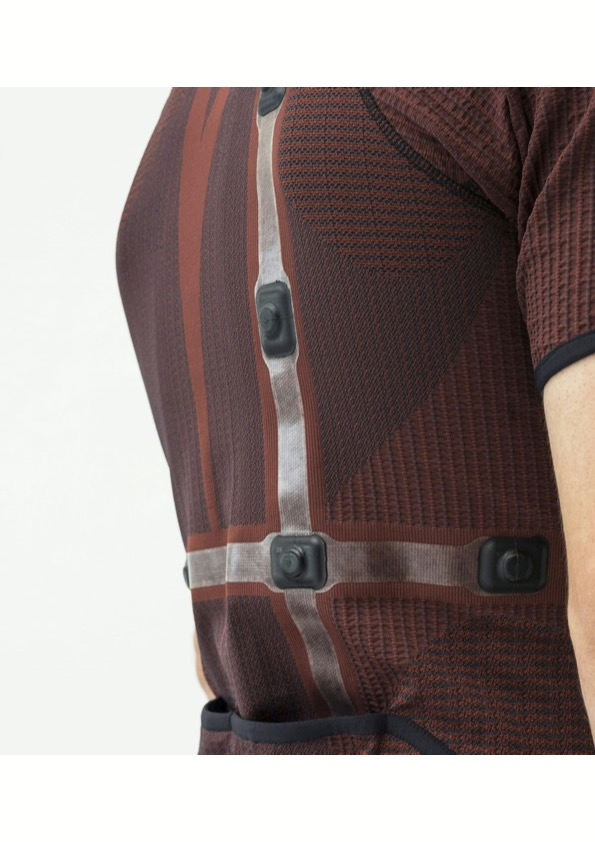
A decade ago, most haptic wearables relied on a single eccentric rotating mass motor producing a generic buzz. Today, development teams are deploying arrays of actuators embedded directly into garments, vests, and orthotic devices, each independently addressable and capable of conveying directional, intensity-graded, or rhythm-coded information. The Mission Navigation Belt developed for the Royal Netherlands Army is a practical example: rather than a simple alert, it delivers directional navigational cues through precisely timed vibration patterns, freeing soldiers from visual or auditory distractions in the field.
Textile integration has been the other major driver. Embedding haptic actuators into washable, flexible fabrics without compromising signal fidelity or durability was a genuine engineering barrier for years. Progress in conductive yarn technology, printed electronics, and modular attachment methods has made it possible to build haptic systems that survive real-world conditions, including sweat, movement, and repeated washing cycles.
What types of haptic actuators are used in modern wearables?
Modern haptic wearables use three primary actuator types: Eccentric Rotating Mass (ERM) motors, Linear Resonant Actuators (LRAs), and piezoelectric actuators. Each delivers vibrotactile feedback through a different physical mechanism, and the right choice depends on the application, body location, required frequency range, power budget, and form factor constraints.
ERM motors
ERM motors are the most established and cost-effective option. They generate vibration by spinning an off-centre mass, producing a broad, low-frequency rumble that is easy to feel through clothing or skin. Their main limitation is latency: because they rely on a spinning mass, they respond slowly to on/off commands, which makes precise pattern timing difficult. For applications where nuanced pattern differentiation matters, ERMs are often outperformed by newer alternatives.
LRA actuators
Linear Resonant Actuators operate at a specific resonant frequency, producing a cleaner, more focused vibration with significantly faster response times than ERMs. This makes them well suited for body-worn devices where the user needs to distinguish between multiple distinct signals. LRAs are widely used in medical wearables and navigation devices where signal clarity is critical, though they require careful firmware-level control to stay on resonance as temperature and load conditions change.
Piezoelectric actuators
Piezo actuators offer the highest frequency range and the fastest response, making them capable of delivering fine-grained tactile textures rather than simple pulses. They are thin, silent, and highly controllable, which makes them attractive for skin-contact applications in medical and prosthetic contexts. The trade-off is that they require higher drive voltages and more complex driver circuitry, which adds to system complexity and cost. For applications demanding precision over simplicity, piezo is increasingly the actuator of choice in 2026.
Which industries are adopting haptic wearables in 2026?
In 2026, the industries with the most active haptic wearable adoption are medical and rehabilitation, defence and public safety, sports performance, and industrial training. Each sector is driven by a different core need, but all share a common requirement: reliable, body-worn feedback that communicates information without demanding visual or auditory attention from the wearer.
- Medical and rehabilitation: Haptic wearables are being used to support balance disorders, post-stroke rehabilitation, and proprioceptive training. Devices like the BalanceBelt, which delivers real-time postural feedback, represent a growing category of therapeutic wearables designed for daily use outside clinical settings.
- Defence and public safety: Military and emergency services applications prioritise silent, eyes-free communication. Navigation belts, situational awareness vests, and proximity warning systems are all active development areas where haptic feedback replaces or supplements radio communication.
- Sports performance: Athletes and coaches are using haptic wearables to deliver real-time technique feedback during training, reducing the lag between an error and its correction. Motion capture integration, as seen in work with Xsens, is enabling data-driven haptic cueing in sports and biomechanics research.
- Industrial and safety: Proximity alerts, posture correction, and hazard warnings delivered through smart PPE are emerging use cases, particularly in environments where auditory signals are masked by noise.
What’s the difference between tactile and kinaesthetic haptic feedback in wearables?
Tactile haptic feedback stimulates the skin’s surface receptors to create sensations like vibration, pressure, or texture. Kinaesthetic haptic feedback engages the muscles, joints, and tendons to simulate force, resistance, or movement. In body-worn devices, tactile feedback is far more common because it can be delivered through compact, low-power actuators embedded in a garment. Kinaesthetic feedback requires mechanical systems capable of exerting physical force on the body, which significantly increases device complexity.
Most wearable haptic systems in commercial and professional use today are tactile. A vibrating belt that tells a soldier which direction to turn, or a garment that cues an athlete’s shoulder position, both rely on skin-surface stimulation. The nervous system is remarkably good at interpreting these signals when the patterns are well designed, which is why firmware-level timing and pattern engineering are as important as actuator selection in haptic wearable development.
Kinaesthetic feedback is more commonly found in exoskeleton and soft robotics research, where pneumatic or hydraulic textile actuators can apply controlled compression or resistance to a limb. These systems are technically demanding and remain closer to the research frontier, though medical and rehabilitation applications are beginning to bring them closer to commercial viability. The distinction matters for any development team deciding on scope early in a project: tactile systems are achievable within conventional wearable form factors, while kinaesthetic systems require a fundamentally different engineering approach.
How do haptic wearables integrate with AI and sensor data?
Haptic wearables integrate with AI and sensor data by using real-time inputs from onboard sensors to trigger, modify, or suppress haptic signals based on the wearer’s state or environment. Rather than delivering pre-programmed alerts, AI-driven haptic systems adapt their output dynamically, making feedback more relevant, timely, and less disruptive to the wearer’s primary task.
The sensor layer typically includes inertial measurement units (IMUs), accelerometers, and biosignal sensors such as ECG or EMG electrodes. These feed continuous data into an embedded processing layer, where algorithms interpret movement patterns, physiological states, or environmental conditions and translate them into haptic commands. The firmware must manage this pipeline efficiently, since processing delays of even a few hundred milliseconds can make haptic cues feel disconnected from the triggering event.
AI integration adds the ability to personalise and learn. A rehabilitation wearable might adjust the intensity of balance feedback based on how a patient has responded over previous sessions. A sports wearable might suppress feedback during high-intensity intervals and re-enable it during recovery phases. These behaviours require not just sensor fusion but decision logic that can operate reliably on embedded hardware with constrained power budgets, which is where firmware architecture becomes a critical design consideration.
The challenge for development teams is ensuring that the sensor, processing, and haptic output layers are designed as an integrated system from the start. Retrofitting haptic feedback onto an existing sensor platform often produces latency and power problems that are expensive to resolve late in development.
What are the main challenges in developing haptic feedback wearables?
The main challenges in developing haptic feedback wearables are actuator selection and placement, textile integration durability, firmware complexity, power management, and designing feedback patterns that are genuinely interpretable by end users under real-world conditions. Each of these problems is manageable in isolation, but they interact in ways that make haptic wearable development significantly harder than standard electronics product development.
- Actuator selection: Choosing between ERM, LRA, and piezo is not just a cost decision. Body location, skin sensitivity, signal frequency requirements, and enclosure constraints all affect which actuator will actually work. A choice that looks correct on a datasheet can fail in practice when the device is worn on a moving body.
- Textile integration: Embedding electronics into garments introduces durability and washability challenges that do not exist in rigid enclosures. Connection points, cable routing, and component attachment methods must all be engineered for flex fatigue, moisture exposure, and repeated mechanical stress.
- Firmware and timing: Haptic patterns are only effective if the timing is precise. Firmware must manage actuator sequencing, sensor input, and power states simultaneously without introducing latency that degrades the user experience. Proprietary platforms like TacOS, purpose-built for wearable applications, exist specifically to address this complexity.
- Power management: Haptic actuators are power-hungry relative to other wearable components. Battery life problems often surface late in development when the full system is running under realistic usage conditions. Treating power as a system-level design constraint from the start, rather than a component-level afterthought, is the difference between a product that ships and one that stalls.
- User perception and pattern design: Technical performance means nothing if the wearer cannot reliably interpret the haptic signal. Pattern design requires iterative user testing under realistic conditions, including movement, noise, and cognitive load, not just lab evaluation.
How Elitac Wearables helps with haptic feedback wearable development
Developing a haptic feedback wearable that actually works in the field, passes certification, and reaches production is a multi-disciplinary challenge. For most organisations, the gap is not ambition or budget. It is the absence of a team that can hold the full system together from actuator selection through to firmware, textile integration, and regulatory compliance without fragmenting across vendors.
Elitac Wearables is built specifically to close that gap. As a specialist haptic wearable development partner, the team brings together every discipline a complex project requires under one roof:
- Actuator selection and haptic system design across ERM, LRA, and piezo technologies
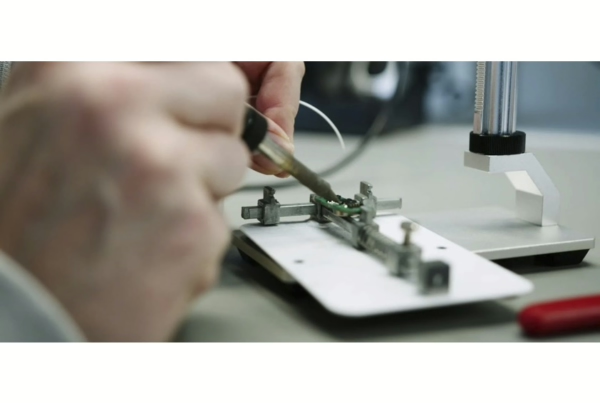
- Electronics-textile integration using conductive yarns, printed electronics, and modular attachment methods suited to washable, body-worn devices
- Firmware development on the proprietary TacOS platform, designed for real-time haptic pattern control on power-constrained wearable hardware
- Biosignal sensing integration for AI-driven, sensor-responsive haptic feedback
- Human factors and end-user testing to ensure feedback patterns are interpretable under real-world conditions
- Certification guidance for MDR, CE marking, and sector-specific requirements from the earliest design phase
Whether you are at the concept stage, stuck at a proof of concept, or facing reliability problems before scale-up, Elitac Wearables works as an extension of your team, not a hand-off point. If you are developing a haptic wearable and need a partner with the depth to take it from idea to certified product, get in touch with the Elitac team to discuss your project.