Military wearable technology relies on a combination of inertial measurement units (IMUs), biometric sensors, environmental monitors, and haptic actuators working together as an integrated system. Unlike commercial wearables, sensors in military applications are selected and engineered to function reliably under extreme physical stress, harsh environmental conditions, and operational security requirements that consumer devices were never designed to meet. The sections below unpack the specific sensor types used, how they work together, and what makes designing them so technically demanding.
How do sensors in military wearables differ from commercial ones?
Sensors in military wearables differ from commercial equivalents primarily in their ruggedisation, reliability standards, and operational context. Where a consumer fitness tracker is designed for comfort and convenience, a military wearable sensor must function accurately during high-intensity movement, in extreme temperatures, under electromagnetic interference, and in environments where a false reading could have serious consequences.
The differences go beyond hardware specifications. Commercial sensors are typically validated in controlled conditions against average users. Military sensors must be validated against edge cases: a soldier sprinting in 40-degree heat, a diver operating in cold water, or a pilot subject to high G-forces. That demands different component selection, different calibration approaches, and a fundamentally different tolerance for failure.
There are also integration constraints that do not apply to consumer devices. Military wearables must often be silent, covert, and screen-free to avoid compromising operational security. This rules out many of the feedback mechanisms that consumer devices rely on and pushes the design toward haptic output and passive sensing. Certification requirements are also significantly stricter, covering electromagnetic compatibility, environmental sealing, and in some cases specific military standards that govern how electronics behave in the field.
What are inertial measurement units used for in military wearables?
Inertial measurement units, or IMUs, are used in military wearables to track movement, orientation, and position without relying on external signals. An IMU combines accelerometers, gyroscopes, and often magnetometers to measure how a body moves through space. In military contexts, this data supports navigation, activity classification, fatigue monitoring, and biomechanical analysis.
One of the most operationally significant uses of IMU data in military wearables is dead reckoning navigation. When GPS signals are jammed or unavailable, which is an increasingly common scenario in contested environments, an IMU can estimate a soldier’s position by tracking movement from a known starting point. This is the core function behind systems like the Mission Navigation Belt, which delivers silent, screen-free directional guidance to soldiers by combining GPS with onboard motion data, keeping hands, eyes, and ears free.
Beyond navigation, IMUs in military wearables are used to classify physical activity and detect fatigue. By analysing gait patterns and movement signatures, a wearable system can flag when a soldier’s biomechanics are deteriorating, which often precedes injury or impaired decision-making. In training environments, the same data supports performance analysis and load optimisation.
The challenge with IMU data in military wearables is motion artefact management. High-impact activities generate noise that can corrupt sensor readings if the firmware and signal processing are not specifically tuned for those conditions. Placement on the body also matters significantly: an IMU on the torso behaves differently from one on a limb, and the integration technique used to attach the sensor affects how well it stays in contact with the body during dynamic movement.
What biometric sensors are integrated into military wearables?
Military wearables integrate biometric sensors to monitor the physiological state of the wearer in real time. The most common types are electrocardiogram (ECG) sensors for heart rate and heart rate variability, electromyography (EMG) sensors for muscle activity, respiration sensors, and skin conductance sensors that measure stress response. Together, these provide a continuous picture of how a soldier’s body is coping with physical and cognitive demand.
ECG and heart rate variability monitoring
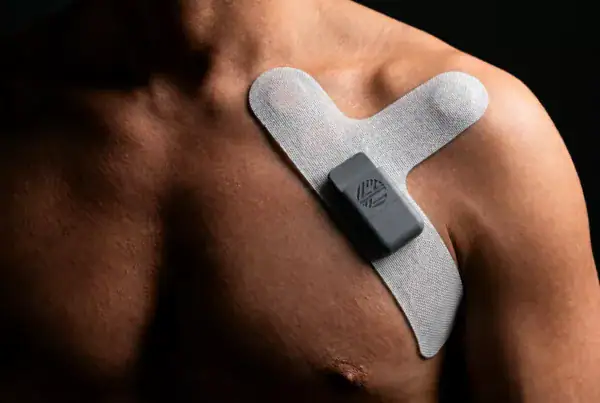
ECG sensing in military wearables goes beyond simple heart rate. Heart rate variability, or HRV, is a particularly valuable metric because it reflects the autonomic nervous system’s response to stress and fatigue. A declining HRV can indicate that a soldier is approaching a physiological limit before any outward signs are visible. The challenge is obtaining a clean ECG signal from a body in motion, which is why dry electrode technology is critical in this context.
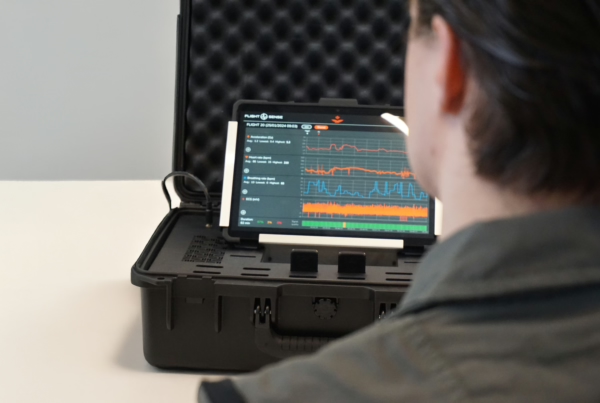
Dry electrodes do not require gel or skin preparation, making them practical for field use. However, they are more susceptible to motion artefact than wet electrodes, so the signal processing algorithms and electrode placement must be carefully engineered for high-movement conditions. The Flight Sense System, developed for military and extreme-condition use, addresses exactly this challenge by combining advanced dry-electrode ECG sensing with onboard signal processing optimised for dynamic environments.
Respiration and stress sensing
Respiration rate is another biometric indicator that military wearables track, both as a standalone metric and as an input to stress and exertion models. When combined with HRV and skin conductance data, respiration patterns help build a more complete picture of cognitive and physiological load. Electrodermal activity (EDA) sensors, which measure changes in skin conductance caused by sweat gland activity, are increasingly used in research-grade military wearables to quantify stress response in real time.
How are haptic actuators used alongside sensors in military wearables?
Haptic actuators in military wearables translate sensor data into tactile signals that the wearer can feel without looking at a screen or listening to audio. Sensors collect the data, and haptic actuators deliver the output, creating a closed loop that keeps the soldier informed while keeping their senses free for the environment around them. This combination is particularly valuable for navigation, alert systems, and physiological feedback.
The most operationally mature example is haptic navigation. A GPS or IMU-derived heading is converted into a directional vibration pattern delivered to the torso. The wearer feels a cue indicating which direction to move, eliminating the need to check a device or receive a radio instruction. This is the principle behind the Mission Navigation Belt developed for the Royal Netherlands Army: a belt fitted with haptic actuators that communicate navigation instructions silently and hands-free in the field.
Haptic actuators are also used alongside biometric sensors to deliver physiological alerts. If a system detects that a soldier’s heart rate or HRV has crossed a threshold indicating dangerous exertion or stress, a haptic alert can prompt the wearer to slow down or signal a team leader without breaking radio silence or requiring the soldier to check a readout.
The actuator type matters significantly in military applications. ERM (Eccentric Rotating Mass) actuators are common in consumer devices but generate relatively imprecise vibration patterns. LRA (Linear Resonant Actuator) and piezo actuators offer more precise frequency control and faster response times, which is important when haptic patterns need to convey specific directional or urgency information. Selecting the right actuator for a body-worn military application involves balancing signal clarity, power consumption, durability, and the acoustic signature of the device, since some actuators produce audible noise that is unacceptable in covert operations.
What environmental sensors are found in military wearable devices?
Environmental sensors in military wearables monitor conditions outside the body rather than within it. Common types include temperature sensors, barometric pressure sensors, gas detectors, and radiation monitors. These sensors extend the wearable’s function from personal health monitoring into situational awareness, alerting the wearer to environmental hazards that may not be immediately perceptible.
Temperature and humidity sensors are among the most straightforward environmental additions. They help systems contextualise biometric data, since a rising ambient temperature changes how heart rate and sweat response should be interpreted, and can also trigger heat stress alerts independently. Barometric pressure sensors serve dual purposes: they contribute to altitude estimation in navigation systems and can detect rapid pressure changes that indicate environmental events.
Gas detection is a more specialised capability found in wearables designed for CBRN (chemical, biological, radiological, and nuclear) environments. Miniaturised electrochemical sensors can detect specific chemical agents or oxygen depletion and trigger immediate haptic or audio alerts. The engineering challenge here is integrating sensitive chemical sensors into a wearable form factor without compromising their accuracy or exposing them to damage from physical activity.
Radiation monitoring wearables use dosimeters embedded into clothing or vest systems to provide continuous exposure tracking. These are particularly relevant for military personnel operating near nuclear facilities or in post-incident environments. The data from these sensors is typically logged and transmitted rather than acted on in real time, though threshold alerts are standard.
What challenges affect sensor accuracy in military wearable systems?
The primary challenges affecting sensor accuracy in military wearable systems are motion artefact, body placement variability, electromagnetic interference, environmental extremes, and power constraints. Each of these can degrade the quality of sensor data in ways that are acceptable in a consumer context but potentially critical in a military one.
Motion artefact is the most pervasive challenge. When a soldier runs, crawls, or carries heavy loads, the physical movement of the sensor relative to the skin introduces noise into biometric signals. ECG and EMG readings are particularly vulnerable. Addressing this requires a combination of dry electrode design optimised for high-movement conditions, signal filtering at the firmware level, and careful attention to how sensors are attached to the body. The integration technique, whether conductive yarn, printed electronics, or a modular attachment, directly affects how much artefact is introduced.
Electromagnetic interference is a significant concern in military environments where radios, radar systems, and other high-power electronics operate nearby. Sensor circuits must be shielded and firmware must be designed to distinguish genuine physiological signals from electromagnetic noise. This is not a problem most commercial wearable developers need to solve, but it is a baseline requirement in military wearable design.
Power management is a constraint that affects sensor accuracy indirectly. To extend battery life, sensors are often duty-cycled, meaning they are switched off between readings. If the duty cycle is too aggressive, fast-changing physiological events are missed. If it is too conservative, battery life drops to unacceptable levels. Getting this balance right requires treating power as a system-level problem, optimising across hardware, firmware, and sensor sampling rates rather than simply selecting a larger battery.
Body placement variability adds another layer of complexity. Sensors designed for a specific body location may shift during intense activity, changing the signal quality. Wearable systems intended for military use must account for a wide range of body types and movement patterns, and the mechanical design of the garment or carrier system must keep sensors in consistent contact with the body across all of them.
How Elitac Wearables helps with military wearable technology
Designing sensors into military wearables is one of the most technically demanding challenges in the wearable development space. It requires deep expertise across hardware, firmware, textile integration, signal processing, and human factors, all applied simultaneously, with no room for the kind of iterative failure that consumer product teams can absorb.
Elitac Wearables brings that integrated capability to defence and military wearable projects from a single team. Relevant capabilities include:
- Biometric sensor integration covering ECG, EMG, EDA, and IMU sensing, with specific expertise in dry electrode selection and motion artefact mitigation for high-movement conditions
- Haptic actuator design across ERM, LRA, and piezo technologies, including firmware-level timing and pattern design for silent, screen-free feedback systems
- Electronics-textile integration using conductive yarns, printed electronics, and modular attachment techniques suited to ruggedised, body-worn applications
- Embedded hardware and firmware development, including the proprietary TacOS operating system, built specifically for wearable constraints including power management and real-world usage patterns
- Military certification guidance, with experience navigating the specific standards that govern electronics in defence environments
The Mission Navigation Belt and the Flight Sense System are both live examples of this capability applied to military and extreme-condition contexts. If you are developing a military wearable and need a partner who has already solved the hard problems, get in touch with the Elitac Wearables team to discuss your project.
Related Articles
- What industries benefit most from smart textile development?
- What is augmented reality used for in military wearables?
- How do defence forces use biometric wearables?
- How do you evaluate the technical readiness of a wearable product before going to market?
- How do you align your wearable product development with your go-to-market strategy?