

Wearables improve training outcomes for defence personnel by delivering real-time physiological data, enabling silent situational communication, and reducing injury risk through continuous monitoring. The technology gives commanders and trainers objective insight into soldier readiness, workload, and performance that no traditional assessment method can match. The questions below unpack exactly how that works in practice.
What types of wearables are used in defence training?
Defence training environments use several categories of wearable technology, each targeting a different layer of soldier performance. The primary types are biosignal monitoring devices, haptic communication systems, motion capture and movement analysis wearables, and environmental exposure sensors worn on the body or integrated into protective gear.
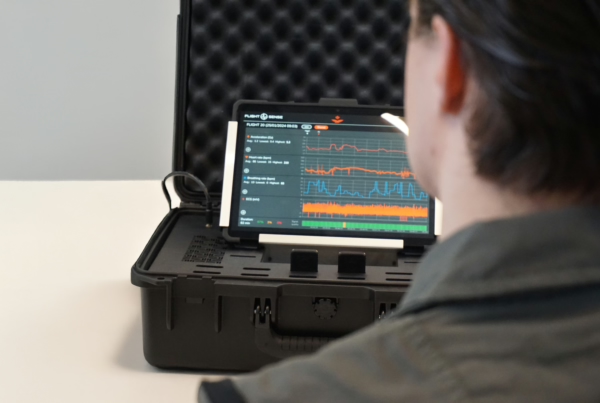
Biosignal wearables measure physiological markers including heart rate, heart rate variability, respiration, and skin temperature. These devices give trainers a real-time window into how hard a soldier’s body is actually working, independent of what the soldier reports. In high-stress scenarios, self-reported fatigue is notoriously unreliable, making objective sensor data essential.
Haptic wearables serve a different function entirely. Rather than measuring the wearer, they communicate with them through vibrotactile signals, delivering directional or instructional information without requiring the soldier to look at a screen or listen for a verbal command. The Mission Navigation Belt, developed by Elitac Wearables in collaboration with the Dutch Ministry of Defence, is a direct application of this principle: a belt that delivers silent, screen-free navigation cues to soldiers in the field, keeping eyes, hands, and ears fully operational.
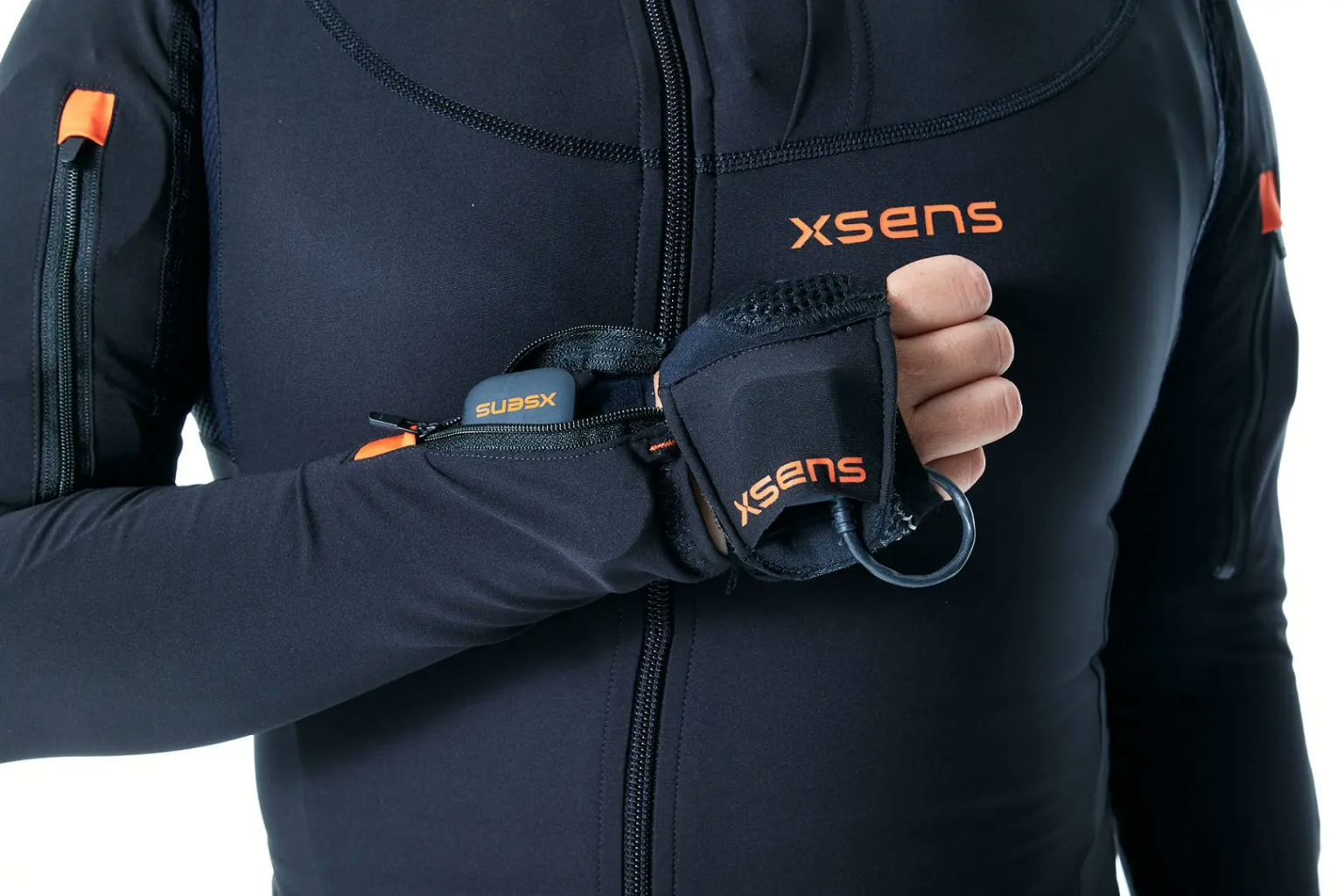
Motion capture and inertial measurement unit (IMU)-based wearables track joint angles, movement patterns, and load distribution across the body. These are increasingly used in training to assess technique, flag asymmetries that predict injury, and provide coaches with biomechanical data that goes far beyond what a human observer can capture.
How does haptic feedback technology enhance soldier performance?
Haptic feedback technology enhances soldier performance by delivering information through vibration or pressure on the body, bypassing the visual and auditory channels that are frequently overloaded or compromised in operational and training environments. A soldier who can receive a directional cue through a belt or vest does not need to glance at a GPS device or listen for a radio call.
The performance gains from haptic wearables fall into two categories: cognitive load reduction and communication reliability. In complex training scenarios, every additional demand on a soldier’s attention has a cost. Haptic signals communicate without adding to visual clutter or audio noise, which means the soldier can maintain situational awareness while still receiving navigational or instructional input.
Haptic feedback is also far more discreet than any audio or visual alert. In scenarios where silence is a tactical requirement, vibrotactile signals allow trainers to communicate with personnel in real time without compromising the exercise. This makes haptic wearables particularly valuable in scenarios designed to simulate live operational conditions.
The technology itself comes in several forms. Eccentric rotating mass (ERM) actuators are common in consumer devices, but defence applications often demand more precise timing and pattern control. Linear resonant actuators (LRAs) and piezo actuators offer better directional resolution and faster response times, which matters when a haptic pattern needs to distinguish between “turn left,” “stop,” or “threat detected.” Getting that actuator selection right for body-worn defence applications requires both haptic engineering expertise and an understanding of how signals are perceived differently at various body locations.
What training outcomes can wearable data actually measure?
Wearable data can reliably measure physical exertion, cardiovascular stress, movement quality, sleep and recovery status, and cumulative training load across a unit. These are not soft indicators: they are quantifiable metrics that allow training programmes to be adjusted based on what soldiers’ bodies are actually experiencing rather than what a schedule assumes.
Physiological performance metrics
Heart rate and heart rate variability (HRV) are among the most informative signals available from a wearable. HRV in particular is a well-established indicator of autonomic nervous system recovery, meaning it can flag when a soldier is physiologically under-recovered before that manifests as degraded performance or injury. Respiration rate under load, combined with acceleration data, gives trainers a composite picture of cardiovascular strain during specific activities.
Biomechanical and movement quality metrics
IMU-based wearables track how a soldier moves, not just how hard they are working. Gait asymmetry, joint loading patterns, and changes in movement efficiency over the course of a training session all carry predictive value. A soldier whose stride mechanics deteriorate in the final kilometres of a loaded march is demonstrating measurable fatigue that a trainer might otherwise miss entirely. This data supports both individual performance coaching and unit-level readiness assessments.
How do wearables reduce injury risk during military training?
Wearables reduce injury risk in military training by providing early warning signals that precede physical breakdown. Rather than responding to injuries after they occur, wearable monitoring allows trainers to intervene when data indicates a soldier is approaching a physiological threshold that significantly increases injury probability.
The most direct mechanism is continuous load monitoring. Military training injuries, particularly musculoskeletal injuries from running, load carriage, and repetitive movement, are strongly associated with training load spikes. When a soldier’s cumulative physical stress increases too rapidly over a short period, the injury risk rises sharply. Wearables that track daily and weekly training load allow training staff to identify these spikes in real time and adjust programming before the body fails.
Secondary mechanisms include posture and movement monitoring, which can identify compensatory movement patterns that place excessive stress on specific joints. A soldier unconsciously favouring one side due to minor discomfort will show detectable asymmetry in IMU data well before the compensation becomes a clinical problem.
There is also a fatigue dimension specific to defence contexts. Cognitive fatigue from sleep deprivation, which is endemic in military training environments, has measurable physiological correlates. HRV suppression and altered respiration patterns can indicate when a soldier’s decision-making capacity is compromised, which is relevant not just for injury prevention but for safety in live-fire or vehicle-based training scenarios.
What are the challenges of deploying wearables in defence environments?
Deploying wearables in defence environments is significantly harder than deploying the same technology in a clinical or sports setting. The primary challenges are environmental durability, data security, integration with existing military systems, and the physiological demands placed on sensors by high-intensity, unpredictable activity.
Durability requirements in defence contexts go well beyond standard IP ratings. Wearables must survive submersion, extreme temperature ranges, physical impact, and prolonged field use without requiring maintenance or calibration. Components that perform reliably in a lab or on a sports field often degrade quickly under genuine operational conditions. This places demands on materials selection, enclosure design, and textile integration that consumer and clinical wearable development simply does not address.
Biosignal sensing in high-movement conditions introduces a specific technical problem: motion artefacts. Sensors that work well during steady-state activity produce corrupted data during explosive, irregular movement. Dry electrode technology, which avoids the gel required by traditional wet electrodes, is better suited to defence applications, but dry electrodes are more susceptible to motion artefacts and require careful signal processing to produce reliable data during combat-relevant activities.
Battery life is another persistent constraint. A wearable that needs recharging every eight hours is impractical in field training that runs for days. Extending battery life without increasing device size requires system-level optimisation across firmware, hardware, and data architecture, not simply fitting a larger battery.
Data security and sovereignty add a layer of complexity unique to defence. Biometric data collected on military personnel is sensitive by definition, and any wearable system deployed in a defence context must meet strict requirements for data handling, transmission encryption, and storage. Off-the-shelf consumer platforms are almost never appropriate for this reason alone.
When should a defence organisation invest in custom wearable development?
A defence organisation should invest in custom wearable development when the operational requirement cannot be met by existing commercial products, when data security or integration requirements rule out off-the-shelf solutions, or when the wearable must function reliably in environmental and physiological conditions that consumer-grade devices are not designed for.
The clearest signal that custom development is warranted is when a commercial product gets close to the requirement but falls short on one or two critical dimensions. A device that monitors the right signals but cannot survive field conditions, or that works in the right conditions but transmits data through infrastructure incompatible with military systems, is not a viable solution. Adapting a commercial product to close that gap is often more expensive and less reliable than building for the requirement from the outset.
Custom development is also the right choice when haptic communication is part of the requirement. Haptic wearables for defence use, such as navigation belts or alert systems, require precise actuator selection, firmware-level control of vibration patterns, and careful human factors work to ensure signals are correctly interpreted under stress. There is no commercial equivalent for many of these applications, because the market for defence-specific haptic wearables is small enough that no mass-market manufacturer has addressed it.
The investment threshold matters too. Custom wearable development is not a small commitment, and organisations should approach it with a clear validation strategy. Building for validation before committing to production tooling reduces financial risk significantly. A functional demonstrator that proves the concept with real users in realistic conditions is far more valuable than a fully engineered product that turns out to solve the wrong problem.
How Elitac Wearables helps defence organisations develop effective training wearables
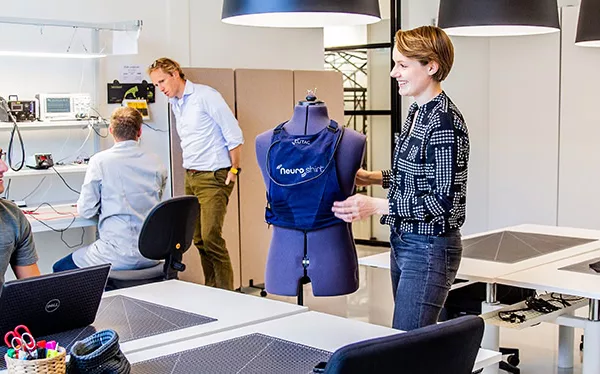
Elitac Wearables brings together the specific disciplines that defence wearable development demands, including haptic engineering, dry-electrode biosignal sensing, electronics-textile integration, embedded firmware, and battery optimisation, under one roof. For defence organisations, this matters because fragmented development across multiple suppliers consistently produces integration failures and schedule overruns that a single accountable partner prevents.
- Haptic system design: Full actuator selection, firmware-level pattern control, and body-location optimisation for silent communication wearables
- Biosignal sensing for high-movement conditions: Dry electrode technology and motion artefact mitigation, directly applicable to combat-relevant training activities
- Durability-first hardware and textile integration: Over ten years of experience designing electronics into textiles for field-deployable, washable, and ruggedised wearables
- Battery life extension without redesign: System-level firmware and hardware optimisation that has extended battery performance by up to 50% in existing wearable programmes
- Validation before production commitment: Functional demonstrators delivered quickly to prove the concept with real users before major tooling investment is required
The Mission Navigation Belt, delivered to the Royal Netherlands Army, demonstrates what this looks like in practice: a haptic wearable that integrates with existing GPS systems, keeps hands and eyes free, and functions reliably in genuine field conditions. If your organisation is working through a similar requirement and needs a development partner with the technical depth to deliver it, contact Elitac Wearables to discuss your project.