
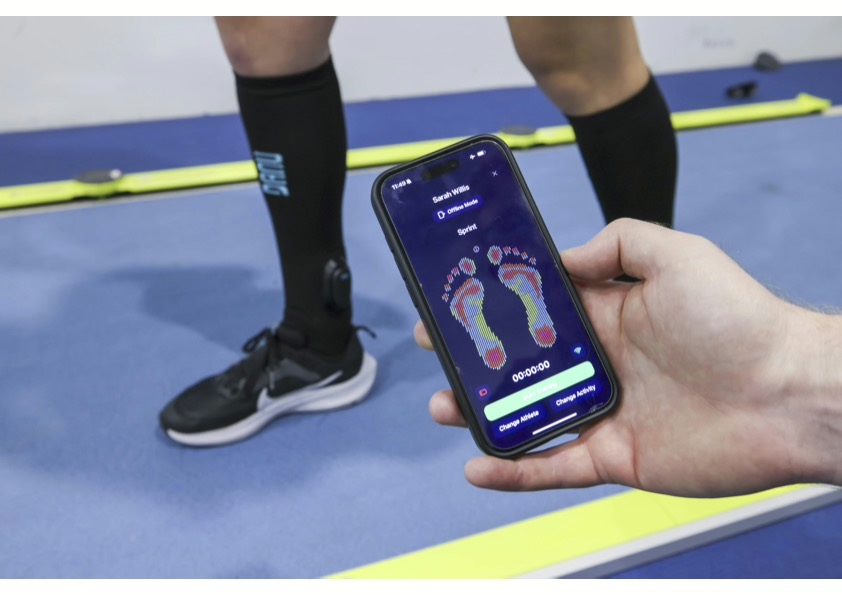
Yes, a startup can successfully compete in wearable product development — but not by trying to out-resource established players. The startups that win do so by moving faster in a focused niche, partnering strategically for technical depth, and solving a specific problem better than anyone else. The key is knowing where your limitations are before they become failures. This article addresses the most common questions founders, product leads, and CTOs ask when entering the wearable development space.
What makes wearable product development so technically challenging?
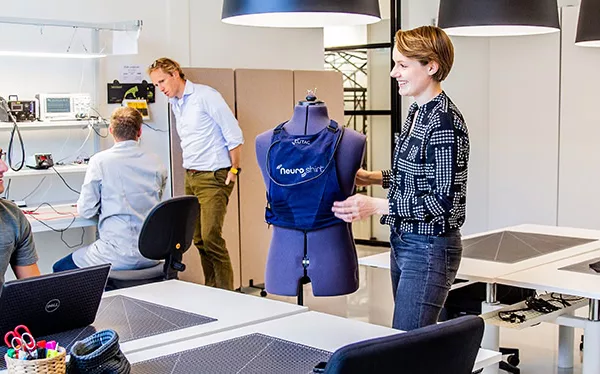
Wearable product development is technically challenging because it requires simultaneous expertise across multiple disciplines that rarely coexist in a single team: electronics, firmware, textiles, human factors, biosignal processing, and regulatory compliance. Each layer introduces its own failure modes, and those failure modes interact in ways that are difficult to predict until a product is worn by a real person in a real environment.
Unlike conventional electronics products, wearables must perform reliably while being bent, stretched, washed, sweated on, and worn for extended periods. A circuit board that works perfectly on a bench can fail within minutes when integrated into a garment that flexes with the body. The integration of electronics into textiles alone involves choices between conductive yarns, printed electronics, and modular attachment systems — and the wrong choice at the design stage can make a product impossible to manufacture at scale or impossible to certify for its intended market.
Add to this the challenge of power management. Wearables are typically battery-constrained, and firmware that keeps components active longer than necessary can halve a product’s usable battery life without any visible hardware change. Solving this requires treating power as a system-level problem across hardware selection, firmware behaviour, data handling, and real-world usage patterns — not simply swapping in a larger battery.
For startups, the compounding nature of these challenges is the real danger. A mistake in textile integration affects comfort, which affects user compliance, which affects clinical or commercial validity. Problems do not stay in their lane.
Where do most wearable startups struggle most?
Most wearable startups struggle at the transition from prototype to a reliable, manufacturable product. Getting a wearable to work once, in controlled conditions, is achievable with enough engineering effort. Getting it to work consistently, across diverse users, in real-world conditions, and in quantities that support a business — that is where most early-stage teams hit a wall.
The most common failure points are:
- Reliability gaps between prototype and production: A prototype built with off-the-shelf components and manual assembly rarely translates directly to a manufacturable design. Tolerances, component availability, and assembly repeatability all change at scale.
- Underestimating certification requirements: Medical wearables require MDR compliance in Europe. Wearables for hazardous environments need ATEX certification. Military applications carry their own standards. These are not final-stage checkboxes — they shape hardware and firmware decisions from the start, and ignoring them early creates expensive rework later.
- Fragmented supplier relationships: Many startups piece together a development team from separate hardware, firmware, and textile suppliers. Without a single party accountable for the whole system, integration problems fall into the gaps between vendors, and no one owns the fix.
- Insufficient user testing: Wearables fail in ways that only real users reveal. Comfort issues, skin irritation, incorrect sensor placement, and behavioural adaptations that defeat the product’s purpose are all invisible until the device is worn in context.
The pattern is consistent: startups underestimate the distance between a working prototype and a product that is ready for real-world deployment. That distance is where most wearable development budgets and timelines are lost.
How does a startup compete against established wearable companies?
Startups compete against established wearable companies by doing one thing better than anyone else in a specific context — not by building a broader platform. Established players have scale, existing supply chains, and brand recognition. Startups have speed, focus, and the ability to solve problems that large companies consider too niche or too risky to address.
The most successful wearable startups win by:
- Owning a specific problem in a specific sector: A startup that builds the best wearable for fall detection in post-surgical rehabilitation has a defensible position. A startup that builds “a health wearable” does not.
- Moving faster through iteration: Without the approval layers and legacy product constraints of a large organisation, a startup can move from feedback to a revised prototype in weeks rather than quarters.
- Accessing technical depth through partnerships: Startups do not need to employ every specialist in-house. Partnering with a development team that has deep expertise in haptic feedback, electronics-textile integration, or biosignal sensing gives a startup capabilities that would take years to build internally.
- Prioritising end-user insight: Large companies often optimise for the buyer, not the wearer. Startups that embed genuine end-user feedback into every development stage build products that actually get adopted and used — which is the real competitive moat in wearable technology.
The competitive advantage is not about matching resources. It is about being more focused, more responsive, and more genuinely useful to a specific group of people than any established player is willing to be.
Should a startup build wearable development capabilities in-house or outsource?
For most wearable startups, outsourcing development to a specialist partner is the more effective path — at least in the early stages. Building in-house wearable development capability requires hiring across hardware, firmware, textiles, and human factors simultaneously, which is expensive, slow, and creates significant execution risk before the product concept is even validated.
The core question is not build versus buy — it is where your team’s time and capital create the most value. For a startup, that is almost always in understanding the problem, accessing the market, and validating that the product works for real users. The engineering execution, particularly for complex multi-discipline wearables, is where specialist partners earn their cost.
That said, the outsourcing decision depends on a few factors:
- Stage of development: If you have a concept but no prototype, a full-service development partner reduces risk dramatically. If you have a working prototype and need to address specific technical gaps, targeted specialist support may be more appropriate.
- Sector requirements: Medical and defence wearables involve certification requirements that demand documented development processes, traceability, and regulatory expertise. These are not skills you want to build for the first time under deadline pressure.
- Long-term product strategy: If your product is a one-time device rather than a platform, building permanent in-house capability may never be justified. If you are building a product family, internalising core competencies over time makes sense — but start with a partner who can establish the technical foundation.
The startups that struggle most are those that try to build everything in-house too early, burning runway on hiring and infrastructure before they have validated that the product concept is commercially viable.
What does the wearable product development process actually look like?
A structured wearable product development process moves through six distinct phases, from feasibility verification through to scaled production. Each phase has a defined output, a realistic duration, and a decision point that determines whether to proceed, pivot, or stop. Understanding this structure helps startups plan budgets, timelines, and investor conversations with accuracy.
The six phases are:
- Feasibility Check: A rapid verification of whether the proposed techniques and materials can deliver the intended function. Typically completed within 14 weeks. This phase answers the question: is this technically possible within the constraints we have?
- Proof of Concept (PoC): A basic working version built with off-the-shelf components, designed to gather initial market or clinical feedback. Completed in under one month. The goal is learning, not polish.
- Pilot Samples (2 to 10 units): Functional samples used to explore features and form factor in controlled user tests. Completed in under two months. This is where real user insight begins to shape the product.
- Final Prototypes (5 to 30 units): Prototypes with all required features and final form factor, used in uncontrolled user tests. Duration: two to twelve months, depending on complexity.
- First Series (30 to 50 units): In-house production of a limited series, suitable for certification, early sales, and market exploration. Duration: one to five months.
- Scaled Production (50+ units): Design of peripherals, documentation, and manufacturing handover for unlimited external production. Duration: one to five months.
End-to-end, this process typically takes between six months and three years. If a startup enters with an existing prototype or proof of concept, both time and cost can be significantly reduced. New technologies, full miniaturisation, and medical or military certification requirements all extend timelines and increase cost — these are not surprises, but they must be factored in from the start.
Which wearable sectors offer the best entry point for startups?
The sectors that offer the best entry point for wearable startups are those where the problem is clearly defined, the end-user benefit is measurable, and the regulatory path is proportionate to the product’s risk level. In practice, this points most clearly to sports performance, occupational safety, and lower-risk medical monitoring applications.
Sports and performance wearables
Sports wearables benefit from a relatively accessible regulatory environment for non-medical devices, a user base that actively wants to try new technology, and clear performance metrics that make product validation straightforward. Motion capture, load monitoring, and recovery tracking are all areas where startups have successfully built defensible positions. The challenge is that consumer sports wearables are a crowded market — the entry point is in professional, team, or clinical sports contexts where precision and reliability matter more than price.
Medical monitoring and rehabilitation
Medical wearables carry higher regulatory requirements, but they also command higher price points, longer product lifecycles, and more committed buyers. Class I medical devices — those with lower risk profiles — offer a more accessible entry point than Class II or III, while still addressing genuine clinical needs. Wearables for rehabilitation, chronic condition monitoring, and post-surgical recovery are areas where startups can build meaningful products without immediately confronting the full complexity of high-risk medical device certification.
The sectors to approach with more caution are those where the incumbent players have deep regulatory experience, long-established supply chains, and direct relationships with institutional buyers — such as defence procurement. These are not closed to startups, but they require a level of technical credibility and certification capability that takes time to build. Partnering with an experienced development team is often the fastest route to credibility in these markets.
How Elitac Wearables helps startups with wearable product development
Elitac Wearables works with startups and scale-ups that have a strong product concept but need the technical depth to make it real. If your team has identified the problem and understands the market, we provide everything required to move from that point to a certified, manufacturable product — without the risk of fragmented suppliers or knowledge gaps between disciplines.
For startups specifically, the practical advantages of working with Elitac include:
- All disciplines in-house: Hardware, firmware, textile integration, biosignal sensing, haptic feedback, human factors, and certification guidance are handled by one team in one facility — no handoffs, no coordination risk between vendors.
- Proprietary TacOS firmware platform: Our purpose-built wearable operating system reduces development time and cost compared to building firmware from scratch, which is particularly valuable for startups working within fixed budgets.
- Phased development with defined decision points: You are never committed to the full development roadmap from day one. Each phase has a clear output and a natural point to reassess — which is how startups should manage development risk.
- Rapid demonstrator capability: When you need to demonstrate a concept to investors or partners within a fixed timeline, we can deliver functional wearable demonstrators quickly and at a fraction of production-phase cost.
- Sector experience across medical, defence, and sports: With over 50 products developed across more than a decade, we understand the certification requirements, user expectations, and technical constraints of the sectors where startups are most likely to compete.
If your wearable development project has hit a wall — whether at the concept stage, the prototype stage, or the transition to production — contact Elitac Wearables to discuss where you are and what it would take to move forward.