
Developing a wearable product starts with a feasibility check, followed by a structured sequence of proof of concept, prototyping, user testing, and production. The process is rarely linear, and the specific path depends on how mature your concept already is, what sector you are building for, and whether certification is required. This article walks through the key questions every product team faces, from defining requirements to choosing the right development partner.
What does the wearable product development process look like?
Wearable product development follows a phased process that moves from technical feasibility through proof of concept, functional prototyping, user testing, and into certified production. Each phase has a distinct purpose, and skipping or rushing any one of them is one of the most common reasons wearable projects stall before reaching market.
A practical framework for custom wearable product development typically includes six stages:
- Feasibility check — A rapid verification of whether the core techniques and materials required for your concept are viable. This phase typically takes one to four weeks and prevents expensive dead ends early.
- Proof of concept — A basic working version built with off-the-shelf components to test the core idea and gather initial market or clinical feedback. Duration is usually under one month.
- Pilot samples — Two to ten functional samples that explore features and form factor in controlled user tests. Expect this phase to take under two months.
- Final prototypes — Five to thirty units with all required features and the intended form factor, ready for uncontrolled user testing in real environments.
- First series — A limited in-house production run of thirty to fifty units, suitable for certification submissions, early sales, and market exploration.
- Scaled production — Design of manufacturing documentation and peripherals to enable unlimited external production.
Total end-to-end development typically takes between six months and three years. If you already have a working prototype or proof of concept at the start, both time and cost can be significantly reduced. Introducing new technologies, full miniaturisation, or medical-grade certification adds time and cost at every stage.
What do you need to define before development begins?
Before any development work begins on a wearable product, you need to define the end user, the use context, the core functional requirement, and the target regulatory environment. These four elements shape every technical decision that follows, from component selection to form factor to certification path.
Many projects arrive at the development stage with a clear product vision but underspecified requirements. This creates costly rework later. The questions worth answering in detail before a single component is selected include:
- Who is wearing this, and in what conditions? A device worn during high-intensity sport has completely different durability, washability, and sensor requirements than one worn by a hospital patient during monitoring.
- What is the primary function? Is the wearable sensing, actuating, communicating, or some combination? Each function carries its own hardware and firmware implications.
- What does success look like for the end user? End-user centricity at this stage prevents feature creep and ensures the product solves a real problem rather than a theoretical one.
- What is the regulatory classification? A medical wearable destined for EU markets under MDR Class II has fundamentally different documentation and testing requirements than an industrial safety device or a sports performance tool. Knowing this before development begins shapes hardware choices, not just the final submission.
- What is the budget and timeline? Wearable product development at a professional level requires a meaningful investment. Projects below a certain budget threshold often cannot be executed to the quality and reliability standard required for real-world use.
Getting these answers documented before development begins is not administrative overhead. It is the single most effective way to prevent the most common and expensive failure mode in wearable development: building the wrong thing with precision.
What are the biggest technical challenges in wearable development?
The biggest technical challenges in wearable product development are electronics-textile integration, power management, sensor accuracy under movement, and miniaturisation. These are not isolated problems. They interact with each other, and solving one often creates constraints in another.
Electronics-textile integration
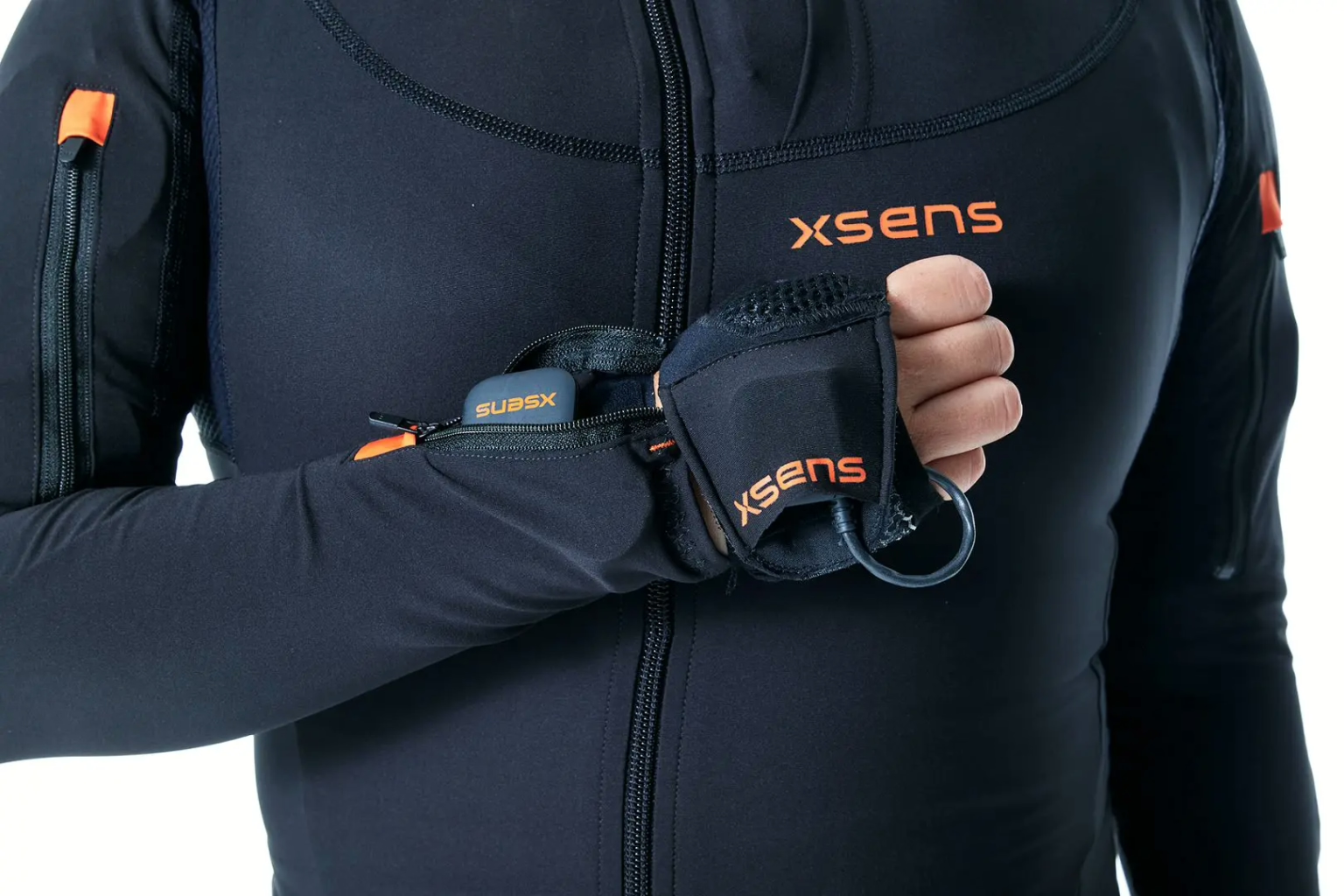
Embedding electronics into a garment or soft form factor is one of the most demanding engineering challenges in the wearable space. The integration technique, whether conductive yarns, printed electronics, or modular attachment, must account for washability, flexibility, mechanical stress during wear, and long-term reliability. A connection that works in a lab prototype can fail within weeks of real-world use if the integration method is not matched to the specific textile and wear pattern.
Power management and battery life
Battery life is consistently one of the top complaints in deployed wearable products. The root cause is almost never the battery itself. It is typically firmware that keeps components active longer than necessary, sensors and radios not optimised for actual usage patterns, inefficient data handling, or hardware components mismatched to the real-world use case. Effective battery performance optimisation treats this as a system-level problem across hardware, firmware, and data architecture simultaneously.
Sensor accuracy in motion
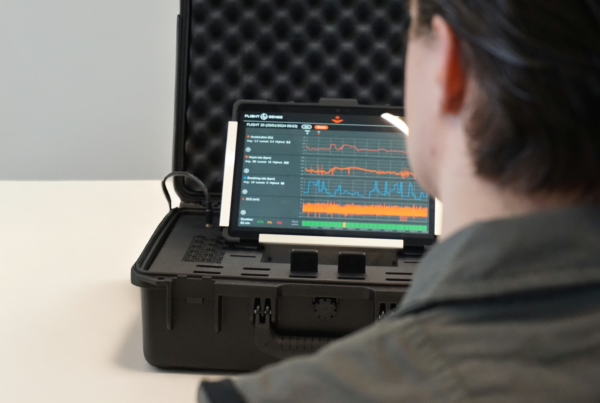
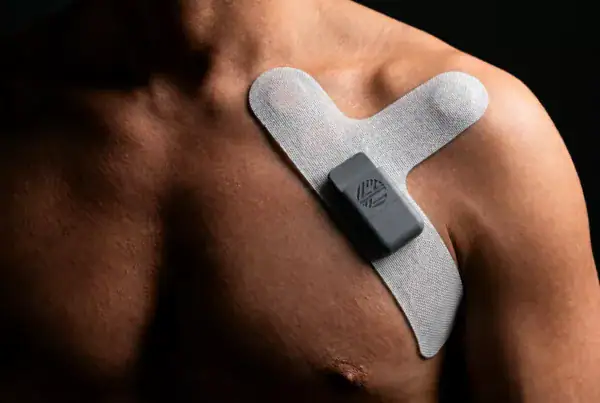
Biosignal sensing in wearables, particularly ECG, EMG, and EDA, is significantly complicated by movement. Motion artefacts can render data clinically unusable if electrode selection, placement, and signal processing are not designed specifically for the intended activity level. Dry electrodes, which are essential for comfort and practical use, require careful selection and validation for high-movement conditions to maintain signal quality.
Haptic feedback precision
For wearables that deliver tactile output, actuator selection and firmware-level timing are critical. The difference between ERM, LRA, and piezo actuators is not just technical specification. Each has different latency profiles, frequency ranges, and power draws that directly affect whether the haptic signal is perceptible, comfortable, and meaningful in a real-world context.
How do you build and test a wearable prototype?
Building a wearable prototype starts with a proof of concept using off-the-shelf components to validate the core function, then progresses to functional prototypes that test form factor and user experience in controlled conditions, before moving to final prototypes for uncontrolled real-world testing. Each stage answers a different set of questions and produces different types of evidence.
The proof of concept phase is about answering one question: does the core technology work? This is not about finish or form. It is about establishing that the sensing, actuation, or communication principle is viable in a body-worn context. Using existing building blocks and modular components at this stage keeps cost low and iteration speed high.
Pilot samples introduce form factor into the equation. At this stage, you are testing whether the device can be worn comfortably, whether the integration holds up under realistic use, and whether the user interaction model makes sense. Controlled user tests here surface problems that no amount of bench testing will reveal.
Final prototypes are built to the intended specification and tested in uncontrolled environments, meaning real users in real conditions. This is where edge cases emerge: the garment that performs perfectly in a lab but causes skin irritation after four hours of wear, or the sensor that loses signal quality when the wearer moves in an unexpected direction. Catching these issues before first series production is the entire purpose of this stage.
Rapid validation is also possible when timelines are compressed. Delivering a small number of functional demonstrators within weeks is achievable when the development team has in-house R&D infrastructure and does not need to coordinate across multiple external suppliers.
When should you bring in an external development partner?
You should bring in an external wearable development partner when your internal team lacks one or more of the core disciplines required, when a prototype exists but is not reliable enough for real-world use, or when the project is stalled at the transition to production. Waiting until a project is already in trouble is the most expensive point to seek external expertise.
The most common situations where an external partner adds the most value include:
- No in-house wearable expertise: Many organisations have strong domain knowledge, whether clinical, industrial, or athletic, but have never built a body-worn electronic device. The gap between knowing what a product needs to do and knowing how to build it is significant.
- Single-discipline suppliers are insufficient: Wearable development requires hardware, firmware, textile, and algorithm expertise working in close coordination. A supplier that handles only electronics, or only garment construction, cannot be accountable for the integrated result.
- A prototype is not production-ready: Many teams reach a working prototype but find it fails under real-world conditions. Reliability issues at this stage often require systemic diagnosis across multiple disciplines simultaneously.
- Certification is required: Medical Device Regulation, CE marking, ATEX, or military certification requirements demand documentation, testing, and design decisions that need to be built into development from the start, not retrofitted at the end.
The earlier an experienced development partner is involved, the more influence they can have on the architecture of the product. Bringing in external expertise after key hardware decisions are locked in limits the options available and often means undoing work that has already been paid for.
What certifications does a wearable product need before launch?
The certifications a wearable product requires before launch depend on its intended use, target market, and classification. For EU markets, medical wearables typically require CE marking under MDR (Medical Device Regulation), industrial wearables used in hazardous environments may require ATEX certification, and defence wearables are subject to military-specific standards. Consumer wearables require CE marking as a baseline for EU sale.
Certification is not a final step. It is a design constraint that shapes hardware selection, materials, documentation, and testing protocols from the earliest stages of development. The most common and costly mistake in wearable product development is treating certification as something to address once the product is built. By that point, design choices that are incompatible with regulatory requirements are already locked in.
Key certification pathways for wearable products in the EU include:
- MDR Class I and Class II: Applicable to medical wearables. Class II devices require a notified body and substantially more documentation and clinical evidence than Class I. The classification depends on the intended purpose and risk level of the device.
- CE marking (general product safety): Required for most wearable electronics sold in the EU, covering electromagnetic compatibility, electrical safety, and radio equipment directives where applicable.
- ATEX: Required for wearables intended for use in potentially explosive atmospheres, such as certain industrial and oil and gas environments. This adds substantial testing and documentation requirements.
- Military standards: Defence wearables are subject to specific environmental and performance standards that vary by country and procurement authority.
Certification costs and timelines scale significantly with classification. A general CE-marked wearable and a Class II medical device are in entirely different cost brackets. Building the certification path into the project plan from the feasibility stage is the only way to avoid late-stage redesigns and missed launch windows.
How Elitac Wearables helps with wearable product development
Elitac Wearables is a Netherlands-based development partner that takes wearable products from initial concept through to certified, market-ready devices. For product managers, CTOs, and R&D directors who need a team that can own the full development cycle without handoffs between vendors, Elitac offers a specific and concrete capability set:
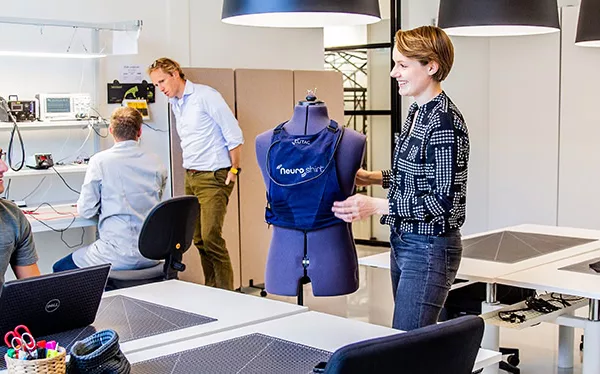
- All disciplines in-house: Hardware, firmware, textile integration, biosignal sensing, haptic feedback, and human factors expertise under one roof, with a 180m² R&D facility for faster iteration.
- Proprietary TacOS platform: A wearable-specific firmware operating system that reduces development time and cost compared to building from scratch.
- Certification-aware development: Experience with MDR Class I and II, CE marking, ATEX, and military standards, built into the development process from the feasibility stage rather than added at the end.
- Proven track record: Over 50 products developed across medical, defence, sports, and industrial sectors, including the Mission Navigation Belt for the Royal Netherlands Army and biosensor wearables for clinical and sports applications.
- Structured six-phase process: From feasibility check to scaled production, with fixed daily rates, transparent cost estimates, and a commitment that actual hours will not exceed the estimate by more than 10% without prior consultation.
If your wearable project is at any stage, whether you are starting from an idea, have a prototype that is not performing reliably, or are stuck at the transition to production, contact Elitac Wearables to discuss where you are and what the right next step looks like.