
AI plays a meaningful but supporting role in modern wearable product development. It accelerates sensor data processing, improves pattern recognition in biosignal analysis, and can shorten iteration cycles during prototyping. For development teams working on complex, body-worn devices, AI is most valuable as a tool that handles computational heavy lifting, freeing engineers to focus on the physical, mechanical, and regulatory challenges that algorithms alone cannot solve. The sections below address the specific questions that matter most to product leaders and R&D teams evaluating where AI fits in their wearable development strategy.
How does AI actually change the wearable development process?
AI changes wearable product development primarily by improving the speed and accuracy of data-driven decisions across the development cycle. It does not replace the engineering disciplines required to build a functional, body-worn device, but it does reduce the time needed to extract meaningful insights from sensor data, identify failure patterns in testing, and refine user-facing behaviour. For teams working on custom wearable product development, the practical impact is most visible in signal processing, anomaly detection, and firmware-level optimisation.
The development process for a wearable is fundamentally different from building a standard electronic product. The device moves with the body, operates in variable environmental conditions, and must remain comfortable and reliable across long wear periods. These constraints create enormous volumes of messy, real-world data during development and testing. AI tools, particularly machine learning models trained on that data, can identify patterns that would take human analysts weeks to find manually.
That said, AI introduces its own complexity. Models need training data, and gathering high-quality labelled data from body-worn sensors is time-consuming and expensive. The risk of over-engineering the AI layer and underestimating the physical and regulatory challenges is real. Development teams that treat AI as a shortcut rather than a specialist tool tend to encounter problems late in the process, when they are most costly to fix.
What types of AI are used in wearable technology?
The most commonly used types of AI in wearable technology are machine learning for signal classification, deep learning for biosignal interpretation, and edge AI for on-device inference. Each serves a different function depending on the wearable’s purpose, the sensors involved, and the computational constraints of the hardware platform.
Machine learning for signal classification
Machine learning models are widely used to classify sensor outputs, for example, distinguishing between walking, running, and standing based on accelerometer data, or identifying a specific gesture from an IMU signal. These models are typically trained offline on labelled datasets and then deployed to the device. They are well-suited to wearables because they can be optimised to run on low-power microcontrollers without draining the battery.
Deep learning for biosignal interpretation
Deep learning, particularly convolutional and recurrent neural networks, is increasingly used for interpreting complex biosignals such as ECG, EMG, and EEG. These models can detect subtle patterns in raw waveforms that rule-based algorithms would miss. In medical wearables, this capability is directly relevant to clinical utility, for instance, identifying arrhythmia signatures or stress indicators from heart rate variability data.
Edge AI for on-device inference
Edge AI refers to running AI inference directly on the wearable’s embedded processor rather than sending data to the cloud. This matters enormously for wearables because cloud dependency introduces latency, increases power consumption, and raises data privacy concerns, particularly in medical and defence contexts. Frameworks such as TensorFlow Lite and similar embedded inference tools make it possible to run compact models on constrained hardware, though this requires careful co-design of the model and the firmware early in the development process.
How does AI improve sensor data processing in wearables?
AI improves sensor data processing in wearables by filtering noise, compensating for motion artefacts, and extracting meaningful features from raw sensor streams more accurately than traditional signal processing methods. This is particularly valuable in body-worn devices, where movement, sweat, skin contact variability, and environmental interference all degrade signal quality in ways that are difficult to handle with fixed algorithms.
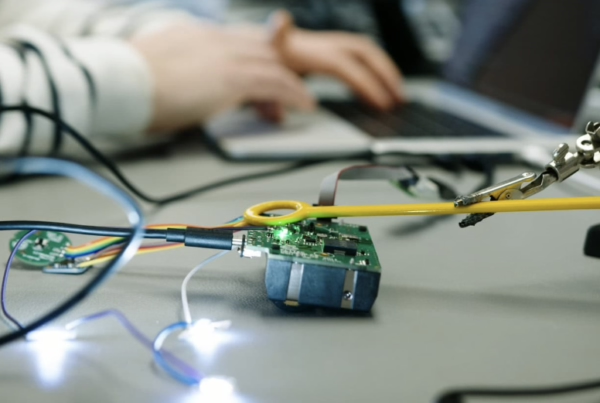
Motion artefacts are one of the most persistent challenges in wearable biosignal sensing. When a device measuring ECG or EMG is worn on a moving body, mechanical vibrations corrupt the signal. Classical filtering approaches use fixed frequency thresholds, but movement-induced noise often overlaps with the frequency bands of the signal of interest. Machine learning models trained on paired clean and corrupted signal data can learn to separate the two far more effectively.
Dry electrode systems, which are essential for practical wearables that do not require gel application, are particularly susceptible to contact quality variation. AI-based signal quality assessment can flag low-quality segments in real time, preventing unreliable data from being passed downstream to clinical or performance analytics systems. This is not a theoretical benefit: it directly affects whether a wearable produces data that a clinician or coach can act on.
Beyond artefact removal, AI enables feature extraction that would be computationally impractical with traditional methods. Heart rate variability analysis, gait phase detection, and fatigue estimation all depend on identifying patterns across time windows in multi-sensor data. AI models handle this efficiently, even on hardware with limited processing headroom.
Can AI speed up wearable prototyping and iteration?
AI can speed up specific stages of wearable prototyping, particularly data analysis, failure pattern identification, and algorithm tuning, but it does not accelerate the physical development work. Mechanical design, electronics integration, textile construction, and user testing all operate on timelines that AI cannot compress. The realistic benefit is in reducing the analytical bottlenecks between physical iteration cycles.
During prototype testing, development teams generate large volumes of sensor data across different users, body positions, and activity conditions. Manually reviewing this data to identify where a prototype underperforms is slow. AI-assisted analysis tools can surface anomalies, cluster failure modes, and highlight which test conditions produce the most problematic outputs, helping engineers prioritise what to fix in the next iteration rather than reviewing every data file manually.
Simulation is another area where AI is beginning to contribute. Generative models and surrogate modelling techniques can help predict how design changes will affect sensor performance before a new physical prototype is built. This is still an emerging capability in the wearable domain, and it requires a solid base of prior experimental data to be reliable. Teams without that data history cannot shortcut to simulation-led development.
The honest framing for product leaders is this: AI reduces analytical overhead between physical iterations. It does not replace them. A wearable that needs ten physical prototypes to reach reliability will still need those prototypes. AI might help the team learn faster from each one, but the physical work remains.
What are the limitations of AI in wearable product development?
The primary limitations of AI in wearable product development are data dependency, hardware constraints, regulatory complexity, and the risk of misallocating development effort. AI models require substantial, high-quality training data that is specific to the wearable’s use case and target population. That data is often expensive and time-consuming to collect, particularly in medical or defence applications where access to participants is restricted.
Hardware constraints are a persistent challenge. A model that performs well in a cloud environment may be too large or too computationally demanding to run on the embedded processor inside the wearable. Compressing models for edge deployment without significant accuracy loss requires specialist firmware and machine learning expertise that many development teams do not have in-house. This is a genuine technical barrier, not a software problem that can be solved by choosing a different framework.
Regulatory complexity is the limitation that catches the most teams off guard. In medical wearable product development, any AI component that influences a clinical decision is subject to regulatory scrutiny under frameworks such as the EU Medical Device Regulation. Demonstrating the safety and performance of an AI-driven feature requires validation evidence, version control, and documentation standards that go well beyond typical software development practice. Teams that treat the AI layer as a standard software component and address regulatory requirements late in the process face significant rework.
There is also a more fundamental risk: investing heavily in AI capability before the underlying wearable is reliable. A sophisticated algorithm running on a device with inconsistent sensor contact, variable battery life, or mechanical durability problems will not produce trustworthy outputs regardless of model quality. The physical foundation has to be solid before the AI layer adds value.
Should wearable development projects invest in AI capabilities early?
Wearable development projects should invest in AI capabilities early only when the AI functionality is core to the product’s value proposition and the team has a clear plan for acquiring training data. For most projects, the higher priority in early development stages is validating the physical device, not building the algorithm layer. Premature AI investment is a common cause of wasted budget and delayed timelines.
The decision depends on what role AI will play in the finished product. If the wearable’s primary function is to classify biosignals or deliver personalised haptic feedback based on user behaviour, then the AI architecture needs to be considered from the start, because it will influence hardware selection, data storage design, and firmware structure. Building the device first and adding AI later in these cases leads to expensive redesign.
If AI is a secondary feature, for example, improving data quality or enabling analytics in a companion app, it can be addressed in later development phases without compromising the core device. The risk of doing it too early is that the team optimises an algorithm for prototype data that does not represent real-world usage, then has to retrain from scratch once the device is in user testing.
A practical approach is to design the data architecture with AI in mind from the beginning, even if model development happens later. Ensuring the device captures the right signals at the right resolution, and that data is logged in a format suitable for training, costs little in early phases and avoids significant rework later.
How Elitac Wearables helps with AI-integrated wearable product development
Integrating AI into a wearable is not a software challenge with a wearable attached. It is a system-level problem that spans hardware design, firmware architecture, sensor selection, data collection strategy, and regulatory planning. Getting any one of those layers wrong undermines the rest.
Elitac Wearables approaches AI as part of a broader wearable product development system, not as a standalone capability. The in-house team combines embedded hardware design, firmware engineering including the proprietary TacOS platform, biosignal sensing expertise, and human factors knowledge under one roof. That means the decisions that affect AI performance, sensor placement, signal quality, data architecture, and power management are made by the same team responsible for delivering the finished device.
For product leaders evaluating where AI fits in their wearable project, Elitac offers a structured starting point: a feasibility check that maps the technical requirements, identifies where AI adds genuine value, and surfaces the constraints that will shape the development roadmap. The outcome is a clear picture of what needs to be built, in what order, and why, before significant budget is committed.
- Sensor and hardware selection informed by the AI processing requirements of the finished product
- Firmware architecture designed to support on-device inference where needed
- Biosignal expertise covering ECG, EMG, EEG, and IMU data, including motion artefact handling
- Regulatory guidance for AI-enabled medical wearables under MDR and CE marking requirements
- End-to-end development from proof of concept through to certified, production-ready device
If your team is building a wearable where AI is part of the product, and you want a development partner who understands every layer of that challenge, contact Elitac Wearables to discuss your project.
Related Articles
- How do you build a wearable product business case that gets board-level buy-in?
- What happens when wearable product development goes over budget, and how do you prevent it?
- What are the regulatory risks that can stall a wearable product launch, and how do you mitigate them?
- What should a CTO look for when evaluating a wearable development partner?
- What role does firmware play in wearable product development?