

You turn a university wearable prototype into a commercial development project by validating market need early, securing clear IP rights, and redesigning the device for manufacturing and certification. Most research prototypes prove a principle but cannot survive real users, real production, or regulation. Expect a structured, phased path that typically runs from 0.5 to 3 years, depending on complexity and certification.
What gaps separate a research prototype from a product?
A research prototype proves that a principle works under controlled conditions. A product must work reliably for untrained users, survive daily wear and washing, meet regulations, and be built repeatedly at a known cost. The gaps sit in robustness, integration, usability, manufacturability, and compliance.
Four gaps cause most of the trouble:
- Reliability: Lab setups tolerate loose wires, development boards, and a researcher standing nearby. A product cannot. Sensors behave differently on a moving body, and connections fail under flexing, sweat, and abrasion.
- Integration: Research devices often strap electronics onto a garment. Commercial wearables need electronics and textiles designed together, including washability, biocompatibility, sizing, and conductivity.
- Firmware and power: Research code is written to demonstrate a result. Production firmware must handle edge cases, update safely, and meet battery targets. Battery problems are rarely solved with a bigger cell; they are system-level inefficiencies across hardware, firmware, and data handling.
- Documentation: Regulators and manufacturers need traceable specifications, test records, and a bill of materials. Few research projects produce these.
In technology readiness terms, most university wearables sit around TRL 3 to 4. Commercial products need TRL 8 to 9, and the distance between them is where most projects stall.
Who owns the IP in a university wearable project?
It depends on the university’s IP policy, employment contracts, and any funding agreements. In many cases the university owns inventions created by its staff, while students, researchers, and co-funders may hold claims too. Settle ownership and licensing in writing before commercial development begins.
Check these points before you invest:
- Who contributed what: List every researcher, student, and external partner who touched the concept, code, or design.
- Funding conditions: Public grants and industry sponsors often attach rights or reporting duties to the results.
- Licence terms: A spin-off typically needs a licence or assignment from the university technology transfer office. Exclusive rights matter to investors.
- Background versus foreground IP: Separate what existed before the project from what a development partner creates during it.
The same logic applies to your development partner. Agree up front who owns new results. Some partners retain IP and grant a non-exclusive licence by default, while others can assign exclusive IP for a different price. Investors and acquirers will ask about this, so resolve it early.
How do you validate market need before investing further?
Validate market need by putting a functional demonstrator in front of real users and buyers before committing to tooling or certification. Test whether people want it, whether it fits their workflow, and whether they will pay. Build for validation, not for production, and treat a clear no as a useful result.
Industry experience shows that many wearable prototypes never reach production, and the main cause is validating too late rather than technical infeasibility. Tooling alone can cost six figures, so assumptions that survive until tooling are expensive to correct.
A practical validation path looks like this:
- Run a feasibility check first: Confirm the idea is technically possible, identify key risks, estimate component costs, and scope compliance before building anything custom.
- Build a rough proof of concept: Use off-the-shelf parts and wired connections to show that the working principle functions as intended.
- Produce a small batch of pilot samples: Put 2 to 10 functional units into controlled user tests to explore features and form factor.
- Test comfort and perceived value: Users often care about fit, discretion, and feedback quality more than the feature the researchers prioritised.
- Talk to buyers, not only users: A hospital, army, or sports club has procurement constraints that shape the product.
Haptic wearables deserve special attention here. Users cannot easily describe the feedback they need, so they must feel it on the body. Early testing with real actuators saves expensive rework.
What changes when redesigning for manufacturing and certification?
Almost everything changes. Design for manufacturing replaces hand-built parts with repeatable processes, custom PCBs, defined suppliers, and tested assemblies. Certification adds documented requirements, risk analysis, and formal testing. Both push you to freeze decisions that a prototype left open.
Design for manufacturing
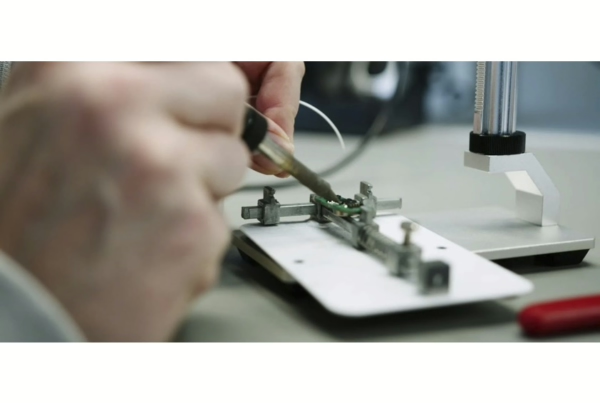
Prototype choices rarely scale. Hand-soldered connections become reliable interconnects, development boards become custom PCBs, and one-off garments become patterns that a factory can sew consistently. Early series can often be produced in-house, while higher volumes need external manufacturing partners and complete production documentation. Miniaturisation and new materials add time and cost, so decide early how far the design needs to go.
Certification and compliance
Wearable product certification depends on the intended use. A device that influences a medical decision falls under medical device regulation in the EU, which demands quality management, clinical evidence, and extensive documentation. Explosive environments require ATEX, and defence work brings its own standards. Certification increases cost substantially because of documentation and testing, so scope it during the feasibility phase rather than after the design is fixed.
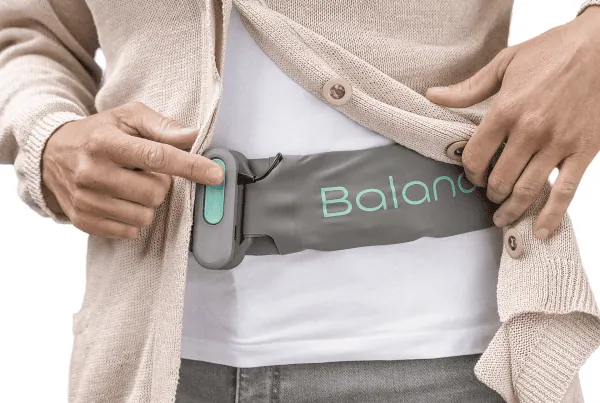
The BalanceBelt, a medical wearable that combines motion sensing with haptic feedback for people with severe balance disorders, shows what this demands in practice: MDR compliance, quality management, clinical validation, and production all had to be solved alongside the technology itself.
What should you look for in a development partner?
Look for a partner that covers hardware, firmware, textiles, and algorithms under one roof, has shipped certified products in your sector, and can build and test in-house. Fragmented supply chains create integration gaps that nobody owns, and those gaps cause most late-stage failures.
Use these criteria when comparing candidates:
- Relevant specialisation: Haptic feedback, electronics-textile integration, and biosignal sensing are niches. Generic electronics houses often lack the experience.
- End-to-end capability: Ask who handles prototyping, certification support, and production. Handoffs between several suppliers lose knowledge.
- In-house facilities: A lab with 3D printers, laser cutters, and testing set-ups shortens iteration cycles and lowers risk.
- Shipped products: Ask for examples that reached customers, not only demonstrators.
- Research links: A partner connected to universities and hospitals can translate academic results into practical designs.
- Transparent phases and pricing: Clear phase gates, estimates, and a defined IP position protect your budget.
Be wary of anyone who promises a market-ready product from a single prototype iteration. Honest partners tell you where the risks are.
How long does the transition from prototype to product take?
End-to-end wearable development typically takes between half a year and three years. The range depends on device complexity, how far along your prototype already is, and whether the product needs medical, ATEX, or military certification. A working proof of concept can shorten both time and cost.
A phased approach gives the best planning visibility. Rough durations by phase:
- Feasibility check: about 1 to 4 weeks.
- Proof of concept: under 1 month.
- Pilot samples (2 to 10 units): under 2 months.
- Final prototypes (5 to 30 units): 2 to 12 months.
- First series (30 to 50 units): 1 to 5 months.
- Scaled production documentation: 1 to 5 months.
Budgets scale with the same variables. Rough development ranges run from tens of thousands of euros for a simple app or product design effort to several hundred thousand for custom textile, hardware, and software, and higher still for medical class, ATEX, or military products. Full miniaturisation and new technologies increase both time and cost. Starting with a university prototype is an advantage: existing results can compress the early phases, as long as the design is honestly assessed rather than assumed ready.
How Elitac Wearables helps with turning a university prototype into a product
Elitac Wearables takes university prototypes through a structured six-phase process, from feasibility check to scaled production. The team combines hardware, firmware, textile, and haptics expertise in a 180 m² in-house Wearables Lab, so there are no handoffs between suppliers. Here is what that means for your project:
- A feasibility check that tests your prototype’s technical risks, costs, and compliance scope before you commit budget
- Fast demonstrators and pilot samples built with proven building blocks and the TacOS firmware platform, so you validate with real users early
- Experience with MDR-compliant, certified products such as the BalanceBelt, and defence-grade products such as the Mission Navigation Belt
- Limited in-house production of up to 100 pieces, plus a trusted manufacturing network for larger volumes
- Close ties with universities and research institutes, so academic results translate into practical designs
Want to see how the process works? Read about how we work or learn what it means to start working with us. When you are ready to discuss your prototype, contact our team and we will help you plan the next step.
Related Articles
- What is the difference between an exoskeleton and a smart vest?
- What materials are used to make military wearables durable?
- What are the security considerations for haptic feedback wearables?
- How do haptic feedback wearables reduce notification fatigue?
- How do enterprise wearable products differ in development from consumer-facing devices?