

Yes, haptic wearables can meaningfully improve training and simulation outcomes. By delivering real-time tactile feedback directly to the body, they close the sensory gap that traditional simulation tools leave open, helping trainees build faster, more accurate responses in contexts where visual and audio cues alone fall short. The sections below unpack how haptic feedback works in practice, which training environments benefit most, and what organisations need to consider before investing in custom development.
How does haptic feedback work during training and simulation?
Haptic feedback in training works by translating digital signals into physical sensations on the body, typically through vibration actuators embedded in a wearable garment or device. When a trainee performs an action or encounters a simulated event, the system triggers a specific tactile pattern at a precise body location, giving the wearer immediate, instinctive information without requiring them to look at a screen or listen for an audio cue.
The core hardware behind this is an actuator, and the type matters significantly. The three most common options are ERM (Eccentric Rotating Mass) motors, LRA (Linear Resonant Actuator) units, and piezo actuators. ERMs are cost-effective and produce strong vibrations but are slower to respond and less precise. LRAs offer sharper, more controllable feedback and are better suited to nuanced pattern design. Piezo actuators respond almost instantaneously and can produce a wide range of tactile sensations, making them well suited to applications requiring fine-grained differentiation between signals.
In a simulation context, the haptic system is typically connected to the training software via firmware that translates scenario events into actuator commands. A soldier approaching a boundary might feel a pulse on their left hip. A surgical trainee applying too much pressure might feel a warning vibration on their fingertip. A rehabilitation patient completing a movement correctly might receive a confirming buzz on their wrist. The feedback is immediate, spatially meaningful, and does not compete with visual attention the way a screen alert would.
Effective haptic training systems also require careful pattern design. A single vibration means little unless the trainee has been conditioned to associate it with a specific meaning. That conditioning is part of the training design itself, and getting it right requires close collaboration between haptic engineers and training specialists.
What types of training benefit most from haptic wearables?
Training environments that involve high-stress conditions, physical movement, or situations where visual attention cannot be diverted benefit most from haptic wearables. These are contexts where the body needs to respond before the mind has time to process a screen or spoken instruction.
The clearest use cases fall into four categories:
- Military and tactical training: Navigation, situational awareness, and threat response all benefit from directional haptic cues. The Mission Navigation Belt developed for the Royal Netherlands Army is a direct example, using vibrotactile feedback to guide soldiers without requiring them to look at a device.
- Medical and surgical simulation: Trainees learning manual procedures, such as catheter insertion or laparoscopic technique, need pressure and resistance feedback that a screen cannot provide. Haptic wearables can simulate tissue response and alert trainees to force thresholds in real time.
- Sports performance training: Athletes working on movement mechanics, posture, or timing can receive immediate body-location feedback during drills, reinforcing correct patterns faster than verbal coaching alone.
- Rehabilitation and motor relearning: Patients relearning movement after injury or neurological events benefit from haptic cueing that prompts correct muscle activation or movement sequencing without requiring constant therapist intervention.
What these scenarios share is a need for feedback that is fast, spatially specific, and does not interrupt the primary task. Haptic wearables deliver exactly that.
What’s the difference between haptic wearables and traditional simulation tools?
Traditional simulation tools, such as screen-based environments, VR headsets, or physical mannequins, engage trainees primarily through visual and auditory channels. Haptic wearables add a third channel: touch. That distinction matters because the body processes tactile information differently, and in many training scenarios, touch is the most ecologically valid form of feedback.
Consider a VR surgical simulator. A trainee can see the procedure on screen and hear audio prompts, but without haptic feedback, they have no sense of how much force they are applying or whether their grip is correct. That missing layer is exactly where simulation outcomes tend to break down, producing trainees who perform well in the virtual environment but struggle to transfer skills to the real world.
Haptic wearables also differ in how they scale across physical environments. A screen-based simulator requires the trainee to be stationary and visually engaged. A haptic wearable works while the trainee is moving, wearing other equipment, or operating in low-visibility conditions. For military, emergency response, and industrial training, that mobility is not a luxury but a requirement.
The other meaningful difference is latency and instinct. Visual processing takes time. Tactile processing is faster and more automatic, which is why haptic cues can prompt corrective responses before a trainee has consciously registered the problem. That speed advantage is particularly valuable in high-stakes training where reaction time is part of what is being developed.
How do haptic wearables integrate with existing training systems?
Haptic wearables integrate with existing training systems through a combination of hardware interfaces, firmware communication protocols, and software APIs that connect the wearable to the simulation platform. The specifics depend heavily on what the training system already uses, but the integration pathway is well established for most modern simulation environments.
At the hardware level, the wearable needs a communication link to the simulation system, typically via Bluetooth, Wi-Fi, or a wired connection depending on the latency requirements and environment. For real-time training applications, latency is critical. A haptic cue that arrives 300 milliseconds after the triggering event trains the wrong association. The firmware managing the actuators must be tightly synchronised with the simulation engine.
At the software level, the training platform needs to expose events or state changes that the haptic system can respond to. In some cases, this means working with the simulation vendor to add haptic output hooks. In others, the wearable firmware can interpret sensor data from the trainee’s own body, such as movement or posture, and generate feedback autonomously without needing a real-time data feed from the simulation software.
The integration challenge is rarely insurmountable, but it is rarely trivial either. Off-the-shelf haptic devices often come with fixed APIs and limited customisation. For training applications with specific feedback requirements, a custom-developed haptic wearable with purpose-built firmware gives the integration team far more control over timing, pattern design, and system behaviour.
What challenges come with deploying haptic wearables in simulation environments?
Deploying haptic wearables in simulation environments introduces technical, physiological, and operational challenges that are easy to underestimate at the concept stage. The most common ones centre on signal design, wearability, and system reliability under real training conditions.
Signal design and trainee conditioning
A haptic pattern is only useful if the trainee understands what it means. Designing an intuitive haptic vocabulary, one that maps body location, vibration intensity, and rhythm to meaningful training events, requires iterative user testing. Patterns that seem logical to an engineer can be confusing or even distracting to a trainee under stress. Getting this right takes time and a human factors perspective built into the development process from the start.
Wearability and comfort under operational conditions
A haptic wearable worn during a two-hour training session must remain comfortable, correctly positioned, and reliably connected throughout. Actuator placement shifts if the garment moves. Sweat affects skin conductivity and, in some designs, signal quality. Battery life must cover the full session without interruption. These are not afterthoughts; they are engineering problems that need to be solved before deployment, not after the first field trial.
There is also the question of how the haptic wearable interacts with other equipment the trainee is already wearing. In military or industrial training, a vest or harness may already occupy the torso. The haptic layer needs to work within those constraints, not against them.
Reliability and calibration at scale
When a single trainee uses a haptic wearable, calibration is manageable. When a training programme involves dozens of trainees with different body sizes, movement patterns, and sensory thresholds, maintaining consistent feedback quality becomes a systems challenge. Vibration perception varies between individuals, and a pattern that is clearly perceptible on one person may be imperceptible or overwhelming on another. Robust deployment requires a calibration process and, ideally, adaptive firmware that adjusts to the wearer.
When should an organisation invest in custom haptic wearable development?
An organisation should invest in custom haptic wearable development when the training or simulation requirement is specific enough that no existing product can deliver the right feedback, in the right location, with the right integration, for the right use case. Off-the-shelf haptic devices cover broad consumer or gaming applications. Professional training environments, particularly in medical, military, or industrial contexts, almost always have requirements that fall outside that range.
The decision point typically arrives when one or more of the following conditions are true:
- The feedback needs to be spatially precise, such as a specific limb, joint, or body region, rather than a general vibration alert.
- The wearable must integrate with proprietary simulation software or hardware that standard devices do not support.
- The training environment imposes constraints, such as hygiene requirements, ruggedisation, or compatibility with existing PPE, that consumer devices cannot meet.
- The organisation needs to own and iterate on the feedback design as the training programme evolves.
- Regulatory or certification requirements apply, such as use in a clinical training setting governed by medical device regulations.
Custom development carries higher upfront cost and a longer lead time than purchasing an off-the-shelf device. But for organisations running structured, repeatable training programmes where outcome quality directly affects performance or safety, the investment pays for itself through measurably better transfer of training to real-world conditions.
The risk of going custom is not the cost. It is choosing a development partner without the full range of disciplines in-house, which leads to integration failures, reliability gaps, and prototypes that never reach deployment. That is where most custom haptic wearable projects stall.
How Elitac Wearables helps with haptic feedback training
Elitac Wearables develops custom haptic wearables for organisations that need tactile feedback systems built to work in real training and simulation environments, not just in a lab. For CTOs, product leads, and procurement decision-makers evaluating a haptic development partner, here is what working with Elitac Wearables looks like in practice:
- Full actuator selection and system design: Elitac Wearables advises on ERM, LRA, and piezo actuator selection based on your specific application, body location, and feedback requirements, then designs the complete haptic system, including firmware-level timing and pattern logic.
- Proprietary TacOS firmware platform: The in-house TacOS operating system is purpose-built for wearables, enabling precise haptic pattern control with the low latency that training applications demand.
- Integration with simulation systems: The team handles the firmware and software integration between the haptic wearable and your existing training platform, reducing the coordination risk that comes from managing multiple suppliers.
- Human factors built in: Wearability, comfort, and signal intelligibility are part of every development stage, not an afterthought, because a haptic training tool that trainees find uncomfortable or confusing will not deliver the outcomes you need.
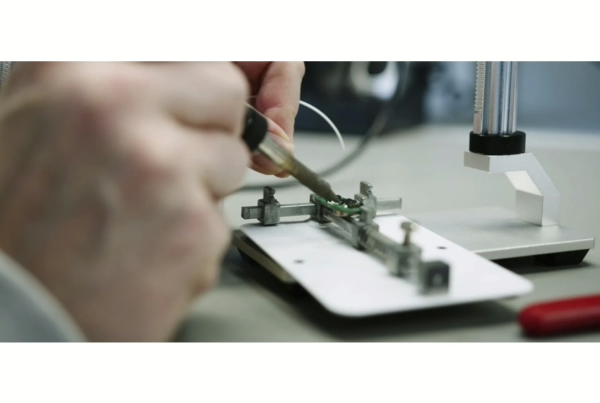
- From proof of concept to deployment-ready product: Elitac Wearables takes projects from early feasibility through to a certified, field-ready wearable, with all disciplines, hardware, firmware, textiles, and algorithms, managed under one roof.
If your organisation is evaluating haptic wearables for a training or simulation application and needs a development partner with the technical depth to deliver it properly, contact Elitac Wearables to discuss your requirements.
Related Articles
- How do haptic wearables integrate with existing enterprise software?
- How does haptic feedback work in wearable devices?
- How do you scale a wearable product from pilot to mass production?
- What are the hidden costs of wearable product development that most vendors won't tell you?
- What are the most common mistakes made in wearable product development?